
AI Agent Explainability: 2026 Software Guide

If an AI agent can act, it must also be traceable, reviewable, and open to challenge. In 2026, that means I don’t just ask what output the agent gave. I ask how it got there, which tools it used, what data it touched, who could stop it, and what record exists after the fact.
Here’s the short version:
- AI agent explainability is about the whole decision chain, not one reply
- I need traceability, audit records, human review, and appeal paths
- 40% of respondents in a McKinsey 2024 survey named explainability as a key AI risk, but only 17% were working to reduce it
- For Canada, this is tied to rules such as the Directive on Automated Decision-Making and Quebec’s Law 25
- The main ways to explain agent behaviour are:
- feature attribution
- counterfactuals
- trajectory tracing and tool logs
- rule-based checks with human approval points
- The main weak spots are:
- missing logs
- untracked tool calls
- overconfident explanations
- bias
- sensitive-data leaks
- weak reviewer checks
A simple way to think about it: a chatbot answers, but an agent does things. And once software can send emails, update files, route cases, or deny requests, which is how workflow automation enhances efficiency, I need proof of why, how, and under what rule.
A few terms matter most:
- Explainability: why the agent made this choice
- Traceability: the step-by-step path from input to action
- Auditability: whether someone can verify that path later
- Contestability: whether a person can question or appeal the result
- Human oversight: whether someone can pause, approve, correct, or override the agent
The article’s main takeaway is simple: I should build agent explainability into the software from day one with inventories, versioned prompts and models, structured logs, approval gates, short explanation notes, and recourse paths. That’s what makes an AI agent easier to inspect, govern, and defend.
| Area | What I need to have in place |
|---|---|
| Decision trail | Input, tool calls, state changes, output |
| Review | Human checkpoints for high-impact actions |
| Records | Logs, timestamps, versions, policy references |
| User recourse | Notice, explanation, review, appeal |
| Risk control | Redaction, retention rules, access limits |
If I’m building or buying agent software in Canada on September 4, 2026, this is the baseline I should expect.
Explainable AI: Demystifying AI Agents Decision-Making
sbb-itb-fd1fcab
Core terms for agent explainability
Before you build or govern an explainable AI agent, it helps to get everyone using the same language. If people use the same term to mean different things, review gets messy fast.
Explainability, interpretability, traceability, and auditability
These four terms often get lumped together. But they do different jobs.
Explainability means being able to say, in plain language, why an agent produced a given result or took a given action.
Interpretability is about understanding how the system works under the hood and how inputs connect to outputs.
Traceability means you can follow a decision across the full path: the request, instructions, model version, retrieved documents, tool calls, key parameters, timestamps, and final output.
Auditability means the system keeps enough structured evidence for later review or compliance checks. This depends on logging being built in from the start, not bolted on after something goes wrong.
| Term | What it answers | Scope |
|---|---|---|
| Explainability | Why did the agent produce this result? | Specific outputs, decisions |
| Interpretability | How does the system work? | Model logic, design review |
| Traceability | What chain of steps led here? | Full input-to-action path |
| Auditability | Can this be independently verified later? | Compliance, investigations |
In practice, these differences shape what a reviewer can see, question, and sign off on. For agent systems, traceability and auditability often matter more than a one-line "why" answer. Why? Because risk sits in the full action path, not only in the final output.
Contestability and human oversight
Contestability means a person can question, challenge, or appeal an AI-driven decision. Human oversight means a person can monitor, approve, pause, correct, or override the agent before or after it acts.
These ideas matter most when outcomes affect staff, customers, patients, or citizens. Take a citizen-facing benefits assistant. It should be able to send a case for manual review and give the affected person a clear path to request human review.
Oversight should match risk. A drafting assistant may need only light review. But a system that closes cases, updates records, or affects eligibility should have a documented approval gate.
"Teams that trust AI outputs without human oversight create single points of failure." – Digital Fractal Technologies Inc
That’s why review controls matter just as much as explanation.
Single-output explanations vs. agent decision-chain explanations
A single-output explanation answers one narrow question: why did the agent say this? That can work for simple recommendation tools or classifiers. But it falls short for agents that act across many systems.
An agent decision-chain explanation shows the full sequence: planning, retrieval, tool calls, intermediate results, state changes, and final execution. The gap is bigger than it first seems.
For example, if an agent denies a request, a single-output explanation might say the request did not meet policy criteria. A decision-chain explanation would show the policy checked, the data retrieved, the rule that triggered the denial, and any human checkpoint along the way.
"AI systems require continuous oversight because their behavior can shift as input data changes, as users find unexpected ways to interact with them, or as the external environment evolves." – Digital Fractal Technologies Inc
These differences matter most when you review why agent decisions need human oversight. They lead straight to the next question: when do agent decisions need review?
Why agent decisions need review
Agents don’t just suggest things. They act across workflows. That means each decision needs to be reviewable from input to action.
When the chain breaks, the harm isn’t abstract. It’s direct. A miscategorised benefits claim, a biased procurement score, or a misrouted request can affect someone’s finances, access to care, or legal standing. So review can’t stop at the final answer. It has to cover the full path the agent took to get there.
Safety, bias detection, quality control, and legal defensibility
Unchecked scoring systems can repeat disparate harm. That’s why agent outputs need structured review for bias, safety, and policy drift.
Pre-deployment review helps teams catch problems before a system goes live, such as:
- unsafe behaviour
- hallucinated facts
- policy violations
- escalation failures
Post-deployment review supports monitoring after launch, as behaviour shifts with use and model drift. For high-impact systems, review also matters for legal defensibility. Teams need records showing what data was used, what policy was applied, what oversight was in place, and what mitigation steps were taken.
Canada-specific expectations for internal and citizen-facing systems
In Canada, these review controls are often a compliance requirement, not just a good idea.
The standard changes based on who the system serves. Internal enterprise tools are often judged on auditability and operational control. Put plainly: can the right people inspect behaviour, are logs kept, and are escalation paths defined and tested?
Citizen-facing systems face a higher bar. The Treasury Board’s Directive on Automated Decision-Making requires explanations of input data, evaluation criteria, operations, review results, outputs, and the main factors behind a decision. It also requires notice, human review, and appeal pathways when automation materially affects an administrative action. For higher-impact systems, the rules become stricter, with stronger explanations and oversight expectations for decisions that deny benefits or services.
In practice, the difference is pretty clear. An internal agent used to optimise maintenance scheduling may focus on technical logs and access controls. A citizen-facing agent that determines eligibility for a bill assistance programme needs plain-language explanations, complaint and review channels people can use, and disclosures that are understandable in both official languages. These are governance requirements.
Explainability methods for AI agents
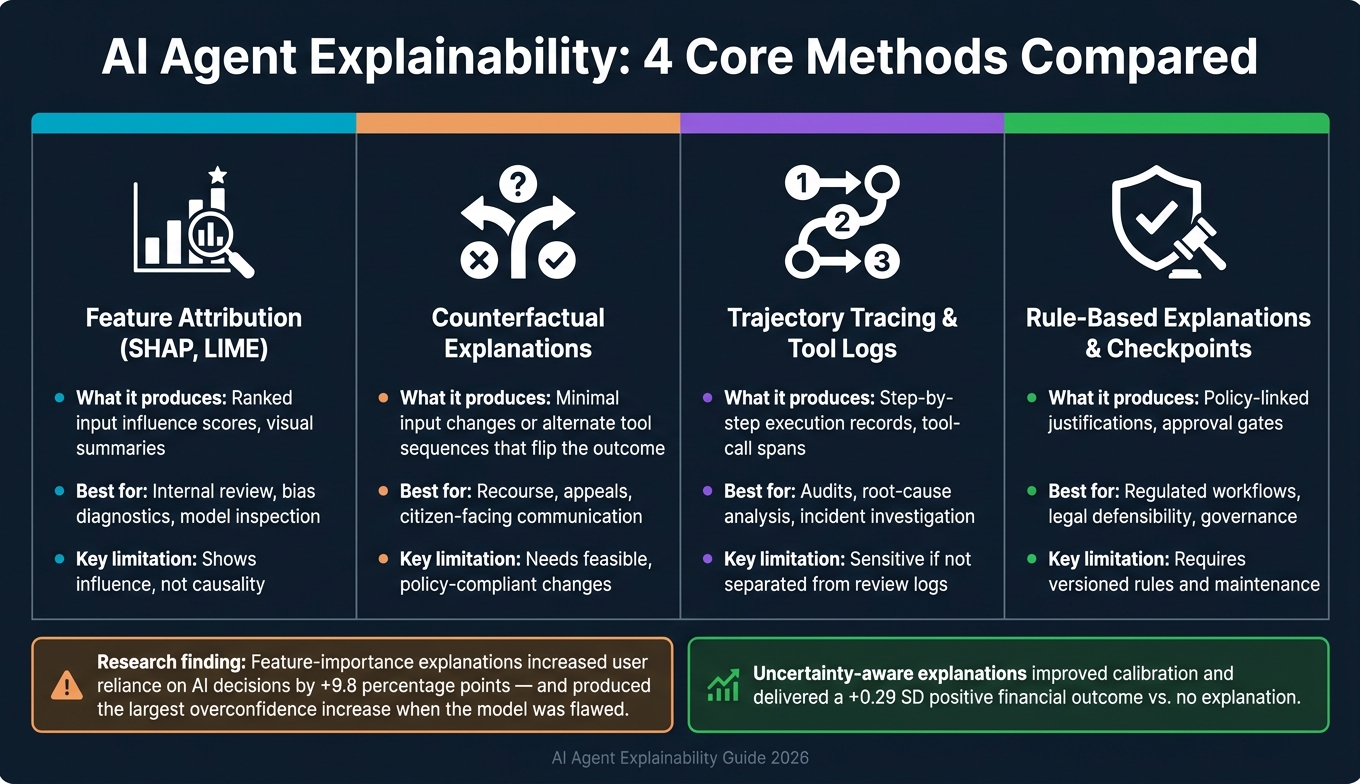
AI Agent Explainability Methods Compared: Attribution, Counterfactuals, Traces & Rules
No single method can explain everything an AI agent does. That’s because agents don’t make one isolated choice. They act across multiple steps, use tools, and update state along the way. So if you want a usable explanation, you need coverage across the whole chain.
Each method helps with a different kind of review. Some are better for diagnosis. Some help with recourse. Others support audits or human sign-off. In practice, the main options fall into four groups: attribution, counterfactuals, trace logs, and rule-based checkpoints.
Feature attribution and counterfactual explanations
Feature attribution gives an importance score to each input for a given decision. Tools like SHAP and LIME show which inputs mattered most, often through ranked scores or visual summaries. For a Canadian bank pre-screening mortgage applications, attribution can show that debt-to-income ratio, employment duration, and credit history were the main drivers of a decline recommendation. That makes it useful for bias checks and quality control.
Counterfactual explanations answer a different question: what would need to change for a different result? For a denied application, a counterfactual might read: "If supporting documentation had been submitted and income were above the threshold, this application would likely be approved." In agentic systems, counterfactuals can also describe alternate paths, such as a different sequence of tool calls that would have led to another outcome.
The two methods work well together. Attribution is best for internal review and model inspection. Counterfactuals are better for recourse, appeals, and communication with affected users. Attribution scores can mislead users when they try to infer counterfactual behaviour from them alone. Simpler, directly simulated counterfactuals are often more dependable for that job.
Trajectory tracing, reasoning logs, and tool-interaction records
If you need a full audit trail, you have to move past input influence and look at step-by-step execution records. Record each task as a trace, and each step or tool call as a span, with IDs, timestamps, agent identity, tool version, redacted inputs, outputs, status, and permissions.
A two-layer approach helps keep this under control. The internal reasoning layer stores raw prompts, detailed system messages, and intermediate reasoning steps. That’s useful for debugging, but it’s sensitive and should be tightly restricted. The review-safe layer stores structured, stripped-down records that auditors, supervisors, and complaint handlers can use: what the agent did, when it did it, under which policy, and what result followed. Storing verbatim user text or raw reasoning chains beyond what’s needed adds both privacy risk and model inversion risk, so compact, policy-aligned summaries are usually the better choice.
In many cases, the most useful audit record is the trace itself. If a public-sector team needs to reconstruct why an eligibility agent escalated a case, reviewers usually need the operational log, not the raw prompt history. Trajectory tracing supports root-cause analysis. For example, it can show that a mis-specified retrieval query at step 2 pushed an error through the rest of the workflow.
Rule-based explanations and human review checkpoints
When policy matters more than model inference, it makes sense to tie explanations to explicit rules. Rule-based explanations connect agent actions directly to documented policies or thresholds. Each high-impact decision gets a plain-language justification that points to the specific rule used: the policy ID, the condition checked, and the outcome. For example: "This transfer exceeded the $10,000 discretionary limit under Policy FIN-102, Section 5. Manager approval is required." This format is audit-ready and easier to defend.
Human review checkpoints are what make those controls stick. These are clear points in the workflow where a person must confirm or override before the agent carries out a high-impact action. The reviewer sees the agent’s recommendation, the attribution or rule-based explanation, and any relevant counterfactual. They then record their decision, and that record becomes part of the audit trail. For Canadian organisations, these checkpoints make high-impact workflows reviewable in a practical way. Local firms often work with AI consulting services to implement these governance layers.
The table below shows how the four method families compare in practice:
| Method | What it produces | Best for | Key limitation |
|---|---|---|---|
| Feature attribution (SHAP, LIME) | Ranked input influence scores, visual summaries | Internal review, bias diagnostics, model inspection | Influence, not causality |
| Counterfactual explanations | Minimal input changes or alternative tool sequences that flip the outcome | Recourse, appeals, citizen-facing communication | Needs feasible, policy-compliant changes |
| Trajectory tracing and tool logs | Step-by-step execution records, tool-call spans | Audits, root-cause analysis, incident investigation | Sensitive if not separated from review logs |
| Rule-based explanations and checkpoints | Policy-linked justifications, approval gates | Regulated workflows, legal defensibility, governance | Requires versioned rules and maintenance |
These methods work best when paired with audit-friendly design patterns and clear escalation paths. The next step is deciding where each method fits in the workflow and what controls it needs.
Design patterns, risk areas, and Canadian implementation
Design patterns that support audit trails and rollback
Start with four basics: inventories, versioning, logging, and approval gates.
An agent inventory lists each agent’s purpose, data access, tools, and risk level. That gives governance teams a clear view of which systems can affect employees, customers, or citizens. Standardised decision records show what the agent did, which inputs it used, and which approvals were involved. That creates a clean trail for audits and investigations.
Versioned prompts and models make the record repeatable. Store the active model, prompt, and configuration used for each decision so any challenge can be answered with precision. Structured tool-call logging records every tool invocation – API calls, database queries, timestamps, parameters, and results. If an agent uses a tool, there should be a record of it. That same record also supports rollback because it shows what the agent changed. Explanation payloads require agents to return a short rationale summary with each major decision, so reviewers have context right away.
| Design Pattern | Governance Value |
|---|---|
| Agent Inventories | High |
| Standardised Decision Records | High |
| Versioned Prompts & Models | High |
| Structured Tool-Call Logging | High |
| Approval Gates | Very High |
| Explanation Payloads | High |
Approval gates bring the most overhead, but they matter in high-stakes workflows where a wrong automated action is hard or expensive to reverse. Set out where the gate sits, who approves, and what gets logged. These controls only work if logs are complete, explanations are candid, and reviewers can push back on the result.
Common risk areas in agent explainability
Even with the right patterns, explainability can fall apart fast. The usual weak spots are incomplete logging, explanations that sound more certain than they should, and shallow review.
Unlogged tool use happens when agents call external APIs or internal services without leaving a clear record of what was used or why. The fix is plain: structured tool-call logging with explicit parameters and results, built in from day one.
Missing or incomplete logs make it impossible to reconstruct events or meet audit requirements.
Overconfident explanations are more subtle, and often more dangerous. Research on the "Explainable AI Paradox" found that feature-importance explanations increased user reliance on AI decisions by +9.8 percentage points compared with no explanation and produced the largest overconfidence increase when the model was flawed. The same research found that uncertainty-aware explanations improved calibration and delivered a positive financial outcome of +0.29 standard deviations relative to no explanation. In plain terms, an explanation can make a weak system look more convincing than it is. Agents can also confabulate plausible but false rationales, which makes mistakes look solid on paper. Reviewers need training to test the underlying evidence, not just read the explanation and nod along.
Hidden bias can come from training data, prompt design, tool choices, or contextual signals. It may stay out of sight unless teams test for it on purpose, especially when agents affect employment, credit, housing, or public services.
Sensitive-data leakage through logs and explanation payloads is a direct risk. Security research suggests that secrets stored in LLM context have a 78% chance of eventual exposure through prompt injection, hallucination, or logging failures. Use hashed identifiers, redact sensitive fields such as Social Insurance Numbers or financial account numbers, and apply clear retention schedules.
Weak human oversight makes every other risk worse. If reviewers are just rubber-stamping approvals without checking the agent’s reasoning, the whole control setup is little more than paperwork.
Applying explainability in Canadian organisations
Start inside the organisation. Then carry the same controls into citizen-facing systems.
Building the core patterns – inventories, logs, versioning, and approval gates – on internal workflows first gives teams time to build governance skill, spot gaps, and sharpen reviewer training before they take on public-facing duties.
In Canada, these controls line up well with risk-based governance rules. Canada’s federal Directive on Automated Decision-Making (DADM) applies to all automated decision systems developed or procured after 1 April 2020, with existing systems required to comply with updated obligations by 24 June 2026. Federal institutions must complete an Algorithmic Impact Assessment (AIA) – a standardised questionnaire that assigns an impact level (I through IV) and maps it directly to governance requirements such as explanation duties and human oversight. Even for organisations outside the federal public service, this framework is a strong reference point for setting up risk-based oversight.
Once teams extend these systems to citizen-facing or customer-facing use, expectations get tighter. People should get clear notice when and how agents are involved. Explanations should be in plain language. Review and appeal controls should also be stronger. Sector-specific transparency rules are expanding across regulated industries, and they point back to the same core controls: inventories, logs, versioning, and approval gates.
Conclusion: What to build into every explainable AI agent
Explainability isn’t something you tack on after an AI agent is already built. It needs to be part of the design and governance from day one. If you wait until the end, the methods and patterns discussed above tend to fall apart. The practical stuff has to live inside the system from the start: shared definitions, structured logs, versioned configs, review gates, and recourse paths.
Traceability, auditability, and contestability should be treated as system requirements, not vague ideals. Those terms matter for a simple reason: they decide who gets to inspect, challenge, and override an agent’s decision.
At the workflow level, this gets even more important. Multi-step agents need trajectory logs, approval gates, rollback, and version control because errors don’t just sit still – they stack up across actions, impacting your workflow automation ROI.
For Canadian organisations, the requirements are concrete: inventories, logs, versioning, approval gates, plain-language explanations, human review, and appeal paths – whether a system is internal or citizen-facing.
Organisations that treat explainability as only a model-level issue will have a hard time meeting Canadian expectations for transparency, accountability, and recourse. The ones that build it into software architecture and governance frameworks – from the agent inventory to the appeal workflow – will be in a much stronger position to deploy AI agents that are safe and defensible.
FAQs
How do I make an AI agent explainable from day one?
Build explainability in from day one. Don’t treat it like a patch you add later.
Start with clear objectives and risk-tiered use cases. Then use a plan, confirm, execute flow so the system shows what it plans to do, gets confirmation, and only then takes action. For high-stakes actions, put human approval in the loop. And when AI is involved, tell people in plain language.
Just as important, log every decision with an audit trail. That record should include:
- Event IDs
- ISO 8601 UTC timestamps
- Model version and configuration
- Prompt or template IDs
- Input and output hashes or pointers
- Call chain
- Human overrides
This kind of record-keeping makes it much easier to trace what happened, when it happened, and who stepped in.
When should a human be required to review an agent’s action?
Human review is a must for high-stakes actions. If a mistake could lead to financial loss, legal trouble, or safety risks, a person needs to check the outcome before anything moves ahead.
That applies to:
- sensitive operations
- irreversible actions
- decisions that call for empathy or trust
- new or unclear problems
- any case where rules require sign-off from a named professional
In the public sector, ADM Level III or IV systems also need human sign-off for final decisions.
What records should I keep for AI agent audits in Canada?
Keep records for the full decision lifecycle in immutable, append-only logs. That means logging what happened from start to finish, not just the final call.
For each event, record:
- agent and operator IDs
- UTC ISO-8601 timestamps
- model version hashes
- temperature settings
- prompt template IDs
- input fingerprints
- outputs
- confidence levels
- decision rationales
Human involvement matters too. If someone approves, changes, or overrides a decision, log that as well.
For Canadian privacy expectations, don’t store raw personal data in these records. Use hashes or pointer IDs instead. On top of that, keep your Gap Register up to date, along with policy versions and Privacy Impact Assessment records.