
Ultimate Guide to AI Audit Trail Systems

AI audit trail systems are becoming essential as organizations increasingly rely on AI for critical tasks like loan approvals, fraud detection, and resource management. These systems provide detailed, unalterable records of AI decisions, ensuring transparency, compliance, and accountability. Here’s what you need to know:
- What They Are: AI audit trails record not just what decisions were made, but also why and how, including data inputs, model configurations, and human interventions.
- Why They Matter: With regulations like the EU AI Act (effective August 2, 2026) and HIPAA requiring detailed logging, non-compliance can lead to fines up to €35 million or 7% of global revenue.
- Key Industries: Public sector, healthcare, banking, energy, and software development are leading adopters due to high stakes and strict regulations.
- Core Features: These systems log event IDs, timestamps, model details, inputs/outputs, decision rationale, and human actions. Cryptographic methods like hash chaining and WORM storage ensure data integrity.
- Challenges: High storage costs, privacy concerns, and tamper-proofing are common issues, but strategies like tiered storage, automated redaction, and hash-based security help mitigate them.
- Implementation: A phased approach, starting with schema definition and ending with validation, ensures a smooth rollout. Regular audits and maintenance are crucial for long-term success.
AI audit trails are not just about compliance – they also improve operational transparency and enable organizations to defend AI-driven decisions. For businesses in regulated industries, investing in AI consulting services for these systems is a smart move to avoid costly penalties and maintain trust.
Core Components of AI Audit Trail Systems
Key Data Fields to Record
The strength of an audit trail lies in capturing detailed and structured data. The table below highlights the essential fields needed to track every decision, ensuring transparency and accountability. These fields cover identity, model configurations, inputs, outputs, agent actions, and governance.
Each log entry must include an Event ID (UUID), a UTC timestamp in ISO-8601 format, a System ID, and a Session or Correlation ID to link related events. It’s also crucial to document the exact model version (e.g., not just "GPT-4" but a specific build like "GPT-4o-2024-11-20") and configuration settings, such as temperature and top-p parameters.
For inputs and outputs, the best practice is to log prompt template IDs and versions rather than raw prompt text. This saves storage space and ensures records remain meaningful, even if templates are updated. Using cryptographic hashes (input fingerprints) to reference processed data also enhances privacy compliance.
| Category | Essential Fields |
|---|---|
| Event Identity | Event ID (UUID), UTC Timestamp, System ID, Session/Correlation ID |
| Model Info | Model Name, Exact Version/Hash, Configuration (Temperature, Top-p) |
| Inputs | Prompt Template ID/Version, Input Fingerprint (Hash), RAG Document IDs |
| Outputs | Predicted Label/Score, Confidence Level, Raw Output, Decision Rationale |
| Agent Actions | Tool Name, Input Parameters, Tool Output, Latency, Call Tree Parent ID |
| Governance | Operator ID, Approver ID, Override Flag, Human Justification Notes |
For systems that involve multiple sequential steps, it’s vital to log parent/child IDs to capture the full call tree. If a human intervenes – whether to approve, override, or edit an AI output – that action should be logged with the intervenor’s identity, a timestamp, and records of the changes made. These practices build the foundation for a scalable and reliable audit trail.
System Architecture Overview
An AI audit trail system operates as a layered stack. Here’s how it works:
- Agent Runtime Logger: Captures events in real time.
- Log Aggregation Pipeline: Uses asynchronous message queues like Apache Kafka or Amazon Kinesis to transport and enrich log data without slowing down performance.
- Query and Analysis Platform: Provides long-term storage and reporting capabilities.
This separation ensures that auditing doesn’t interfere with the system’s overall performance.
To protect data integrity, the storage layer incorporates tamper-proofing techniques. Hash chaining links each log entry to the previous one using SHA-256, so any alteration breaks the chain. Additionally, Write-Once-Read-Many (WORM) storage solutions, such as AWS S3 Object Lock or Azure Immutable Blob Storage, enforce retention policies that prevent modification. As Bob Ertl of Kiteworks put it:
"Tamper-evidence is a technical property, not a policy one. A log stored in a writable database is not tamper-evident, regardless of who has access to it."
For large-scale environments, methods like Merkle tree anchoring secure log batches by storing the root hash in an external system, such as a public blockchain. This provides undeniable proof of data integrity. Adding RFC 3161-compliant trusted timestamping from a third-party authority ensures records cannot be backdated.
Consider a system processing 10 million decisions daily, with an average context size of 5 KB per decision. This setup could generate about 50 GB of audit data per day, or roughly 18 TB annually. Planning storage capacity carefully is clearly essential for such volumes.
Integrating with Existing Systems
A robust logging framework and secure storage are just the beginning. Seamless integration across systems is crucial to reconstruct complete decision paths. Assigning a Correlation ID or Trace ID to every event allows teams to trace the full decision process – from the initial trigger, through each tool call, to the final output. This is particularly important because a Q1 2026 survey of 420 organisations revealed that 83% of teams couldn’t trace the entire sequence of tool calls and inputs after an AI agent error.
The JSONL format (newline-delimited JSON) has become the standard for primary log capture. It efficiently handles complex, nested data structures like tool-call trees and reasoning traces. While SIEM systems (e.g., Splunk) are useful for downstream security and alerting, they should complement rather than replace JSONL as the primary system of record.
For distributed tracing in complex environments, OpenTelemetry (OTel) offers a standardized approach. It maps agent tasks as "traces" and tool invocations as "spans." To address privacy concerns, storing hashes or pointer IDs instead of raw personal data reduces compliance risks. For high-stakes decisions, integrating human-in-the-loop approval gates directly into the runtime ensures that every approval is logged with structured records, including the approver’s identity and timestamp. This approach ensures transparency and accountability throughout the system.
sbb-itb-fd1fcab
How to Implement an AI Audit Trail System
Planning and Governance
Before diving into the technical side of things, it’s critical to understand what you’re auditing and why. Start by conducting a structured inventory of all AI systems and agents in your organisation. Identify their risk levels and the types of decisions they make. This will help you determine the depth of logging required. For instance, a low-risk recommendation engine won’t need the same level of detail as a high-risk credit adjudication model.
Next, define your record schema. Decide what data needs to be captured, which compliance frameworks apply, and how long records must be retained. The stakes are high – fines under the EU AI Act can hit up to €35 million or 7% of global annual turnover. A 2024 survey revealed that 67% of AI deployments faced audit issues due to insufficient logging, with average remediation costs of $125,000. It’s far cheaper to get governance right from the start than to fix it later.
"A result without a reason is not proof. Store decision records tied to policy versions." – Ken O’Friel, CEO, Toku
To ensure accountability, assign each AI agent a unique Ed25519 key pair to sign operations. This creates unforgeable records at the agent level, offering a layer of accountability that access-control policies alone can’t provide.
Once you’ve established governance parameters, move forward with a phased deployment to integrate and validate the system without disruption.
Deployment Steps
A phased rollout helps manage risks and keeps the process under control. Here’s a suggested 60-day roadmap:
- Days 1–20: Define and instrument
Finalise your audit schema and embed policy snapshots in each log. Record human-in-the-loop approver IDs and use ISO‑8601 UTC timestamps with millisecond precision to avoid sequence errors caused by clock skew. Avoid logging raw personal data; instead, store SHA‑256 hashes or pointer IDs. This approach ensures compliance without creating additional risks. - Days 21–40: Unify and harden
Deploy a log aggregation pipeline using durable message queues like Kafka or Kinesis. These tools handle backpressure without blocking the system’s response path. Use immutable pointers for context records and enforce append-only storage or cryptographic hash chaining. Make sure asynchronous capture keeps latency below 5 milliseconds. - Days 41–60: Validate and document
Run simulated incidents to confirm that the full decision chain can be reconstructed end-to-end. Publish an audit response runbook so your team is prepared to provide evidence when regulators or internal reviewers request it.
This phased approach ensures a functional and secure audit trail system that aligns with the principles of reliable and immutable record-keeping.
Ongoing Maintenance and Updates
Deploying the system is just the beginning. Continuous oversight is essential to ensure the audit trail remains accurate and compliant over time. As Rohit Parmar-Mistry of Pattrndata explains:
"If you cannot explain exactly how an AI-driven decision happened (and prove it later), you do not have an audit trail. You have a pile of logs."
To keep your audit trail meaningful, maintain policy versioning – a complete history of every prompt template and policy bundle in effect at the time of each decision. Pair this with a Gap Register, a living document that tracks known technical or compliance issues and their resolution status.
Integrate your audit data with a Security Information and Event Management (SIEM) system for real-time monitoring. This allows you to detect anomalies like volume spikes or unauthorised access attempts immediately. Schedule simulated incident drills every 60 days to ensure evidence packages are complete and retrievable. These drills also help keep your audit response runbook up to date.
Retention requirements will vary depending on the framework. For example, HIPAA requires records to be retained for up to six years, while the EU AI Act mandates keeping high-risk system logs for at least six months. Some interpretations extend this to the system’s lifetime plus an additional 10 years. Ensure your legal-basis decisions are well-documented and revisit them as regulations evolve.
Audit Trails and AI Transparency – Regulatory Compliance under the EU AI Act
Benefits and Challenges of AI Audit Trails
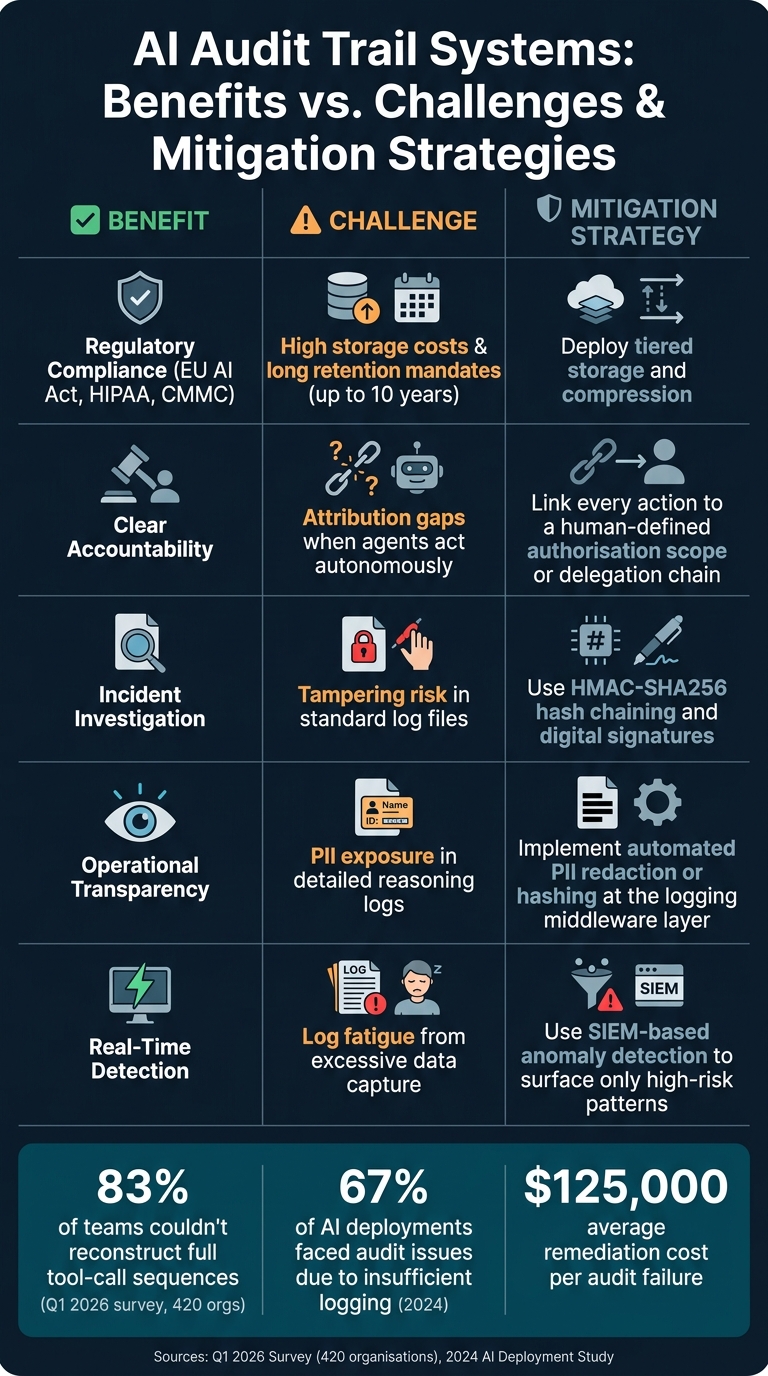
AI Audit Trail Systems: Benefits vs. Challenges & Mitigation Strategies
Business Benefits
AI audit trails do more than just keep your organisation compliant – they can also refine your operations and AI enhanced mobile & web apps. Regulatory frameworks like the EU AI Act (Article 12), HIPAA, and CMMC demand detailed records of AI decision-making processes. Falling short of these requirements can result in hefty penalties.
But beyond compliance, audit trails offer forensic accountability. Imagine an AI system makes a controversial decision, like rejecting a loan application unfairly or giving an incorrect medical recommendation. With a proper audit trail, you can trace back to see what data the AI used, the decision-making process, and the policies in place at the time. As Bob Ertl from Kiteworks explains:
"The audit trail is the only control that serves two purposes simultaneously: it satisfies regulatory evidence requirements for past access events, and it enables real-time detection of governance failures in progress."
Integrating audit trails with Security Information and Event Management (SIEM) systems takes this even further. This setup can help detect anomalies – like unauthorised data access or prompt injection attacks – much faster. While these benefits boost operational transparency, they come with their own set of challenges.
Common Challenges
Despite their advantages, audit trails present some tough hurdles. One major issue is storage volume. Large-scale systems generate massive amounts of data, and regulatory requirements for retention can make this even worse. For example, HIPAA mandates that records be kept for six years, while some interpretations of the EU AI Act extend retention to the system’s lifetime plus 10 years. These long-term storage needs can quickly drive up costs.
Data integrity poses another challenge. Log files stored in writable databases can be tampered with – an admin with access could alter or erase records without detection. As Jeff Leva, Founder & CEO of AI Identity, puts it:
"The distinction is not academic. It is the difference between evidence that a regulator accepts and evidence that a regulator dismisses."
Using cryptographic hash chaining and append-only (WORM) storage can help safeguard these records.
Then there’s the issue of privacy. Detailed reasoning logs, while essential for transparency, can unintentionally capture sensitive personal information (PII). The solution? Instead of storing raw data, log cryptographic hashes of sensitive inputs and use automated PII redaction at the middleware level before the data reaches the audit store.
Benefits vs. Challenges: A Side-by-Side View
| Benefit | Associated Challenge | Mitigation Strategy |
|---|---|---|
| Regulatory Compliance | High storage costs and long retention mandates (up to 10 years) | Deploy tiered storage and compression |
| Clear Accountability | Attribution gaps when agents act autonomously | Link every action to a human-defined authorisation scope or delegation chain |
| Incident Investigation | Tampering risk in standard log files | Use HMAC-SHA256 hash chaining and digital signatures |
| Operational Transparency | PII exposure in detailed reasoning logs | Implement automated PII redaction or hashing at the logging middleware layer |
| Real-Time Detection | Log fatigue from excessive data capture | Use SIEM-based anomaly detection to surface only high-risk patterns |
Best Practices for AI Audit Trail Systems
Protecting Data Integrity
Ensuring that audit records remain tamper-proof is non-negotiable. Techniques like WORM storage, SHA-256 hash chaining, Ed25519 cryptographic signing, and RFC 3161-compliant trusted timestamping work together to create an environment where records are both immutable and traceable to specific agents. Additionally, every access to these audit records should be logged to eliminate any potential blind spots.
Once data security is firmly in place, the next challenge is building a system that can handle growth efficiently.
Scalability and Performance
Managing massive amounts of audit data requires a system that balances speed, cost, and efficiency. A tiered storage model is an effective solution: recent records are stored in fast, accessible systems like Elasticsearch or ClickHouse, while older records are moved to more affordable, unchangeable cold storage for long-term retention.
To keep performance smooth, asynchronous, non-blocking logging ensures that interactions maintain a latency of under 5 milliseconds. For high-volume, low-risk workflows, selective sampling can help control costs by storing full details for a sample set while keeping metadata-only logs for the rest. Using a unique correlation ID (UUID) for every event in an agent’s execution chain simplifies the process of reconstructing events for forensic analysis.
Regular Reviews and Audits
Once the system is operational, regular monitoring and updates are critical to staying ahead of compliance requirements. A 2024 survey revealed that 67% of AI deployments faced audit findings due to insufficient logging, with the average cost of remediation reaching approximately $125,000. Organizations can use a workflow automation savings estimator to better understand the financial impact of optimizing these processes.
To avoid these pitfalls, periodic incident drills are invaluable. These drills, which involve replaying past decisions, can uncover issues such as incomplete logs or missing prompt context before regulators identify them. A structured 60-day improvement cycle can help address these gaps effectively. For example:
- In the first three weeks, finalize schema and policy snapshots.
- Over the next three weeks, align service timelines.
- Use the remaining time to run simulated drills to test the completeness of evidence.
Integrating these processes with a SIEM system elevates logs from being passive records to active tools for governance. This approach enables real-time anomaly detection and enhances overall system oversight.
Digital Fractal Technologies Inc Approach

Digital Fractal Technologies Inc takes a tailored approach to creating AI audit trails that meet the specific workflows and needs of your organisation. Their solutions are designed to align architecture, data fields, retention policies, and integration points with your unique requirements. This end-to-end service ensures the technical demands of a robust audit trail system are seamlessly met.
Custom Software and AI Consulting
Based in Alberta, Digital Fractal Technologies Inc brings over four years of experience working on AI projects in both the public and private sectors. They begin their process with a 30-day AI Readiness Audit. This discovery phase evaluates your organisation’s current processes, data pipelines, and tools to identify where intelligent logging systems can have the most impact. The result? A detailed 6–12 month transformation roadmap instead of generic recommendations. Pricing for this service typically ranges from $2,500 to $10,000, depending on the scope.
Once the audit is complete, their team develops mobile and web applications that integrate AI capabilities – such as automated workflows, computer vision, and predictive analytics – directly into your existing platforms. This approach avoids a complete system overhaul while achieving the level of traceability and accountability required for compliance.
Solutions Built for Specific Industries
Digital Fractal also offers industry-specific modules to address the unique compliance challenges faced by various sectors. For example, their work with Xtreme Oilfield, a Canadian energy services company, highlights the effectiveness of these tailored solutions.
"The Xtreme Oilfield mobile application and web backend system that was developed for us, digitised paper forms, automated permit management, and computerised job dispatching, and brought timesheets, vehicle repair and communications to the field on an iPad." – Regg M., Operations, Xtreme Oilfield
In construction, they’ve developed specialised pipeline quality control applications that streamline data-driven workflows and enforce accountability at every stage. Their Compliance Agents ensure that safety forms, toolbox talks, and sign-offs are completed and recorded, while HSE Safety Agents in the energy sector verify that all necessary safety documentation is in place before fieldwork begins.
This level of customisation ensures their solutions are not only effective but also sustainable for the long term.
End-to-End Support
Digital Fractal’s commitment doesn’t end with deployment. Their structured process takes clients through every stage – discovery, architecture, development, pilot, launch, and ongoing optimisation – often delivering results within 90 days. Post-launch, they provide continuous support, which is crucial for organisations operating in regulated environments where compliance standards and logging requirements frequently evolve.
"Our experts become an extension of your team, collaborating to ensure our solutions are built to your specific needs." – Digital Fractal Technologies Inc
Wrapping It Up
AI audit trail systems have come a long way, evolving from basic logs to becoming essential pillars of responsible AI governance. They’re no longer just about tracking what happened – they also capture the why and who behind every decision.
Key Points to Remember
A Q1 2026 survey involving 420 organisations revealed some eye-opening stats: 83% of teams struggled to reconstruct full tool-call sequences, and 67% of AI deployments in 2024 faced audit issues. The average cost of fixing these problems? A hefty CAThe average cost of fixing these problems? A hefty CA$125,00025,000 (you can estimate your own potential savings with a workflow automation benefits calculator). These aren’t isolated incidents – they’re a reality for organisations that overlook the importance of robust audit trails.
The main takeaway here is simple: effective AI audit trails need to be immutable, well-structured, and fully traceable. This spans across five critical layers: Intent, Design, Code, Test, and Deploy. When these elements are solid, the benefits are clear:
- Audit prep time shrinks from weeks to hours.
- Incident responses are quicker and more efficient.
- Compliance becomes a proactive process rather than a frantic scramble to piece things together.
As Axiom Studio aptly puts it:
"Audit trails are not a compliance afterthought. They are the foundation of AI governance." – Axiom Studio
These principles set the stage for organisations to make immediate and meaningful improvements.
Where to Go from Here
If you’re ready to move from reactive logging to a truly audit-ready system, consider partnering with Digital Fractal Technologies Inc. Their 30-day AI Readiness Audit (priced between CA$2,500 and CA$10,000) offers a tailored approach to mapping your current processes and data pipelines. You’ll receive a detailed 6–12 month roadmap designed to meet your specific compliance needs, no matter your industry – be it energy, construction, public services, or beyond. The best part? Their solutions are built around your workflows, ensuring a seamless integration.
FAQs
What should we log for each AI decision?
To comply with regulations such as the EU AI Act and maintain a thorough forensic record, it’s essential to log the entire decision lifecycle. This includes tracking:
- Metadata: Unique identifiers (UUID), UTC timestamps, and operator IDs.
- Inputs: Prompt IDs, input data, and reasoning steps taken during the process.
- Outputs: Results, confidence scores, and any downstream actions triggered.
- Human Intervention: Approver IDs, timestamps, and details of any overrides made.
Ensure these records are structured, cryptographically signed, and stored in an immutable format. This approach supports both transparency and regulatory compliance.
How do we keep audit logs tamper-proof?
To maintain the integrity of audit logs, consider these key practices:
- Append-Only Databases or WORM Storage: Use systems where data can only be added, not modified or deleted. This ensures a clear and unalterable record of events.
- Cryptographic Chaining: Link each record to the hash of the previous one. This method makes it nearly impossible to alter a log entry without detection.
- Unique Cryptographic Keys for AI Agents: Assign distinct keys to each AI agent for signing operations. This adds an extra layer of accountability and security.
- Merkle Trees: Use these data structures to anchor a root hash to trusted systems, creating a verifiable chain of records.
If you’re looking for expert assistance, Digital Fractal Technologies Inc offers solutions to build secure and scalable audit systems that prioritize transparency and security.
How can we audit AI without storing personal data?
To audit AI systems while safeguarding personal data, the key is to work with metadata rather than raw sensitive information. Here are some effective techniques:
- Immutable pointers: These allow you to reference data without creating duplicates, keeping the original data secure.
- Cryptographic hashes: Instead of storing actual content, log input/output hashes to maintain a record without exposing sensitive details.
- Automated redaction: Implement systems that remove sensitive data automatically during the data ingestion process.
- Structural metadata: Document elements like policies, decision-making logic, and timestamps to build a transparent audit trail.
These approaches help maintain privacy while still providing the necessary tools for thorough auditing.