Smart Contracts for Royalty Distribution

Smart contracts are transforming royalty payments by automating processes, reducing delays, and improving transparency. Traditional systems are slow, with payments taking 6–18 months and creators often receiving only 12% of generated revenue. Smart contracts simplify this by using blockchain to execute payments in near real-time, cutting intermediary costs by up to 85%, and ensuring creators earn more – up to 40–80% of revenue. These contracts also tackle issues like fragmented metadata and complex revenue splits across platforms.
Key Points:
- Faster Payments: Settlement times drop from months to under 24 hours.
- Higher Earnings: Creators can earn significantly more by reducing intermediaries.
- Transparency: Payments are recorded on a public blockchain, making them easy to track.
- Automation: Smart contracts use oracles to fetch data (e.g., streams or sales) to trigger payments.
However, challenges remain, such as integrating off-chain data, navigating legal frameworks, and managing taxes. In Canada, compliance with regulations like PIPEDA and CRA taxation rules is essential. Smart contracts offer a promising solution, but proper implementation and governance are crucial for success.
Root Causes of Royalty Payment Delays and Disputes
Fragmented Data and Metadata Problems
One of the biggest issues behind royalty payment delays is the industry’s struggle to accurately match songs with their rightful owners. Music compositions are tracked with ISWC codes, while sound recordings use ISRC codes – and there’s no universal system to connect these two identifiers. This disconnect means that the same song can appear in multiple databases under slightly different names, creating confusion and gaps in ownership records.
The impact is huge. In 2021, the Mechanical Licensing Collective (MLC) reported holding $424,384,787 in unmatched royalties – funds that couldn’t be distributed because the system couldn’t determine who owned them. Out of an estimated 97 million songs worldwide, only about 52 million have unique ISWC codes. That leaves nearly half of the music catalogue stuck in administrative limbo.
Amanda Sharp from the University of San Diego School of Law explains the problem clearly:
"Database discrepancies create incomplete, inconsistent data entries that result in lost wages, data duplication, and unmatched or unclaimed musical works."
Even small differences, like listing "Back Vocalist" instead of "Back Vocals", can throw off automated systems and delay payments. These inconsistencies lead to further delays when manual intervention is required to resolve the issues.
Reliance on Intermediaries and Manual Processes
Even when metadata is accurate, royalty payments often pass through a complex chain of intermediaries – record labels, publishers, distributors, and collective rights organizations like ASCAP and BMI. Each of these entities operates on its own reporting schedule, with average payout delays of 6.5 months for labels and 5.5 months for publishers.
The reliance on manual processes, such as reconciling payments through spreadsheets or outdated software, only makes things worse. Errors pile up, and the payment chain becomes opaque, making it hard to track or verify payouts. For creators, this means frequent disputes and the financial burden of resolving them. These manual processes also complicate revenue splits across diverse platforms, adding yet another layer of difficulty.
Complex Revenue Splits and Multi-Platform Accounting
Today, content is rarely tied to a single platform. Take a film score, for example – it can generate royalties from streaming services, broadcast licences, sync deals, and international distribution agreements. Each of these revenue streams operates under different contracts, currencies, and accounting systems, creating a logistical nightmare.
The situation worsened during the major industry mergers of 2025–26. These consolidations introduced overlapping rights, legacy agreements, and increasingly tangled revenue-sharing structures. Producers, directors, writers, and studios may all have claims to different portions of a single revenue stream, making disputes inevitable. Resolving these disputes can take months – or even years – leaving creators waiting for their payments.
"The music industry is notorious for fragmented data regarding who owns what percentage of a song (writers, performers, publishers)." – Chainlink
These challenges highlight the urgent need for automated and transparent systems. By addressing these inefficiencies, smart contract technology could offer a way to streamline royalty distribution and reduce delays.
sbb-itb-fd1fcab
How Smart Contracts Automate Royalty Distribution
What Are Smart Contracts?
Smart contracts are essentially programs that operate on a blockchain. Once deployed, they function exactly as written, with no need for human intervention. Nadcab describes them as follows:
"A smart contract is a program that runs on a blockchain. Once deployed, it executes precisely as coded, without anyone being able to interfere."
These contracts are designed to act automatically when certain conditions are met – like a stream or licence trigger – making them a game-changer for automating processes such as royalty payments.
How Smart Contracts Handle Royalty Distribution
The process of royalty distribution through smart contracts involves three key steps: origination, minting, and distribution.
- Origination: Rights holders determine ownership splits using a system based on basis points, where 10,000 basis points equal 100%. This allows for precise calculations down to 0.01%, eliminating the rounding errors often seen in traditional accounting. For instance, a producer with a 5% stake would have their share encoded as 500 basis points, ensuring clarity and accuracy.
- Minting and Distribution: Once the smart contract is live, it requires external data to trigger payouts. Since blockchains don’t have direct access to external platforms, they rely on decentralised oracles – tools like Chainlink Functions – to fetch streaming data from platforms like Spotify or Apple Music. When the oracle confirms a qualifying event, the contract calculates each stakeholder’s share and records it as a claimable balance. Instead of automatically pushing funds to wallets, these systems often use a pull-based approach, where stakeholders actively retrieve their funds. This method prevents a single wallet error from disrupting the entire payment process.
These automated steps not only simplify the process but also tackle long-standing inefficiencies in royalty allocation.
Mapping Problems to Smart Contract Solutions
The automation provided by smart contracts directly addresses issues like fragmented data and manual reconciliation. Problems such as scattered metadata, lengthy intermediary chains, and complicated revenue splits across platforms all stem from a lack of a unified, trusted record of ownership and payments. Smart contracts solve this by creating a verified, on-chain record that eliminates ambiguity and opacity.
The impact is significant. Smart contract-based systems can reduce settlement times from the current industry average of 18 months to less than 24 hours. They can also cut up to 85% of intermediary costs typically incurred in traditional royalty distribution. Businesses can use a workflow automation benefits calculator to estimate similar savings across their own operations. For example, the IOTA Foundation showcased this potential in 2024 during a test under the European Blockchain Pre-Commercial Procurement programme. In a film industry scenario, a synchronisation licence triggered instant payments from the producer’s wallet to publishers, labels, and artists – all in one seamless transaction, without the need for manual checks.
"By encoding royalty agreements into self-executing smart contracts… blockchain-based systems can deliver real-time, transparent, and accurate royalty distribution at a fraction of the cost of traditional intermediaries." – Sarah Chen, Blockchain Council Research Team
Transparency is another major advantage. Every transaction is publicly recorded on the blockchain, allowing rights holders to audit their payment history at any time. No more waiting for quarterly statements or filing disputes – everything is visible and verifiable in real time.
Music royalties on blockchain. Fair pay or new trap for artists?
What to Consider Before Implementing Smart Contracts
After understanding how smart contracts simplify royalty distribution, it’s important to focus on some critical factors before diving into custom workflow automation and implementation.
Connecting Smart Contracts to Existing Systems
Smart contracts can’t directly access off-chain data, like streaming metrics or sales reports, without the help of decentralised oracles. Tools like Chainlink Functions can bridge this gap by securely fetching external data and feeding it into the contract, enabling automated payments.
"The viability of this model depends on reliable data connectivity… smart contracts must be able to access offchain performance data – such as streaming numbers or sales reports – to trigger accurate payments." – Chainlink
Payment architecture is another key consideration. A pull-based system, where recipients withdraw their funds rather than receiving them automatically, is more stable. This setup avoids scenarios where a single wallet issue could disrupt the entire payment process.
These connectivity challenges also shape how royalty rules need to be structured for flexibility and reliability.
Building Flexible and Transparent Royalty Rules
The technical limitations of Solidity, such as the absence of floating-point support, mean that royalty splits must be calculated in basis points (where 10,000 equals 100%, and 1 basis point equals 0.01%).
Handling multiple currencies is another practical concern. Royalty systems often need to manage payments in ETH, USDC, USDT, and other tokens. Using libraries like OpenZeppelin‘s SafeERC20 ensures smooth transfers, even with tokens like USDT that can behave unpredictably. Additionally, provisions for dealing with "dust" – the tiny leftover fractions from divisions – should be included. Redirecting these amounts to a treasury address prevents funds from becoming permanently inaccessible.
For rules that may need adjustments over time, implementing a multi-signature (multi-sig) governance model is a smart safeguard. This requires multiple signers (e.g., 3 out of 5) to approve changes, ensuring no single party can unilaterally alter royalty rules.
Beyond technical configurations, organisations must also navigate compliance and governance requirements, particularly in Canada.
Compliance and Governance in Canada
In Canada, regulatory obligations don’t vanish just because payments are automated. The table below highlights key regulatory bodies and their impact on royalty systems:
| Regulatory Body | Key Focus | What It Means for Royalty Systems |
|---|---|---|
| CSA / OSC | Securities Law | Royalty tokens could be classified as securities under the investment contract test |
| FINTRAC | AML/KYC Compliance | Platforms handling crypto royalties may need to register as a Money Services Business (MSB) |
| CRA | Income Tax Act | Crypto royalties are taxable as business income at fair market value (FMV) at the time of receipt |
| Privacy Commissioner | PIPEDA | Personal data must remain off-chain; blockchain’s permanence conflicts with PIPEDA’s right to erasure |
One major challenge is the conflict between blockchain’s immutability and PIPEDA’s privacy rules. Blockchain records are permanent, but PIPEDA gives individuals the right to request the deletion of their personal information. As Irbaz Wahab, Founder of Cloudhaus Law, explains:
"Blockchain is permanent. PIPEDA says you should not keep data longer than necessary. Blockchain is public and immutable. PIPEDA says people have the right to correct or request deletion of their personal information."
To address this, it’s best to keep all personally identifiable information (PII) off-chain, storing only cryptographic hashes on the blockchain. Additionally, every smart contract deployment should be backed by a traditional legal agreement. This written document outlines governing law, liability, and dispute resolution under Canadian rules, ensuring legal clarity if disputes arise.
Benefits and Trade-Offs of Smart Contracts for Royalty Distribution
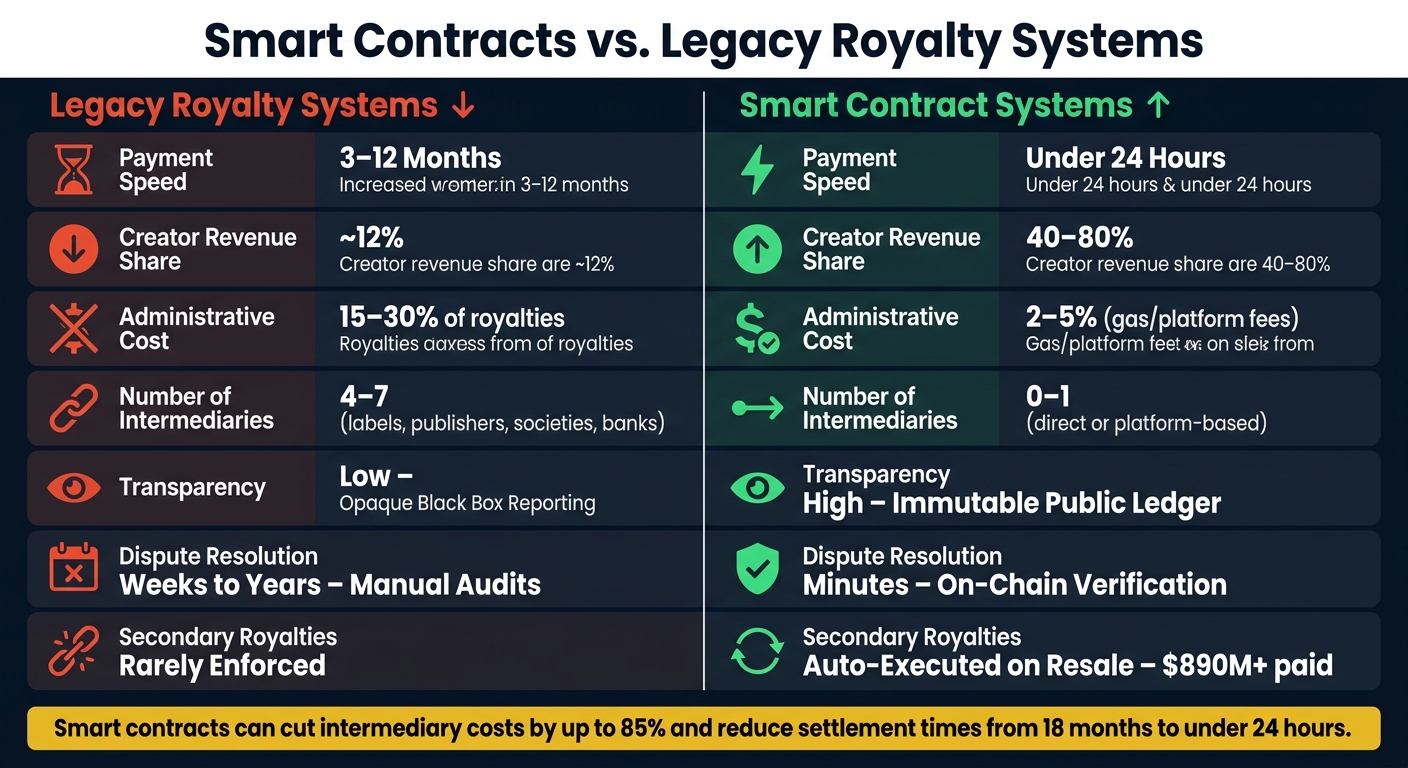
Smart Contracts vs. Legacy Royalty Systems: Key Metrics Compared
Smart contracts offer a mix of financial and administrative perks, along with some notable challenges. Let’s break these down.
Financial and Administrative Benefits
Automated smart contracts significantly speed up payment processes, reducing settlement times from the traditional 3–12 months to under 24 hours. By eliminating multiple intermediaries, revenue shares for creators can jump from 12% to an impressive 40–80%, while administrative costs drop from 15–30% to just 2–5%.
The secondary market also sees a transformation. Traditionally, creators miss out on royalties when their work is resold. With smart contracts, a royalty percentage can be automatically applied to every resale of a digital asset. This mechanism has already resulted in over $890 million in secondary-sale royalties for creators.
That said, these benefits come with certain challenges.
Challenges and Limitations
Smart contracts aren’t without their flaws. A major issue is the oracle problem – smart contracts can’t access off-chain data directly. If off-chain data is delayed or inaccurate, payouts can be affected. As one expert puts it:
"The viability of this model depends on reliable data connectivity… the smart contracts governing these assets must be able to access offchain performance data."
Legal ambiguity is another hurdle. While smart contracts execute automatically, they don’t carry the same legal weight as traditional signed agreements. Bugs or unintended outcomes could lead to irreversible financial losses, as the immutability of blockchain records can make errors permanent.
Taxation is another sticking point. In Canada, the CRA views each crypto royalty payment as a taxable event at its fair market value. For creators receiving thousands of micropayments, this can create a heavy reporting burden. Consulting a CPA is highly recommended to navigate these complexities.
Comparison Table: Legacy Systems vs. Smart Contract Systems
| Feature | Legacy Royalty Systems | Smart Contract Systems |
|---|---|---|
| Payment Frequency | 3–12 months | Near real-time (minutes to hours) |
| Transparency | Low – opaque "black box" reporting | High – immutable public ledger |
| Administrative Cost | 15–30% of total royalties | 2–5% (gas/platform fees) |
| Dispute Resolution | Weeks to years; requires manual audits | Minutes via on-chain verification |
| Intermediaries | 4–7 (labels, publishers, societies, banks) | 0–1 (direct or platform-based) |
| Data Accuracy | Fragmented, inconsistent metadata | Deterministic, code-enforced math |
| Secondary Royalties | Rarely enforced | Automatically executed on resale |
Smart contracts clearly bring efficiency and transparency to royalty distribution, but creators should carefully weigh the trade-offs before diving in.
Conclusion: The Future of Royalty Distribution
Traditional royalty systems are plagued by delays and lack transparency. Smart contracts, however, bring automation to payments and offer clear revenue splits for creators.
Key Takeaways
With smart contracts, settlement times drop from 6–18 months to under 24 hours, intermediary costs can decrease by up to 85%, and musicians’ earnings rise significantly, from 12% to 40–80%. These contracts also provide a unified, reliable record, eliminating the issues caused by conflicting data. This shift from manual processes to automated, blockchain-based solutions represents a major transformation, as explored throughout this article.
For optimal results, smart contracts should be supported by strong legal agreements, thorough security audits, and a defined tax strategy – factors that are especially important in Canada’s regulatory environment.
These advancements highlight the opportunity for Canadian organisations to upgrade their royalty management systems.
How Digital Fractal Technologies Inc Can Help
Canadian media and entertainment companies can now move from outdated systems to blockchain-driven royalty solutions. Digital Fractal Technologies Inc specializes in developing custom software to facilitate this transition. They integrate on-chain settlements with enterprise systems, streaming data, and compliance frameworks. Their team can design royalty automation solutions tailored to your specific rights structure, using oracle-based data feeds to ensure accurate payouts while adhering to Canadian legal and tax regulations. Whether you’re managing a complex rights catalogue or testing automation on a smaller scale, they provide scalable solutions to meet your needs.
FAQs
How do smart contracts know when a stream or sale happened?
Smart contracts are inherently limited when it comes to accessing off-chain data, such as streaming metrics or external sales figures. To bridge this gap, they rely on oracles – tools like Chainlink Functions – that securely retrieve data from external sources, including APIs from platforms like Spotify or enterprise systems.
For on-chain NFT sales, standards like ERC-2981 come into play. This standard defines royalty information, allowing marketplaces to automatically handle royalty payments without manual intervention. Companies like Digital Fractal Technologies Inc specialize in creating custom tools to integrate these technologies seamlessly into your business processes, ensuring smooth and efficient operations.
What data should stay off-chain to comply with PIPEDA?
Under the Personal Information Protection and Electronic Documents Act (PIPEDA), personal information must not be stored directly on blockchain due to its permanent and public nature. This includes sensitive details such as:
- Names
- Email addresses
- Phone numbers
- Government-issued IDs
- Financial records
- Health information
- Wallet addresses
Since blockchain’s immutability conflicts with privacy laws, Digital Fractal Technologies Inc suggests a hybrid approach. They recommend leveraging cryptographic hashes or zero-knowledge proofs for on-chain processes. Meanwhile, sensitive data should be stored securely in off-chain systems to ensure compliance with privacy standards. This method balances blockchain’s functionality with the need to protect personal information.
How are crypto royalty payouts taxed in Canada?
In Canada, the Canada Revenue Agency (CRA) considers cryptocurrency royalty payouts as taxable income at the time they are received. To determine the taxable amount, you’ll need to track the fair market value of the cryptocurrency at the moment of payment.
Here’s how it works:
- Business Income: If the royalties are earned as part of a business, they must be reported on Form T2125. You can also claim eligible deductions related to earning this income.
- Passive Income: If the royalties are passive, they should be reported on Line 13000 of your tax return. However, deductions for passive income are much more limited.
All income must be reported in Canadian dollars, so you’ll need to convert the cryptocurrency’s value accordingly. Additionally, if your total revenue exceeds $30,000, you may need to register for GST/HST, as this threshold triggers tax registration requirements under Canadian law.