
Steps to Digitize Public Sector Operations with AI

Canada’s public sector faces pressure to modernize, with only 22.5% of federal services fully accessible online despite 77% of Canadians interacting with government digitally. AI can help bridge this gap by automating routine tasks, improving service delivery, and addressing inefficiencies. However, successful implementation requires clear goals, readiness assessments, and compliance with legal and ethical standards.
Key takeaways:
- Assess readiness: Evaluate goals, constraints, data quality, and systems maturity.
- Identify priorities: Focus on high-impact, low-complexity workflows like chatbots for inquiries or automating document processing.
- Build and test: Start with small-scale pilots, establish governance, and train staff to manage AI responsibly.
- Ensure compliance: Follow Canada’s privacy laws and the Directive on Automated Decision-Making.
- Track results: Monitor metrics like processing speed, satisfaction, and costs to refine and improve systems over time.
AI can transform public services, but careful planning, strong governance, and ongoing monitoring are essential to ensure success.
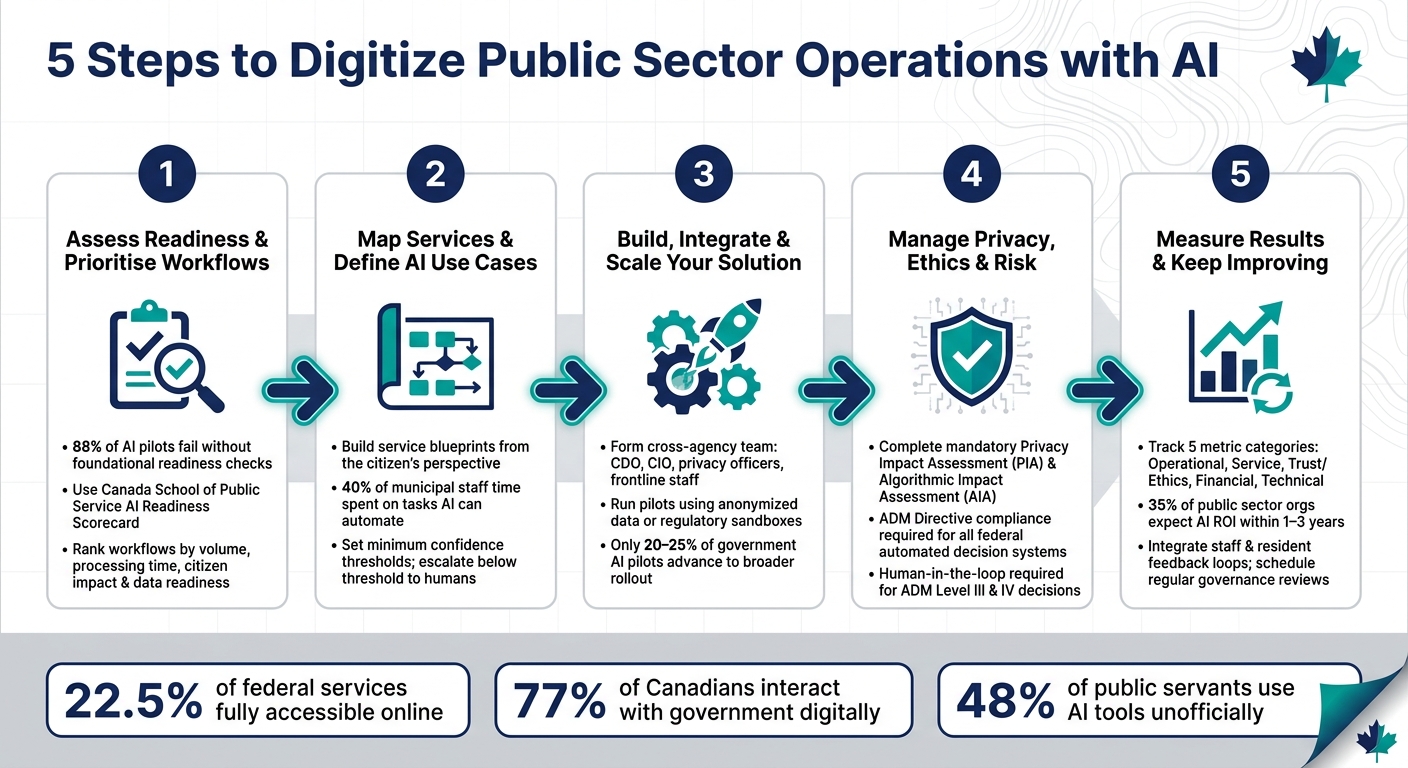
5 Steps to Digitize Public Sector Operations with AI in Canada
AI in Government: Scaling with Google Public Sector & TELUS Digital
sbb-itb-fd1fcab
Step 1: Assess Your Agency’s Readiness and Prioritise Workflows
Before diving into AI adoption, it’s crucial to evaluate your agency’s readiness. Research indicates that 88% of AI pilots across industries fail to progress into full production, often because foundational steps are skipped. This initial assessment sets the stage for a smoother transition to AI.
Define Organisational Goals and Constraints
Start by asking yourself: "What results are we aiming for, and how can AI help us achieve them?" Clear, purpose-driven goals ensure AI projects deliver meaningful public benefits.
"The most important thing with the implementation of any artificial intelligence project is that it’s purpose-led. … AI is just a tool that needs to be directed to a purpose." – Senior Official, EY Canada Report
Consider your budget carefully, factoring in all costs – technology, training, governance, and ongoing maintenance. Many agencies underestimate these expenses by 5 to 10 times when scaling from pilot projects to full deployment.
Legal and policy constraints also play a big role. In Canada, data residency is a key concern, with 93% of public servants believing citizen data must remain within the country. Be sure to account for federal, provincial, and municipal governance rules that may influence how and where AI can be implemented.
Once you’ve established your goals and constraints, the next step is to review your current data and system capabilities.
Evaluate Your Data and Systems Maturity
The success of any AI initiative hinges on the quality of the data it uses. Before committing to a specific solution, the Canada School of Public Service recommends using their AI Readiness Scorecard during the discovery phase. This tool evaluates four critical areas: governance infrastructure, enterprise architecture, stakeholder readiness, and psychological safety.
Workforce trust is particularly important. Research suggests that psychological safety should be weighted 1.5 times more heavily in readiness assessments, as its absence often leads to project failure. Strong data and system maturity are also vital to support Canada’s broader digital government efforts.
Data quality must align with Canada’s Directive on Automated Decision-Making. This means ensuring your data is relevant, accurate, timely, and traceable. Additionally, review your current application portfolio for outdated systems that could hinder integration. Be aware of informal AI use within your agency – nearly 48% of Canadian public servants report using AI tools unofficially, which can introduce hidden risks. A thorough readiness review will bring these issues to light.
After evaluating your readiness and data maturity, it’s time to focus on workflows where AI can have the biggest impact.
Choose the Workflows with the Most Impact
To maximise efficiency, prioritise workflows that offer the greatest potential for improvement. Rank them based on four factors: volume, processing time, citizen impact, and data readiness. Early wins often come from high-volume, low-complexity tasks with clean data.
| Priority Level | Workflow Characteristics | Examples |
|---|---|---|
| High Priority | High volume, routine, low complexity, high citizen impact | Chatbots for routine inquiries, permit applications, benefits fraud detection |
| Medium Priority | Moderate complexity, requires human oversight, significant data integration | Document redaction for ATIP requests, infrastructure maintenance prediction |
| Low Priority | High complexity, high risk to rights, low volume, or poor data quality | Complex policy decisions, high-impact enforcement applications without oversight |
Leverage Canada’s Algorithmic Impact Assessment (AIA) to classify workflows by risk level, ranging from Level I (low risk, using non-personal data) to Level IV (very high risk, involving sensitive or classified information). This helps determine the level of human oversight required and ensures you avoid deploying AI in areas where governance demands outweigh the potential benefits. By focusing on the right workflows, you can improve operational efficiency and enhance interactions with citizens.
Step 2: Map Your Services and Define AI Use Cases
Now that you’ve pinpointed your top-priority workflows, it’s time to dig deeper. This step focuses on mapping these workflows in detail and turning them into actionable AI use cases. The goal? To make abstract objectives tangible.
Build Service Blueprints to Identify AI Opportunities
Using the groundwork from Step 1, direct your attention to functions – those activities that cut across departments and lead to clear outcomes, like eligibility checks or issuing permits. These are often ripe for AI because they involve repetitive tasks, paperwork, and coordination gaps that slow everything down.
Start by mapping the entire journey of each function from the citizen’s perspective. Don’t skip measuring the current state – this helps establish a performance baseline and highlights problem areas. Skipping this step could lead to automating a flawed process instead of fixing it.
"The question isn’t whether governments should deploy agentic AI, but where to begin. Our analysis of 70 core functions reveals something striking: nearly half are both high-impact and achievable in the near term." – Kelly Ommundsen, Head of Digital Inclusion, GovTech, & Regulatory Innovation, World Economic Forum
As you map each function, evaluate it based on two factors: its ability to deliver public value and its practical and ethical complexity. Focus first on functions that score high on value but low on complexity – they’re your best starting point.
Define Specific AI Use Cases for Your Agency
With detailed service blueprints in hand, you can now align each workflow step with an AI capability, building on the prioritisation criteria from Step 1. Research shows that municipalities spend about 40% of staff time on tasks AI can partially or fully automate, so there’s no shortage of possibilities. Start with tasks that are both impactful and easy to automate.
Here’s a breakdown of potential use cases:
| AI Use Case Category | Public Sector Examples |
|---|---|
| Service Delivery | Chatbots for routine questions, digital assistants for navigating benefit programs |
| Document Processing | Automating classification, redaction, and retrieval for access-to-information requests |
| Fraud & Compliance | Detecting anomalies in tax compliance, procurement, or benefit administration |
| Infrastructure | Predicting maintenance needs and optimising traffic flows |
| Administrative | Automating internal approvals, pre-populating forms, and routing workflows |
For each use case, set a minimum confidence threshold for AI outputs. Anything below this threshold should automatically escalate to a human caseworker. This simple design choice helps maintain public trust. Policy and legal teams should address governance issues – like data handling and escalation paths – before diving into technical implementation.
Once your use cases are defined, the next step is to ensure smooth integration of AI into your existing systems.
Plan Integration with Existing Systems
Integrating AI with legacy systems can be one of the trickiest parts of this process. It builds on the systems maturity review you conducted in Step 1. Many Canadian agencies already have key assets like databases, identity systems, and APIs that can act as starting points for integration.
The priority here is model replaceability – design systems so that AI models can be swapped out easily as technology evolves. This prevents vendor lock-in and keeps your options open. Defining workflows in machine-readable formats also ensures they can work across different technical setups.
Take this time to assess whether existing solutions – AI or otherwise – can be adapted instead of starting from scratch. Reusing what you already have can save both time and money. For example, Digital Fractal Technologies Inc offers tailored AI consulting and integration services for public sector agencies, helping them avoid the common pitfalls of retrofitting AI onto outdated systems.
With your workflows mapped and AI use cases defined, you’re well-positioned to move forward with integration and deployment.
Step 3: Build, Integrate, and Scale Your AI Solution
With workflows mapped out and use cases clearly defined, the next step is putting your plans into action. This involves forming the right team, running small-scale tests, and preparing for full-scale integration.
Build Your Delivery Team and Establish Governance
Rolling out AI successfully requires a collaborative effort across your entire agency. From the start, key figures like your Chief Data Officer (CDO) and Chief Information Officer (CIO) should lead the charge. They’ll need support from policy advisors, privacy officers, frontline staff, and, when necessary, external technical partners.
One critical step is setting up governance early. Define who makes decisions, secure funding, and create oversight that spans IT, privacy, legal, and service design. As the Government of Canada advises:
"Departments should not invest in technology unless they have the capacity needed to understand, develop and maintain the project." – Guide on Departmental AI Responsibilities
A hub-and-spoke model is one approach that scales well. Here, a central Centre of Excellence handles technical standards and oversees AI governance, while department-specific leads ensure solutions address operational needs. For example, the Australian Taxation Office uses this model, with a central team of about 1,000 people managing data and AI governance, while "client account managers" connect the central hub to departmental teams.
If external expertise is needed, companies like Digital Fractal Technologies Inc can assist with AI consulting and custom integrations, ensuring alignment with your governance structure and enterprise needs.
With governance in place, the next step is to test your solution through a pilot phase.
Run a Pilot or Proof of Concept
Before diving into full-scale deployment, start small. Use anonymized datasets, regulatory sandboxes, or even digital twins of your operations to test your solution in a controlled environment.
Define clear success metrics before starting the pilot. These could include processing times, error rates, cost per transaction, or staff hours saved. Training staff is also essential – make sure they’re equipped to manage the system, identify biases, and intervene when needed. Keep in mind that only 20% to 25% of government AI pilots typically move on to broader implementation. Pia Andrews, Chief Data Officer at Australia’s Department of Home Affairs, highlights the importance of human expertise:
"Officer expertise is deep and is always going to pick up on new patterns, behaviours or issues that a machine is not going to detect… It’s certainly not about replacing people. It’s about amplifying their impact."
Once the pilot achieves its goals, you’ll be ready to scale the solution across the agency.
Scale AI Solutions Beyond the Pilot
After a successful pilot, the challenge becomes scaling the solution while managing costs and risks. Many agencies underestimate AI costs by five to 10 times, and over 60% of government leaders cite privacy and security concerns as major hurdles to scaling. To avoid surprises, build a detailed cost model from the beginning, factoring in long-term maintenance, retraining, and infrastructure needs.
As your AI system encounters new data, monitor for model drift – this ensures the system remains accurate and effective. Establish communities of practice across departments to share insights, improve onboarding, and boost AI literacy. These networks can also help identify internal advocates – individuals who promote adoption and play a key role in determining whether a tool gains traction or falls by the wayside.
Step 4: Manage Privacy, Ethics, and Risk in Government AI
Once your AI pilot is up and running, the next step is to focus on managing the legal, ethical, and operational responsibilities that come with it. Beyond the technical aspects, ensuring compliance with Canadian laws and ethical standards is critical for maintaining public trust. Scaling AI in government demands a careful balance of innovation and accountability.
Meet Canadian Privacy and Legal Requirements
In Canada, federal privacy laws like the Privacy Act regulate how government institutions handle personal information. Another key regulation is the Directive on Automated Decision-Making (ADM), issued by the Treasury Board of Canada Secretariat. This directive applies to any federal system that makes or assists in decisions affecting individuals. Agencies using automated systems implemented before 24 June 2025 must ensure compliance with updated directive requirements by 24 June 2026.
Before deploying your system, two assessments are mandatory:
- Privacy Impact Assessment (PIA): This evaluates your system for compliance with privacy laws and identifies potential risks.
- Algorithmic Impact Assessment (AIA): This tool includes 65 risk-related questions and 41 mitigation-focused questions. It determines your system’s risk level and outlines necessary controls. For example, if your mitigation score reaches 80% or higher, 15% is deducted from your raw impact score.
Provincial agencies should also consider local regulations, such as British Columbia and Alberta’s Personal Information Protection Act and Quebec’s Act Respecting the Protection of Personal Information in the Private Sector. Additionally, with Bill C-27’s Artificial Intelligence and Data Act (AIDA) moving through Parliament, agencies must stay informed about its potential requirements for AI risk management and fairness.
Once legal frameworks are addressed, the focus shifts to ethical practices and transparency.
Apply Ethical AI Principles and Maintain Transparency
In government AI, ethics start with a simple rule: people must be able to understand and challenge decisions that affect them. The ADM Directive requires agencies to provide plain-language explanations of how automated decisions are made, including the key factors and data sources involved. For systems classified as ADM Level III or IV, a human must make the final decision, with AI serving only as an advisory tool. This "human-in-the-loop" approach is especially critical for decisions related to benefits, enforcement, or immigration.
The directive outlines its purpose as follows:
"The objective of this directive is to ensure that automated decision systems are used in a manner that reduces risks to clients, departments and Canadian society, and leads to more efficient, accurate, consistent and interpretable decisions made pursuant to Canadian law." – Directive on Automated Decision-Making, Treasury Board of Canada Secretariat
For systems with moderate to high impact, conduct a GBA Plus review to identify potential inequities across demographic groups such as gender, race, or age before deployment. Publishing your AIA results on the Open Government Portal can further demonstrate accountability and build public trust.
Identify Risks and Put Controls in Place
With ethical practices in place, the next step is to address operational risks. Every AI deployment comes with risks, but these can be managed through targeted controls. Here’s a breakdown of common risks and how to mitigate them:
| Risk | Impact | Mitigation Measure |
|---|---|---|
| Bias & Discrimination | Unfair denial of services; amplification of stereotypes | Conduct a GBA Plus review, test training data for representativeness, and monitor outcomes across demographic groups |
| Privacy Breach | Unlawful disclosure of personal data to third parties | Complete a PIA, avoid inputting sensitive data into public AI tools, and use secure government-managed infrastructure |
| Lack of Transparency | Decisions that cannot be explained or contested | Provide plain-language notices and publish the principal factors behind each decision |
| Security & Cyber Risk | Data poisoning; unauthorised system modifications | Conduct penetration and adversarial testing; follow guidelines from the Canadian Centre for Cyber Security |
| Automation Bias | Over-reliance on AI outputs despite contradictory evidence | Provide role-based staff training and establish clear human-override protocols |
It’s also worth noting that many commercial generative AI platforms restrict their use in high-stakes areas like immigration or law enforcement. Always review vendor agreements carefully before selecting tools for sensitive applications.
Managing these risks isn’t a one-time task. Continuous monitoring and updating of control measures are essential throughout the lifecycle of your AI system. This approach ensures that your deployment remains both effective and accountable.
Step 5: Measure Results and Keep Improving Your AI Services
Once you’ve established privacy controls and risk management, the next step is to ensure your AI solution delivers measurable results and keeps evolving. Performance tracking and ongoing improvement are essential for achieving meaningful outcomes in public services.
Set Clear Performance Indicators
Start by recording baseline metrics – such as processing times, error rates, costs, and inquiry volumes – before deploying your AI solution. Without these benchmarks, it’s impossible to demonstrate the system’s impact.
After deployment, focus on tracking these five key categories of metrics:
| Metric Category | Metrics |
|---|---|
| Operational | Processing speed, error rates, task completion time, inquiry volume handled |
| Service/Client | Client satisfaction scores, wait time reduction, accessibility compliance |
| Trust/Ethics | Bias detection rates, human override frequency, transparency of explanations |
| Financial | Cost per transaction, total cost of ownership, ROI against baseline |
| Technical | System uptime, model drift, cyber resilience, infrastructure stability |
To make these metrics actionable, implement real-time dashboards so decision-makers and operational teams can monitor performance continuously, rather than waiting for quarterly reports. Pay special attention to human overrides of AI recommendations – these moments often highlight areas where the model needs adjustment.
Interestingly, 35% of public sector organizations anticipate seeing returns on their AI investments within one to three years. By setting clear performance thresholds during the pilot phase and holding the system accountable to those standards, you can keep this timeline achievable. These metrics will also guide the refinement process, ensuring the system keeps improving.
Create Feedback Loops with Staff and Residents
Metrics are only part of the story. The people interacting with your system – both staff and residents – can uncover issues that data might miss.
For residents using AI-assisted services, integrate feedback prompts directly into the interface. A simple question like "Was this helpful? Yes / Needs improvement" can provide valuable insights. For negative responses, offer follow-up options such as "The answer was unclear", "incomplete", or "incorrect." These details help identify whether the problem lies in the content or the technology. For example, Canada.ca receives around 4,000 user feedback comments daily, providing a rich dataset for refining AI responses.
Internally, involve teams like call centre staff in evaluating AI outputs before launching the system publicly. Also, establish a formal process for employees to flag errors or unusual behaviour. As Michael Klubal, National Industry Leader at KPMG Canada, notes:
"With public sector employees already adopting AI tools to carry out their job responsibilities, public sector organizations must accelerate their deployment of formal AI adoption policies. Strong governance, oversight, and training are essential to balance innovation with accountability."
Make sure every AI interaction includes a clear escalation path to a human agent. This not only safeguards residents but also provides data on where the AI struggles, helping you refine its capabilities.
Plan for Long-Term Maintenance and Growth
Using insights from feedback, commit to regularly reviewing and updating your AI system. Treat AI as an ongoing operational model, not a one-time project. Schedule governance reviews – including updates to your Algorithmic Impact Assessment whenever the system’s scope or functionality changes. Provide recurring, role-specific training to ensure staff can effectively manage, audit, and override the AI when necessary.
Design your infrastructure with flexibility in mind. Use shared components and avoid vendor lock-in to make future updates and expansions easier.
Lastly, establish clear criteria for when to retire, update, or replace the system. Without regular reviews and maintenance, an AI solution can gradually drift away from serving the needs it was designed to address.
FAQs
What’s the first AI project a government team should start with?
Government teams can make a big impact by starting with automation for straightforward, repetitive, and low-risk tasks. This not only improves efficiency but also frees up staff to focus on more critical responsibilities. For instance, AI can be used to summarize data, draft documents, perform basic research, or handle citizen inquiries through chatbots. Companies like Digital Fractal Technologies Inc offer customized AI and workflow automation solutions to simplify these tasks and drive digital transformation.
How do we keep AI decisions explainable and challengeable for residents?
To ensure that AI decisions remain clear and open to scrutiny, government agencies need to prioritise transparency and fair procedures. This means providing straightforward notices that let people know when AI is being used, along with easy-to-understand explanations of how decisions are made. It’s equally important to offer clear reasons for outcomes and set up simple, accessible ways for residents to contest or question these results.
Digital Fractal Technologies Inc helps public sector clients achieve this by creating transparent systems and effective automation solutions. Their approach helps build public trust and accountability, especially as governments move towards greater digitisation.
What assessments are needed in Canada before using AI in public services?
Before introducing AI into Canadian public services, agencies need to carry out a series of thorough evaluations. A good starting point is using an AI readiness scorecard. This helps assess factors like how clearly the problem is defined, the quality of available data, and the organization’s capability to implement AI solutions.
Key steps involve conducting an Algorithmic Impact Assessment (AIA) to identify risks tied to automated decision-making systems. Additionally, agencies must perform Privacy Impact Assessments, security reviews, and check the state of their IT infrastructure. Reviews should also cover cloud readiness and ensure compatibility with chosen vendors.