AI Workflow Automation Edmonton: Local Use Cases

AI workflow automation is transforming Edmonton businesses by eliminating repetitive tasks, improving efficiency, and ensuring compliance with Canadian regulations. Companies in sectors like healthcare, logistics, energy, and public services are leveraging automation to save time, reduce costs, and streamline operations. Here’s what you need to know:
- Time Savings: Employees save 20–50 hours monthly by automating tasks like data entry and approvals.
- Cost Reduction: Alberta Health Services saved CA$1.3 million by automating 47 processes.
- Efficiency Gains: Edmonton manufacturers and energy companies are automating inspections, reporting, and job dispatching for smoother workflows.
- Compliance Support: Automation simplifies regulatory tasks, cutting audit prep time from weeks to hours.
Edmonton’s strong AI ecosystem, supported by the Alberta Machine Intelligence Institute and local companies like Digital Fractal Technologies, makes it easier for businesses to adopt tailored automation solutions. Whether it’s logistics scheduling, legal document processing, or public sector operations, automation is already delivering measurable results. The key is starting small, identifying high-impact workflows, and preparing your systems and team for the transition. Following a structured workflow automation process can ensure a smooth implementation.
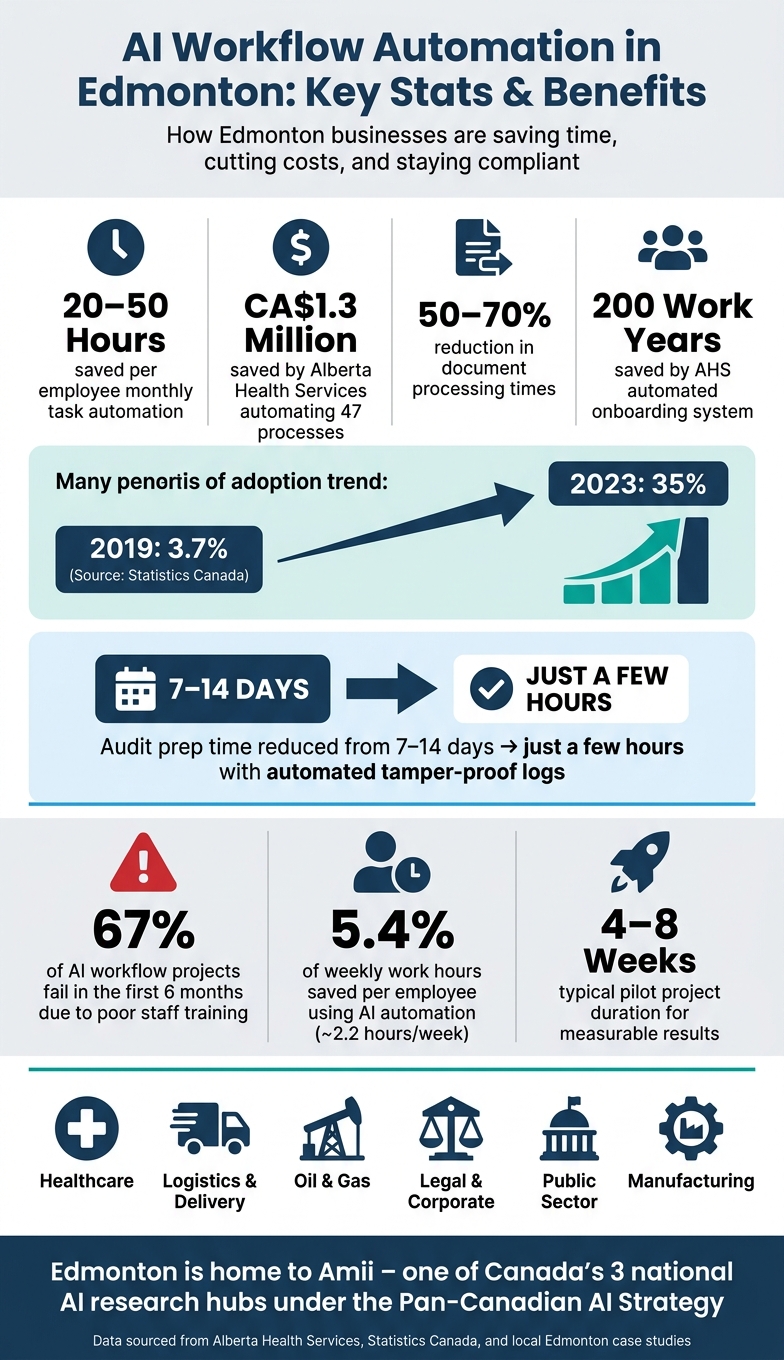
AI Workflow Automation in Edmonton: Key Stats & Benefits
Inspired Method | How Edmonton Contractors Use AI to Automate Their Business Real Systems That Work
sbb-itb-fd1fcab
Key Benefits of AI Workflow Automation for Edmonton Companies
AI workflow automation is reshaping how Edmonton businesses operate, offering measurable advantages like cutting administrative costs and boosting around-the-clock productivity. (Use our workflow automation benefits calculator to estimate your potential savings.)
Automating Repetitive Processes
Many businesses underestimate how much time is spent on repetitive tasks. Activities like data entry, document creation, and approval processes can eat up countless hours. Alberta Health Services (AHS) provides a powerful example: by automating 47 processes – including IT service desk setups, HR letters, shift scheduling, and clinical data PDF generation – AHS saved 200 work years and cut costs by CA$1.3 million. Their automated onboarding system now handles 17,000 new hires and 47,000 staff transfers annually, all without increasing staff.
"Intelligent Automation has enabled us to streamline time-consuming administrative tasks, reducing manual work and freeing up our healthcare staff to focus on delivering quality care." – Jesse Tutt, Program Director, Intelligent Automation, Alberta Health Services
This kind of efficiency demonstrates how automation can drive daily improvements across Edmonton’s industries.
Improving Day-to-Day Efficiency
Automation doesn’t just lighten workloads – it also makes workflows smoother. Companies using AI for document processing report cutting processing times by 50% to 70%. In Edmonton’s energy and construction sectors, automating tasks like incident reporting, job-site inspections, and compliance paperwork allows field workers to focus on their core responsibilities instead of being bogged down by admin work.
Manufacturers in the region are also seeing gains. Flexxaire, a local manufacturing company, introduced automation to enable 24-hour warehouse production. CEO Jon McCallum highlighted that this approach supports scaling global operations while keeping high-value engineering jobs in Canada. Similarly, Akash Group of Companies spent months building a solid data foundation before integrating AI into its homebuilding operations. President Hersh Gupta credits this move with sharpening the company’s competitive edge.
Meeting Compliance and Security Standards
For Edmonton businesses navigating Canadian regulations – like the Artificial Intelligence and Data Act (AIDA) and Bill C-11 – compliance is a critical challenge. AI workflow automation simplifies this by creating tamper-proof, timestamped logs for every automated action, cutting audit preparation time from 7–14 days to just a few hours. Successful automation projects also embed privacy measures from the start. Sensitive data, such as personal information, financial records, and tax filings, is mapped to proper access controls and encryption standards before automation systems go live.
This approach is especially valuable for Edmonton’s public sector and energy companies, where regulatory requirements and data residency rules add layers of complexity. By addressing these needs, automation not only ensures compliance but also supports operational efficiency and strengthens competitiveness in Alberta’s market.
AI Workflow Automation in Action: Edmonton Use Cases
Edmonton businesses across various industries are already using AI workflow automation to achieve real, measurable results. From logistics to legal services and public sector operations, these advancements are making a noticeable impact.
Logistics and Oil & Gas Workflow Automation
In Edmonton’s logistics and delivery sector, Deeleeo introduced a delivery platform in October 2020 that replaced manual scheduling with a fully automated system. Designed with iOS and Android driver apps alongside a web-based administrative backend, this platform streamlines the entire delivery process. It eliminates the inefficiencies caused by phone calls, spreadsheets, and manual coordination, significantly improving workflow efficiency.
The oil and gas industry in the region has also embraced automation. James M., a local CEO, implemented an automated availability and booking system to address frequent client inquiries about equipment and personnel availability. This system offers a 24/7 self-service experience, removing operational bottlenecks.
"The app gives our clients real time data to what each vendor on their favourites list has at the ready on a 24-hour basis. Having the ability to book in real time or booking equipment into the future makes both operations seamless." – James M., CEO
These examples show how automation can transform industries reliant on logistics and scheduling, but its benefits extend further.
Legal and Corporate Governance Automation
In Edmonton’s legal and corporate services sectors, AI-powered tools are streamlining document-heavy tasks. These tools now handle contract drafting, track document lifecycles, and monitor compliance, cutting down turnaround times and reducing administrative workloads. For instance, AI-driven document processing has been shown to decrease processing times by 50–70%.
In corporate governance, automated audit trails and timestamped logs simplify regulatory compliance, particularly during reviews. Public sector organisations are also adopting similar technologies to manage complex workflows with greater efficiency.
Public Sector Workflow Automation
The public sector in Edmonton stands out as a leader in adopting AI workflow automation. GovLab, a collaboration involving Edmonton-based AltaML, the Government of Alberta, and Mitacs, has developed applications for automated document classification, wildfire prediction, and school space planning. These tools are already integrated into government operations, demonstrating their practical value.
Additionally, Digital Fractal Technologies has supported public sector projects with AI solutions for image and video processing and smart AI agents for daily operations. Their work on enterprise resource planning (ERP) customisations for Landmark is a great example of how automation can ease reporting tasks without requiring a complete system overhaul.
"Digital Fractal provided support to Landmark when extra hands on deck were needed to complete aspects of our enhanced reporting and ERP customizations." – Robert M., Manager, Landmark
These cases highlight how organisations across Edmonton are identifying high-friction processes and following a digital transformation checklist to implement targeted automation tools to achieve tangible improvements. By focusing on specific needs, these businesses and institutions are setting the stage for smoother, more efficient operations.
How to Implement AI Workflow Automation in Edmonton
Finding the Right Processes to Automate
The first step in adopting AI workflow automation isn’t about technology – it’s about understanding your current workflows. This often involves choosing between Zapier vs. Make to connect your existing tools. Take time to map out your processes from start to finish and pinpoint areas where delays happen. Common bottlenecks include manual hand-offs, email-based approvals, paper forms, and repetitive data entry tasks.
Narrow down 3–5 processes that could make the most impact by considering factors like time savings, error reduction, and freeing up staff hours. In Edmonton’s industrial sectors, tasks such as safety inspections, equipment logs, and field ticket processing often offer quick wins. A great example is Xtreme Oilfield, an energy services company in the Edmonton area. By working with Digital Fractal Technologies Inc., they digitized paper forms, automated permit and certificate management, and streamlined job dispatching, leading to significant efficiency gains.
Once you’ve identified the right processes to automate, the next step is ensuring your data and systems are ready for integration.
Getting Your Data and Systems Ready
After selecting which workflows to automate, it’s essential to prepare your data and systems for smooth implementation. Start by auditing your data to understand its structure and determine what integrations are needed.
One challenge many Edmonton companies face is dealing with older, legacy systems. To overcome this, you can bridge outdated ERPs and field service tools with modern AI platforms using custom APIs, middleware connectors, or integration bots. With the right approach, workflows can often be launched within 4 to 8 weeks. Before development begins, document every detail of the current process – tasks, triggers, and systems. Skipping this step can lead to stalled projects and missed opportunities.
Once your systems are in sync, the focus shifts to preparing your team for the transition.
Training Staff and Managing the Transition
For businesses in Edmonton, helping staff adapt to AI automation is just as important as updating your systems. Research shows that 67% of AI workflow projects fail to gain traction within the first six months due to inadequate staff training. Drawing inspiration from companies like Xtreme Oilfield and GovLab, local businesses can follow a step-by-step approach to ensure success.
Instead of overhauling everything at once, start small. Roll out one high-impact workflow, achieve measurable results, and expand from there. Be transparent with your team – explain that automation is designed to take over repetitive, low-value tasks, allowing employees to focus on work that requires human expertise. On average, workers using AI automation tools save 5.4% of their weekly work hours, which translates to about 2.2 hours per full-time employee.
"Introduction of AI workflow automation changes the way teams work every day. Employees need guidance to understand how AI complements their roles rather than replaces them." – Tollanis
To ease the transition, host workshops, provide clear and concise documentation, and assign a dedicated point of contact for support. If adoption rates fall below 60% after the first 30 days, it’s often a sign that the workflow itself needs re-evaluation rather than simply more training.
Conclusion: What AI Workflow Automation Means for Edmonton’s Future
Edmonton’s business landscape is undergoing a major shift. According to Statistics Canada, AI adoption among Canadian enterprises skyrocketed from 3.7% in 2019 to 35% by 2023. Companies that embrace automation early are already gaining an edge in cost efficiency, speed, and service quality. Success stories in energy field ticketing, legal document processing, aviation compliance, and public-sector case management all highlight one key takeaway: targeting high-volume, rule-based workflows delivers the greatest impact. Short, focused pilot projects – lasting just 4–8 weeks – can yield tangible results without requiring a complete overhaul of operations.
Edmonton is uniquely positioned to build on these opportunities. The city is home to the Alberta Machine Intelligence Institute (Amii), one of three national AI research hubs under the Pan-Canadian AI Strategy. This gives Edmonton a central role in applied AI research and access to top-tier talent in Western Canada. Local businesses benefit from a strong ecosystem that provides expertise, training, and partnerships that are hard to find elsewhere.
With this foundation, Edmonton companies can take advantage of tailored AI solutions that meet Canadian regulatory and privacy standards. For example, Digital Fractal Technologies Inc. offers end-to-end support, helping organizations identify the right workflows, evaluate current systems, develop custom integrations, run pilot programs, and provide ongoing assistance. Their services span industries like energy, construction, the public sector, and professional services.
AI workflow automation isn’t something to plan for down the road – it’s already here and delivering real benefits to Edmonton businesses. The real question now is which process should you start with?
FAQs
Which workflows should my Edmonton business automate first?
Edmonton businesses can boost productivity by automating repetitive and time-draining tasks like approvals, invoicing, form submissions, onboarding processes, and data management. These tasks often rely on manual methods – think endless email chains and spreadsheet juggling – which can slow things down.
To get started, map out your workflows to pinpoint bottlenecks. Once identified, you can create custom automation plans that simplify operations. Additionally, conducting an AI Readiness Audit can reveal areas where automation will have the greatest impact, helping you achieve quick results and measurable improvements for your business.
How long does an AI automation pilot usually take to deliver results?
An AI automation pilot typically requires several weeks to a few months to deliver measurable outcomes. The exact timeline hinges on the project’s complexity and scope, which can involve elements like system integration and data preparation. Setting clear goals and investing in thorough planning can help smooth the process and achieve results within the expected timeframe.
How do we stay compliant with Canadian privacy and AI rules when automating?
To comply with Canadian privacy and AI regulations, it’s crucial to align your systems with the principles outlined in PIPEDA (Personal Information Protection and Electronic Documents Act). This means adopting tools that prioritize privacy, such as those with zero-trust architectures and auditability features.
In sectors like healthcare – where data sensitivity is paramount – ensure that your use of AI is backed by proper documentation and lawful authority. Regular reviews of your compliance practices are also essential to keep up with changing regulations and maintain adherence to legal standards.