
10 AI Transformations: Business Case Studies

AI is reshaping industries by solving specific challenges with measurable results. From retail to healthcare, businesses are seeing faster processes, cost savings, and improved outcomes. Key examples include:
- Retail: LuxeWell boosted revenue by 34% in 90 days with AI product recommendations. Walmart‘s AI search increased order values by 35%.
- Finance: JPMorgan Chase cut legal review time from 30 hours to seconds with its COIN platform.
- Healthcare: Pfizer sped up clinical trial data processing from 30 days to 22 hours using AI tools.
- Manufacturing: BMW uses AI for defect detection, reducing errors by 40%, while Schneider Electric‘s AI systems lower energy costs by up to 40%.
- Public Sector: Alberta Health Services automated tasks, saving 200 work years. The Ottawa Hospital introduced an AI assistant to enhance patient care.
These examples show how AI is helping organizations across Canada and beyond achieve efficiency, accuracy, and better decision-making. Success relies on clear goals, quality data, and compliance with privacy regulations.
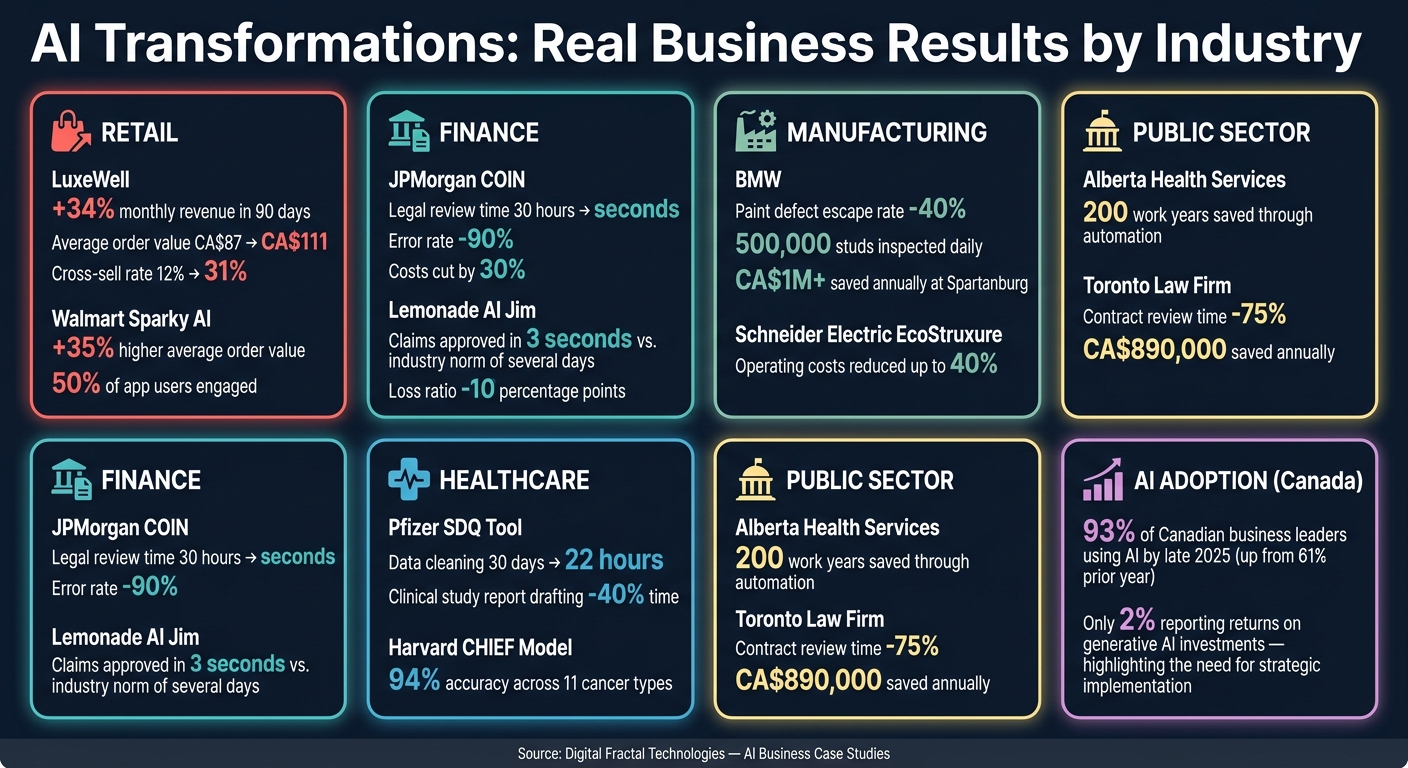
AI Business Impact: Key Stats Across Industries
AI in Retail and E-Commerce
The retail industry was one of the first to embrace AI, and the results have been game-changing. From smarter product recommendations to virtual try-ons, AI is reshaping both how customers shop and how retailers manage their operations. Before implementing these tools, businesses should use a digital transformation readiness checker to assess their current infrastructure. Let’s explore a few examples that highlight how AI is driving revenue growth and improving customer experiences.
How Recommendation Engines Increase Revenue
In the past, product recommendations were static – manually curated lists that struggled to keep pace with changing customer preferences. AI has completely transformed this process. By analysing real-time data like browsing history, cart contents, and purchase patterns, AI-powered recommendation engines can deliver highly relevant suggestions at just the right time.
The impact is undeniable. LuxeWell, a premium wellness brand, adopted artificial intelligence machine learning solutions as part of a three-phase strategy to refine its product recommendations. They replaced manual cross-sells on their website, added post-purchase recommendation blocks, and personalised their email marketing. The results? Within just 90 days, their monthly revenue jumped by 34%, and the average order value increased from CA$87 to CA$111.
| Metric | Before AI | After AI (90 Days) |
|---|---|---|
| Monthly Revenue | CA$420,000 | CA$562,800 |
| Average Order Value | CA$87 | CA$111 |
| Cross-Sell Rate | 12% | 31% |
| Repeat Purchase Rate (30-day) | 7% | 18% |
It’s worth noting that AI recommendation systems typically require a learning phase of three to four weeks. During this time, performance may dip slightly before showing improvements.
Walmart‘s AI-Powered Search
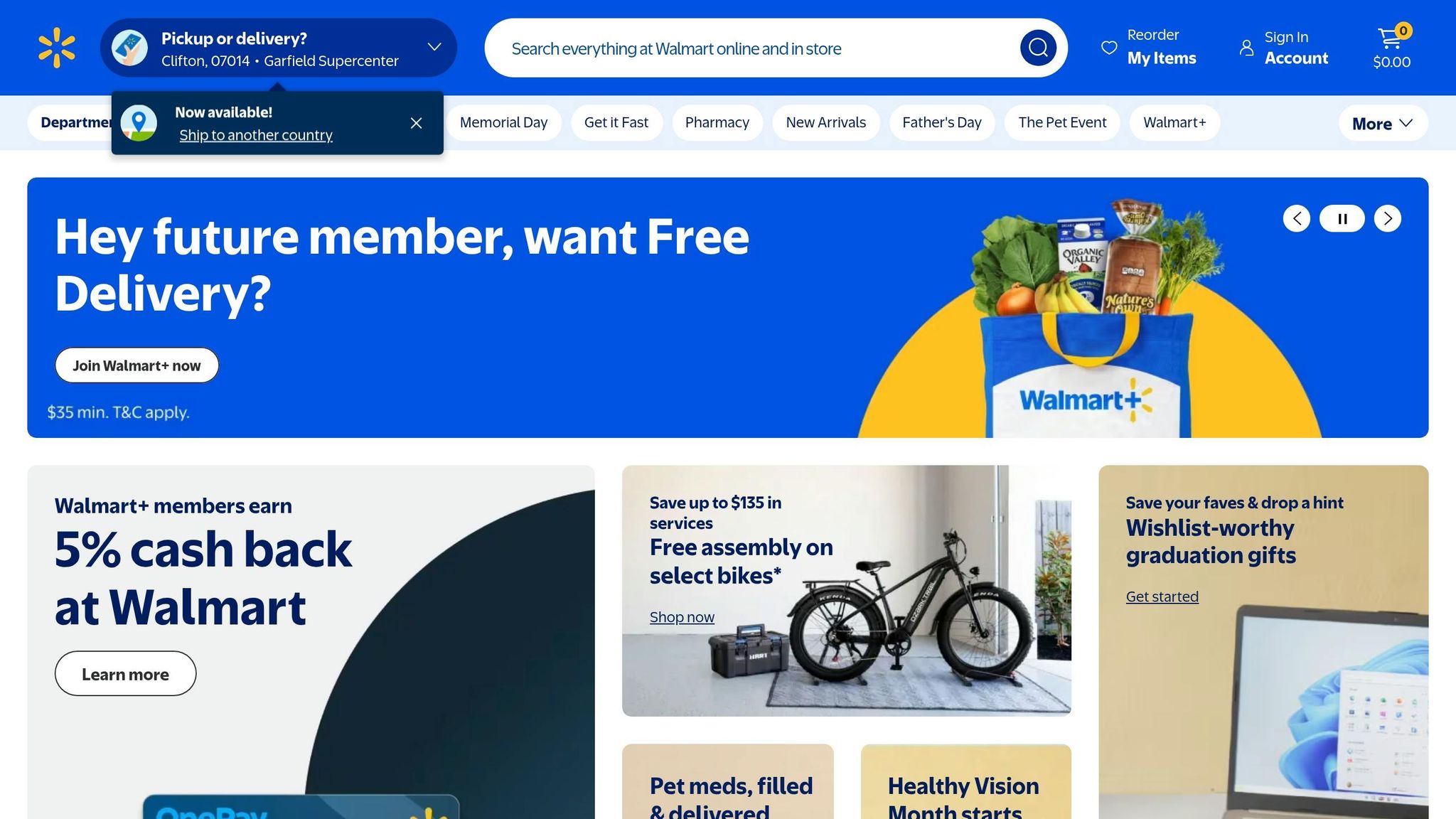
Retailers are also revolutionising their search tools. Walmart, for instance, has moved beyond basic keyword searches to what it calls "goal searching." In January 2024, the company rolled out a generative AI-powered search feature on iOS that understands context and intent. For example, instead of searching for individual items, a customer might type, "Help me plan a football watch party", and the system generates a ready-to-shop list tailored to that request.
The results have been impressive. Customers using Walmart’s Sparky AI shopping assistant have an average order value that’s 35% higher than those who don’t. Additionally, about 50% of Walmart app users have engaged with the feature.
"Sparky is essentially helping us evolve from traditional search to intent-driven commerce." – David Guggina, President and CEO, Walmart U.S.
In Canada, Staples has achieved similar success. By implementing AI-driven dynamic re-ranking for its massive 200,000-item inventory, Staples Canada was able to adapt search results to shifts in consumer demand – like the increased need for home-office furniture during the pandemic. This led to a double-digit boost in conversion rates and resolved 65% of search relevance issues automatically.
Sephora‘s AR Shopping Experience
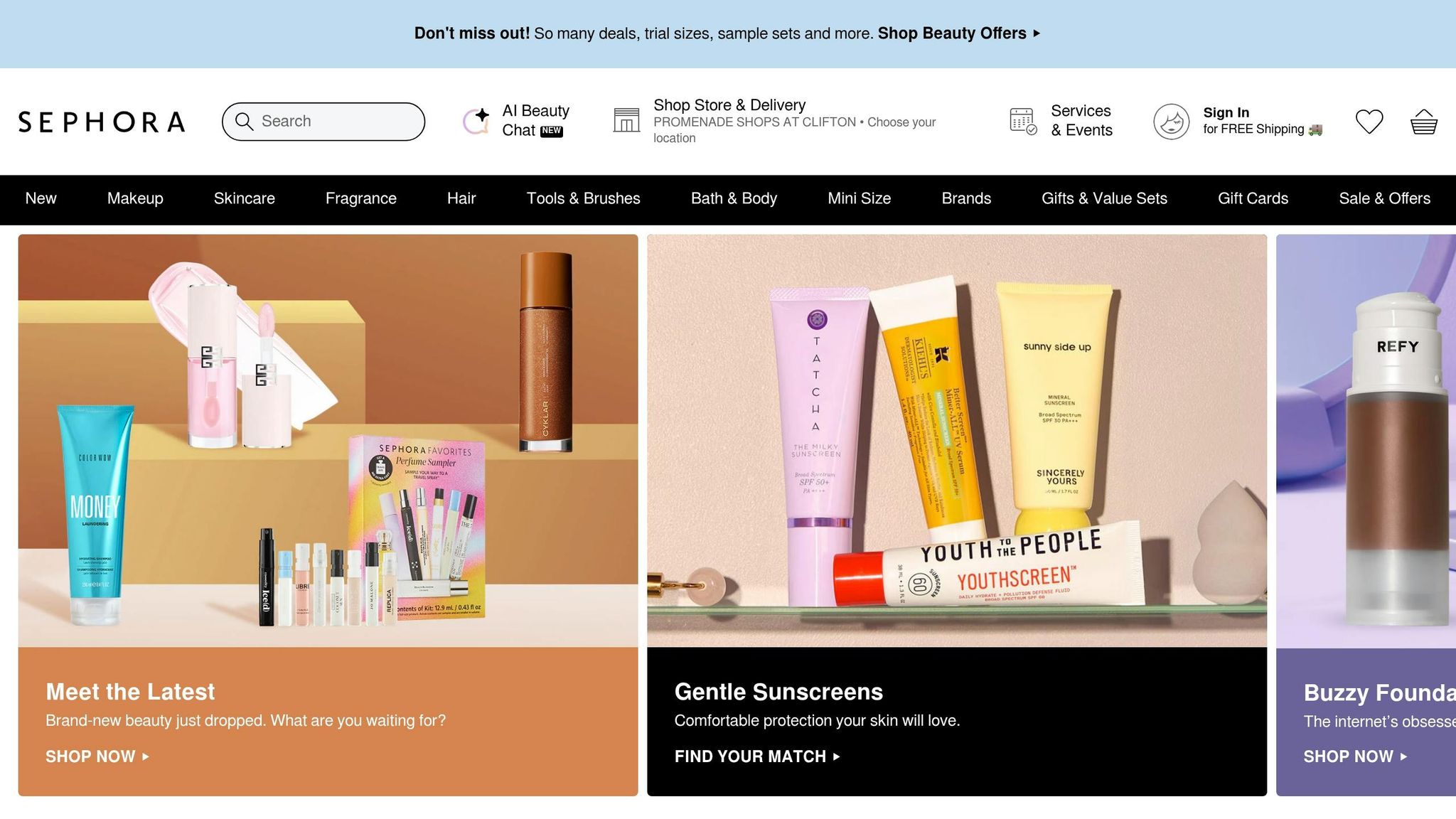
The beauty industry faces unique challenges in online shopping, particularly when it comes to product fit. For instance, 70% of women report difficulty finding the right foundation shade. Sephora tackled this issue with its Virtual Artist tool, which uses augmented reality (AR) and facial landmark detection to let customers try on thousands of products virtually.
By 2024, the tool supported over 10,000 product shades and had facilitated more than 200 million virtual try-on sessions. The impact was clear: customers using Virtual Artist were 11% more likely to make a purchase, had 8.5% higher average order values, and returned products 28% less often.
"Customer data is lent to Sephora by the customer in exchange for better experiences." – Mary Beth Laughton, Former Chief Digital Officer, Sephora
What sets Sephora apart is its approach to customer data. Instead of collecting information indiscriminately, Sephora introduced a Beauty Profile system where customers voluntarily share preferences in exchange for tailored recommendations. This approach has paid off – 76% of Beauty Insider members describe the AI personalisation as "helpful", far exceeding the 41% industry average.
sbb-itb-fd1fcab
AI in Financial Services and Insurance
Finance and insurance might not seem like the most dynamic fields for AI, but these industries have embraced AI to streamline repetitive, high-volume tasks that follow strict rules.
JPMorgan Chase‘s COIN Platform for Legal Review

JPMorgan Chase used to spend an astounding 360,000 hours annually on manual reviews of commercial loan agreements – each document taking about 30 hours to process. But that all changed in June 2017 with the launch of COIN (Contract Intelligence), an NLP-powered platform hosted on the bank’s private Gaia cloud. This tool extracts over 150 attributes from each agreement in mere seconds.
The results? Processing time dropped from 30 hours to just seconds, error rates fell by 90%, compliance-related mistakes decreased by 80%, and legal operations costs were cut by 30%. This equates to savings equivalent to the workload of 180 full-time lawyers. Freed from these time-consuming tasks, teams could shift their focus to higher-value activities like deal negotiations and risk analysis.
"Our loan service error rate is less than a tenth of what it used to be a decade ago thanks to COiN and updated processes." – Sri Shivananda, CTO, JPMorgan Chase
Following its success with commercial loans, COIN has expanded to handle other document types, including credit default swaps, custody agreements, and financial reports. The takeaway? AI thrives when applied to high-volume, well-structured tasks, and COIN’s success has inspired similar innovations in areas like claims management. Businesses can use an AI Integration Benefits Analyzer to identify similar high-impact opportunities.
Lemonade‘s AI for Claims and Fraud Detection

Taking a different approach, Lemonade designed its insurance platform with AI at its core from day one. Its claims-handling bot, AI Jim, automates every step of the process: claims assessment, policy verification, fraud detection, and even payment initiation.
The efficiency is impressive. AI Jim can approve simple claims in as little as three seconds, compared to the industry norm of several days. Lemonade reports a 10-percentage-point reduction in the loss ratio for AI-processed claims versus those handled by humans, highlighting its superior fraud detection capabilities. By analysing thousands of data points for each claim – including subtle behavioural cues during submission – AI Jim identifies anomalies that traditional systems often miss. This has significantly reduced fraudulent payouts while maintaining some of the highest customer satisfaction scores in the industry.
AI in Manufacturing and Industrial Operations
AI has made significant strides in manufacturing and energy management, moving well beyond experimental stages. Companies like BMW and Schneider Electric illustrate how AI can tackle large-scale, precision-focused challenges with impressive results.
BMW‘s AI Visual Inspection System
Manually inspecting every vehicle on a production line is simply not feasible. As Camille Roberts, IT Project Lead at BMW Group, explained: "It’s not really humanly possible to inspect every single car. … The production numbers just wouldn’t meet the global demand [without AI]."
To address this, BMW transitioned from traditional rule-based camera systems – which often struggled with reflective surfaces and false alarms – to deep learning models capable of detecting even subtle defects, such as micro-scratches or orange peel textures. These AI systems can scan each vehicle body in under two seconds, allowing for 100% inline inspection without disrupting production. This has cut the paint defect escape rate by 40%.
At BMW’s Spartanburg plant, robots weld 300–400 metal studs onto SUV frames. Here, AI inspects 500,000 studs daily and directs robots to fix any misalignments in a fully automated closed-loop system. This process not only saves over CA$1 million annually but also increases efficiency fivefold, offering significant workflow automation benefits.
"It’s a fully closed loop… [AI] removes the human thinking, the human manual intervention, directly out of the equation." – Curtis Tingle, BMW Group Manager
Globally, BMW employs over 400 AI-driven solutions in its production facilities. These systems have drastically reduced the time required for employees to create and deploy new quality assurance models by more than two-thirds.
AI’s impact is equally significant in the realm of energy management.
Schneider Electric‘s AI Energy Management

Schneider Electric’s EcoStruxure platform tackles energy inefficiencies in commercial buildings by responding dynamically to real-time factors like occupancy and weather. Traditional fixed-schedule systems waste between 30% and 50% of energy because they fail to adapt to such variables. EcoStruxure uses AI to autonomously identify and resolve inefficiencies, such as adjusting HVAC schedules or dimming lights in empty areas.
The platform includes specialised tools for different needs: the Building Advisor handles complex commercial systems, the Microgrid Advisor manages renewable energy storage and grid decisions, and the Industrial Advisor targets waste and inefficiencies in manufacturing equipment. Together, these tools can lower operating costs for large facilities by as much as 40%.
These examples highlight AI’s ability to excel in high-volume, well-defined tasks where human intervention is limited by scale. By automating processes and improving efficiency, AI is reshaping operations in industries that demand precision and adaptability.
AI in Healthcare and the Public Sector
Healthcare and public services face some of the toughest, high-stakes decisions out there. AI consulting is stepping in as a powerful ally – not to replace human judgement, but to process data at incredible speed and scale, making critical decisions more efficient. Just like in manufacturing and finance, AI is enabling quicker, smarter outcomes in these fields.
How Pfizer Used AI to Speed Up Clinical Trial Site Selection
In healthcare, where timing can mean everything, Pfizer turned to AI to speed up clinical trial site selection. Clinical trials are infamously slow, with one major hurdle being the identification of suitable patients – especially in oncology, where treatment windows can close rapidly. Using machine learning, Pfizer analysed medical data to identify cancer patients likely to qualify for trials, aiming to boost enrolment rates by over 20%.
During the COVID-19 vaccine trials, Pfizer collaborated with Saama Technologies to create the Smart Data Query (SDQ) tool in just six weeks through its Breakthrough Change Accelerator program. This tool slashed a data-cleaning process that used to take over 30 days down to just 22 hours, saving an entire month in trial timelines. Pfizer didn’t stop there; it expanded its AI applications to streamline document generation, cutting the time to produce a first draft of a clinical study report by 40% and reducing manuscript submission timelines by 15%.
"We have the ability to be transformative in how we identify patients who are likely to become eligible for a trial – something we simply couldn’t do before these new technologies." – Jeanine Bortel, Vice President and Head of AI Portfolio Development, Pfizer
AI for Disease Screening and Diagnostics
AI isn’t just speeding up trials – it’s reshaping how diseases are detected, offering faster, more accurate diagnostics. For example, Stanford University‘s CheXNet model can analyse a chest X-ray for 14 different conditions in about 90 seconds, a task that would take radiologists hours. Meanwhile, Harvard Medical School‘s CHIEF model, trained on 15 million unlabelled images, achieved nearly 94% accuracy across 11 cancer types, including a 0.98 accuracy rate for colon cancer, slightly outperforming trained pathologists at 0.969.
These tools are especially valuable in areas where specialist access is limited. In Canada, rural and remote communities often face long waits for diagnostic care. AI-powered platforms capable of delivering specialist-level analysis digitally can help close this gap. For instance, the Canadian-built BlueDot platform flagged the COVID-19 outbreak days before international health alerts by analysing global news and airline data.
Closer to home, The Ottawa Hospital introduced an AI-powered Digital Teammate in September 2024, developed with Deloitte Canada. This tool offers patients round-the-clock information, helping them prepare for surgeries and navigate the hospital’s new campus. By integrating with electronic medical records, it personalises interactions, easing administrative workloads for staff while improving patient readiness. This approach reflects how AI is enhancing both patient care and system efficiency across Canada. For local organizations, AI consulting services for Edmonton businesses can help bridge the gap between global innovation and regional implementation.
"Our goals for innovation at The Ottawa Hospital are to improve patient care, create a better experience for patients and staff, and enhance value in the health system." – Kara Kitts, Director of Digital Innovation, The Ottawa Hospital
Custom AI Solutions for Canadian Businesses
The examples above – from Pfizer’s clinical trial advancements to other tailored applications – show that successful AI adoption in Canada isn’t a one-size-fits-all process. These achievements required careful planning and customization, built around specific business needs, unique datasets, and compliance with Canadian regulations.
A Phased Approach to AI Integration
A KPMG Canada survey reveals that 93% of Canadian business leaders were using AI in some capacity by late 2025, a sharp rise from 61% the previous year. However, only 2% reported seeing returns on their generative AI investments. This gap underscores the importance of a clear, step-by-step approach.
The most effective implementations begin by targeting a specific challenge – like manual data entry, compliance tracking, or slow contract reviews. Privacy and risk assessments come next, followed by testing with real data. From there, businesses can gradually build internal expertise and scale up. Take the example of a Toronto-based corporate law firm with 45 lawyers: they introduced an AI-powered contract analysis system for M&A due diligence. The system launched in 12 weeks and reduced contract review times by 75%, saving an estimated $890,000 annually.
"The AI does not replace legal judgment – it gives our lawyers more time for the high-value strategic work our clients actually pay for." – Managing Partner, Toronto Corporate Law Firm
For projects involving sensitive data, compliance with frameworks like the Artificial Intelligence and Data Act (AIDA) and CGSB 72.34 standards is essential. A good example is British Columbia’s Ministry of Mining and Critical Minerals, which developed an AI-powered permit library in July 2025. This system tracked Mines Act conditions buried in decades of PDFs, eliminating manual due-date tracking and improving compliance oversight for inspectors. The takeaway? Regulatory requirements aren’t obstacles – they’re integral to the design process.
"Canadian organisations need to accelerate AI implementation into core operations to start achieving near- to medium-term productivity gains if we hope to become more economically competitive as a country." – Stephanie Terrill, Canadian Managing Partner of Digital and Transformation, KPMG Canada
This systematic approach also highlights the importance of choosing the right partner for AI transformation projects.
How Digital Fractal Technologies Supports AI Projects
For Canadian businesses without in-house AI expertise, finding the right partner is critical. Digital Fractal Technologies, based in Alberta, specializes in helping organizations in sectors like public services, construction, energy, and industrial operations. They focus on transforming outdated, paper-based processes into AI-ready systems – delivering solutions quickly while adhering to Canada’s strict regulatory and privacy standards.
Their process begins with an AI Readiness Audit, which provides a 6–12 month roadmap tailored to a company’s current data, workflows, tools, and risk profile. Instead of starting from scratch, they enhance existing systems with features like computer vision, predictive analytics, and automated workflows. For Xtreme Oilfield, this meant digitizing forms, automating certificate management, and enabling mobile job dispatching on iPads.
"The Xtreme Oilfield mobile application and web backend system that was developed for us, digitised our paper forms, automated certificate/permit management, computerised job dispatching, and brought timesheets, vehicle repair and communications to the field on an iPad." – Regg M., Operations, Xtreme Oilfield
A key focus is data sovereignty, ensuring that business data remains within the company’s ecosystem rather than being transferred to external platforms. For Canadian companies navigating stringent privacy laws, this approach balances efficiency with control, making AI adoption both practical and compliant.
Conclusion
The ten case studies above show how focusing AI on specific challenges can reshape operations across various industries. A common theme runs through these examples: AI delivers tangible outcomes when applied to well-defined problems, rather than being treated as a broad experiment. Success stories consistently tie back to clear objectives and strategic planning.
Certain patterns stand out: the importance of high-quality data, integrating AI into the core of operations, and the critical role of people in driving adoption. As Yoshua Bengio, Scientific Director at Mila, explained:
"Bell’s approach shows that AI transformation is not about isolated projects. It’s about rethinking how the entire business operates."
EY’s initiative further supports this idea. By May 2026, 83% of their 400,000-person global workforce had completed foundational AI training, contributing to over 2 million learning hours. This highlights that successful transformation isn’t just about the technology itself – it’s about how effectively it’s embraced and implemented across an organisation.
Bridging the gap between experimenting with AI and fully leveraging its potential demands a focus on use cases that directly improve operations, enhance customer satisfaction, and boost financial outcomes. AI transformation is a continuous journey of addressing challenges, testing solutions, and scaling what works.
FAQs
What’s the best first AI use case to start with?
A great starting point for AI adoption is tackling routine administrative tasks. Take Alberta Health Services, for example – they used intelligent automation to streamline operations, saving both time and money.
Canadian businesses can see immediate benefits by using AI tools like chatbots, document processing systems, or workflow automation. These tools not only enhance productivity but also deliver clear, measurable returns on investment.
Industries such as energy and utilities are already leveraging AI for increased efficiency and predictive maintenance. This makes them excellent candidates for businesses looking to explore AI’s potential in practical, impactful ways.
How much data do we need for AI to work well?
The type and amount of data required for AI depend heavily on the task’s complexity and the model being used. Machine learning and deep learning models, in particular, often thrive on large, high-quality datasets to deliver consistent results. However, while having more data can boost accuracy, quality and relevance are equally important. Focusing on specific, well-curated data that aligns with your objectives is a solid starting point. For more sophisticated applications, larger datasets often become indispensable.
How do Canadian privacy rules affect AI projects?
Canada has some of the toughest privacy regulations, and they directly affect how AI projects are designed and operated. Laws like the Personal Information Protection and Electronic Documents Act (PIPEDA) require organizations to:
- Obtain clear and informed consent before collecting personal data.
- Limit data collection to only what’s necessary for the purpose at hand.
- Be upfront about how they use, store, and share information.
On top of that, the Artificial Intelligence and Data Act (AIDA) pushes for responsible AI development, aligning with Canadian principles of privacy and fairness. It promotes accountability, ensuring AI systems respect these protections.
Failing to follow these rules can have serious consequences. Non-compliance may lead to investigations, penalties, or even calls for changes in legislation to tighten enforcement. These regulations make it clear: privacy and transparency are non-negotiable in AI development in Canada.