
AI Agents vs SaaS: 2026 Trends

SaaS and AI agents are transforming how businesses operate in 2026. Here’s the key takeaway: SaaS provides reliable, consistent tools for predictable tasks, while AI agents handle complex, multi-step workflows with minimal human input. The choice between them depends on your needs – but combining both could be the smartest move.
- SaaS is best for tasks like payroll, compliance, and data management. It’s predictable but often underused, with Canadian organizations losing millions annually on unused licences.
- AI agents excel in automating repetitive, multi-platform workflows. They’re growing fast, with 75% of businesses investing in them, but they require strong governance to avoid risks like errors or misuse.
- In Canada, adoption is high, but ROI lags behind global benchmarks due to challenges like employee resistance, compliance needs, and bilingual operations.
Quick Overview:
- SaaS Strengths: Consistency, compliance, embedded business logic.
- AI Agent Strengths: Flexibility, automation, cross-platform execution.
- Challenges in Canada: Data sovereignty, regulatory hurdles, trust issues.
The future isn’t about choosing one over the other – it’s about using SaaS as your system of record and AI agents as your execution layer. Done right, this hybrid approach can save time, reduce costs, and improve efficiency.
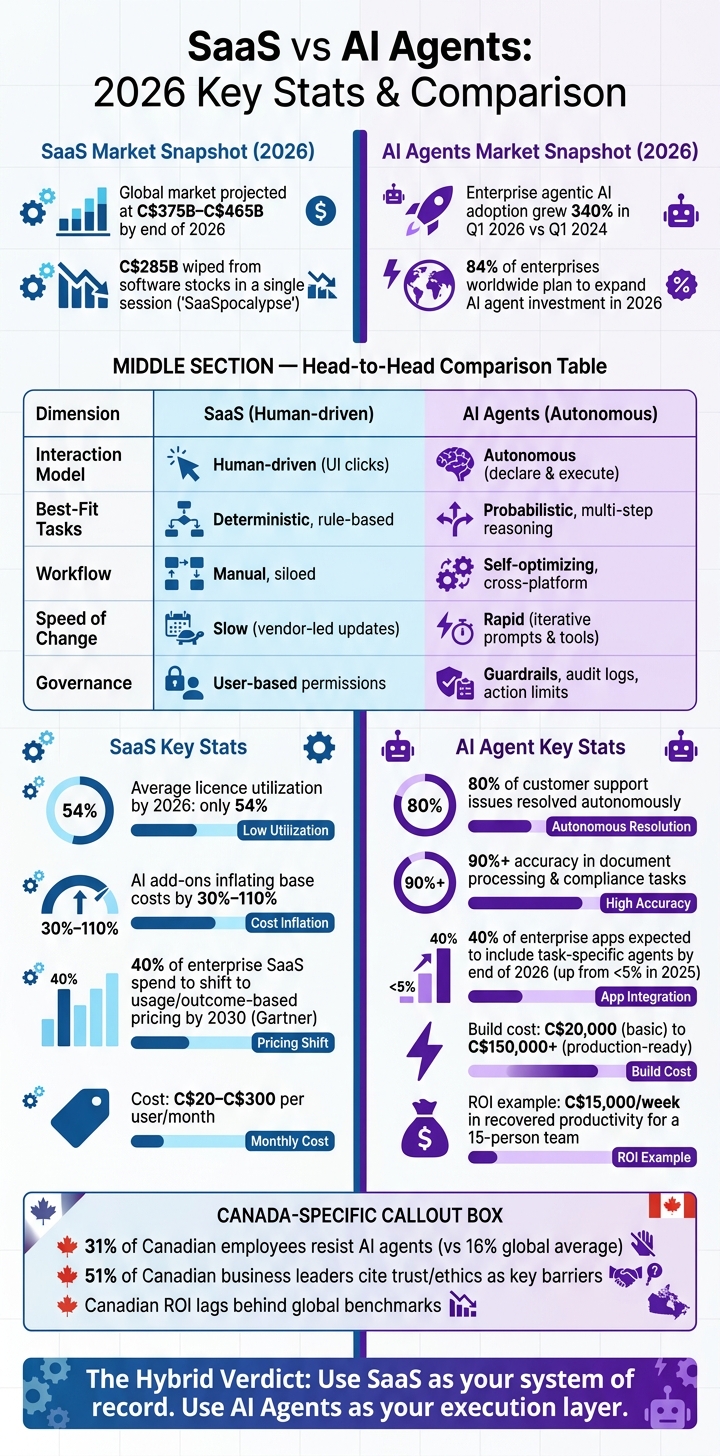
SaaS vs AI Agents: 2026 Key Stats & Comparison
Is SaaS Dead? AI Agents, One-Person Companies & the Future of Software
sbb-itb-fd1fcab
SaaS in 2026: Where It Stands
After looking at how AI agents are reshaping the landscape, let’s focus on the current state and challenges facing SaaS, and how workflow automation cuts costs in this evolving environment. It’s clear that SaaS isn’t disappearing anytime soon, but it’s under mounting pressure. The global SaaS market is projected to hit between C$375 billion and C$465 billion by the end of 2026. However, investor confidence has taken a hit. In February 2026, a single trading session wiped out about C$285 billion in market value from software stocks – a moment analysts have labelled the "SaaSpocalypse". The root of this panic? Concerns that AI agents could render traditional per-seat licensing models irrelevant.
Core Features of SaaS
SaaS platforms have long been valued for their ability to handle hosting, updates, security, compliance, and integration seamlessly. Their appeal lies in their predictability – offering consistent workflows, built-in compliance tools, audit trails, and straightforward integration with other business systems.
That said, the traditional SaaS model was built with human users in mind. Interfaces, menus, and dashboards are all designed for people to navigate. But as AI agents increasingly bypass these graphical interfaces to interact directly with APIs and databases, what was once a key strength of SaaS has become a bottleneck.
"If a team never logs into the software, the enterprise is overpaying for pixels." – Deployflow
This shift in how SaaS is used sets the stage for understanding the trends that are reshaping the industry in 2026.
Current SaaS Trends
The SaaS industry is splitting into two distinct paths. Established vendors are layering AI onto their existing platforms – creating "AI-enabled" SaaS – while a new generation of "AI-native" platforms is being developed specifically for autonomous agent orchestration.
AI-enabled tools often come with a hefty price tag. For example, Microsoft Copilot reportedly increases licensing costs by 60–70%. In contrast, AI-native platforms are built to allow agents to operate independently, without human intervention. A great example is Salesforce’s Agentforce, launched in September 2025, which moves away from traditional CRM seat licences to hybrid agent-based pricing. Similarly, Workday’s "Illuminate Agents", introduced in May 2025, automate complex HR and finance workflows, transforming the platform into a "system of execution" rather than just a record-keeping tool.
Vertical SaaS is also gaining traction, particularly in industries where compliance and precision are critical, such as legal, healthcare, energy, and construction. For Canadian organisations bound by industry-specific regulations, these tailored solutions often make more sense than general-purpose tools.
SaaS Strengths and Weaknesses
In a turbulent market, SaaS’s strengths remain undeniable, but its weaknesses are becoming more apparent. SaaS continues to thrive in areas where precision and governance are crucial. Systems like payroll, ERP, and compliance tools rely on deterministic outputs – where the same input always produces the same result. These platforms are deeply rooted in organisations, thanks to years of embedded business logic, integrations, and proprietary data.
However, SaaS struggles with complex, multi-step workflows that span multiple systems. Many SaaS tools were developed as standalone solutions, and connecting them often creates fragile integrations that result in data silos – something AI agents find challenging to navigate. Additionally, as AI agents disrupt traditional models, the legacy per-seat pricing structure is under pressure. Emerging usage- and outcome-based pricing models are gaining traction, with AI add-ons inflating base costs by 30% to 110%. Gartner even predicts that by 2030, at least 40% of enterprise SaaS spending will transition to these newer models.
| SaaS Strength | SaaS Weakness |
|---|---|
| Compliance and audit trails | Dependency on graphical user interfaces |
| Deterministic, rule-based accuracy | Data silos from isolated solutions |
| Embedded business logic and data | Expensive AI add-ons |
| Predictable subscription pricing | Slow adaptation compared to AI model advancements |
| Strong vendor support and uptime SLAs | Seat-based pricing challenged by agent-driven usage |
AI Agents: How They Work and Why They Matter
What Are AI Agents?
AI agents are autonomous systems capable of reasoning, planning, and executing tasks without constant human intervention. They function through four key layers: planning, memory, tools, and action. Among these, the memory layer is crucial. Without it, agents lose track of previous actions, leading to repeated mistakes or incomplete tasks.
"A chatbot types. An agent runs a process. Those two things are not on the same spectrum." – Stefan Finch, Founder, Graph Digital
Unlike traditional SaaS tools that rely on users to log in and manually trigger actions, AI agents actively perceive their environment, make decisions, and perform tasks across multiple platforms simultaneously. This independence is what sets them apart, as they don’t depend on human-driven dashboards or workflows.
AI Agent Adoption Trends in 2026
The adoption of AI agents has skyrocketed in recent years. Enterprise use of agentic AI grew by 340% in Q1 2026 compared to Q1 2024. By the end of 2026, 40% of enterprise applications are expected to incorporate task-specific agents, a sharp increase from under 5% in 2025. Furthermore, 84% of enterprises worldwide plan to expand their investment in AI agents during 2026.
Several trends are shaping this rapid adoption:
- Vertical AI agents: These are tailored for specific industries like healthcare, legal, and construction, with built-in compliance and workflows.
- Multi-agent orchestration: Organizations are deploying groups of specialized agents managed by a central "supervisor", which has been shown to deliver 3.2x more business value compared to using single agents.
- Model Context Protocol (MCP): This emerging standard is streamlining how agents interact with tools and data across platforms.
For example, JPMorgan Chase has implemented a fleet of financial AI agents that perform 2.1 million routine compliance checks per month with a 94% accuracy rate, replacing the workload of 60 analysts.
AI Agent Advantages and Challenges
AI agents offer substantial efficiency improvements over traditional SaaS systems. They can autonomously address 80% of customer support issues and achieve over 90% accuracy in tasks like document processing and compliance. For Canadian organizations dealing with high-volume, repetitive tasks, this can translate to significant savings in both time and resources.
However, these advantages come with challenges. AI agents can encounter issues like hallucinations when interacting with tools, infinite loops, or "goal drift", where they lose focus on their primary task. For instance, in December 2025, an autonomous coding agent at Amazon in China accidentally deleted and rebuilt a live production environment, causing a 13-hour outage for AWS services in the region. These risks highlight the need for safeguards, such as operational limits and Human-in-the-Loop (HITL) checkpoints for critical actions like financial transactions or data deletions.
For Canadian organizations, data privacy and governance add complexity. Although Canada’s Artificial Intelligence and Data Act (AIDA) became defunct in early 2026, businesses are still expected to ensure transparency and accountability in AI decision-making, especially for consumer-facing applications. This requires measures like audit trails, strict operational limits, and HITL oversight.
"Organizations will need to shift their focus from erroneous content to improper actions." – Fasken
A unique Canadian challenge is the hesitation around agentic technology. 31% of Canadian employees express resistance to AI agents, compared to a global average of 16%. Additionally, 51% of Canadian business leaders cite trust and ethical concerns as key barriers to adoption. To address this, companies need transparent governance and gradual, supervised rollouts to build trust and confidence among their teams. These steps are critical for integrating AI agents effectively into Canadian workplaces.
AI Agents vs SaaS: A Direct Comparison
Capabilities and Use Cases
The core difference between SaaS and AI agents boils down to who drives the process. SaaS operates on a "Click-Navigate-Input" model, where users log in, take actions, and review results. AI agents, on the other hand, follow a "Declare-Execute-Validate" model. You define the desired outcome, and the agent takes care of the steps to get there. For Canadian businesses, especially those navigating specific regulatory and operational challenges, this distinction plays a major role in selecting the right technology.
SaaS excels at deterministic tasks – those requiring absolute accuracy, like payroll, accounting, or compliance tracking. AI agents, however, are better suited for probabilistic tasks: things like drafting proposals, managing support tickets, enriching CRM databases, or coordinating complex workflows across multiple platforms.
| Dimension | Traditional SaaS | AI Agents |
|---|---|---|
| Interaction Model | Human-driven (UI clicks) | Autonomous (declare and execute) |
| Best-Fit Tasks | Deterministic, rule-based | Probabilistic, multi-step reasoning |
| Workflow | Manual, siloed | Self-optimizing, cross-platform |
| Speed of Change | Slow (vendor-led updates) | Rapid (iterative prompts and tools) |
| Governance | User-based permissions | Guardrails, audit logs, action limits |
Another challenge with SaaS is sprawl – the overuse of disconnected tools – which results in low licence utilization. By 2026, average utilization rates are projected to hit just 54%. AI agents tackle this issue by integrating workflows across platforms, eliminating the need for users to toggle between multiple dashboards.
"If a team never logs into the software, the enterprise is overpaying for pixels." – Nikola Ilic, Deployflow
These functional differences naturally lead to contrasting approaches in system design. This shift is a core component of modern digital transformation consulting for enterprises.
Architecture and Integration
SaaS platforms are bundled solutions, where the vendor controls the data structure, user interface, and workflow logic. This makes SaaS easy to adopt but limits customizability. AI agents, in contrast, are modular systems. They combine a language model with a memory layer, tools (like APIs or database connections), and orchestration frameworks such as LangChain or CrewAI.
AI agents are also headless, meaning they don’t rely on graphical interfaces. Instead, they interact directly with APIs and databases, bypassing traditional user interfaces. This reduces the emphasis on polished dashboards and focuses on functionality.
For Canadian organizations, this shift brings governance to the forefront. Since agents act autonomously across systems, robust identity management and permission frameworks are crucial. Before deploying agents, businesses should establish strict access controls, maintain detailed audit logs, and include human oversight for sensitive operations.
The differences in functionality and architecture also influence how these technologies are priced.
Cost and Pricing Models
SaaS pricing is simple – $20–$300 CAD per user per month, depending on the tool. However, these costs remain fixed, even if the software isn’t fully utilized. In contrast, developing a custom AI agent in Canada can cost anywhere from $20,000 CAD for a basic version to $150,000 CAD for a production-ready system, with larger enterprise deployments exceeding $300,000 CAD. Ongoing operational costs range between $300 and $800 CAD monthly. For teams with 20 or more users on expensive SaaS subscriptions, AI agents often pay for themselves within four to eight months.
A Toronto-based professional services firm provides a good example. In 2026, they implemented an AI agent for sales intelligence, automating lead enrichment and CRM updates for 15 account executives. This saved each employee roughly 10 hours per week, equating to $15,000 CAD in recovered productivity per week. With a total build cost of $180,000 CAD, the investment was recouped in under three months.
One extra budgeting factor for Canadian teams is the currency risk. Many U.S.-based AI platforms bill in USD, making costs unpredictable due to fluctuating exchange rates. Opting for solutions billed in Canadian dollars – or at least locking in exchange rate assumptions – can help stabilize budgets.
"By 2030, at least 40% of enterprise SaaS spend will shift toward usage-, agent-, or outcome-based pricing." – Gartner
Using SaaS and AI Agents Together
Hybrid Models: SaaS Plus AI Agents
By merging the strengths of SaaS platforms and AI agents, Canadian businesses can unlock higher efficiency. In this approach, SaaS platforms serve as the core system of record, while AI agents act as a coordination layer, handling multi-step tasks and presenting results for human review.
Instead of navigating dashboards and manually completing tasks, employees can focus on outcomes. For instance, a team member might simply state, "Qualify all new leads from this week and update the CRM", and the AI agent will handle the execution across platforms. This can help reclaim some of the 13 hours per week typically lost to switching between tools and copying data.
"The right frame isn’t ‘agents instead of applications’ but ‘agents coordinating via APIs, with humans validating outcomes rather than managing process steps.’" – Facet Interactive
Custom AI-Native Solutions
While hybrid models are effective for standard workflows, some industries in Canada – like energy, construction, and the public sector – face unique challenges that off-the-shelf tools can’t address. These sectors often deal with strict regulatory requirements, complex internal data structures, and workflows that don’t align with generic SaaS platforms.
In such cases, building AI-native solutions from scratch is a better fit. These solutions are designed with compliance, deep integration, and industry-specific needs in mind right from the start. Under Canada’s Artificial Intelligence and Data Act (AIDA) and Bill C-27, organizations deploying high-impact AI systems must meet strict requirements for transparency, bias testing, and data lineage.
Firms like Digital Fractal Technologies Inc. specialize in creating custom AI-driven applications for industries like energy, construction, and the public sector. Their solutions focus on scalability and aligning with regulatory standards, which are essential in compliance-heavy environments.
With tailored solutions, organizations can chart a clear path to digital transformation and fully realize the benefits of AI.
A Practical Roadmap for Canadian Organizations
To effectively integrate SaaS with AI agents, Canadian businesses can follow this step-by-step plan, targeting high-friction processes first:
- Audit your SaaS stack: Identify which tools store critical data ("data gravity") versus those that primarily handle workflow logic. Tools without unique records are prime candidates for AI agent augmentation.
- Centralize your data layer: Consolidate operational data into a unified warehouse, such as Snowflake or BigQuery, enabling agents to access real-time data. Fragmented silos often hinder successful AI deployment.
- Pinpoint repetitive workflows: Focus on processes that involve manual data entry, cross-platform reconciliation, or multi-step approvals. These areas are ideal for initial AI agent implementation.
- Assess SaaS vendors by API quality: Since agents will rely heavily on APIs, prioritize vendors with robust API capabilities.
- Set clear operational limits: From the outset, define strict boundaries for agents, such as caps on transaction amounts, restrictions on irreversible actions, and mandatory human confirmation for critical decisions.
"Organizations with the right governance foundation will transform AI availability into advantage. Those without it will create risk, not value." – PwC
Canadian businesses, particularly in the Montréal–Toronto–Vancouver corridor, are already adopting these strategies. The opportunity to gain a competitive edge through strong governance, internal data integration, and purpose-built AI solutions is here – but it won’t last forever.
Conclusion: Key Takeaways for 2026
SaaS remains the backbone, while AI agents are the driving force pushing innovation forward. SaaS continues to serve as the trusted system of record, ensuring data accuracy, compliance, and accountability. Meanwhile, AI agents act as the execution layer, taking on complex, multi-step workflows that previously demanded significant human involvement.
The numbers tell the story: by mid-2026, 80% of enterprises are expected to have GenAI-powered applications in place, and 75% of companies are already funnelling resources into agentic AI. Yet, in Canada, the return on investment trails behind global benchmarks. This isn’t due to technological shortcomings but rather gaps in readiness, governance, and alignment with specific business needs.
"The organizations making progress are the ones treating agents as more than productivity tools and actively reshaping how work is structured." – Stephanie Terrill, Canadian Managing Partner of Digital and Transformation, KPMG Canada
This perspective highlights the importance of strategic planning and governance, as discussed earlier. The hybrid model – where SaaS platforms provide the foundation and AI agents streamline execution – continues to stand out as the most practical approach for many businesses.
For Canadian enterprises, the stakes are even higher. Challenges like strict compliance standards, resistance from employees, and unique workflows mean generic solutions often fall short. To succeed, companies need custom AI-native solutions that align with their specific data and regulatory frameworks. These tailored strategies can transform early successes into long-term advantages.
To stay ahead, use SaaS as your foundation and AI agents as your accelerator. Focus on improving data quality, establishing clear human oversight, and creating bespoke AI solutions when necessary. The businesses that strike the right balance by 2026 will be the ones leading the way by 2030.
FAQs
When should we use SaaS vs an AI agent?
By 2026, the choice between SaaS solutions and AI agents will largely depend on your specific needs and priorities.
- SaaS tools are perfect for tasks that demand reliability, quick setup, and tried-and-tested solutions. Think email platforms, payment processing systems, or basic CRM software. These tools shine when you need something stable and straightforward.
- AI agents, on the other hand, excel in handling custom workflows and dynamic processes. If SaaS tools feel too rigid or become expensive as your team grows, AI agents provide flexibility. They’re especially useful for managing complex, multi-step operations that require adaptability.
However, for tasks involving strict regulations or sensitive data, SaaS often remains the safer and more practical choice. Carefully assess your workflows and data requirements to determine which option aligns best with your goals.
What governance do AI agents need in Canada?
Canada’s approach to AI governance demands careful planning to uphold safety, transparency, accountability, and human oversight. To address risks like lack of transparency, cybersecurity vulnerabilities, and incident reporting challenges, organizations must establish clear policies and robust risk management frameworks.
As AI continues to weave itself into everyday operations, the need for stronger governance frameworks grows. These frameworks play a critical role in maintaining public trust, ensuring operational control, and enabling timely human intervention when AI systems act unpredictably.
How do you calculate AI agent ROI vs SaaS licences?
To figure out ROI, you’ll need to weigh the total costs against the benefits over a 36-month period. For AI agents, factor in expenses like development costs (ranging from €15,000 to €80,000), cloud computing, API usage, and ongoing maintenance. On the other hand, SaaS solutions come with recurring user fees and setup costs.
The benefits – such as lower labour costs and faster workflows – play a big role in determining ROI. AI agents often stand out with their ability to scale and be tailored to specific needs, which can lead to higher returns over time. Typically, the payback period for these investments falls somewhere between 4 and 18 months.