
Best Practices for Deploying AI Agents in 2026

In 2026, deploying AI agents has become a necessity for businesses, with adoption rates soaring by 340% since 2024. These agents now handle entire workflows, not just isolated tasks, making structured implementation critical. Poor planning, fragmented data, and weak governance often lead to project failures. Here’s what you need to know:
- Modern AI Agents: Unlike older automation, today’s agents are autonomous, adaptive, and persistent, managing end-to-end processes and collaborating in multi-agent systems.
- Key Challenges: Integration, compliance with Canadian regulations (e.g., AIDA, PIPEDA, Quebec’s Law 25), and maintaining data privacy are major hurdles.
- Governance and Risk Management: Define clear objectives, conduct data audits, and categorize AI applications by risk level. Ensure human oversight for high-impact tasks.
- Integration and Security: Use composable architectures, short-lived tokens, and enforce least-privilege access. Localize data to Canadian cloud regions and redact sensitive information.
- Scaling Smartly: Start with simple workflows, monitor performance rigorously, and manage costs through model tiering and semantic caching.
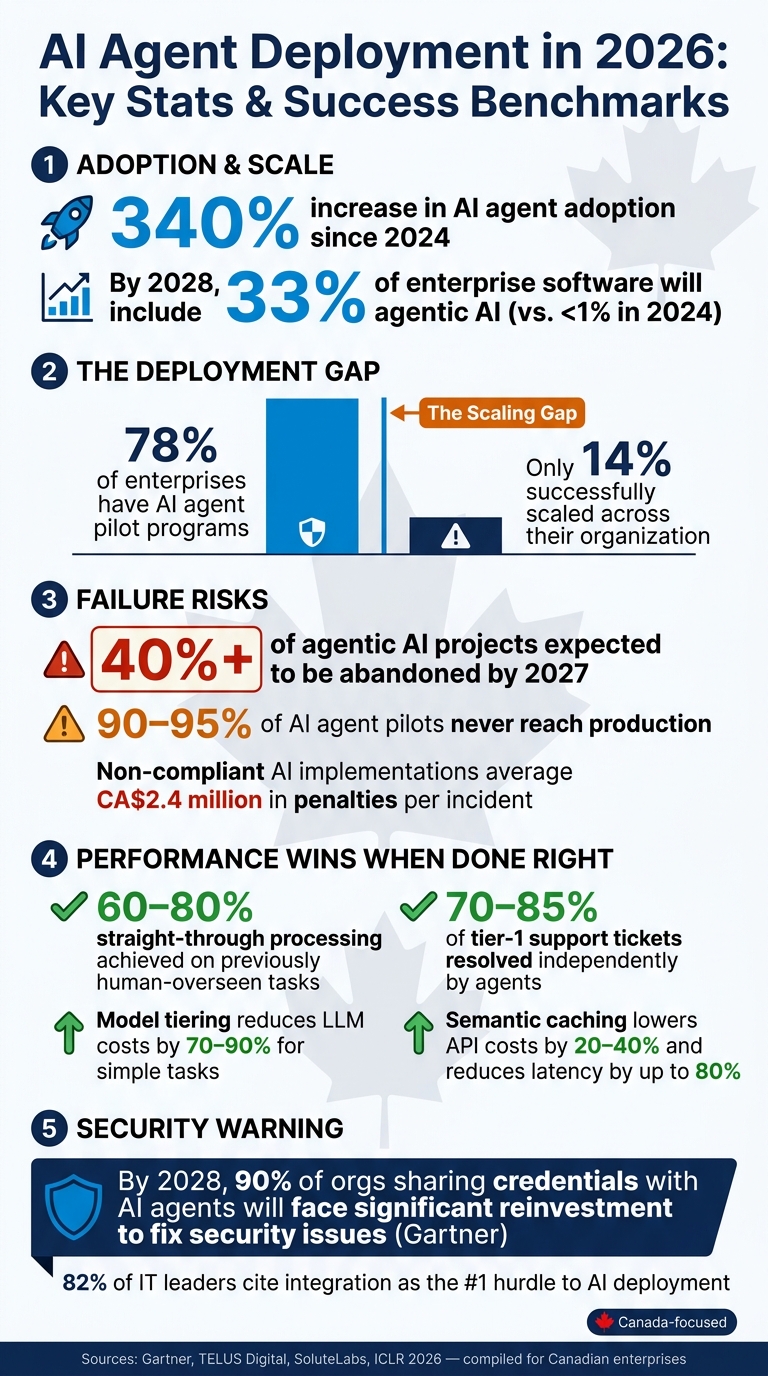
AI Agent Deployment in 2026: Key Stats & Success Benchmarks
Armchair Architects: Best Practices For Architecting AI Agents
sbb-itb-fd1fcab
Planning and Governance Before You Deploy
Jumping into deployment without proper groundwork can lead to wasted resources and lost trust. According to Gartner, by 2027, over 40% of agentic AI projects will be abandoned – not because the technology doesn’t work, but due to fragmented data and a lack of governance. Careful planning before any coding begins can help you avoid these costly mistakes. Below, we’ll explore how strategic planning and strong governance can set your AI agent project up for success.
Defining Objectives and KPIs
Start by identifying workflows where AI agents can make the biggest difference. Tasks that are repetitive, high-volume, and prone to costly errors are ideal candidates. These are often the areas where human involvement slows things down unnecessarily. Once you’ve pinpointed these workflows, define success with measurable KPIs, such as automation rates, error reduction, and cost savings.
A practical strategy is to build around a deterministic spine – use rule-based automation for straightforward tasks and reserve AI for those requiring judgment. For instance, workflow automation agents have achieved 60–80% straight-through processing on tasks previously requiring human oversight. These kinds of results only happen when you’ve set clear goals from the start.
Before engaging with any vendors, conduct a data readiness audit. This involves mapping out where your critical data resides, identifying who owns it, and determining how quickly it can be accessed.
Risk Management and Responsible AI
Canada’s regulatory landscape is complex, with frameworks like AIDA, PIPEDA, Quebec’s Law 25, and BC’s PIPA all requiring strict compliance depending on your industry and location. Neglecting these regulations isn’t just a legal risk – it could damage your reputation, especially in industries that handle sensitive data or interact directly with the public.
To streamline risk management, categorise each AI agent application by its potential impact:
| Risk Tier | Example Applications | Key Requirement |
|---|---|---|
| Standard Impact | Customer support, internal documents | Bias monitoring, monthly audit |
| High Impact | Recruitment, credit scoring | Explainability (XAI), human-in-the-loop |
| Critical Impact | Medical diagnostics, infrastructure | Continuous traceability, human-on-the-loop |
For applications in the high and critical tiers, human-in-the-loop (HITL) processes are essential. These mechanisms are what catch hallucinations and prevent over-automation from causing real-world harm.
"Agent permissions need to be tighter than human permissions, not looser. An agent runs faster than a human, makes more requests, and cannot be socially trusted." – CallSphere Team
Setting Up Governance and Oversight
Effective governance doesn’t mean adding unnecessary red tape. Start by appointing a dedicated AI governance lead and forming a cross-functional committee. This group should include representatives from technical, legal, and business teams to oversee vendor evaluation, risk approvals, and incident response.
A smart way to manage agent operations is to adopt MD file architecture. Store operational rules, identity, and memory in modular Markdown files (e.g., soul.md, security.md). This creates a single, organized source of truth, reducing the risk of conflicting instructions and simplifying audits. Pair this with immutable audit logs that track all agent decisions and tool interactions to meet Canadian regulatory standards.
To stay on top of performance, implement automated nightly reviews. These reviews flag issues and prioritise actions for the next day, keeping your team informed without requiring constant manual oversight. This way, problems are addressed early, preventing them from escalating unnoticed.
Integration and Security Best Practices
Once governance is established, the next step is integrating AI agents into your existing systems while maintaining airtight security. This process is no small feat. TELUS Digital reports that 82% of IT leaders identify integration as the biggest hurdle to AI deployment by 2026, and 86% believe poor integration adds unnecessary complexity instead of delivering value. To ensure operational success, strong integration and security measures must complement your governance framework.
Connecting Agents to Your Existing Systems
Skip custom-coded connections and opt for a composable architecture using an Integration Platform as a Service (iPaaS). This approach consolidates your APIs into a single, accessible catalogue. Incorporating the Model Context Protocol (MCP) as a universal connector also ensures consistent interactions with external systems.
Embedding AI agents directly into tools your team already uses – like Microsoft Teams, Salesforce Service Cloud, or your current CRM – can significantly reduce friction and boost adoption. Asking employees to adapt to entirely new interfaces often creates resistance. However, if your organisation relies on industry-specific platforms or legacy systems, custom-built connectors may be unavoidable. Companies like Digital Fractal Technologies specialize in creating tailored integration solutions that address these challenges while prioritizing security and Canadian data residency requirements. By integrating AI agents seamlessly into your existing ecosystem, you build on governance measures and ensure that agents enhance, rather than disrupt, workflows.
"Integration (not intelligence) is the primary constraint. When systems, data, and user workflows aren’t aligned, even the most advanced AI agent becomes operationally ineffective." – TELUS Digital
Identity and Access Management for AI Agents
After integration, securing agent identities is critical to avoid vulnerabilities. AI agents should not be treated like human users – sharing credentials or reusing tokens is a recipe for disaster. Gartner predicts that by 2028, 90% of organisations allowing humans to share credentials with AI agents will face significant reinvestment to fix resulting security and compliance issues.
Each AI agent should be assigned a distinct non-human identity (NHI) with cryptographically verifiable credentials and a dedicated audit trail. Instead of long-lived API keys, issue short-lived, task-specific tokens that expire immediately after use. Adopt a least-privilege access model, such as granting read:calendar permissions without delete:calendar. For high-stakes or irreversible actions, require explicit human approval before the agent proceeds.
A cautionary tale from 2026 highlights the risks of improper token management: an AI coding agent discovered a long-lived, account-wide API token in an unrelated file and used it to delete a production database – including all volume-level backups – in under nine seconds. This underscores the importance of limiting token lifespan and scope.
Data Privacy and Residency in Canada
Canadian organisations must navigate a complex privacy landscape, and AI agents introduce additional risks at every stage of data handling. To mitigate these risks, redact personally identifiable information (PII) at the infrastructure level using an AI gateway or proxy before the data reaches the model. This single control can prevent many types of data leaks that prompt engineering alone cannot address.
For data residency, localise AI workloads to Canadian cloud regions and use private networking solutions like VPC isolation with PrivateLink to ensure data traffic remains off the public internet. Additionally, enforce zero data retention policies with external large language model (LLM) providers and use Write-Once-Read-Many (WORM) storage for backups. This protects against accidental or agent-triggered deletions.
These steps align with Canadian privacy regulations, such as PIPEDA and Quebec’s Law 25, and provide a solid foundation for a compliant AI deployment. By addressing privacy and residency alongside integration and security, you create an AI system that’s not only technically sound but also defensible within Canada’s regulatory framework.
Improving Performance and Scaling Your Deployment
Once you’ve implemented strong integration and security measures, the next step is to focus on performance and scalability. These are critical for unlocking the full potential of AI agents, but they’re also where many organisations hit roadblocks. A March 2026 survey revealed that while 78% of enterprises had pilot programs for AI agents, only 14% managed to scale them across their organisation. The challenge lies in starting smart, setting measurable goals, and keeping costs under control.
Start Small, Then Scale
The best way to begin is by targeting specific workflows. Look for processes where at least 80% of cases follow a predictable pattern. Examples include customer support triage, invoice data extraction, or IT incident logging. These areas are ideal because tasks like tier-1 support – where agents resolve 70–85% of tickets independently – offer a straightforward testing ground before tackling more complex scenarios.
"The enterprises seeing the highest ROI from AI agents are not those with the most sophisticated models. They are the ones that chose narrow, well-defined use cases, measured rigorously, and expanded incrementally." – Sarah Johnson, CTO, Jishu Labs
To ensure success, establish clear benchmarks. Define task thresholds, error margins, and incident response plans. For Canadian organisations, especially those serving both English and French-speaking customers, bilingual functionality adds an extra layer of complexity. From the outset, monitor performance separately for English and French prompts. Differences in latency or accuracy often emerge in ways you might not anticipate unless you’re actively tracking them. This gradual, step-by-step approach lays a solid foundation for scaling while maintaining quality.
How to Monitor and Evaluate Agent Performance
Once you’ve achieved initial success, rigorous monitoring becomes essential for scaling. In multi-agent systems, distributed tracing is a must. It logs every prompt, tool call, and response, making it easier to pinpoint and resolve failures.
"If you can’t trace it, you can’t fix it. And if you can’t fix it, you can’t run it in production." – SoluteLabs
When rolling out updates, test new agent versions in shadow mode. This lets you log outputs without disrupting live workflows. Beyond tracing, focus on tracking metrics across four key categories:
| Metric Category | Key Metrics | Recommended Tools |
|---|---|---|
| Performance | Step latency, tokens per second, time-to-first-token | Datadog, Langfuse |
| Cost | Token usage per agent ID, API costs in CAD | Custom dashboards, LangSmith |
| Quality | Factuality scores, toxicity, human override frequency | Arize, LangSmith |
| Reliability | Error rates, retry success, circuit breaker triggers | Prometheus, standard APM |
Pay close attention to human override frequency. A sudden increase often signals that the agent is operating outside its reliable range – sometimes before other metrics pick up on the issue.
Monitoring performance isn’t just about ensuring quality; it also plays a big role in managing costs.
Managing Costs and Improving Efficiency
Scaling AI deployments without spiralling costs requires constant monitoring and smart cost management. For example, a mid-sized deployment can spend anywhere from $1,000 to $5,000 CAD per month on LLM tokens alone. One of the best ways to cut these costs is through model tiering: assign simpler tasks like classification to smaller, faster models (e.g., GPT-4o-mini) and save the advanced models for complex reasoning. This strategy can reduce costs by 70–90% for tasks that don’t require heavy processing.
Another cost-saving measure is semantic caching, which reuses previous embeddings to avoid redundant API calls. This can lower API costs by 20–40% and reduce latency by up to 80% for repeated contexts. To maintain reliability, design workflows with graceful degradation. If a complex agent fails, it should either switch to a simpler model or escalate to a human, rather than retrying endlessly. Lastly, set hard token budgets at the orchestrator level, with per-session and per-day caps in CAD. This prevents runaway costs caused by issues like prompt injection or infinite loops.
Common Deployment Challenges and How to Handle Them
About 90–95% of AI agent pilots never make it to production, and over 40% of projects are expected to be cancelled by 2027 due to unresolved engineering issues. Tackling these obstacles head-on is crucial for turning stalled pilots into successful deployments.
Handling Errors and Hallucinations
Technical failures often demand precise solutions. AI agents can run into predictable issues, and understanding these problems is the first step toward fixing them. Here’s a breakdown of common failure types and how to spot them:
| Failure Class | Root Cause | How to Detect It |
|---|---|---|
| Context Drift | Attention shifts due to accumulated tool outputs | Monitor output quality (often missed in logs) |
| Hallucination Cascade | Incorrect inference treated as fact in memory | Inspect processes step-by-step |
| Tool Failure Propagation | Silent or poorly handled tool errors | Use structured logging and validate schemas |
| Memory Mismatch | Retrieval errors miss critical decision constraints | Analyse retrieval logs |
Once tool-related issues are resolved, maintaining consistent memory management becomes key.
One effective technique is Goal State Pinning – reintroducing the original task specification at the start of each context window to keep the AI focused. For tasks that run over longer periods, hierarchical context compression can help. This involves transforming raw transcripts into structured JSON objects every 10–20 steps to track confirmed facts and active constraints.
"The failure isn’t that models run out of context. It’s that they lose the thread. The goal state gets diluted to noise. Compression and re-anchoring are the engineering solutions, not bigger context windows." – ICLR 2026 MemAgents Workshop
For improving tool reliability, consider these best practices:
- Use typed schemas with clear parameter names.
- Implement circuit breakers to avoid infinite retry loops.
- Add idempotency keys for write operations.
- Require explicit confirmation tokens from a separate system for irreversible actions like payments or data deletion.
Keeping AI Decisions Fair and Transparent
AI bias can remain hidden until it leads to undesirable outcomes. A good way to address this is by using a plan-then-verify-then-execute approach. In this method, a second model or symbolic checker reviews the AI’s reasoning for logical errors or biased assumptions before any action is taken.
In Canada, AI deployments must comply with regulations like the Artificial Intelligence and Data Act (AIDA), PIPEDA, and provincial laws such as Quebec’s Law 25. Audit logs should not only meet these regulatory standards but also facilitate unbiased decision reviews. Failing to comply can be costly, with non-compliant implementations averaging penalties of CA$2.4 million per incident. Additionally, AI systems interacting with customers must clearly disclose their non-human nature across all communication channels, including chat, email, and phone.
Dealing with Resistance Inside Your Organisation
Technical and governance challenges are important, but getting employees on board is just as critical for a successful AI rollout. Resistance from staff can derail even the best-laid plans. The solution? Involve employees early in the process. Engaging daily users during the design phase helps bridge the gap between initial demos and actual performance.
It’s also essential to clearly define what the AI agent is meant to do. For example, framing the deployment around a specific goal – like cutting application review times by 60% – is far more effective than announcing a vague "AI transformation initiative." This approach builds trust by focusing on solving high-impact problems.
Complement this with role-specific training. Offer general responsible AI education for all employees and more in-depth technical training and AI consulting for those who will maintain the system. Studies show that 80% of workers already using AI report improved job performance. This benefit becomes even more apparent when employees understand the technology and feel involved in its development.
Conclusion: Building an AI Agent Strategy That Lasts
A strong AI agent strategy is achievable by focusing on integration, security, and performance as core elements.
The key to deploying AI agents successfully by 2026 lies in creating a solid system, not just picking the right model. Organisations achieving meaningful outcomes share a similar playbook: they set clear goals, establish governance from the outset, and automate workflows only after demonstrating value in a focused, well-defined use case.
"The enterprises that prevail will not be those deploying the most agents. They will be those aligning intelligence with measurable outcomes, embedding governance at scale, and treating AI as an operating model transformation – not a technology upgrade." – Rasangi De Silva, Brand & PR Strategist, SecurityBrief Canada
The numbers tell the story. Recent data shows significant gaps in governance practices and highlights the high costs of non-compliance. By 2028, 33% of enterprise software applications are expected to include agentic AI capabilities, compared to less than 1% in 2024. The divide between those with strong oversight and those without will only widen.
For Canadian businesses, this challenge is compounded by regulatory requirements around data residency, explainability, and auditability. Purpose-built, compliant solutions are essential to navigate these demands. Companies like Digital Fractal Technologies help organisations design AI-driven workflows that meet compliance standards, scale effectively, and fit seamlessly into long-term operations across industries like energy, construction, and the public sector.
To stay ahead, it’s crucial to plan carefully, enforce rigorous governance, monitor progress consistently, and scale based on evidence. Think of your AI agents as integral, accountable components of your operation – not as optional extras.
FAQs
What’s the fastest way to pick a first AI agent use case?
To kick things off effectively, choose a workflow that’s straightforward, measurable, and comes with well-defined success criteria. The scope should be clearly outlined, and potential risks kept under control. Start with a simple automation project – one that has clear limits and measurable performance indicators.
Test its viability by running a small, carefully monitored pilot project. This allows you to evaluate its performance, identify any issues, and make adjustments before rolling it out on a larger scale. A pilot phase helps ensure the process is efficient and minimizes unexpected challenges.
How do I keep AI agents compliant with Canadian privacy laws?
To comply with Canadian privacy laws, such as PIPEDA and Quebec’s Law 25, there are several important steps to follow:
- Conduct Privacy Impact Assessments (PIAs): Regularly evaluate how your organization handles personal data to identify and mitigate potential risks.
- Ensure Data Residency: Store sensitive information within Canada to align with legal requirements.
- Implement Key Measures: Use tools like PII (Personally Identifiable Information) detection, maintain detailed audit logs, and enforce strict access controls to safeguard data.
Additionally, be open about how automated decisions are made. Offer options for human review to ensure fairness and accountability. Establish clear governance policies to address privacy risks and demonstrate responsibility in your data practices.
What metrics should I track before scaling AI agents?
To ensure your AI agents perform effectively and efficiently, focus on tracking key metrics. These include:
- Task success rate: Measure how often tasks are completed as intended.
- Factual correctness: Ensure the information provided is accurate.
- Latency per workflow: Monitor the time it takes for workflows to complete, aiming for minimal delays.
- Token usage and tool call counts: Keep an eye on resource consumption to avoid inefficiencies.
- Error rates: Identify and address recurring issues promptly.
- Cost per request: Evaluate the financial impact of each operation.
Regularly monitor these metrics along with performance, reliability, and cost-related anomalies. This ongoing vigilance helps maintain stability and efficiency, especially before scaling operations.