
Checklist for Deploying AI Agents in Edmonton Companies

Deploying AI agents can help Edmonton businesses save costs, improve efficiency, and streamline operations across industries like energy, construction, and professional services. Companies like ATB Financial and PCL Construction have already seen measurable gains, such as reducing fraud detection errors by 45% or cutting project delays by 28%.
To successfully integrate AI agents, follow these key steps:
- Assess Readiness: Audit your systems, data, and team skills to identify gaps. Local audits cost CAD $2,500–$10,000 and provide a roadmap within 30 days.
- Focus on High-Impact Use Cases: Target processes bogged down by paperwork or inefficiencies (use a workflow automation benefits calculator to quantify potential gains), such as automating compliance checks or scheduling tools.
- Build and Integrate Thoughtfully: Define clear objectives, start with low-risk applications, and ensure seamless connections with CRMs, ERPs, or safety systems.
- Prioritize Security and Governance: Implement strict access controls, ensure compliance with Canadian data laws, and monitor for risks like model drift.
- Launch and Optimize: Use phased rollouts, track KPIs like reliability and efficiency, and continuously improve systems to scale effectively.
Monthly operational costs for AI agents range from CAD $3,200 to $13,000, covering API usage, security, and monitoring tools. Start small, monitor closely, and scale gradually to maximize ROI and avoid common pitfalls like unclear benefits or rising costs.
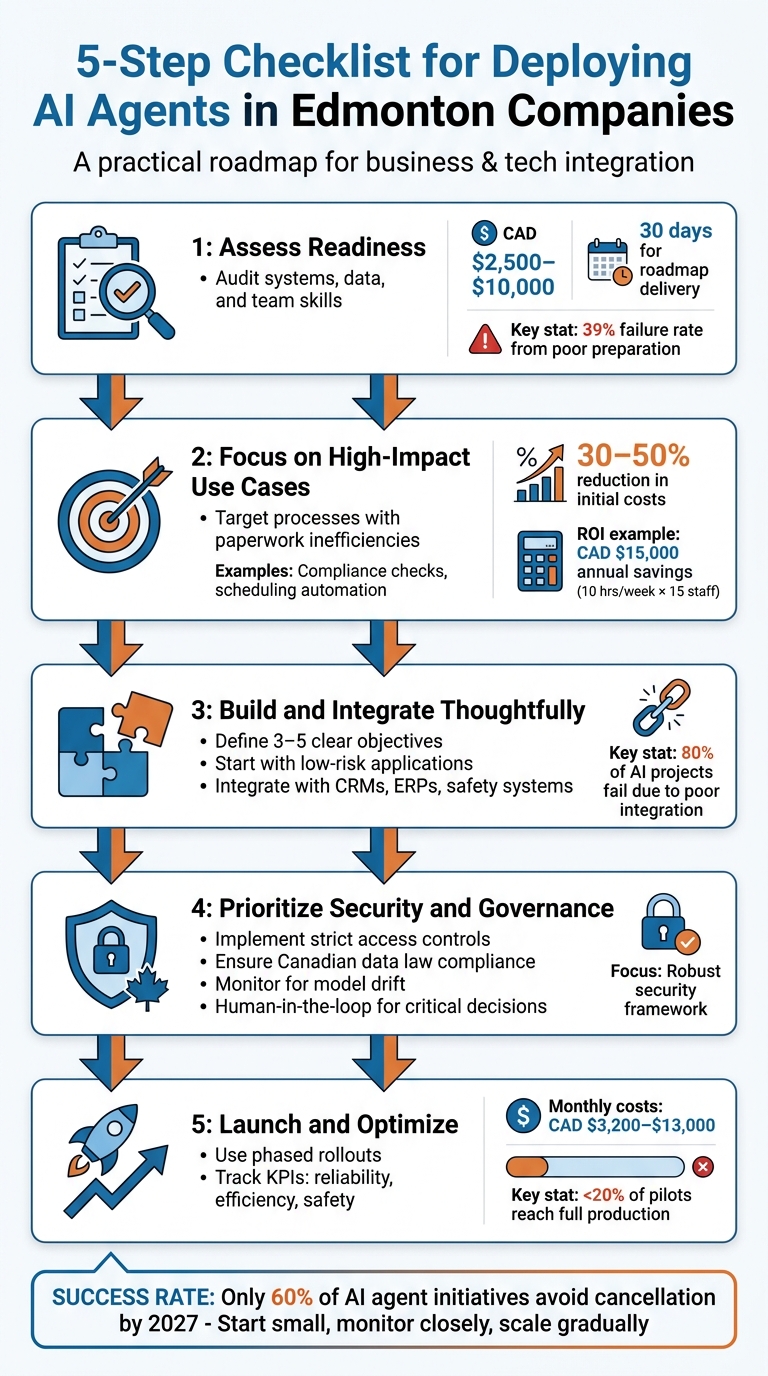
5-Step Checklist for Deploying AI Agents in Edmonton Companies
Building Enterprise AI Agents: Architecture & Best Practices [Webinar]
sbb-itb-fd1fcab
Pre-Deployment Assessment
Before rolling out an AI agent, it’s essential to take a close look at your current setup. This upfront work can save time, cut down costs, and help avoid the 39% failure rate linked to poor preparation. By mapping out your existing environment and identifying key opportunities, you’ll set a solid foundation for success.
Evaluate Infrastructure and Data Governance
Start by auditing your systems to ensure they can handle AI. Check if your unstructured data – like field tickets, PDFs, OCR scans, contracts, or resumes – and communication channels (email, phone, etc.) are ready for AI-driven processes.
Don’t forget to review your core systems. For instance, platforms like CRMs, scheduling tools, or HR and finance software should be assessed. In industries such as energy and construction, compliance systems that track WCB, insurance, and HSE documentation are also critical.
In Edmonton, you can hire professionals for AI consulting services to conduct a readiness audit. For CAD $2,500–$10,000, you’ll get a detailed report, a 6–12 month roadmap, and a cost-savings model – all delivered within 30 days. Once this audit is complete, you’ll have a clearer picture of where AI can make the biggest impact.
Identify High-Value Use Cases
To manage costs effectively, focus on targeted use cases that can reduce initial expenses by 30–50%. In Edmonton’s energy sector, examples include automating field ticket processing, ensuring HSE compliance, and predicting asset maintenance needs. For construction, consider streamlining job-site form processing, equipment scheduling, and incident reporting workflows.
Look for processes bogged down by paperwork. For example, a sales intelligence agent that saves 10 hours a week for 15 account executives can recover approximately CAD $15,000 worth of productive time annually. Define clear outcomes for each use case, and set up safeguards to ensure human intervention for any unexpected errors.
"A smart agent that occasionally makes a confident mistake is worse than a simpler one that fails safely." – Carlos Gonzalez de Villaumbrosia, CEO at Product School
Assess Team Skills and Readiness
After identifying key opportunities, evaluate your team’s ability to implement these AI solutions. This includes assessing whether your in-house expertise is sufficient or if you’ll need external help.
Conduct a maturity analysis using stakeholder interviews, system audits, and data reviews to uncover any gaps. Training programs and feasibility studies can also highlight challenges and help you prepare before scaling up.
It’s worth noting that fewer than 20% of AI pilots successfully move into full production, often because teams aren’t fully equipped to handle the transition. Investing in a readiness assessment at the start can save you from costly mistakes down the road. If you need extra support, local experts like Digital Fractal Technologies Inc. (https://digitalfractal.com) provide tailored assessments and training to ensure your team is well-positioned for AI integration.
Development and Integration of AI Agents
Once you’ve assessed your readiness, the next step is turning your plan into actionable AI solutions designed specifically for Edmonton businesses. By building on your evaluation, you can establish how the AI agent will operate within your systems, ensuring it delivers measurable results that align with your business goals.
Define Objectives and Custom Requirements
Start by setting 3–5 clear business objectives tied to the success metrics you’ve already outlined. For industries like energy and construction, focus on measurable targets that address specific operational hurdles. Use an Agentic Value Map to pinpoint where human effort, AI automation, or a combination of both is most effective. This mapping exercise clarifies which tasks should remain under human control – like final safety approvals – and which can be automated. For any irreversible actions, ensure human confirmation is required through approval gates.
"The day a finance team trusts an AI to handle their money is when AI has truly delivered. You can build self-driving cars and cool agents, but try convincing finance people to trust an AI with their money. That’s the real test for the AI agent you’re deploying."
– Karandeep Anand, President and CPO, Brex
To ensure early success, categorize use cases by risk and start with low-risk, internal-facing applications.
Build and Train AI Agents
Define the core data, functions, and policies your business depends on. For example, energy companies might focus on real-time field data and safety compliance records, while construction firms could prioritize job-site inspections and safety protocols.
Before launching, establish how the AI agent will create value by tracking its performance against specific KPIs. Design the agent to perform single, well-defined actions with clear input/output schemas, avoiding broad API endpoints that could lead to unintended consequences. For processes that alter system states – like updating a CRM record – use idempotency to prevent errors from duplicate calls. Additionally, adopt a "plan, confirm, execute" workflow to allow human intervention at critical points.
Integrate with Existing Systems
After training your agent, the next challenge is seamless integration with your existing infrastructure. This involves breaking down data silos across your CRM, ERP, and cloud platforms to create a unified data source. Poor planning and lack of integration are the main reasons over 80% of AI projects fail, and 95% of generative AI pilots struggle to show measurable impact. These issues often arise from execution problems rather than technology limitations.
Ensure your legacy systems can handle real-time data processing. For Edmonton businesses, this might mean connecting agents to CRMs, scheduling tools, and safety documentation systems, ensuring smooth data flow from spreadsheets, databases, or even physical records. In energy sectors, linking field ticket processing agents with equipment logs and maintenance schedules can be critical. Construction companies, on the other hand, may benefit from tying compliance agents to safety inspection platforms and subcontractor management tools. Start with small pilot projects to demonstrate ROI and troubleshoot technical challenges before scaling up.
"The hardest part of agentic AI implementation isn’t the AI. It’s coordinating everything around it: the approvals, the handoffs, the exception handling, the audit trails."
– Moxo Team
Establish governance early by creating a comprehensive rulebook that addresses ethics, bias prevention, and disaster recovery. Design your agents to escalate high-stakes or ambiguous tasks to human operators rather than making decisions independently. This human-in-the-loop approach is particularly important in industries where safety and compliance are critical. If you’re looking for expert help with custom development and integration, Digital Fractal Technologies Inc. (https://digitalfractal.com) offers tailored AI solutions for Edmonton’s energy, construction, and public sector industries.
Governance, Security, and Compliance
After integrating AI agents into your operations, the next focus should be on securing these systems and ensuring they meet compliance standards. For businesses in Edmonton, this means addressing specific regulatory challenges and embedding security measures from the outset. A notable example of the risks involved occurred in March 2026, when a flaw in an internal AI agent at Meta allowed unauthorized employee access to sensitive data for over two hours. To prevent such incidents, it’s critical to establish clear steps for managing agent access and control.
Establish Access Controls and Permissions
Each AI agent should have a distinct, verifiable identity – whether through a named service account, certificates, or OAuth 2.0 credentials. This ensures accountability and prevents agents from unintentionally inheriting broad human permissions, which can lead to significant security gaps. As Emily Winks, a data governance expert at Atlan, points out:
"The absence of agent identity is the precondition for every other access control failure. Without it, there is no meaningful basis for authorization or audit".
To strengthen security, apply the principle of least privilege, granting agents only the permissions necessary for their specific tasks. Separate read, write, and execute privileges, and limit access to high-risk APIs or production systems. Use Role-Based Access Control (RBAC) for static roles and Attribute-Based Access Control (ABAC) for dynamic, context-sensitive permissions.
For high-impact actions like financial transactions, deletions, or code deployments, require Human-in-the-Loop (HITL) approval. This is particularly important considering that 79% of Canadian office workers use AI tools, but only 25% rely on enterprise-grade solutions with proper governance. Weak controls can be costly, as seen in iTutorGroup’s $365,000 settlement for discriminatory hiring software and Deloitte’s partial refund of A$440,000 for a report containing AI-generated errors.
AI agents also need the same oversight as administrative accounts. This includes time-limited sessions, integration with Privileged Access Management (PAM) systems, and regular rotation of API keys and tokens. Additionally, maintain detailed audit logs to track agent activity, including data accessed and decision-making processes.
Ensure Data Sovereignty and Compliance
For Edmonton businesses, compliance is a legal obligation, not an option. Start with a risk-based approach that aligns traditional security practices with the fast-paced evolution of AI technologies. CyberAlberta’s "Guide to Establishing Safe and Secure AI Practices" offers tailored strategies for Alberta companies aiming to enhance their digital security.
In industries like construction, energy, and logistics, compliance agents can automate checks for regulatory requirements. For instance, in construction, these agents can ensure safety forms and sign-offs are completed before work begins. Energy companies might use HSE (Health, Safety, and Environment) Safety Agents to confirm all documentation is in place, while logistics firms could deploy AI to validate customer claims and damage reports for regulatory adherence.
Additionally, ensure your AI systems are hosted on Canadian data centres if privacy or data sovereignty laws demand it. For localized support, Edmonton-based Digital Fractal Technologies Inc. offers consulting services to help businesses prepare for AI integration and meet compliance requirements.
Once compliant data practices are in place, maintain vigilance with active monitoring and quick incident response.
Set Up Monitoring and Incident Response
After deploying AI agents, continuous monitoring is essential to safeguard their operation and security. Use automated detection systems to identify harmful activities and check performance across different demographic groups to ensure fairness. Regularly evaluate for "model drift", where an AI’s performance may deviate from its original design.
Prepare for emergencies with "kill switch" protocols that define when and how an AI system should be deactivated during malfunctions or risks. Establish clear escalation procedures and dedicate incident response teams to quickly address any problems. As noted by Innovation, Science and Economic Development Canada:
"Managers of AI systems are well-positioned to address risks that arise from system-level design and operational choices, due to their proximity to the context of use".
Create multiple channels for users to report issues, and schedule regular reviews to address these concerns. Formal change management and version control processes should be in place for all system updates, with centralized documentation for risk assessments, incident reports, and performance metrics. Finally, conduct regular adversarial testing to uncover potential vulnerabilities in the AI system and its environment.
For Edmonton businesses, resources like CyberAlberta’s guide can help bridge the gap between traditional security protocols and the unique challenges posed by AI. This approach ensures AI systems operate transparently and securely, enhancing business operations without exposing organizations to unnecessary risks.
Launch, Optimize, and Scale AI Agents
After securing solid integration and governance, it’s time to roll out AI agents into production. This step demands careful planning, constant monitoring, and thoughtful expansion of what works.
Launch and Continuous Improvement
Rolling out an AI agent isn’t a one-and-done deal – it’s an iterative process. Start small with a phased rollout, keeping a close eye out for any errors before scaling up.
Use sandbox and staging environments that mimic your production setup, including cloud infrastructure, data structures, and APIs. For high-stakes tasks like handling financial transactions or deleting data, set up Human-in-the-Loop (HITL) processes to ensure the agent seeks human confirmation when needed.
"The day a finance team trusts an AI to handle their money is when AI has truly delivered. You can build self-driving cars and cool agents, but try convincing finance people to trust an AI with their money. That’s the real test." – Karandeep Anand, President and CPO at Brex
Define clear shipping gates with performance thresholds for task accuracy and tool functionality. If these benchmarks aren’t met, pause the release. Edmonton businesses can evaluate their readiness with a "30-day AI Readiness Audit" from Digital Fractal Technologies Inc. These audits, priced between CA$2,500 and CA$10,000, help identify opportunities in sectors like energy, logistics, and construction.
To ensure smooth operation, use distributed tracing to monitor AI calls, tool usage, and reasoning in real time. Circuit breakers can prevent costly infinite loops by limiting retries and tool calls. With a 39% failure rate in AI projects due to poor evaluation and monitoring, having strong observability measures in place from the start is critical.
Monitor Performance and ROI
Ongoing monitoring is the backbone of keeping AI agents effective and cost-efficient. Focus on four key performance areas:
- Reliability: Completion rates and reasons for task failure.
- Efficiency: Metrics like tokens per request and response time.
- Safety: Escalation rates and content filter activations.
- Integration: Tool accuracy and latency during invocation.
For Edmonton-based companies, monthly operating costs for AI agents generally range between CA$3,200 and CA$13,000. This includes expenses like LLM API tokens (CA$1,000–CA$5,000), vector database hosting (CA$500–CA$2,500), monitoring tools (CA$200–CA$1,000), prompt tuning (CA$1,000–CA$2,500), and security maintenance (CA$500–CA$2,000). Keep a close watch on token usage – GPT-4 Turbo, for instance, costs around CA$0.01–CA$0.03 per 1,000 tokens, which can add up quickly for applications with 1,000 daily users.
Combine automated scoring with human reviews to assess factors like tone and customer satisfaction. Be alert for model drift, where performance declines as the AI’s data environment changes.
"If an AI agent makes a wrong decision, it should be able to self-correct." – Vinesh Sukumar, Vice President of Generative AI and Machine Learning Product Management at Qualcomm
Implement semantic caching to store API responses, reducing redundant calls and cutting costs and latency. When rolling out updates, test changes on a small percentage of users to catch potential issues before they impact everyone.
Expand and Scale AI Solutions
Once performance metrics are solid, the focus shifts to scaling up. But don’t rush – Gartner estimates that over 40% of AI agent initiatives will be abandoned by 2027 due to rising costs and unclear benefits. Start by creating agents that excel at one specific task – like document intake or lead qualification – to reduce initial development costs by 30–50%.
In Edmonton’s energy, logistics, and construction sectors, potential applications include:
- Field Ticket Processing Agents for oilfield services.
- AI Dispatch Agents for trucking operations.
- Subcontractor Onboarding Agents to verify WCB and insurance documents.
As you scale, consider adopting an internal platform approach to standardize environments, manage secrets, and streamline deployment pipelines. This helps prevent operational inconsistencies.
For enhanced security, use MicroVM isolation (like Firecracker) instead of standard containers for agents running LLM-generated code. MicroVMs offer faster boot times (about 125 milliseconds) and minimal memory usage (under 5 MiB). Co-locating agent code with its execution environment can also eliminate network latency, which is crucial for multi-step workflows.
Although 60% of organizations now deploy AI agents in production, fewer than 20% manage to scale their pilots successfully. To avoid pitfalls, assign clear ownership and governance for each agent. For high-risk tasks, require human oversight as you scale. Build tamper-evident audit trails using cryptographic signing to meet regulatory requirements like those outlined in the EU AI Act.
AI agents have the potential to boost productivity by 40% and automate 60–70% of current tasks. But as James Kim, Senior Managing Partner at Concentrix, cautions:
"We’re still seeing a lot of FOMO out in the marketplace… it’s resulting in siloed behaviour where teams race to deploy something without a shared view of success." – James Kim, Senior Managing Partner at Concentrix
Conclusion
Deploying AI agents in Edmonton is no small feat – it demands careful planning, Edmonton app development services, and ongoing fine-tuning. With statistics showing that 39% of AI projects fail due to poor evaluation, monitoring, and governance, and 40% of agent-driven AI initiatives are expected to be cancelled by 2027, success depends on a methodical and thoughtful approach.
Start with an AI Readiness Audit to pinpoint 3–5 high-impact opportunities specific to your industry. Whether you’re in energy, logistics, construction, or professional services, these audits – usually priced between CA$2,500 and CA$10,000 – offer a focused 30-day roadmap. This roadmap not only identifies potential cost savings but also helps you decide whether to move forward with full-scale development.
When building your AI agents, ensure they operate within well-defined boundaries and keep human oversight in place for critical decisions. Set clear KPIs, begin monitoring from the outset, and establish a 6–12-month roadmap with realistic budgets and timelines. Monthly operational costs for AI agents typically range from CA$3,200 to CA$13,000, so plan your investments accordingly.
Another essential piece of the puzzle is equipping your team with the right skills. Industry-specific training sessions and AI workshops can empower your staff to manage and optimize these tools effectively. Without team involvement and the necessary expertise, even the most advanced AI systems risk falling short of expectations.
FAQs
How do I pick the first AI agent use case?
To kick off, begin with an AI Readiness Audit to pinpoint automation opportunities that can make the biggest difference in your organization. This process involves conducting interviews, reviewing existing systems, and analysing your data to gauge your current level of digital maturity.
Next, perform an opportunity assessment that includes ROI modelling. The goal here is to identify three to five use cases that promise strong returns on investment. Prioritise opportunities that deliver quick results and meaningful advantages.
Once you’ve identified these, map out a detailed roadmap. This should include clear timelines, realistic budgets, and measurable KPIs to guide the implementation process effectively.
What data needs to be cleaned up before deploying an agent?
Before rolling out an AI agent, it’s essential to clean your data thoroughly to maintain quality and reliability. Problems like noise, missing values, outdated entries, or mislabelled fields can directly impact how well the agent performs. Taking a structured, step-by-step approach ensures that your data is accurate, complete, and correctly labelled. Reliable data lays the groundwork for getting the most out of your AI agent.
How do we keep AI agents secure and compliant in Canada?
To keep AI agents secure and compliant within Canada, it’s crucial to take a few key steps. Start by conducting a Privacy Impact Assessment and using a Privacy Checklist whenever personal information is involved. These tools help identify potential risks and ensure privacy standards are upheld.
Limit the amount of data collected, remove sensitive details where possible, and actively monitor for security threats. Adopting best practices like identity management, least privilege access, and runtime guardrails can add additional layers of protection.
Other essential measures include implementing input validation to prevent malicious data entry, creating robust incident response plans to address breaches effectively, and adhering to governance frameworks. These actions are critical for safeguarding systems and ensuring compliance with Canadian privacy and security regulations.