AI-Driven Software for Indigenous Education Systems

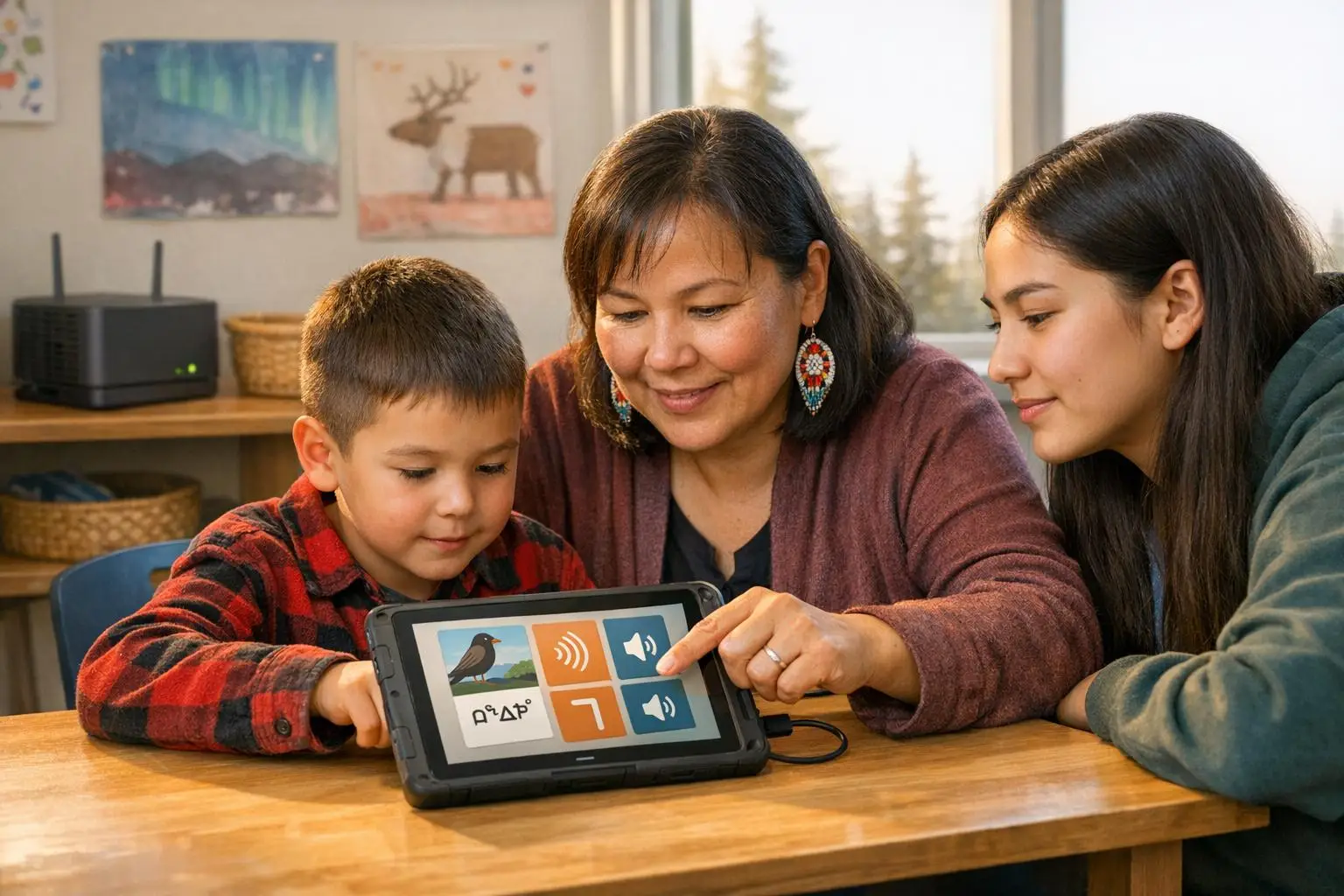
AI tools are reshaping education for Indigenous communities in Canada, addressing unique challenges like remote access, language preservation, and data sovereignty. Here’s how these solutions are making a difference:
- Custom AI Development: Companies like Digital Fractal Technologies Inc create software tailored to Indigenous priorities, ensuring alignment with governance frameworks like OCAP® and offline functionality for remote areas.
- Language Preservation Tools: AI-powered applications, such as verb conjugation software and ReadAlong Studio, support endangered languages like Mohawk and Inuktitut, helping students learn and connect with their heritage.
- Remote Learning Platforms: Adaptive systems designed with Indigenous principles improve access to education in remote communities, offering offline capabilities and culturally aligned content.
These tools succeed by prioritizing community collaboration, respecting data control, and addressing infrastructure gaps. However, challenges like limited funding, data scarcity, and long-term sustainability remain critical concerns. Tailored partnerships and governance frameworks are key to ensuring these technologies serve their intended purpose effectively.
How AI can play a part in the revitalization of Indigenous languages | APTN News
sbb-itb-fd1fcab
1. Digital Fractal Technologies Inc
Digital Fractal Technologies Inc, also known as DigitalStaff, focuses on creating tailored software solutions for Indigenous education. Their tools are built from scratch to address the specific needs of each community, ensuring alignment with governance structures, connectivity limitations, and data ownership.
Cultural Alignment and Governance
As an OCAP® Certified Partner, Digital Fractal incorporates frameworks like OCAP® for First Nations, OCAS for Métis, and IQ/NISR for Inuit. These frameworks ensure that data governance respects each community’s distinct requirements. For example, AI-generated outputs that could impact resource allocation are reviewed by community leaders before implementation. Indigenous organizations are recognized as "Data Controllers," while Digital Fractal operates solely as a "Data Processor".
"We do not treat data governance as a checkbox. Every automation, every dashboard, every AI system we build for Indigenous organizations is engineered from the ground up to safeguard community rights." – DigitalStaff
This commitment to respecting cultural frameworks shapes every technical decision, ensuring the software fits seamlessly with the community’s needs.
Infrastructure and Accessibility
Digital Fractal’s offline-first architecture tackles the connectivity challenges often faced in remote locations. This design allows tasks to be completed locally and synced online when possible. Additionally, their platform integrates with older systems like Xyntax or Sage through lightweight automations, avoiding the need for costly infrastructure upgrades. All data is hosted in Canadian data centres, protected from foreign legal claims such as the U.S. CLOUD Act. Security measures include AES-256 encryption for stored data and TLS for data in transit, with decryption keys managed solely by the Indigenous organizations.
AI Capabilities and Features
The software streamlines workflows for education coordinators by automating tasks like document intake, eligibility verification, and application prioritization. Instead of generative AI, Digital Fractal uses rule-based automations to ensure precision in execution. Repetitive processes, such as data entry and federal reporting (e.g., ISC/CIRNAC), are handled by Robotic Process Automation (RPA) bots powered by UiPath, cutting down reporting time significantly. These targeted automations help improve operational efficiency, directly benefiting educational processes.
Impact on Educational Outcomes
With more than five years of collaboration with First Nations, Inuit, and Métis organizations, Digital Fractal has achieved a perfect 5/5 rating on Clutch from nine client reviews. Their ability to transform complex community needs into practical software solutions has earned them widespread praise.
"DigitalStaff’s responsive team fosters an environment that values every client’s contribution." – Marilee A. Nowgesic, CEO, Canadian Indigenous Nurses Association
Each project begins with a community listening phase, lasting one to two weeks, to gather insights into local governance and daily challenges. This co-design process ensures the final software aligns with the community’s workflows, avoiding the pitfalls of rigid, one-size-fits-all solutions.
2. AI-Driven Indigenous Language Tools
Indigenous communities make up less than 6% of the world’s population, yet they speak over 4,000 languages – many of which are at risk, with 2,500 facing the threat of extinction. AI-driven tools have the potential to breathe new life into these languages. When developed with strong technical foundations and genuine collaboration with Indigenous communities, these tools can play a key role in preserving cultural heritage while also enriching educational experiences in classrooms.
Cultural Alignment and Governance
One significant challenge lies in data sovereignty. When external organizations collect Indigenous language materials to train AI models, there’s a risk that communities may lose control over their own cultural assets. To address this, effective tools are co-designed from the outset, involving local partners and creating governance frameworks that clearly define data ownership and usage rights. This might include forming Indigenous advisory committees and drafting legally binding agreements to ensure that language data isn’t used for commercial AI applications without the community’s consent. These governance measures establish a foundation for the advanced AI tools discussed below.
AI Capabilities and Features
Canada has already seen some promising developments in this space. For example, in April 2026, the National Research Council (NRC) introduced verb conjugation software for Mohawk, Algonquin, and Michif – languages known for their complex polysynthetic structures. Another NRC initiative, ReadAlong Studio, now supports 22 languages, offering synchronized audio-text interaction to aid learning. In January 2026, Microsoft, in collaboration with the Government of Nunavut, integrated Inuktitut and Inuinnaqtun into Microsoft Translator. This addition allows educators to create report card comments directly in Inuktitut, making classroom communication more inclusive.
Infrastructure and Accessibility
Accessibility is a key focus, especially given the challenges of limited data and unreliable internet access in many Indigenous communities. Traditional speech recognition systems require vast datasets – around 50,000 hours of audio – but Indigenous languages often have far less available. New approaches are addressing this gap by working with smaller, community-approved datasets. For instance, datasets as small as 500 curated phrases from school curricula have been used to achieve meaningful results. Additionally, offline edge AI devices, sometimes called "language in a box", provide voice-operated language tools that can function without internet connectivity, making them ideal for remote areas.
Impact on Educational Outcomes
Innovative tools are already making a difference in classrooms. Take Vern Lewis from Frog Lake First Nation in Alberta, who developed the "How do I say this in Cree" app. This tool allows students to upload audio recordings and receive Cree translations. It has since expanded to include local plant names, demonstrating how such tools can integrate language learning into everyday life. These efforts not only safeguard endangered languages but also improve educational opportunities in remote areas. As Inbal Becker-Reshef from the Microsoft AI for Good Lab explains:
"Language determines who gets to use AI – remaining inaccessible when people can’t engage with it in their own language."
3. Adaptive Learning Platforms for Remote Indigenous Schools
Cultural Alignment and Governance
For adaptive learning platforms to succeed in Indigenous communities, it’s essential that these communities maintain control over their own data. Many platforms now follow the OCAP® principles – Ownership, Control, Access, and Possession – ensuring that community data remains within the Nation’s jurisdiction. Métis communities use a similar framework called OCAS, while Inuit communities adhere to IQ/NISR (Inuit Qaujimajatuqangit).
| Governance Framework | Target Group | Framework Principles |
|---|---|---|
| OCAP® | First Nations | Ownership, Control, Access, Possession |
| OCAS | Métis | Ownership, Control, Access, Stewardship |
| IQ / NISR | Inuit | Consensus, Capacity, Linguistic Integration |
| CARE | Global Indigenous | Collective Benefit, Authority to Control, Responsibility, Ethics |
Equally important is cultural alignment. Jean‑Paul Restoule, a professor at the University of Victoria, highlights this by stating:
"Relationships between teacher and learner, and between community, culture, and school underlie all aspects of Indigenous education."
Platforms that incorporate the 5Rs framework – Relationships, Respect, Relevance, Responsibility, and Reciprocity – into their design often gain more trust and see higher adoption rates. With communities retaining governance over these platforms, they are better equipped to address challenges like limited internet access.
Infrastructure and Accessibility
Many remote Indigenous schools face ongoing challenges with internet connectivity. To address this, initiatives like the Connected Coast Project are extending high-speed internet to 139 rural and remote communities, including 48 Indigenous communities representing 44 First Nations. For areas where internet access is still unreliable, platforms are designed to queue data offline and sync once a connection becomes available. Additionally, cloud-based virtual machines offer a solution for hardware shortages, providing students with access to full computer environments even on basic devices.
As researchers Derek Jacoby, Saiph Savage, and Yvonne Coady explain:
"This infrastructure can now be leveraged in more effective remote learning platforms, allowing team‑based activities that include participants who otherwise cannot collaborate in‑person."
AI Capabilities and Features
In November 2021, a partnership between the Digital Technology Supercluster, BCIT, Siemens Canada, and Denesoline Corporation launched a Virtual Clean‑Energy Training Platform for the Łutsël K’é Dene First Nation in the Northwest Territories. With an investment of $1.2 million – $700,000 from industry partners and $500,000 from the Supercluster’s Capacity Building Program – the platform enables learners to remotely manage microgrids and earn technical certifications within their community. Dr. Hassan Farhangi, Director of BCIT’s Smart Microgrid Applied Research Team, explains:
"The project team will train members of the Lutsel K’e First Nation’s community to operate and maintain clean power plants virtually. This project could also provide a similar support to the 25 other Indigenous communities and mining operations in the surrounding area."
On the literacy side, the World Literacy Foundation Australia developed an Indigenous Learning App using "Tendril" software. This app creates localized e-books and literacy games in both English and local dialects, addressing the fact that over 80% of Indigenous children in remote Australian communities struggle with reading. Sarah Novinetz, Project Manager in Darwin, worked with the Nawarddeken Academy to develop Kunwinjku language resources for the app. These tools are making a tangible difference in literacy education.
Impact on Educational Outcomes
Implementing these systems often requires specialized AI consulting services to ensure technical infrastructure aligns with community goals.
These platforms are already delivering measurable improvements. Automated administrative tools, such as AI-driven optical character recognition and eligibility ranking for student support programs, reduce the workload for educators, allowing them to focus more on teaching. Early literacy tools introduced before formal schooling are also helping to bridge learning gaps. Andrew Kay, CEO of the World Literacy Foundation, emphasizes:
"We’re excited to launch this new piece of technology, which allows Indigenous children to learn English in parallel with their traditional language either at school, at home or via their mobile devices."
Pros and Cons
AI Solutions for Indigenous Education: Key Strengths & Weaknesses
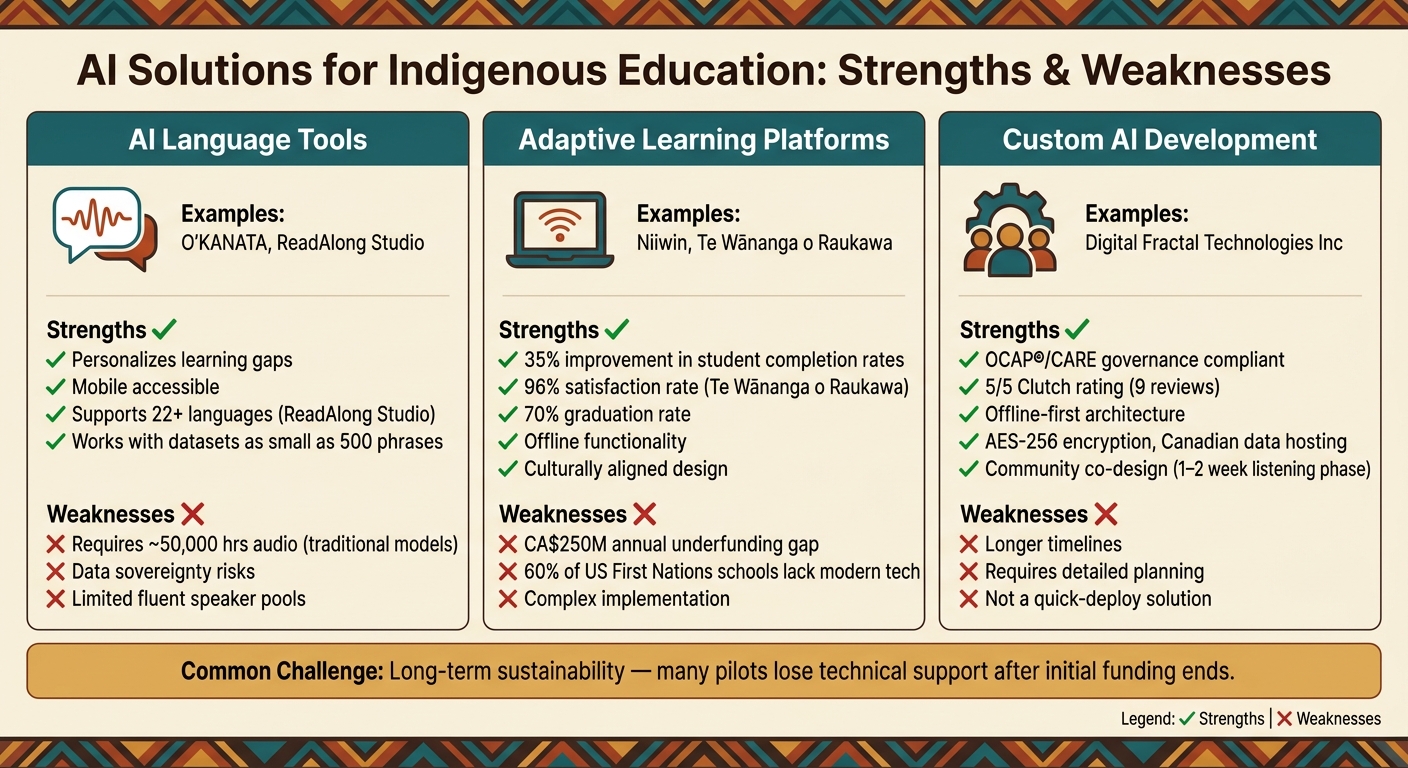
Each type of AI solution brings its own set of strengths and challenges, particularly when applied to Indigenous education and language preservation. Here’s a breakdown of key advantages and limitations:
AI-driven Indigenous language tools are tailored to address individual learning gaps and offer mobile accessibility. However, they face significant hurdles due to limited audio datasets and concerns about data sovereignty. Many Indigenous languages have very few fluent speakers, making it difficult to gather the extensive audio data these models require. Additionally, without strong legal agreements, there’s a real risk of losing control over language data.
"We have to have our own engineers. We need to have our own computer scientists using the software… We need to have sovereignty over our own data." – Michael Running Wolf, Co-founder, Lakota AI Code Camp
Adaptive learning platforms for remote schools help fill infrastructure gaps often overlooked by mainstream systems. For example, platforms designed with Indigenous principles have shown impressive results, like a 35% improvement in student completion rates. A standout example is the Te Wānanga o Raukawa platform, which achieved a 96% satisfaction rate and a 70% graduation rate by incorporating a traditional "whare" (meeting house) model into its digital design. However, these platforms come with high costs and complexities. Tribal colleges, for instance, face an annual underfunding gap of CA$250 million, and 60% of US First Nations schools still lack modern technology.
Custom AI development, such as that provided by Digital Fractal Technologies Inc, is designed to strictly follow community governance frameworks like OCAP® and CARE. While these solutions are tailored to meet specific community needs, they require detailed planning and ongoing collaboration, making them less of a quick fix and more of a long-term commitment.
The table below highlights the key trade-offs for these solutions:
| Solution | Key Strengths | Key Weaknesses |
|---|---|---|
| AI Language Tools (e.g., O’KANATA, ReadAlong Studio) | Personalizes learning and offers mobile accessibility | Faces data scarcity and risks of data sovereignty loss |
| Adaptive Learning Platforms (e.g., Niiwin) | Boosts completion rates, works offline, and aligns with cultural values | High costs, underfunding, and complex implementation |
| Custom AI Development (e.g., Digital Fractal Technologies Inc) | Tailored to community needs with governance frameworks | Requires detailed planning, collaboration, and longer timelines |
A common challenge across all these solutions is long-term sustainability. Many projects start as pilots with initial funding but often lose technical support once the pilot phase ends. Issues like system maintenance, data ownership, and control remain critical to ensuring their continued success.
Conclusion
There’s no one-size-fits-all AI solution for Indigenous communities. A program designed for preserving the Mohawk language in Ontario might not meet the needs of a Dene First Nation in the Northwest Territories. The most impactful tools – whether they’re language apps, learning platforms, or custom systems – are those developed in close collaboration with the communities they’re meant to serve.
This variety in approaches highlights a deeper shift in how AI is designed. While Western AI models often focus on individual goals and outcomes, Indigenous knowledge systems emphasize community, relationships, and collective care. Future tools will need to reflect these values right from the start.
Data sovereignty must also remain a top priority. Legal frameworks should ensure Indigenous organizations are designated as Data Controllers, with tech providers acting only as Data Processors. Additionally, data infrastructure should be hosted within Canadian borders or, ideally, within the community itself – keeping sensitive information safe from foreign jurisdiction.
For partnerships to thrive long-term, tech providers need to fully transfer technical expertise and leadership to Indigenous communities. This includes involving Elders and Cultural Advisors in development and handing over source code and digital assets once projects are complete.
"AI has the potential to support Nation-building, governance, language preservation, and economic development, but only when First Nations leadership guides its design and implementation." – Natiea Vinson, CEO, First Nations Technology Council
FAQs
How can AI be used without compromising Indigenous data sovereignty?
AI can align with Indigenous data sovereignty by following the OCAP principles: ownership, control, access, and possession. These principles prioritize community autonomy over their data and its use.
Key steps include:
- Keeping data within communities: Ensuring data storage happens locally or in Canadian data centres helps maintain control.
- Obtaining explicit consent: Before using data for external purposes, clear and informed consent must be secured.
- Community-led development: Collaborating with community members and elders ensures that AI systems are designed with cultural accuracy and respect.
Additionally, strong governance frameworks and robust security measures are essential. Tools like encryption and role-based access controls not only safeguard sensitive information but also promote digital self-determination for Indigenous communities.
What’s the minimum language data needed to build useful AI learning tools?
To build effective AI learning tools, having a community-defined dataset of phrases, audio, and text is crucial. For widely spoken languages like English, this might mean gathering around 50,000 hours of speech. In contrast, Indigenous languages often require far fewer resources – just hundreds or thousands of phrases can suffice. The active participation of the community is essential to ensure that these datasets respect both the cultural and linguistic nuances of the language.
How do offline-first education platforms work in remote communities?
Offline-first education platforms are making a difference in remote areas by delivering learning opportunities without needing constant internet access. These systems rely on local hardware and storage, such as Raspberry Pi-based learning management tools, to host and share educational materials. By storing resources locally, they ensure students and teachers can collaborate and learn seamlessly, even when internet connections are unavailable.
When internet access is available, these platforms sync data, keeping resources up-to-date and enabling progress tracking. They also promote digital literacy and engagement by providing multimedia-rich and culturally relevant content, tailored to the needs of the community. This approach helps close educational gaps in areas where connectivity is scarce, offering a practical solution for uninterrupted learning.