AI in Oil & Gas: Alberta’s Predictive Maintenance Trends

AI is transforming Alberta’s oil and gas sector by improving predictive maintenance processes. Companies are using advanced tools to monitor equipment, predict failures, and reduce unplanned downtime. Key benefits include:
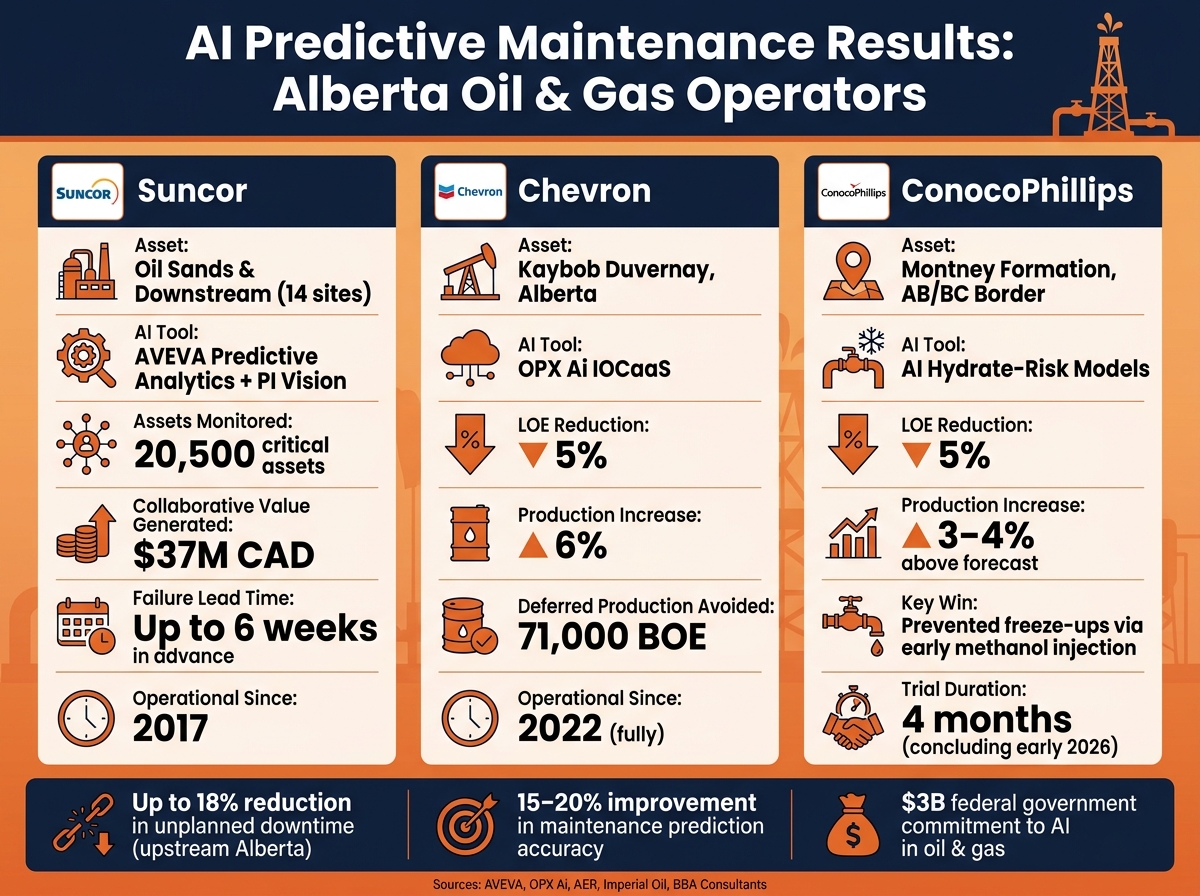
- Downtime Reduction: Upstream operations in Alberta have decreased unplanned downtime by up to 18%.
- Improved Maintenance Accuracy: Predictions are now 15–20% more precise.
- Cost Savings: Imperial Oil reported a $700M profit boost from AI initiatives by 2024, aiming for $1.2B by 2027.
- Government Support: The federal government has committed $3B to AI integration in oil and gas.
Alberta’s success stems from its industrial scale, local AI consulting services, and institutions like Amii and the University of Alberta. However, challenges remain, including data quality, cybersecurity risks, and workforce training. Companies like Suncor, Chevron, and ConocoPhillips are already seeing measurable results, such as lower operating costs and higher production rates. The future of AI in this sector lies in automation, prescriptive maintenance, and secure scaling of these technologies.
AI Predictive Maintenance Research in Alberta
Key Research Themes and Study Types
Alberta’s drive for operational efficiency is reflected in its diverse research efforts, focusing on equipment health monitoring, pipeline integrity, and oil sands logistics. These areas are explored through a combination of field tests, academic research, and industry reports.
For example, researchers are closely examining gas compressors and artificial lift systems. Small changes, like subtle vibration shifts or pressure variations, often signal potential failures. On the pipeline front, AI is being used to predict hydrate formation and liquid loading, especially in challenging winter conditions such as those in the Montney Formation near the Alberta–British Columbia border.
At the University of Alberta, one significant study led by Chengkai Fan in 2023 identified haul distance and ambient temperature as key factors in predicting haul truck productivity in oil sands mining. These findings have practical implications for improving fleet scheduling and reducing costs.
Another intriguing area of research addresses induced seismicity. The Alberta Energy Regulator (AER) has been leveraging data science to link hydraulic fracturing parameters – like injection pressure and fluid volume – to seismic events in the Duvernay Formation. This work helps operators design safer well programs and minimize disruptions.
Data Sources and Modelling Methods
Modern predictive maintenance relies on a wealth of data from SCADA systems, IoT sensors, and data historians. When this operational data is integrated with CMMS and ERP logs, it enables models to distinguish between normal fluctuations and early signs of failure.
"The challenge is no longer collecting data but transforming it into actionable insights that drive smarter and more proactive decision-making." – BBA Consultants
On the modelling front, researchers are moving beyond traditional machine learning techniques. They are now integrating Physics Informed Neural Networks (PINNs) with data-driven methods to ensure predictions align with physical realities, an essential step when dealing with equipment tied to reservoir and facility mechanics. In oil sands applications, Gaussian Mixture Modelling (GMM) has shown remarkable success. A University of Alberta study demonstrated how GMM-based clustering improved the accuracy of truck productivity predictions, with the R² value rising from 23% to 75%.
The table below highlights Alberta’s key research areas, their data inputs, and the modelling techniques used:
| Research Focus | Primary Data Sources | Key Modelling Techniques |
|---|---|---|
| Equipment Health | SCADA, vibration sensors, ERP work orders | Deep learning, digital twins, LSTM |
| Pipeline Integrity | Pressure/temperature sensors, historians | Pattern recognition, hydrate-risk models |
| Oil Sands Logistics | GPS, fleet management systems, weather data | GMM, Bayesian regularized neural networks |
| Reservoir/Seismicity | Injection logs, seismic sensors | Random forest, ANN, PINNs |
Another emerging trend is the adoption of edge-deployed microservices. These systems run analytics directly in the field rather than relying solely on central cloud processing. This approach reduces latency, enabling faster alerts that can prevent failures before they escalate into costly shutdowns. These advances lay the groundwork for the practical applications explored in later sections.
sbb-itb-fd1fcab
Case Study: Boosting Energy Production and Reducing Costs with AI
Alberta Use Cases and Measured Results
AI Predictive Maintenance Results: Alberta Oil & Gas Operators
Rotating Equipment and Facility Maintenance
Facilities in Alberta are seeing impressive results with AI-driven tools. Since 2017, Suncor has utilized AVEVA Predictive Analytics and PI Vision to monitor 20,500 critical assets across 14 sites. Vance Seeley, Senior Analyst and APM Specialist at Suncor, shared:
"Since we got set up in 2017, we’ve produced $37 million of collaborative value between the sites and us."
Using AI, Suncor can detect turbine degradation up to six weeks ahead of failure, allowing maintenance to be scheduled without disrupting production. Similarly, at Imperial Oil’s Cold Lake facility, Spot robots from Boston Dynamics handle 70% of routine inspections. These robots autonomously navigate the site, gather data, and flag anomalies, reducing the need for manual inspections. Additionally, Calgary-based Ambyint Inc. implemented its Amplify Real-Time Controller on Alberta rod and plunger lift wells between 2018 and 2020. This system minimized expensive workovers and cut electricity consumption by regulating pumping autonomously.
These advancements highlight AI’s expanding role in maintaining asset health and ensuring operational efficiency.
Pipeline Integrity Monitoring
AI is also proving invaluable in reducing risks associated with pipeline operations. ConocoPhillips implemented AI hydrate-risk models at its Montney multiwell pads in a four-month trial concluding in early 2026. During a period of steep temperature drops in January, the system identified early signs of pressure changes and cooling trends. This allowed for timely methanol injections at two critical chokepoints, preventing freeze-ups. The result? A 5% reduction in lease operating expenses (LOE) and a 3–4% production boost beyond expectations.
Such proactive measures underscore Alberta’s focus on maintaining steady production through smarter, data-driven approaches.
Refinery and Gas Plant Optimization
In downstream operations, Chevron has seen transformative results with OPX Ai‘s Integrated Operations Center as a Service (IOCaaS) at its Kaybob Duvernay asset. Deployed in phases starting in 2020 and fully operational by early 2022, the AI system monitored gas wells and compressors, detecting a subtle drop in plunger travel velocity – a sign of liquid loading – hours before a potential shutdown. Over 12 months, the system prevented 71,000 BOE of deferred production, cut LOE by 5%, and increased overall production by 6%.
"Automated optimization via IOCaaS reduced production costs per barrel." – Yogashri Pradhan, Chief Growth Officer, OPX Ai
Summary of Key Outcomes
The table below highlights the measurable results achieved by these operators:
| Operator | Asset | Key Outcome |
|---|---|---|
| Suncor | Oil sands & downstream (14 sites) | $37M CAD in collaborative value; 6-week failure lead time |
| Chevron | Kaybob Duvernay, AB | 5% LOE reduction; 6% production increase; 71,000 BOE deferred production avoided |
| ConocoPhillips | Montney Formation, AB/BC border | 5% LOE reduction; 3–4% production increase above forecast |
Across these examples, one thing is clear: AI enables operators to anticipate issues well before they escalate, turning potential shutdowns into manageable situations. This shift from reactive to proactive management is reshaping Alberta’s energy landscape.
What Enables and Blocks AI Adoption in Alberta Oil & Gas
For Alberta’s oil and gas sector, achieving reliable predictive maintenance with AI requires more than just cutting-edge technology. Success depends on solid data systems, trustworthy models, and a workforce ready to embrace change.
Data Infrastructure and Sensor Deployment
A major advantage for Alberta operators is that many already have the groundwork in place. Decades of investment in SCADA systems and data historians provide a strong base for AI integration. Modern AI tools, such as IOCaaS, are designed to layer on top of these existing systems, making implementation less daunting.
However, the quality of infrastructure varies. For example, Chevron’s Kaybob site required a full year to clean and organize its legacy data, while ConocoPhillips’ Montney operation completed a similar process in just four months. Beyond fixed sensors, advancements in mobile data collection are reshaping the game. Autonomous robots and drones now enable AI systems to access more frequent and detailed field readings.
Model Reliability and Governance
Even with excellent data infrastructure, earning engineers’ trust in AI systems can be tricky. At Chevron’s Kaybob site, a gradual approach to AI adoption was used. Engineers initially reviewed every AI recommendation before eventually allowing the system to autonomously adjust gas lift valve settings.
Cybersecurity is another pressing concern. The energy sector accounted for 10% of all cyberattacks handled by IBM’s X-Force team worldwide in 2024. As AI becomes more embedded in operational systems, it also becomes a bigger target for attackers. Tyler Williams, Cybersecurity Leader for Industrials and Energy at EY Canada, highlighted the growing sophistication of these threats:
"Attacks have become so advanced that they can be launched autonomously via AI in seconds, wreaking the kind of havoc that a few years ago would have taken millions of dollars and specialized expertise to pull off."
While technical barriers are being addressed, human factors remain a significant obstacle.
Organizational Adoption and Skills Gaps
Decades of reactive decision-making in the oil and gas industry mean that shifting to proactive, AI-driven workflows requires a significant cultural adjustment. Many AI pilot projects falter because the challenges of change management are underestimated. As BBA Consultants explain:
"Successfully implementing new technology requires a shift in mindset and people to champion and lead that change."
Experience shows that involving operations staff early in the process makes a big difference. When field workers contribute to the design of AI tools, the solutions are more aligned with real-world needs, making adoption smoother. Aligning people and processes with technical advancements is critical to unlocking the full potential of AI in predictive maintenance.
Addressing these infrastructure, governance, and cultural hurdles is key to making AI a transformative tool for Alberta’s oil and gas industry.
Where AI Predictive Maintenance in Alberta Is Headed
Emerging Trends and Technologies
AI in Alberta’s maintenance sector is evolving beyond just identifying faults – it’s now stepping into the realm of prescriptive maintenance. This means systems are not only flagging issues but also taking automated corrective actions. Early examples show that autonomous operational adjustments are no longer just theoretical – they’re already proving effective in real-world applications.
Technologies like Physics-Informed Neural Networks (PINNs) and digital twin technology are gaining traction. These tools combine to offer more precise, physically consistent predictions, which help reduce unplanned outages significantly. Meanwhile, generative AI is transforming workflows. For instance, Imperial Oil’s teams can now query live sensor feeds and maintenance logs using plain language, gaining instant insights. Shannon Wilson, Energy Division Lead at IBM Canada, summed it up well:
"The more repeatable a process is, the more AI can lend itself."
These advancements are not just changing how maintenance is done – they’re also delivering tangible improvements in both cost efficiency and safety.
Cost and Safety Benefits
AI-driven predictive maintenance is proving its worth across Alberta’s oil and gas sector. Companies are reporting reduced lease operating expenses and increased production by integrating AI into their operations. On the safety side, autonomous robots now handle most routine inspections in hazardous environments, keeping workers out of harm’s way and allowing them to focus on more valuable tasks.
The federal government is also backing these developments, pledging $3 billion to support AI integration in the oil and gas industry. This funding covers areas like predictive maintenance and real-time emissions monitoring, further solidifying the sector’s investment in AI-driven solutions.
Research Gaps and Next Steps
Despite these strides, there are still challenges to overcome. Much of the current research focuses on large-scale operators, leaving smaller or more varied operations underrepresented. Additionally, there’s a shortage of professionals skilled in both AI and petroleum engineering, highlighting the need for targeted training programs. Cybersecurity remains another pressing concern. As Tyler Williams of EY Canada noted:
"I think most companies would consider themselves quite on their own to come up with frameworks and controls to make sure that technology gets deployed securely."
Moving forward, fostering collaboration between operators, tech companies, and academic institutions will be critical. By designing pilot projects with scalability in mind, the sector can ensure these advancements benefit a broader range of operations, rather than just proving isolated successes.
Conclusion: Key Takeaways and the Role of Local Expertise
Alberta’s oil and gas industry is now deeply integrating AI-powered predictive maintenance into its operations. From autonomous inspections at Imperial Oil’s Cold Lake facility to AI-managed haul truck fleets at Suncor’s Mildred Lake mine, these advancements are delivering measurable results. Companies have reported lower maintenance costs, reduced downtime, and better use of assets across the board.
What sets Alberta apart is its unique combination of cutting-edge AI research – driven by institutions like the Alberta Machine Intelligence Institute (Amii) and the University of Alberta – and decades of operational know-how. This synergy creates a competitive edge that’s hard to duplicate. However, there are still hurdles to overcome. Skills shortages, cybersecurity risks, and outdated infrastructure continue to challenge smaller operators. Research highlights that success depends on seamless integration, effective change management, operator trust, and strong leadership within organizations. Tackling these issues requires solutions that are both localized and practical.
Local companies, such as Digital Fractal Technologies Inc, are stepping up to meet this need. By combining deep industry knowledge with AI expertise, they’re creating tools tailored specifically for the energy sector. These include innovations like workflow automation and AI-driven monitoring systems designed to address the unique demands of oil and gas operations.
The groundwork has been laid. Moving forward, the focus must be on scaling AI solutions securely while ensuring they deliver tangible, operational results.
FAQs
What data is required to start AI predictive maintenance?
To make AI-driven predictive maintenance work, you need access to real-time operational data. This data typically comes from systems such as SCADA, DCS, historians, and IoT sensor networks. By collecting this information, you can monitor equipment performance, spot anomalies, and create baseline conditions that are essential for accurate analysis.
How do we make AI maintenance models engineers will trust?
To create AI maintenance models that engineers can rely on, you need to prioritize transparency, accuracy, and smooth integration with their current workflows. High prediction accuracy – like hitting 94.7% – and cutting downtime by as much as 18% go a long way in building trust.
Engage engineers throughout the development process and consider using physics-informed neural networks to ensure predictions align with real-world behaviour. Equip them with tools that deliver real-time, actionable insights in an easy-to-use format. Most importantly, focus on explainable models that show clear operational advantages to help boost confidence and encourage adoption.
How can smaller Alberta operators scale AI securely?
Smaller Alberta operators can effectively integrate AI by zeroing in on measurable outcomes, ensuring data readiness, and building trust among operators. Establishing a solid data foundation is key, as it allows AI to seamlessly align with existing workflows. This approach ensures predictive maintenance not only adds value but also reduces potential risks.
A practical way to begin is by launching pilot projects in areas with the most potential for impact. Gradually rolling out AI through phased implementation helps ease the transition while maintaining focus on security and operational stability. By using secure cloud platforms or edge-hosted solutions, operators can enhance data protection, boost resilience, and build confidence in AI systems. This measured approach encourages long-term adoption and trust in AI technologies.