
Top 7 AI Agents for SMB Automation

Running a small or medium-sized business (SMB) in 2026 often means juggling too many tasks with too little time. AI agents can help. Unlike basic chatbots, these tools can handle complex workflows, execute tasks across platforms, and save SMBs significant time and effort. Here’s a quick look at seven AI agents designed for SMBs:
- Digital Fractal Technologies: Tailored AI agents for industries like real estate, trades, and healthcare. Automates end-to-end workflows like scheduling, invoicing, and customer intake.
- Zapier: Connects 9,000+ apps for task automation. Ideal for non-technical users with its no-code setup.
- UiPath: Combines Robotic Process Automation (RPA) with AI to handle tasks on legacy systems, like invoice processing and CRM updates.
- Freshdesk (Freddy AI): Focused on customer service, managing up to 80% of queries and assisting agents with ticket resolution.
- HubSpot Breeze AI: Integrates marketing, sales, and service automation within HubSpot’s CRM ecosystem.
- Tidio (Lyro AI): Specializes in e-commerce, automating customer interactions and managing orders across multiple channels.
- Zoho Desk (Zia AI): Offers customer support automation with tools like ticket tagging, sentiment analysis, and low-code chatbot building.
Key Benefits:
- Save time: SMBs using AI report saving over 20 hours/month.
- Boost revenue: 91% of SMBs using AI see increased earnings.
- Affordable options: Pricing starts as low as CA$9/month, scaling with features and usage.
Quick Comparison:
| AI Agent | Best For | Starting Price (CA$) | Integration Scope | Deployment Ease |
|---|---|---|---|---|
| Digital Fractal | Custom workflows by industry | Custom pricing | API, CRM, legacy systems | Medium |
| Zapier | General task automation | 27/month | 9,000+ apps | High |
| UiPath | Legacy system automation | 400/month | RPA and API | Low |
| Freshdesk (Freddy AI) | Customer service | 9/agent/month | CRM, e-commerce platforms | High |
| HubSpot Breeze AI | CRM-driven sales & support | 20/month/seat | HubSpot ecosystem | Medium |
| Tidio (Lyro AI) | E-commerce support | 33/month | Shopify, WhatsApp, more | High |
| Zoho Desk (Zia AI) | Customer support | 9/agent/month | Zoho apps, 200+ integrations | High |
Choose the AI agent that fits your business’s needs and budget to save time, improve efficiency, and simplify operations.
AI Agents for Small Business: Your New Secret Weapon
sbb-itb-fd1fcab
How We Chose These AI Agents
To qualify as a true AI agent, a tool had to meet four specific criteria. Here’s what we looked for:
- Automation scope: Does the tool handle entire workflows independently, or does it just answer questions? A genuine AI agent should manage multi-step tasks without needing constant input, unlike tools that only focus on single interactions.
- Workflow integration: How well does the tool connect with existing systems like CRMs, email platforms, Slack, or calendars? The goal is seamless data transfer without requiring manual intervention.
- Ease of deployment: Can a non-technical small business owner set it up in under an hour without needing a developer? This was a crucial factor in our evaluation.
- SMB suitability: Are the pricing and features practical for teams with fewer than 50 members? Typically, a robust AI agent setup falls between CA$100 and CA$300 per month.
This framework ensures we differentiate AI agents from traditional chatbots and highlights why they operate on a completely different level.
AI agents vs. chatbots
The distinction is important. As DownGraf explains:
"A chatbot talks; an agent acts. A chatbot can tell you how to reset a password. An agent can log into the admin panel, reset the password, email the temporary one to the user, and close the support ticket."
To make this difference even clearer, here’s a comparison:
| Feature | Basic Chatbot | AI Agent |
|---|---|---|
| Logic | Rule-based (If/Then) | Generative reasoning |
| Initiative | Reactive – waits for input | Proactive – executes goals |
| Capabilities | Answers questions | Executes multi-step tasks across apps |
| Integration | Isolated widget | Connects across your full app stack |
| Data Usage | General knowledge | Your unique business data |
Every tool we selected meets all four criteria. That means no chatbot disguises or flashy demos – only real, functional AI agents made the cut.
1. Digital Fractal Technologies Inc
Digital Fractal Technologies Inc creates industry-specific AI agents designed to handle entire workflows. Their solutions cater to sectors like real estate, trades, allied health, and roofing, with each agent managing a full operational process from start to finish.
Automation Scope and Capabilities
These AI agents are built to cover complete workflows. For example:
- AgentVeronica serves as a 24/7 virtual receptionist, managing tasks like answering calls, booking appointments, and escalating issues without human input.
- AgentLucas supports trades businesses (e.g., HVAC and plumbing) by managing dispatch, quotes, and invoicing – covering the entire service cycle.
- AgentLouise helps allied health clinics by handling scheduling, SOAP notes, and direct billing, all with built-in PHI encryption.
The results speak for themselves: these agents can manage 80% of routine inbound traffic within their first month and help business owners reclaim 15+ hours per week by automating repetitive admin tasks.
Next, let’s look at how seamlessly these agents fit into your existing systems.
Integration With Existing Workflows
These AI agents are designed to integrate with tools small and medium-sized businesses (SMBs) already rely on. Whether it’s WhatsApp, Google Calendar, email, CRM systems, or billing software, these agents fit right in. Most integrations are completed in about an hour, and none take longer than a week. Plus, there’s no need for your team to learn new software or juggle additional logins.
"AI agents that run the repetitive end of your business – bookings, intake, follow-ups, dispatch, billing – so you can spend your hours on the work only a human can do." – Digital Fractal Technologies Inc
Ease of Deployment and Scalability
Getting started is quick. Agents are up and running within 7 days. Digital Fractal also offers a 30-day AI Readiness Audit for CA$2,500–CA$10,000, which outlines a 6–12 month automation plan identifying 3–5 high-impact opportunities. Full implementation typically takes 90 days from start to finish.
Suitability for SMB Operations
For Canadian businesses, regulatory compliance is a priority. These solutions are PIPEDA, PHIPA, and Loi 25 compliant, with an optional ca-only mode to keep all sensitive data within Canada. The agents are also bilingual in English and French, automatically detecting the user’s preferred language from the first interaction. Beta access is offered at a flat monthly rate with no per-seat charges, making it an affordable option for small teams.
Here’s a real-world example: Rachel G., a REALTOR in Calgary, implemented AgentJeff to handle client inquiries, follow-ups, and FINTRAC compliance paperwork. The result? She doubled her deal volume in a single quarter without hiring additional staff and gained back 12 Sundays that were previously spent on admin work.
As we continue, you’ll see how other tools in this list bring unique features to SMB automation, helping you find the best fit for your needs.
2. Zapier
Zapier is a trusted tool for automation, used by 3.4 million companies worldwide. It blends traditional rule-based workflows with AI agents, enabling small and medium businesses to streamline tasks like lead enrichment, customer support ticket routing, content creation, and expense classification.
Automation Scope and Capabilities
Zapier takes automation beyond the usual "if this, then that" logic. Its AI agents can dynamically reason through tasks, tackling challenges like prospect research and support triage with ease. This flexibility allows it to connect seamlessly with a wide range of apps.
"Zapier Agent’s fine-tuned model for research and task management can do things that other models just can’t do. It’s the least lazy AI I’ve found." – Evan Nison, Founder, NisonCo
One standout example comes from 2025, when Andrew Harding, VP of Marketing and Content Partnerships at Slate, used a Zapier Agent to generate over 2,000 leads in just one month. This created a backlog of prospects that his team worked on for months.
Integration With Existing Workflows
Zapier offers integration with over 9,000 apps, including popular tools like HubSpot, Salesforce, Slack, Gmail, Notion, and Asana. With central authentication management, users don’t need to repeatedly configure credentials for each app. This makes even complex system integrations straightforward and hassle-free.
Ease of Deployment and Scalability
Zapier’s visual builder and AI Copilot make it easy for non-technical teams to set up workflows quickly. For companies already using AI tools like Claude or ChatGPT, Zapier’s Model Context Protocol (MCP) allows these external models to trigger actions directly. This expands automation capabilities without requiring additional development work.
Zapier uses a task-based billing model. The free plan includes 100 tasks per month, while the Pro plan starts at CA$27 per month, and team plans begin around CA$94 per month. For businesses with high-volume workflows, these costs can add up over time. Use a workflow automation benefits calculator to determine if the investment aligns with your budget.
Suitability for SMB Operations
Zapier includes built-in AI Guardrails to protect sensitive data by scanning for personally identifiable information, toxic language, and prompt injection. It also supports human-in-the-loop checkpoints, where agents pause for approval before executing critical actions like sending emails or updating CRM records. These safety measures give small and medium businesses the confidence to automate customer-facing workflows securely and effectively.
3. UiPath
UiPath stands out by blending Robotic Process Automation (RPA) with AI-driven automation. Unlike platforms like Zapier that focus on connecting cloud applications, UiPath mimics human actions such as clicking, typing, and navigating screens. This makes it especially handy for small and medium-sized businesses (SMBs) still reliant on older systems without modern APIs.
Automation Scope and Capabilities
UiPath is designed to tackle a variety of workflows across departments. For example:
- Finance teams can streamline tasks like invoice processing, bank reconciliations, and month-end reporting.
- HR departments can automate employee onboarding and document management.
- Sales teams can clean up CRM data and route leads automatically.
The platform’s bots execute tasks up to 10 times faster than humans, potentially reducing daily workloads by about one-third. Its Maestro orchestration layer enhances this capability by allowing AI agents to adapt to unexpected challenges that might derail traditional rule-based systems.
"Orchestrate complex workflows with the open and trusted platform for agentic automation where agents think, robots do, people lead." – UiPath
Integration With Existing Workflows
UiPath excels in integration, earning a 4.7 out of 5 for its ecosystem in a 2026 evaluation. With a developer community of over 500,000 people, the platform supports both API connectors for modern tools and RPA for legacy systems. This dual approach ensures businesses can connect their existing software with minimal friction.
For non-technical users, the UiPath Autopilot feature simplifies integration by allowing them to build workflows using plain language – no coding required. This combination of flexibility and ease of use enables quick deployment and scalability.
Ease of Deployment and Scalability
Most SMBs can deploy their first automation bot within 4 to 8 weeks. Starting with a high-volume process like invoice matching often leads to quick wins, paving the way for broader automation efforts. For teams without IT expertise, UiPath offers Managed Operations, where a partner oversees hosting and monitoring of bots. Additionally, the low-code StudioX tool empowers business users to create simpler automations on their own.
Suitability for SMB Operations
While UiPath’s pricing, based on licences for Studio, Robot, and Orchestrator, might pose challenges for SMBs with tight budgets, the platform scores 4.8 out of 5 for its strong focus on security, compliance, and governance. It also supports air-gapped environments, making it a viable choice for regulated industries.
For SMBs dealing with sensitive data, UiPath offers a "Draft Mode" option. This allows AI agents to operate in a semi-autonomous state for the first two weeks, helping teams build trust in the system before granting full autonomy.
4. Freshdesk
Freshdesk zeroes in on customer service automation, making it a go-to option for small and medium-sized businesses (SMBs) looking to handle more support requests without having to expand their team.
Automation Scope and Capabilities
The Freddy AI Agent is designed to handle up to 80% of incoming queries across platforms like chat, email, and messaging apps. It also executes real-time actions such as processing refunds, updating subscriptions, and checking inventory through its Agentic Workflows. Freshworks reports impressive results with its AI platform, including a 66% ticket deflection rate and a 77% reduction in resolution times. For more complex issues, the Freddy AI Copilot steps in to assist human agents by summarizing tickets, suggesting replies, and providing real-time translations in over 60 languages – all of which can boost agent productivity by up to 60%. These features make it easy to integrate Freshdesk into existing systems without disrupting workflows.
Integration With Existing Workflows
Freshdesk offers seamless integration with popular SMB tools like Shopify, Stripe, PayPal, FedEx, and Wix through its pre-built API actions. It supports omnichannel communication across platforms such as WhatsApp, Instagram, Facebook, and web chat. Setting up a knowledge base is also simple – teams can upload files in formats like .txt, .docx, or .pdf, or even crawl up to 3,000 public pages to train the AI.
Ease of Deployment and Scalability
Freshdesk is built for quick implementation and easy scaling. Its AI Agent Studio includes a no-code builder with over 50 pre-built workflows, enabling SMBs to get started in just minutes. Amanda Pope, a Customer Success Product Manager, highlights this efficiency:
"The best part of the Freddy AI Agent is how quickly it can be deployed. If you have your FAQs and data ready, you can just give those to it and have a new AI agent ready within minutes."
Freshdesk employs a flexible pricing model, starting with a free tier for 1–2 agents and scaling up to an Enterprise plan at CA$119 per agent/month (billed annually for the Omni plan). The Freddy AI Agent and Copilot are available as add-ons for Pro and Enterprise plans, and the first 500 AI sessions are free, allowing businesses to measure ROI before committing further.
Suitability for SMB Operations
In April 2025, Hobbycraft adopted the Freddy AI Agent to manage increasing ticket volumes across social media, email, and voice channels. The AI chatbot took on 30% of queries, achieving an 82% first-contact resolution rate. Simon Birch, Hobbycraft’s Customer Service Manager, shared:
"The setup process was straightforward for Freddy AI Agent and we were able to configure it without any major issues."
For SMBs handling sensitive customer data, Freddy AI Trust provides safeguards like PII protection, content safety measures, and audit logs to ensure privacy compliance. A smart approach for SMBs is to start with basic reflex agents for FAQs and ticket routing, then scale up to more advanced learning agents as support needs grow.
5. HubSpot
HubSpot brings together marketing, sales, and service automation under one CRM platform, powered by its Breeze AI suite.
Automation Scope and Capabilities
The Breeze AI suite offers three key agents: Customer, Prospecting, and Data. These agents handle tasks like resolving support inquiries using your brand’s knowledge base, identifying buying signals to craft tailored outreach, and pulling instant insights from CRM records, documents, and web content. This interconnected system simplifies operations across departments. Real-world results back this up: in 2025, Agicap saved 750 hours per week and boosted deal velocity by 20% with HubSpot Breeze. Similarly, Sandler increased engagement by 25% and generated 4x more sales leads.
Integration With Existing Workflows
HubSpot’s App Marketplace includes over 1,500 native integrations, such as Gmail, Outlook, Slack, and Shopify. Breeze agents seamlessly connect with your CRM data – contacts, deals, and service history – without needing extra setup. For SMBs managing data across platforms like Snowflake, BigQuery, or AWS, HubSpot Data Hub ensures bi-directional syncing, keeping all systems aligned. This smooth integration supports efficient workflow creation, further enhanced by HubSpot’s intuitive deployment tools.
Ease of Deployment and Scalability
A notable 87% of HubSpot users report that the platform is easy to use, which is crucial for SMBs lacking dedicated IT support. The Breeze Assistant allows non-technical staff to create workflows using plain language. For example, typing a command like “When a lead submits a form, assign it to a rep and send a follow-up email” is enough to set up a workflow. To ensure accuracy before going live, HubSpot provides sandbox accounts, allowing you to test workflows without affecting real customer data.
Suitability for SMB Operations
HubSpot’s straightforward deployment, combined with flexible pricing, makes it a great fit for SMBs. The free tier covers essentials like contact management, pipeline tracking, and access to Breeze Assistant. Paid plans start at about CA$20/month per seat (Starter) and go up to CA$75/month per seat (Enterprise). The platform works best when customer data is centralised within HubSpot. Leslie McGill, President and CEO, highlighted the value:
"HubSpot’s implementation costs were 10X less than Salesforce. And they seemed hungrier, more nimble, more willing to work with us, and more flexible. The efficiency gains that we’ve made by implementing HubSpot are astronomical."
6. Tidio
Tidio is built for small to medium-sized businesses (SMBs) that want to automate customer interactions without needing technical know-how. It features two main tools: the no-code Flows visual builder for rule-based tasks and the Lyro AI Agent, which handles more complex support queries.
Automation Scope and Capabilities
Lyro goes beyond basic scripted responses by learning from your existing support materials, such as links, PDFs, and help articles. This allows it to provide conversational, human-like answers to customer questions. It can also take direct actions like updating orders, qualifying leads, processing refunds, and managing shipping changes – all within the chat window. By automating these repetitive tasks, Lyro can save teams up to 67% of their time. Some businesses even report a 90% drop in repetitive support work and a 30% boost in customer satisfaction scores.
Integration With Existing Workflows
Tidio integrates seamlessly with platforms like Shopify, WooCommerce, WordPress, HubSpot, Zoho CRM, Pipedrive, Klaviyo, and Mailchimp. For other tools, it works with Zapier and REST APIs to ensure broader compatibility. It consolidates messages from live chat, WhatsApp, Instagram, Messenger, and email into a single dashboard, simplifying multi-channel management for small teams. Its Shopify integration is particularly robust, letting agents preview carts, check order histories, and process refunds directly within Tidio.
This streamlined integration and quick setup help SMBs see immediate benefits, often as part of a broader digital transformation roadmap.
Ease of Deployment and Scalability
Tidio is easy to set up, taking less than five minutes to get started. Lyro can immediately begin answering customer questions using your existing support content, while the drag-and-drop Flows builder allows non-technical staff to design automation paths quickly. As your business expands, Tidio grows with you through tiered pricing plans and features like "Departments", which automatically route tickets to the right team.
Suitability for SMB Operations
Tidio offers a free plan that includes 50 billable conversations and 50 Lyro interactions, giving businesses a chance to test the platform before committing to a paid plan. Paid subscriptions start at approximately CA$33/month (Starter) and go up to CA$67/month (Growth), which includes advanced analytics and automatic chat assignment. For added peace of mind, Tidio provides a Resolution Rate Guarantee – if Lyro doesn’t improve your resolution rate to at least 50%, you’ll get a refund. This makes it an attractive option for SMBs keeping a close eye on their budgets.
Tidio shows how AI-driven tools can simplify customer support and improve efficiency for growing businesses.
7. Zoho Desk
Zoho Desk is a customer support platform trusted by over 125,000 businesses worldwide. At its core is Zia, an AI assistant that takes care of repetitive tasks like answering common questions, summarizing lengthy ticket threads, and even detecting the emotional tone of customer messages before agents step in.
Automation Scope and Capabilities
Zia goes beyond the basics of a chatbot. It automatically tags incoming tickets, predicts key fields like priority and category to trigger workflows, and ensures requests are routed to the right agent based on skill, workload, and availability. The Blueprint tool lets users visually design resolution workflows without any coding knowledge. On top of that, Guided Conversations, a low-code chatbot builder, can handle up to 80% of repetitive queries, such as checking order statuses or processing refunds. These features significantly improve workflow efficiency and reduce costs.
"Zia’s generative AI has been a game-changer for enhancing productivity and efficiency. Its intelligent insights have streamlined workflows, enabling faster decision-making." – Raju Kumar, Owner, FastWebHost
Integration With Existing Workflows
Zoho Desk integrates with over 200 third-party apps, including Slack, Microsoft Teams, Salesforce, and HubSpot. If you’re already using Zoho products, the integration is even more seamless – Zia works across more than 55 Zoho apps, giving agents a complete customer view without needing to switch tabs. Additionally, the Agents Store offers over 100 pre-built agents compatible with more than 60 apps, allowing businesses to automate specific tasks without custom development.
"The majority of agents work right out of the box and require no special setup. Land and expand – start small and scale on each success." – Kira Tchernikovsky, Co-Founder and CMO, Customerization
Ease of Deployment and Scalability
Zoho Desk stands out for its quick setup. The company claims a 50% faster implementation rate compared to many competitors , making it easier to implement workflow automation effectively, and user feedback supports this claim. For example, Kushagra Sahni, Chief of Staff at a company that adopted the platform, shared that Zoho Desk cut agent onboarding time nearly in half – from five hours to just two and a half to three hours. Features like sentiment analysis and conversation summarization are also available through Canadian data centres, ensuring compliance with data residency requirements.
Suitability for SMB Operations
Zoho Desk offers pricing plans that grow with your business. The Free plan supports up to three agents with basic email ticketing, while paid plans start at about CA$9/user/month (Express) and go up to CA$52/user/month (Enterprise), which includes advanced AI tools like Answer Bot and skill-based routing. Many users highlight the platform’s affordability and its smooth integration with the Zoho ecosystem. One full-stack developer noted that Zoho Desk provides a cost-effective solution without compromising on features. For small and medium-sized businesses, this combination of price and functionality is hard to ignore.
"After switching to Zoho Desk, we saved 35% in licensing costs and experienced a 30% increase in team productivity." – Bianca Bento, Client Experience, NOOA Brasil
Side-by-Side Comparison
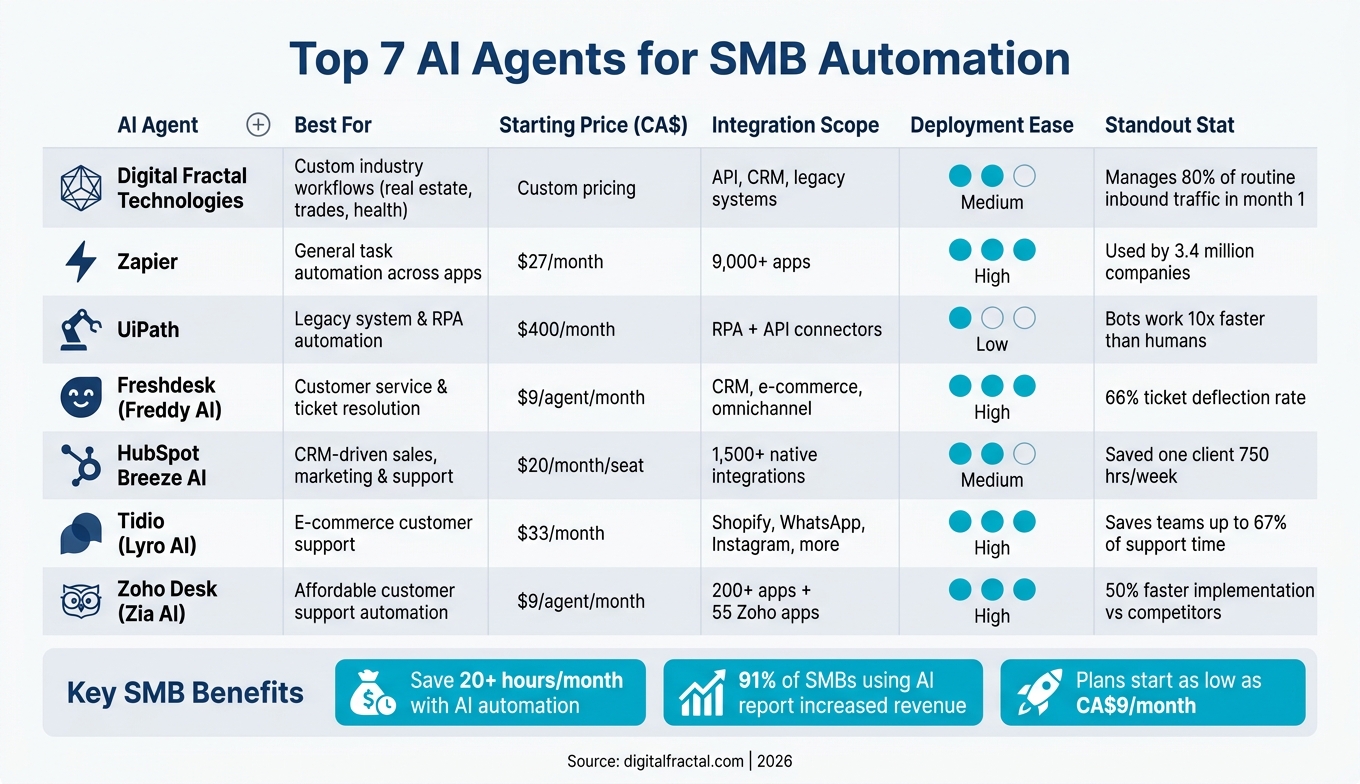
Top 7 AI Agents for SMB Automation: Side-by-Side Comparison
With seven tools to consider, the best choice depends on your business’s daily needs. The table below compares each platform across four essential dimensions for small and medium-sized businesses (SMBs): automation scope, workflow integration, customer service capability, and ease of deployment.
| AI Agent | Automation Scope | Workflow Integration | Customer Service Capability | Ease of Deployment |
|---|---|---|---|---|
| Digital Fractal Technologies | custom-built; tailored to your digital transformation workflows | API integrations, custom CRM, legacy app migration | AI chatbots, bespoke support tools | Medium–High (guided implementation) |
| Zapier | General automation across 8,000+ apps | Extensive app ecosystem integration | Basic agent-based interactions | High (no-code, natural language) |
| UiPath | RPA; excels with legacy desktop software | UI-based automation without requiring API access | Fewer customer service features | Low (technical, enterprise-grade) |
| HubSpot Breeze | CRM-native – prospecting, support, and data quality | Deep integration within the HubSpot ecosystem | Built-in CRM logging for every interaction | Medium (requires HubSpot stack) |
| Tidio (Lyro AI) | E-commerce focused; capable of solving up to 67% of queries autonomously | Multichannel support (WhatsApp, Messenger, Instagram) | Strong performance for retail and e-commerce support | High (plug-and-play) |
Each platform offers unique benefits tailored to different business needs.
Zapier stands out for its vast connectivity, offering automation across over 8,000 apps. It’s a strong choice for businesses looking for easy-to-deploy, no-code solutions. Tidio, on the other hand, shines in the e-commerce space, providing multichannel support and handling a high volume of customer queries autonomously. If your business relies on legacy desktop software, UiPath is a niche solution, though it requires more technical expertise for deployment.
For companies seeking a custom solution, Digital Fractal Technologies is a standout. It builds automation tailored to your workflows, whether that means creating a custom CRM, an AI chatbot, or automating processes that off-the-shelf tools can’t handle. While this approach involves guided implementation, it’s accessible even for teams without developers on staff.
Pricing varies widely among these tools. Zapier offers a Pro plan starting at around CA$29.99/month, while Tidio’s Lyro AI add-on is priced at CA$39/month. HubSpot Breeze sits at the higher end, with advanced features requiring plans near CA$1,170/month. UiPath, being enterprise-focused, starts above CA$400/month. Meanwhile, Digital Fractal Technologies provides custom pricing that adapts to your project’s scope. Matching these price points with your SMB’s specific needs will help you make the most informed decision.
Conclusion
Pick an AI agent that aligns with your specific business needs. There’s no universal solution – different tools shine in different areas.
For customer service, options like Tidio (Lyro AI), Freshdesk (Freddy AI), and Zoho Desk stand out, with pricing starting at around CA$9 per agent per month. If your team already uses HubSpot, Breeze offers a seamless CRM-integrated option.
When it comes to automating tasks across multiple apps, Zapier is a standout, connecting over 8,000 apps without any coding. On the other hand, UiPath is better suited for more complex automation projects, though it may require some technical expertise for implementation.
If your workflows are too specific for off-the-shelf tools, Digital Fractal Technologies Inc can create custom solutions, such as tailored CRMs or AI chatbots, to fit your operations perfectly.
The benefits of adopting AI agents are clear. According to Intuit, small and medium-sized businesses (SMBs) can save up to 12 hours per month by automating repetitive tasks like FAQs, ticket routing, or appointment scheduling. Start small and expand to more intricate workflows as you go.
FAQs
What’s the difference between an AI agent and a chatbot?
AI agents and chatbots may seem similar, but they differ significantly in terms of autonomy and complexity. Chatbots are typically limited to predefined scripts or rule-based responses, making them ideal for straightforward tasks like answering FAQs.
AI agents, on the other hand, are autonomous systems capable of reasoning, adapting, and handling multi-step workflows independently. This ability makes AI agents a better fit for automating more intricate processes, particularly in small and medium-sized businesses looking to streamline operations.
Which AI agent is best for my SMB’s workflow?
The right AI agent for your small or medium-sized business (SMB) depends entirely on what you need to automate. If you’re looking for an all-in-one solution to handle tasks like customer support, sales, and workflow updates, Lindy.ai stands out as a strong option. On the other hand, for app integration or team-focused automation, platforms like Zapier Central and CrewAI are great alternatives. Ultimately, your choice should reflect your business goals and budget to ensure it fits smoothly into your operations.
How do I estimate ROI before rolling out an AI agent?
To figure out ROI, use this formula: (Financial Gain − Investment Cost) ÷ Investment Cost. For small and medium-sized businesses (SMBs), this means estimating factors like time saved, revenue growth, and deducting the costs of the AI tools.
Look at how much efficiency improves – whether it’s through cutting down on manual work or boosting sales – over a trial period. By tracking actual time saved and revenue increases during this phase, you can confirm if the benefits will outweigh the expenses before committing fully.