7 Automation Use Cases for Logistics Teams That Deliver ROI in 90 Days

Logistics automation delivers measurable gains in delivery speed, cost control, and forecast accuracy across seven core use cases: route optimization, warehouse robotics, SKU-level demand forecasting, predictive maintenance, control tower visibility, last-mile orchestration, and back-office document automation. Each targets a specific bottleneck, and each pays back fastest when piloted narrowly before scaling.
TL;DR:
- Successful automation requires high-quality, real-time data and system integration, especially for dynamic routing and predictive maintenance use cases.
- Warehouse robotics and SKU-level demand forecasting show the fastest ROI when implemented at high-volume, high-margin operations with stable processes.
- AI-driven decision-making is most effective when paired with clean data and clear escalation paths, particularly for anomaly detection and demand prediction.
- Pilot projects should focus on one lane or SKU segment, with measurable KPIs and human oversight initially, to avoid scope creep and failure.
- An AI Readiness Audit helps identify the most suitable, scalable use case based on data quality and operational complexity before starting deployment.
Table of Contents
- What Logistics Automation Use Cases Actually Cover
- 1. Route Optimization And Dynamic Dispatch
- 2. Warehouse Automation: Robotic Picking, Packing, And AGVs
- 3. Inventory Optimization And SKU-Level Forecasting
- 4. Predictive Maintenance And Vehicle Health Automation
- 5. Shipment Lifecycle Automation And Control Towers
- 6. Last-Mile Automation: Driver Apps, ePOD, And Delivery Orchestration
- 7. Automating Back-Office Workflows: Documentation, Quoting, Invoicing, And AP
- How An AI Readiness Audit Finds Your Best Pilot
- Benefits, Challenges, And Best Practices For Rolling This Out
- Integrating IoT Sensors For Real-Time Monitoring
- Where AI And Machine Learning Actually Change Decisions
- Automating Reverse Logistics And Returns Management
- Where Blockchain Fits In Logistics Automation
- Case Studies Across Different Industries
- Expert Perspective: Prioritizing Automation Opportunities In 2026
- Get Your AI Readiness Audit Before You Pick A Pilot
- Sources
What Logistics Automation Use Cases Actually Cover
Not every automation problem needs the same tool. Robotic process automation (RPA) handles repetitive, rules-based tasks like data entry between systems. Robotics and AGVs move physical goods inside a warehouse. Transportation and yard management system (TMS/YMS) automation governs dispatch, tracking, and dock scheduling. AI agents and forecasting engines handle the messier, probabilistic work: predicting demand, reading unstructured emails, flagging anomalies before they become failures.
The split matters because deterministic tasks (moving a pallet from A to B) tolerate rigid rules, while probabilistic tasks (will this SKU sell out next Tuesday) need models that learn from data. MIT Sloan’s analysis of AI in logistics points to generative AI now solving routing problems faster than traditional optimization methods, a shift from support tool to primary decision driver.
Before any of the seven use cases below work, you need:
- Clean, timestamped transaction and telemetry data (not spreadsheets updated weekly)
- API or middleware access into your TMS, WMS, or ERP
- A defined owner for exception handling once automation flags something
- A pilot lane, SKU segment, or facility small enough to fail safely
1. Route Optimization And Dynamic Dispatch
Route optimization automates the sequencing and assignment of stops based on traffic, time windows, and vehicle capacity, recalculating in real time as conditions shift. Dynamic dispatch matters most when order volume is unpredictable or service windows are tight, retail delivery, food and beverage, field service. Static routing built the night before fails the moment a customer reschedules.
The data inputs are specific: live telematics feeds, order time windows, driver hours-of-service limits, and vehicle capacity constraints. Skip any one of these and the optimizer produces routes that look efficient on paper and fall apart on the road.
Pilot steps:
- Select two to three lanes with high stop density and frequent schedule changes
- Integrate telematics and order data into the routing engine before touching driver apps
- Run parallel (old process plus new) for two weeks to catch edge cases
- Measure against baseline before full rollout
Pro Tip: Layering an optimization agent on top of your existing routing algorithm, rather than replacing it outright, tends to outperform a full rebuild. Google Cloud’s case study with FM Logistic found evolutionary optimization agents layered on existing baselines produced double-digit routing improvements at warehouse scale.
Track miles saved, fuel consumption, on-time-in-full (OTIF) rate, and driver utilization. A scheduling agent built for logistics dispatch can absorb the recalculation load that used to sit with a human dispatcher juggling three phones.
2. Warehouse Automation: Robotic Picking, Packing, And AGVs
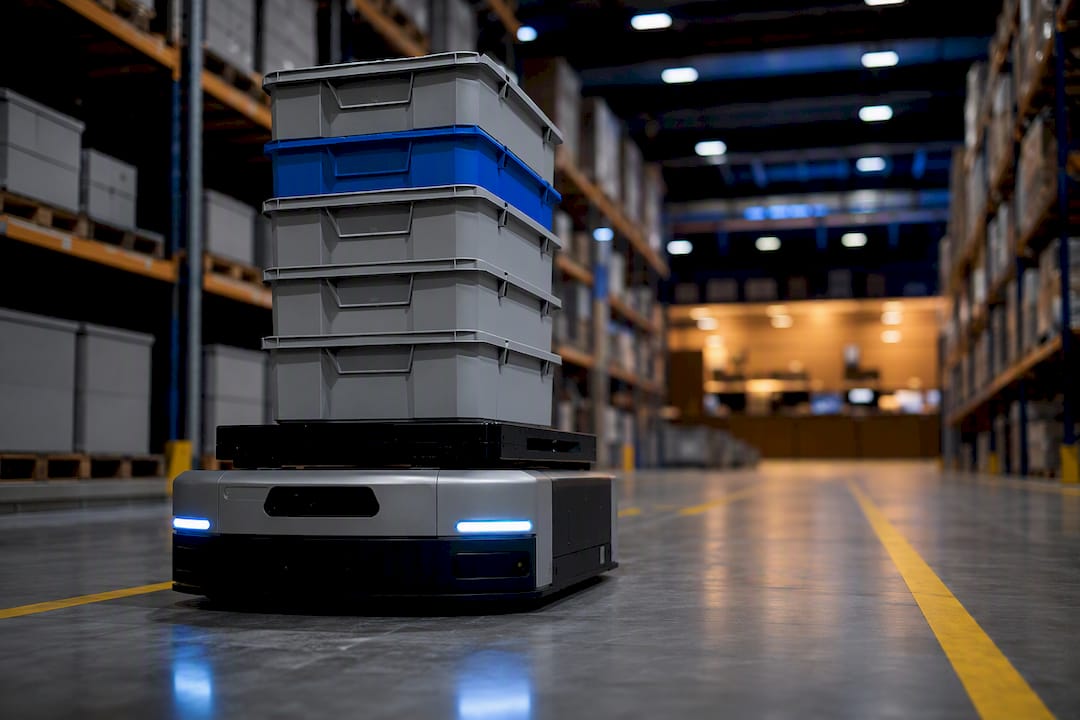
Robotics and automated guided vehicles (AGVs) earn their cost fastest in high-touch, repetitive, high-volume environments, think e-commerce fulfillment with hundreds of SKUs moving through the same zones daily. Below a certain throughput threshold, the payback period stretches past what most operations teams will tolerate.
Amazon’s public rollout illustrates the scale this technology has reached: the company deployed its one millionth warehouse robot in 2025 alongside generative AI models tuned for warehouse decision-making. Most mid-size operations won’t run at that scale, but the underlying signal, that robotics has moved from experimental to standard infrastructure, holds regardless of size.
Before installing anything, confirm:
- Your WMS can talk to the robot control system in real time, not batch overnight
- SKU-mix stability supports fixed picking zones (constant re-slotting kills AGV efficiency)
- Floor layout allows safe human-robot coexistence, not just robot-only zones
- Site changes (charging stations, aisle widths) are budgeted, not an afterthought
Pro Tip: Run the labor and accuracy comparison for 90 days before and after, not just cost per unit. Picking error rates often drop faster than labor hours in the first quarter, because robots don’t get tired on the tenth hour of a shift.
3. Inventory Optimization And SKU-Level Forecasting
SKU-level forecasting predicts demand for each individual item, at each location, rather than relying on category or warehouse-wide averages. Aggregate forecasting smooths over the volatility that actually causes stockouts and overstock, so if you’re still forecasting at the category level, you’re already behind on accuracy.
Automating SKU-level demand forecasting logistics teams need requires several inputs beyond historical sales:
- Point-of-sale data at the SKU and location level
- Lead time variability by supplier, not a flat average
- Returns and cancellation rates (they distort naive sell-through numbers)
- Promotional calendars and seasonality flags
Automated replenishment triggers reorders when a SKU crosses a calculated threshold, and adjusts safety stock dynamically as demand variability changes, rather than using a fixed buffer set once a year and forgotten.
Pilot metrics that matter: weighted mean absolute percentage error (WMAPE) for forecast accuracy, stockout rate by SKU tier, and inventory turns. Teams running SKU-level inventory optimization typically start with their highest-velocity, highest-margin items rather than trying to model the entire catalog at once.
4. Predictive Maintenance And Vehicle Health Automation
Predictive maintenance monitors engine telemetry, brake wear sensors, tire pressure, and fault codes continuously, then converts abnormal readings into automated work orders before a breakdown happens on route. The alternative, fixed-interval maintenance, replaces parts that still have useful life and misses failures that don’t follow a schedule.
- Identify the signals worth monitoring: engine temperature trends, brake pad wear rate, battery voltage drop, and diagnostic trouble codes are the highest-value starting set
- Set alert thresholds that trigger a work order automatically in your maintenance management system (CMMS), not just a dashboard flag someone might miss
- Connect the work order to parts procurement so the part is ordered before the truck reaches the shop
- Track downtime hours avoided and cost per repair against your pre-automation baseline
ASME’s technical resources on industrial AGVs outline similar telemetry-to-maintenance patterns for warehouse equipment, not just over-the-road fleets. The same logic applies to conveyor motors and forklift battery systems.
Run the pilot on your highest-mileage or highest-failure-rate vehicle segment first. A pilot-first predictive maintenance framework gives you a smaller, faster feedback loop than trying to instrument an entire fleet on day one.
5. Shipment Lifecycle Automation And Control Towers
A control tower normalizes shipment events, pickup confirmed, in transit, delayed, delivered, into a single feed, then automates the monitoring and exception routing that used to require someone checking six carrier portals by hand. Event normalization is the unglamorous part that makes everything downstream work.
AI agents extend this further into email-to-order workflows. C.H. Robinson’s LangChain-based agent system now processes roughly 5,500 orders per day automatically, saving over 600 manual hours daily by reading incoming emails, extracting order details, and routing exceptions to a human only when the agent isn’t confident.
- Standardize event taxonomies across carriers before automating decisions on top of them
- Route exceptions by severity, not just by carrier or lane
- Give agents observability tooling so a human can trace why a decision was made
- Track exception rate, average resolution time, and dock dwell time as your core KPIs
Heineken’s unified TMS and control tower deployment cut excessive-stay payments by 28%, halved failed deliveries, and pushed automated route settlement from 70% to over 90% across more than 70 countries. That’s the compounding effect of getting event data standardized once and automating on top of it everywhere.
6. Last-Mile Automation: Driver Apps, ePOD, And Delivery Orchestration
Last-mile automation replaces phone calls and paper signatures with electronic proof of delivery (ePOD), automated ETA notifications, and dynamic reassignment when a driver falls behind schedule. Customers notice this layer more than any other, because it’s the part of logistics they actually see.
- ePOD captures signature, photo, and geolocation at the point of delivery, cutting billing disputes tied to “it never arrived” claims
- Automated ETA notifications reduce failed-delivery attempts by giving customers a real window instead of a vague all-day estimate
- Dynamic reassignment shifts a stop to a different driver mid-route when one falls behind, without a dispatcher manually rebalancing the board
Integration friction usually shows up in driver adoption, not the software itself. Drivers who’ve used the same paper manifest for a decade need a genuinely simpler app, not a more powerful one.
Pro Tip: *Measure failed-delivery reduction and on-time percentage separately.
Customer satisfaction scores tend to move faster than internal ops metrics after ePOD rollout, since the visible experience changes immediately even before backend processes catch up.
7. Automating Back-Office Workflows: Documentation, Quoting, Invoicing, And AP
Back-office automation targets the paperwork that eats hours without moving a single shipment: bill of lading (BOL) ingestion, invoice matching against contracted rates, and freight quoting that still involves someone reading a rate sheet manually.
- Start with BOL and invoice ingestion, since optical character recognition (OCR) paired with RPA handles structured document fields reliably
- Add classifiers to route unstructured documents (damage claims, accessorial disputes) to the right team automatically
- Integrate the output directly into your ERP or TMS so approved invoices post without manual re-entry
- Automate quoting for standard lanes, reserving human review for non-standard freight or new customers
Industry analysis on logistics automation identifies quoting, rate management, and shipment lifecycle documentation as some of the highest-impact, lowest-risk automation targets precisely because the data is already structured and repetitive.
Processing time per document, error rate, and days sales outstanding (DSO) are the three numbers that tell you whether the pilot worked. A drop in DSO of even a few days across your top 50 accounts often outweighs the labor savings on document processing alone, because it frees up working capital faster than any single cost-cutting measure in this list.
How An AI Readiness Audit Finds Your Best Pilot
An AI Readiness Audit exists because most logistics operators know automation would help but can’t tell which of the seven use cases above would pay back fastest for their specific operation. The audit maps your current data quality, system integrations, and manual workflow volume against the use cases most likely to produce a return within 90 days, rather than recommending a generic platform overhaul.
Two patterns show up repeatedly in early-stage automation work across logistics operators:
- A mid-size carrier consolidating dispatch and exception handling into one workflow can reclaim dozens of dispatcher hours per week that used to go into manual carrier follow-ups
- A distributor tightening SKU-level forecasting on its top revenue-generating items typically sees inventory turns improve within one to two quarters, without touching the long tail of slow-moving SKUs
Before a 90-day pilot starts, prepare:
- At least six months of clean transaction or telemetry history for the process you’re automating
- A named internal owner who reviews exceptions during the pilot window
- Access credentials for the systems the pilot needs to read from and write to
- Agreement on the two or three metrics that define success before day one, not after
Pro Tip: Governance matters more than most pilots budget for. Stanford HAI’s AI Index research points to data quality and iterative piloting, not model sophistication, as the real predictor of whether an AI deployment succeeds at scale.
Benefits, Challenges, And Best Practices For Rolling This Out
The benefits compound rather than stack in isolation. Faster routing reduces fuel spend and driver overtime. Better forecasting reduces both stockouts and the working capital tied up in excess inventory. Fewer manual documents mean fewer billing disputes, and fewer disputes mean faster cash collection. None of these gains sit in a silo, they feed each other once two or three pieces are running.
The most common failure mode isn’t the technology, it’s sequencing. Teams try to automate everything simultaneously, run out of internal bandwidth to handle exceptions, and the pilot collapses under its own scope before anyone can measure whether it worked.
Common challenges worth planning for:
- Data fragmentation. Order data in one system, telematics in another, and no clean join key between them stalls automation before it starts.
- Change resistance. Dispatchers and warehouse staff who’ve done a task manually for years will route around automation they don’t trust, quietly reverting to the old process.
- Integration debt. Legacy TMS and WMS platforms often lack modern APIs, requiring middleware that adds cost and latency nobody budgeted for.
- Exception overload. An automation that escalates too many edge cases to humans defeats its own purpose within weeks.
Best practices that actually hold up across pilots:
- Pick one lane, one facility, or one SKU segment, not the whole operation, for the first 90 days
- Define the two or three KPIs that prove success before writing a line of automation logic
- Keep a human reviewing exceptions for the first full cycle, even when the system seems confident
- Budget for legacy system integration work up front rather than discovering it mid-pilot
Integrating IoT Sensors For Real-Time Monitoring
Real-time inventory management and fleet visibility depend on sensor data flowing continuously, not on nightly batch updates that tell you what happened twelve hours ago. Temperature sensors on refrigerated trailers, weight sensors on pallets, and RFID tags on high-value inventory all feed the same underlying need: knowing the actual state of your goods right now, not at yesterday’s close of business.

The practical challenge isn’t the sensors themselves, it’s the middleware layer that translates raw sensor output into something your TMS or WMS can act on. A temperature spike on a refrigerated trailer is useless data if it sits in a vendor’s proprietary dashboard instead of triggering an alert inside the system your operations team actually watches.
Fleet telematics integration guidance for fleet managers covers the practical side of connecting GPS and sensor hardware into usable data feeds, which matters because sensor hardware without integration is just an expensive light blinking on a dashboard nobody checks.
Three sensor categories tend to deliver the fastest payback:
- Temperature and humidity sensors on cold-chain shipments, where a threshold breach needs to trigger an alert within minutes, not hours
- Location and geofencing sensors that flag when a trailer leaves an expected route or dwells too long at a yard
- Load and weight sensors that catch overloading or shifted cargo before it becomes a safety incident
Real-time monitoring only pays off when the alert reaches someone who can act on it immediately. A sensor network feeding a report nobody reads until Monday morning delivers none of the value real-time monitoring is supposed to provide.
Where AI And Machine Learning Actually Change Decisions
AI in logistics examples tend to cluster around three decision types: what to predict, what to prioritize, and what to automate outright. Machine learning models excel at prediction, demand, delay risk, maintenance timing, because they improve with more data and don’t need explicit rules for every scenario. Rules-based automation still wins for prioritization and execution, where the logic is well understood and doesn’t benefit from probabilistic guessing.
The mistake many operations teams make is treating AI as a replacement for judgment rather than an input to it. A demand forecast is a probability distribution, not a promise.
Where AI genuinely changes logistics process improvement outcomes:
- Anomaly detection catches a shipment behaving abnormally (unexpected route deviation, unusual dwell time) faster than a human scanning a dashboard would
- Dynamic pricing and rate prediction for freight procurement adjusts to market volatility in near real time instead of relying on quarterly rate reviews
- Natural language processing reads unstructured freight documents, emails, and customer service tickets, extracting the structured data buried inside them
The organizations getting real value aren’t the ones with the most sophisticated models. They’re the ones who paired a decent model with clean data and a clear escalation path for when the model is wrong.
Automating Reverse Logistics And Returns Management

Returns management is the part of logistics automation most companies bolt on last, and that sequencing mistake costs more than it should. Reverse logistics involves more decision points per unit than forward shipping: is the item resalable, does it need refurbishment, does it go back to the vendor, or does it get written off entirely.
Automating the intake decision, typically through a combination of barcode scanning, condition-assessment rules, and in some cases computer vision inspecting product photos, cuts the time an item sits in receiving limbo before a disposition decision gets made. Every day a returned item sits undecided is a day it isn’t back in sellable inventory or credited against a vendor claim.
The workflows worth automating first in reverse logistics:
- Automated return authorization, so customers get a shipping label without a support ticket sitting in a queue
- Condition-based routing rules that send resalable items back to inventory and damaged items to a separate disposition path automatically
- Vendor claim generation, which often stays manual for months after forward-shipping automation is already live, quietly leaking recoverable revenue
Returns volume tends to be lumpy and seasonal in ways forward shipping isn’t, which makes SKU-level forecasting for returns genuinely harder than forecasting outbound demand. A retailer with a January returns spike from holiday gifting needs different staffing and processing capacity than the rest of the year, and automation that doesn’t account for that seasonality will create backlogs precisely when volume peaks.
Where Blockchain Fits In Logistics Automation
Blockchain’s role in logistics automation is narrower than the early hype suggested, but it solves a specific problem well: creating a shared, tamper-resistant record of custody and condition across multiple parties who don’t fully trust each other’s systems. A shipment moving through three carriers, a customs broker, and a final-mile delivery partner generates five separate records today. Blockchain lets those parties write to one shared ledger instead.
The practical use cases that have held up are narrower than “blockchain will fix supply chains.” Provenance tracking for high-value or regulated goods, pharmaceuticals, luxury goods, certain food categories, benefits most, because the cost of a shared ledger is justified by the liability of getting provenance wrong. Smart contracts that automatically release payment once a delivery event is confirmed on-chain reduce the settlement disputes that plague multi-party freight arrangements.
Where it hasn’t delivered as promised: general-purpose supply chain tracking for low-value goods, where the integration cost and the need for every participant to adopt the same ledger outweighs the benefit over a well-built control tower and standardized event taxonomy. Most of the visibility gains companies actually experience come from the control tower and event-normalization work described earlier, not from a distributed ledger.
Treat blockchain as a targeted tool for specific custody and payment-settlement problems, not a general automation layer, and you’ll allocate the budget more accurately.
Case Studies Across Different Industries
The seven use cases above don’t apply evenly across industries. A retailer’s automation priorities look different from a manufacturer’s, and both differ sharply from an oil and gas logistics operation.
Retail and e-commerce operations lean hardest into warehouse robotics and SKU-level forecasting, because order volume and SKU count are both high and margins are thin enough that a few percentage points of inventory efficiency matter directly to profitability.
Manufacturing and industrial distribution tend to prioritize predictive maintenance and inbound logistics automation, since unplanned downtime on a production line or a delayed component shipment costs far more per hour than a delayed retail order does.
Food and beverage distribution, illustrated by Heineken’s control tower deployment referenced earlier, benefits most from unified visibility across primary and secondary distribution, where perishability and multi-tier distribution networks make manual coordination especially error-prone.
Oil and gas logistics carries unique constraints, remote locations, safety-critical equipment, and irregular demand patterns, that make predictive maintenance and IoT sensor integration disproportionately valuable compared to route optimization, which matters less when delivery windows are measured in days rather than hours.
The pattern across all four: the highest-value automation target is whichever process currently consumes the most manual hours relative to its complexity, not whichever technology sounds most advanced.
Expert Perspective: Prioritizing Automation Opportunities In 2026
Most prioritization frameworks miss the third variable. Everyone ranks automation opportunities by value and ease of implementation, then wonders why the “easy, high-value” pilot stalls. The missing factor is data readiness, specifically, whether the data feeding that use case is clean enough to trust without a human double-checking every output for the first month.
Route optimization and back-office document automation tend to score high on all three axes, which is why they’re usually the right first pilot regardless of what looks most impressive on a roadmap. SKU-level forecasting and predictive maintenance score high on value but often stumble on data readiness, since most operations discover their historical data has gaps nobody flagged until a model started producing obviously wrong predictions.
Keep humans in the loop anywhere the automation’s mistake is expensive or hard to reverse, a misrouted high-value shipment, a wrongly rejected return claim. Full automation belongs where mistakes are cheap and easily caught, like flagging a low-confidence email for review instead of silently misrouting it. Scaling past the pilot stage is a change-management problem as much as a technical one: the team that trusts the system after 90 days is the team that scales it well.
— Souhail
Get Your AI Readiness Audit Before You Pick A Pilot
Most logistics teams don’t fail at automation because they picked the wrong technology. They fail because they picked the wrong starting point, and spent budget on a use case their data wasn’t ready to support. Digitalfractal’s AI Readiness Audit exists specifically to fix that sequencing problem before a single dollar goes into implementation.
The audit maps your current systems, data quality, and manual workflow volume against the seven use cases covered here, then tells you which one has the best combination of value, ease, and data readiness for your specific operation. Unlike a generic consulting engagement, the output is a scoped 90-day pilot plan with defined success metrics and a governance model built around your existing team, not a rip-and-replace platform migration. If your logistics operation is losing hours to manual dispatch, forecasting guesswork, or document processing, request an AI Readiness Audit and get a prioritized pilot roadmap within weeks, not quarters.
Sources
- How artificial intelligence is transforming logistics — MIT Sloan
- How C.H. Robinson automates 5,500 shipments daily with LangChain AI agents — TheApplied
- How FM Logistic tackled the traveling salesman problem at warehouse scale with AlphaEvolve — Google Cloud blog