
How AI Enhances AML Transaction Monitoring

AI helps AML teams cut alert noise, rank risk better, and spot patterns that fixed rules often miss. In many setups, rule-based monitoring creates 90% to 95% false positives, while AI-assisted monitoring has been shown to cut that by 50% to 70% over time.
If I had to sum up the article in plain terms, it comes down to this:
- Rules alone are not enough. They catch thresholds, but they often miss customer context.
- Data quality comes first. If KYC, transaction, device, and geography data are incomplete or inconsistent, AI will not help much.
- AI works best in layers. Machine learning, anomaly detection, and link analysis each catch different types of risk.
- Behaviour-based scoring helps reduce low-value alerts. It looks at what is normal for a customer or peer group, not just a dollar amount.
- Governance matters as much as the model. Firms need testing, explainability, version control, drift checks, and human review.
- The goal is not to replace analysts. The goal is to help them spend more time on higher-risk cases.
A few points stand out right away.
Canadian firms deal with large numbers of transactions every day, and some trigger FINTRAC reporting rules, including cash or virtual currency transactions of CAD 10,000 or more within a 24-hour period. That scale makes manual review hard to sustain.
At the same time, AI is only as good as the data behind it. That means teams need clean records, linked customer and counterparty data, standard timestamps, country codes, and audit trails. Without that, the model may just create a different kind of noise.
Here’s the article’s core message in one line: use AI to add context, not to remove judgment. The best setup combines clean data, better alert ranking, and tight model control so investigators can make better calls with less wasted effort.
Banks’ Secret Weapon Against Money Laundering: Multi-Agent AI
sbb-itb-fd1fcab
2. Build the Data Foundation AI Needs
Once alerts start coming in, the next bottleneck is data quality. AI models can only work with the data they get. So before any model can score risk well, your institution needs complete, standardised data from every source that matters. Get this wrong, and AI won’t sharpen AML monitoring – it’ll just add more noise. One published playbook notes that mature AML programmes often keep missing or invalid KYC data below 5% of records.
Ingest and Normalise Transaction Data Across Systems
Bring in all relevant events: payments, wires, e-transfers, deposits, withdrawals, card activity, account changes, logins, ATM activity, device IDs, and channel data. Each record should land in a structured table with:
- a unique ID
- an ISO 8601 timestamp
- an ISO 4217 currency code
- links to customer and counterparty records
The tougher part is joining old core banking data with newer digital channel data. That usually means using a common data model through ETL or streaming pipelines. Deduplication often relies on composite keys like customer ID, account number, timestamp, amount, and counterparty, plus fuzzy matching on narrative fields to catch repeated or mirrored records. Country codes and province identifiers also need to line up across systems.
If that reconciliation work is sloppy, FINTRAC reporting quality suffers. Malformed or missing fields can lead to report rejections and regulatory findings. And if the inputs are inconsistent, the model learns from a messy picture and misses risk patterns.
Add Customer and Geographic Risk Context
Transaction data on its own doesn’t tell the full story. It needs customer and geographic context so risk scoring has something to anchor to. When you enrich each transaction with KYC and customer profile data – occupation, expected account activity, source-of-funds indicators, products held, PEP status, and past behaviour – the model has a baseline to tell the difference between a normal payroll deposit and something out of place.
Geographic context matters just as much. Tagging transactions with country, region, and sometimes city-level details for originators, beneficiaries, and intermediaries helps models spot flows like funds moving through several jurisdictions before landing at a final destination. Adding external risk feeds – high-risk jurisdiction lists, sanctions lists, and adverse media – gives the scoring more depth. Over time, models can learn what normal cross-border behaviour looks like for each customer segment, whether that’s import/export businesses or foreign students. Then unusual activity stands out faster.
Prepare Data for Real-Time Monitoring
Batch processing looks at transactions hours after they happen. For higher-risk activity – like a suspicious wire nearing settlement or a cash deposit over CAD 10,000.00 – that delay is a serious issue. Real-time monitoring needs low-latency streaming pipelines that validate, normalise, and enrich each event in seconds or minutes.
Data quality checks need to sit inside those pipelines, not off to the side. That includes schema validation, required-field checks, format rules, and business-rule constraints before any event reaches a model. Records that fail validation should be sent to a quarantine queue for review. Data lineage tracking – where each data point came from and how it changed – lets analysts trace an alert back to the source and gives regulators the audit trail they need.
With that data layer in place, the next step is ranking suspicious activity and cutting alert volume.
3. Use AI to Detect Suspicious Activity and Rank Alerts
With clean, enriched data moving through your pipelines, AI models can spot patterns that static rules often miss. They can connect signals across accounts, time periods, and jurisdictions.
Apply Machine Learning, Anomaly Detection, and Link Analysis
A layered AI approach tends to work best.
Supervised machine learning models learn from labelled historical data, including prior investigations and prior suspicious transaction reports. They then score new transactions based on how closely those transactions match confirmed suspicious activity. For structuring, these models can spot repeated deposits just below the CAD 10,000.00 reporting threshold, such as multiple CAD 9,800.00 cash deposits across different branches in a single week. For rapid movement of funds, they track transfer timing, hop count over 24–72 hours, and concentration in high-risk jurisdictions. For layering, they track transfer hops, counterparty churn, and shell-entity links.
Anomaly detection adds another layer by flagging behaviour that sits outside normal patterns, even when there is no labelled example. For instance, a retail client who suddenly sends multiple international wires above CAD 20,000.00 to unfamiliar counterparties may trigger an anomaly alert. That helps teams catch new typologies before they make their way into a rule set.
Network and link analysis brings in a third layer. It builds a graph of accounts, entities, transactions, and shared attributes such as phone numbers, addresses, and device IDs. This can expose hidden relationships that single-account monitoring may miss, including layering chains and mule networks. A mule network might look ordinary when you view each account on its own. But link analysis can reveal a hub-and-spoke pattern where many personal accounts receive small deposits and then funnel funds to a single cash-out account.
Used together, these methods turn raw transactions into ranked risk signals.
Cut False Positives Through Behavioural Scoring
Behavioural scoring helps deal with alert overload by moving away from static thresholds and toward dynamic, customer-specific baselines.
Instead of flagging any transaction above a fixed amount, the model compares current activity with what is normal for that customer and their peer group. A CAD 5,000.00 furniture purchase from a retail client with a history of occasional large purchases may score as low risk. The same amount could look very different if it were part of multiple incoming international wires totalling CAD 50,000.00 over a few days from unrelated entities.
Institutions also group customers by risk profile, such as:
- students
- salaried professionals
- retirees
- small businesses
That way, seasonal spikes are less likely to create extra alerts. AI-powered monitoring can reduce false positives by 50–80%, and some Canadian setups have cut rates from roughly 90% to 60% or less.
That means less noise before investigators even open a case.
Prioritise Alerts and Support Investigations
Once model scores are in place, the system can route alerts by urgency and typology. AI ranks alerts into high-, medium-, and low-priority queues. It can send complex international cases to specialists and sanctions-related alerts to dedicated units. High-risk alerts appear at the top of analyst dashboards with clear severity indicators and typology labels such as potential layering, structuring, or mule activity.
Each alert also includes tools that make the analyst’s job easier, including transaction summaries, network graphs, and plain-language reason codes. Examples include: "sudden increase in international wires to high-risk jurisdiction", "unusual cash deposit structuring below reporting threshold", or "transactions inconsistent with declared occupation."
These narratives help analysts document a clear, auditable rationale for escalations or closures. They also support regulatory expectations for explainable monitoring.
4. Deploy AI-Driven Monitoring With Governance and Controls
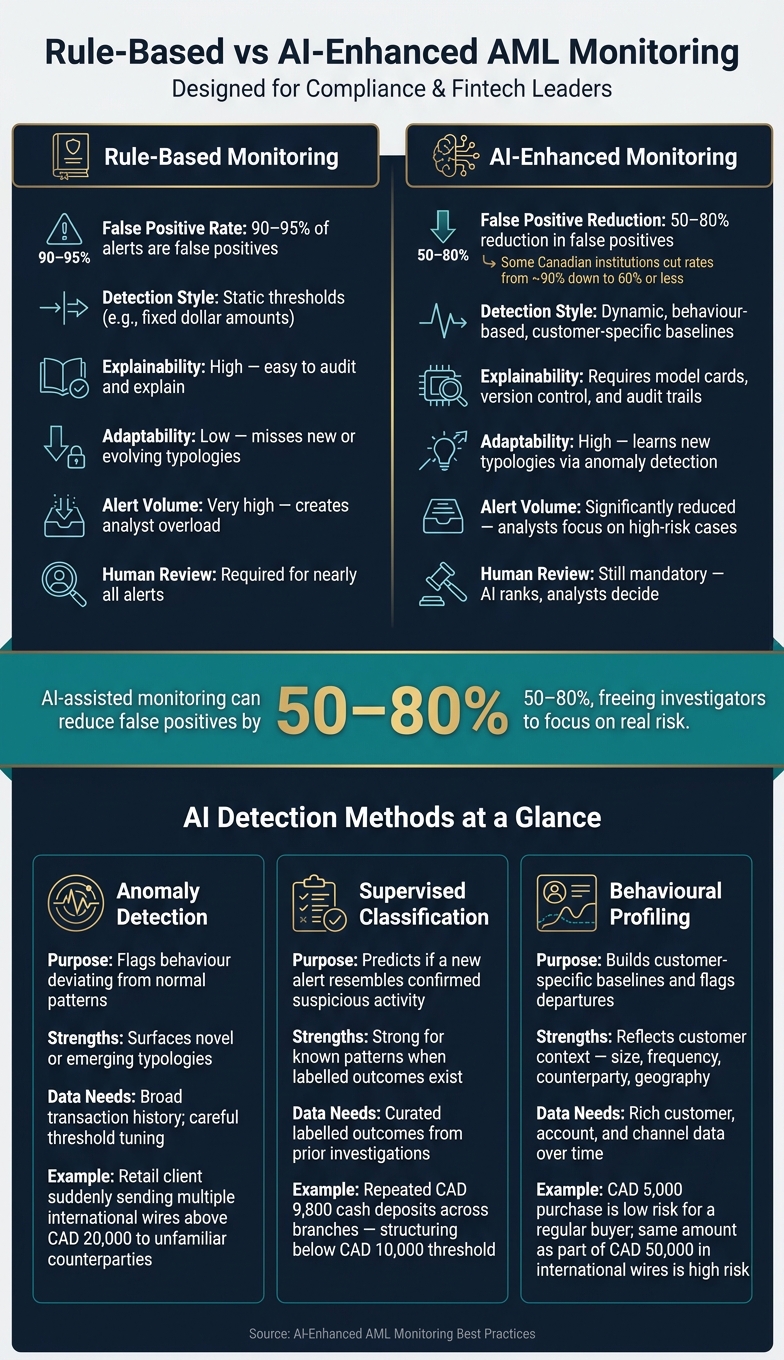
Rule-Based vs AI-Enhanced AML Monitoring: Key Differences & Performance Gains
Follow a Practical Rollout Sequence
Deploying AI in AML monitoring usually works best as a step-by-step rollout, not one big switch. A phased approach cuts operational risk and gives compliance teams time to trust the model before it affects live workflows.
Once alert scoring is in place, the next step is a controlled move from testing into production. In practice, that rollout usually follows a clear sequence.
- Validate live feeds, lineage, and exception handling before cutover. Data lineage should be documented from day one so teams can spot dropped or corrupted feeds.
- Define monitoring objectives and risk scenarios before choosing a model. That could mean lowering false positives, improving alert ranking, or finding new typologies.
- Match the model to the use case, test it on historical cases, then run it in parallel with current rules before any production change. The model is already producing ranked alerts. Deployment is about placing those rankings into a controlled workflow. Parallel testing gives teams a clean side-by-side comparison before anything changes in production.
- Review outputs and tune thresholds in repeated cycles. Investigators can flag false positives, missed alerts, and calibration issues, and that input should feed back into model updates.
After go-live, drift monitoring matters. Customer behaviour changes. Channels shift. Products change. If the model does not keep up, performance can slide.
Compare Rule-Based and AI-Enhanced Monitoring
For governance teams, the difference is not only about detection. It is also about control. Rule-based monitoring is easier to explain. AI can improve prioritisation, but it also calls for tighter validation, stronger records, and closer oversight.
The main AI methods differ in how they work and what data they rely on:
| Method | Purpose | Strengths | Data Needs |
|---|---|---|---|
| Anomaly detection | Flags behaviour that deviates from normal patterns | Useful for surfacing novel or emerging typologies | Broad transaction history; careful threshold tuning |
| Supervised classification | Predicts whether a new alert resembles confirmed suspicious activity | Strong for known patterns when labelled outcomes exist | Curated labelled outcomes from prior investigations |
| Behavioural profiling | Builds customer-specific baselines and flags departures from that baseline | Reflects customer context such as unusual size, frequency, counterparty mix, or geography | Rich customer, account, and channel data over time |
These methods work well together. The right fit depends on the job at hand: discovery, prediction, or customer-level context.
Set Validation, Explainability, and Risk-Based Oversight
Once a model is live, validation does not stop. It becomes a standing control, not a one-time go-live task. That usually includes back-testing against historical cases, checking false-positive and false-negative rates, and confirming that the model behaves in a steady way across customer segments and transaction volumes. Validation usually covers three parts: conceptual soundness, ongoing monitoring, and outcomes analysis, with outputs compared against actual investigation results.
After cutover, the focus shifts from pilot testing to day-to-day model control. Every stage should be documented. Institutions should keep model cards that cover data sources, features, limits, thresholds, and approvals. Version control and reproducible scoring methods are also key, because teams may need to rebuild past outputs during an examination. Institutions must also be able to show how AI models produce risk ratings and suspicious activity flags, with records updated at least once a year or after major model changes.
Risk-based oversight should scale with exposure. PEPs, complex ownership, and high-risk cross-border corridors need closer monitoring, along with products that allow fast movement or layering of funds. In those cases, AI can push alerts higher in the queue, but enhanced due diligence and human sign-off are still needed where the cost of a missed alert is highest. Human review remains mandatory. AI should support analyst judgment, not replace it.
5. Conclusion: Key Steps to Improve AML Monitoring With AI
AI-driven AML monitoring is an ongoing operating model, not a one-time project. The core idea is straightforward: each layer leans on the one before it. You get the best results when data quality, detection, ranking, and governance are built to work together.
The strongest programmes use AI to support human judgment, not take its place. AI can flag and rank activity. Analysts make the call.
Governance also can’t stop at go-live. Risk documentation needs regular updates so it reflects model drift, new typologies, and control changes. Before launch, teams should have a documented AI risk framework, named owners, data provenance records, and clear escalation thresholds in place. Governance should be treated as an operating control, not a box to tick once.
What Decision-Makers Should Do Next
Start with a frank review of your current AML monitoring setup and AI footprint. Create an inventory of every AI system in use, including third-party tools and embedded AI in SaaS platforms. Then pinpoint where data is incomplete, inconsistent, or split across systems. From there, classify each use case by risk materiality so high-impact systems receive the strictest review.
Next, put governance into day-to-day practice. Assign a clear risk owner outside IT for each high-impact system, define who reviews model outputs and how often, and set the thresholds that trigger re-validation or escalation. Documentation should stay live and current, not sit in a folder untouched, and it should change as model behaviour shifts.
Once that base is in place, use deployment readiness audits to spot gaps before deployment. After launch, keep watching for model drift and performance degradation. The teams that get the best outcomes keep compliance, operations, and technology aligned from day one, and through each model update that follows.
For teams ready to move from planning to deployment, execution support matters. Digital Fractal Technologies Inc provides AI consulting and custom development for compliance-heavy workflows.
FAQs
How much clean data does AI need to work well in AML monitoring?
There’s no fixed amount. In AML monitoring, AI tends to work best when it has broad, representative, and normalized data to learn from.
That means the data needs to be cleaned first. Duplicates, gaps, and inconsistent formats can throw things off fast. Most systems also need a 60- to 90-day baselining period to build dependable behaviour profiles.
After that, the work doesn’t stop. Regular validation and data cleanup help cut down on false positives and lower regulatory risk under PIPEDA.
Can AI catch suspicious activity that fixed AML rules usually miss?
Yes. AI can flag suspicious activity that old-school, rule-based AML systems often miss.
Fixed rules depend on static thresholds. AI works differently. It watches behaviour in real time, looks for odd activity and subtle patterns, and adds context to separate normal transactions from suspicious ones.
That means fewer false positives and more time for teams to focus on cases that may point to real risk.
How do firms keep AI-based AML monitoring explainable and compliant?
Firms keep AI-based AML monitoring explainable and compliant by pairing automation with human oversight. They use interpretable AI tools like SHAP and LIME so analysts can see what’s driving a risk score, sense-check the output, and confirm the result makes sense.
They also support compliance with PIPEDA by keeping documented decisions, maintaining detailed audit trails, running regular audits, carrying out human-in-the-loop reviews, and watching for model drift and performance issues over time.