
How AI Improves Credit Risk Assessment

AI can help lenders make credit decisions with more accuracy, more consistency, and less manual work. But that only happens when the data is clean, the model is checked, and the controls are in place.
If I boil this article down, here’s what matters most:
- AI helps estimate PD, LGD, and EAD with patterns older scorecards may miss
- Credit risk is more than scoring. It also includes underwriting, portfolio monitoring, and early warning signals
- Good data drives results: bureau files, income, debt ratios, collateral, and, where allowed, rent or utility payment data
- Common models include logistic regression, random forests, XGBoost, LightGBM, and, in some cases, neural networks
- Explainability matters: tools like SHAP and LIME help show why a model made a call
- Canadian lenders need controls tied to PIPEDA, OSFI guidance, audit trails, and named model owners
- After launch, teams need drift checks, bias reviews, retraining rules, and rollback plans
A few practical facts stand out. The article points to metrics like AUC-ROC, Gini, and KS for model testing. It also notes that model errors can affect loan pricing, approval rules, and reserve levels, which can lead to direct financial impact.
In plain terms, I’d say the article makes one point: AI does not fix weak credit processes on its own. It works best when data, model choice, explainability, privacy, and monitoring all work together.
Before getting into the detail, that’s the simple takeaway: if you want AI in credit risk, you need better prediction, clear reasons, and tight controls at the same time.
Credit Risk Assessment with AI | Exclusive Lesson
sbb-itb-fd1fcab
Data and predictive analytics in credit risk decisions
PD, LGD, and EAD estimates live or die on data quality, provenance, and lawful use. A credit risk model gets better only when the data going in is complete, current, and legally usable.
Core data sources used in credit models
Credit models usually pull from credit bureau records, income, employment, debt ratios, and collateral data. They also use macroeconomic variables with lag terms and, where permitted, rent, utility, and telecom payment records for thin-file applicants.
In Canada, lenders should document data provenance and consent so personal information is collected and used lawfully under PIPEDA. Model cards and data sheets help with that. They record training data sources, known limits, and intended use cases.
That matters for a simple reason: these inputs shape how well the model can tell higher-risk borrowers from lower-risk borrowers.
How predictive analytics workflows operate
The workflow usually starts with data cleaning, missing-value handling, and feature rescaling so one variable doesn’t overpower the model. From there, feature engineering adds interaction terms, quadratic and cubic terms, and macroeconomic lag variables to improve default and loss prediction.
A cluster then predict approach can improve fit by training separate models on more homogeneous borrower groups. Models should then be validated with train-test splits, cross-validation, and forward chaining for time-series data.
Performance is measured with AUC-ROC, the Gini coefficient, the KS statistic, and the effect of errors on required reserves. After deployment, teams should monitor drift against accuracy and fairness thresholds and schedule full model reviews.
Once the data pipeline is stable, model selection and underwriting design can follow.
AI models used in credit scoring and underwriting
Which models are used and why
No single model works for every credit scoring job. Once your features are in good shape, the next step is picking the model that gives you the right mix of accuracy, explainability, and underwriting speed.
Logistic regression is still a mainstay in production because its coefficients are easy to explain. That matters a lot when lenders need to show clear reasons behind a decision.
Gradient boosting models like XGBoost and LightGBM often perform best on tabular credit data, but they need extra explainability support. Random forests are also useful because they can handle non-linear relationships well.
Neural networks tend to make the most sense when lenders work with complex or unstructured inputs.
A cluster-then-predict approach can also lift accuracy while keeping the model easier to explain.
How AI supports underwriting operations
Model choice matters because underwriting value comes from both prediction and process automation. AI also helps with the day-to-day work inside underwriting. It can manage document intake and OCR for pay stubs, bank statements, and tax filings, automate income verification, and flag fraud in near-real-time.
That means routine checks can be automated, so human underwriters spend more time on exceptions and judgment calls.
There’s a catch, though. Those process gains only hold up with steady oversight. AI can improve adaptability and accuracy, but it also adds more governance and monitoring work. AI risk management needs input from legal, operations, compliance, and IT teams.
Governance, explainability, and Canadian compliance
Once AI starts shaping approvals and pricing, governance stops being a side task. It becomes part of day-to-day lending. If a model is going to support live lending decisions, it also needs to be explainable, auditable, and defensible across the full model lifecycle.
Model risk management and explainable AI
Use model cards and data sheets to document training data, intended use, assumptions, and known limits for audit review. This gives reviewers a clear record of what the model was built to do – and where it may fall short.
Explainability tools like SHAP (SHapley Additive exPlanations) and LIME (Local Interpretable Model-agnostic Explanations) help translate model outputs into plain-language feature drivers. That matters when internal teams need to review a decision, and it matters just as much when a regulator pushes back. If someone asks, “Why did this applicant get this outcome?”, you need more than a score. You need a trail that makes sense.
That’s why lenders should keep a full audit trail from data intake to final decision so each outcome is reconstructible for auditors.
Post-deployment monitoring also needs teeth. Teams should flag accuracy and fairness drift before the model touches more decisions. Set formal drift thresholds, review them on a schedule, and require retraining or rollback when those thresholds are breached.
Bias, fairness controls, and OSFI-related expectations
Bias can enter a credit model in a few familiar ways: historical data, feature selection, or the model’s objective. In Canada, production use depends on controls that meet both model risk and privacy duties. Canadian lenders should align AI credit models with PIPEDA, OSFI Guideline E-23, and internal model governance controls; AIDA remains paused.
A pre-deployment bias review is a sensible place to start. For any system that affects individual credit outcomes, that review should include a mandatory sign-off before go-live. To reduce bias, teams can use reweighing, constrained training, or calibration review, depending on data access, model complexity, and validation needs.
AI risk management also needs a named business owner, not a vague sense that “the team” owns it. Oversight should be shared across legal, operations, compliance, and IT. Assign a business risk owner to each material credit model, and swap static risk registers for central incident logs that track AI incidents and performance data so model drift is spotted earlier.
Implementing AI credit risk systems
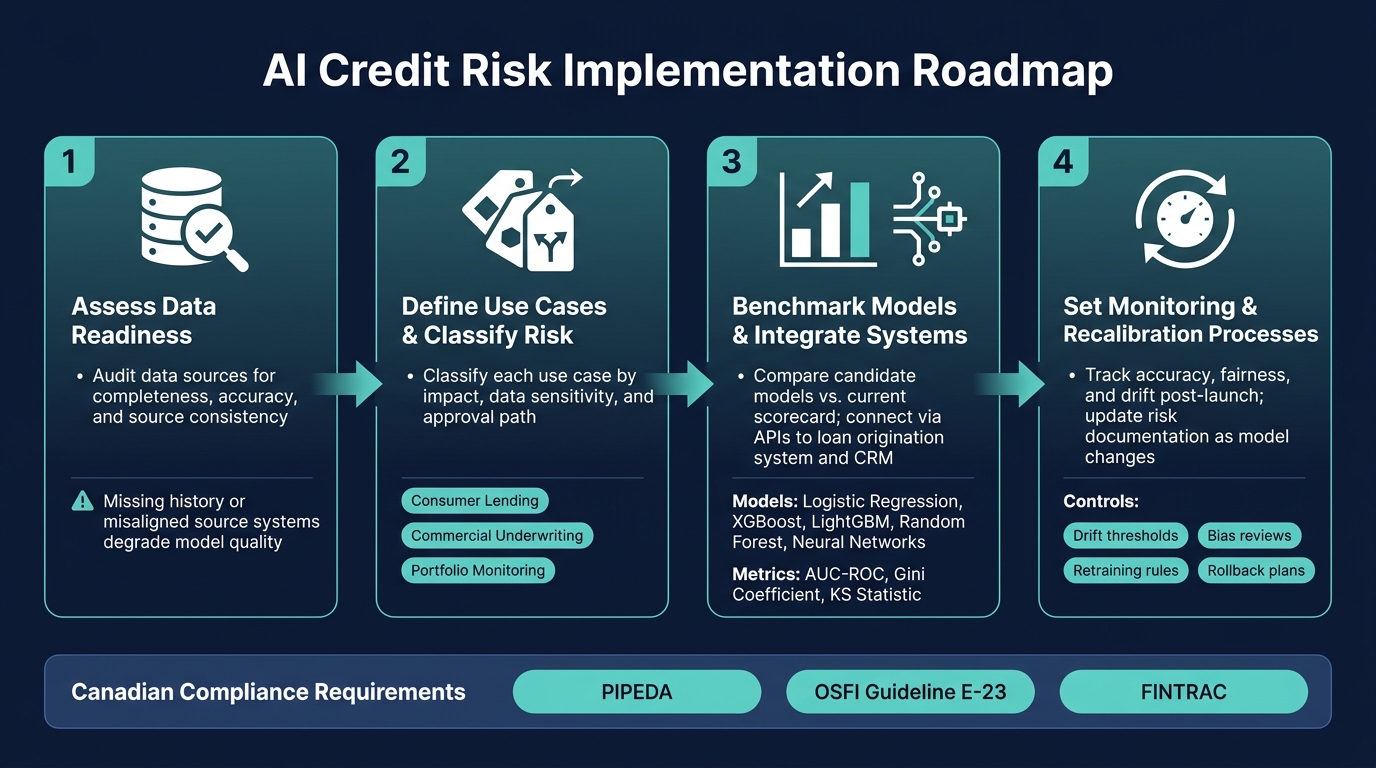
AI Credit Risk Implementation: 4-Step Roadmap for Lenders
Moving from model design to production takes clean data, clear governance, and deployment controls that can support PD, LGD, and EAD decisions. Once your data, models, and governance are set, implementation usually comes down to four steps.
A step-by-step implementation roadmap
The move from pilot to production follows a clear sequence. Skip a step, and the trouble often shows up at the worst time: after go-live.
- Assess data readiness: Before training any model, audit your data sources for completeness, accuracy, and source consistency. If history is missing or source systems don’t line up, model quality will suffer.
- Define use cases and classify risk: Classify each use case by impact, data sensitivity, and approval path before deployment. Decide early if the model will support consumer lending, commercial underwriting, or portfolio monitoring. Each one comes with different data needs and fairness concerns.
- Benchmark models and integrate underwriting systems: Compare candidate models against your current scorecard before replacing anything. Then connect the model to your loan origination system and CRM through APIs so teams don’t have to re-enter data by hand. This also sets up post-launch monitoring and recalibration.
- Set monitoring and recalibration processes: Track accuracy, fairness, and drift after launch, and update risk documentation as the model changes. These controls help keep the model ready for day-to-day use.
Where Digital Fractal Technologies Inc fits
If a lender needs help getting from plan to rollout, Digital Fractal Technologies Inc supports AI credit risk implementations through readiness audits, AI consulting, custom software development, workflow automation, and API integrations for loan origination systems and CRMs.
Conclusion: What it takes to improve credit risk assessment with AI
AI improves credit risk assessment only when data quality, model fit, explainability, fairness, and monitoring work together. In Canada, implementation also needs to align with PIPEDA, OSFI technology risk guidance, FINTRAC dimensions, and the federal Directive on Automated Decision-Making. Voluntary frameworks like the NIST AI Risk Management Framework can give teams a practical way to manage risk over time. The best results come when governance is treated as part of the system, not as something added later.
FAQs
How much data is enough to train a credit risk model?
There’s no fixed threshold. Strong credit risk models depend less on sheer volume and more on clean, representative data that follows Canadian privacy laws, such as PIPEDA.
A smart way to begin is with pilot projects. They let you test performance in a controlled setting before you scale.
After that, the work doesn’t stop. Ongoing monitoring, regular updates, and solid governance help manage model drift and keep accuracy on track as conditions change.
Can AI improve decisions for thin-file applicants?
Yes. AI can improve credit risk assessment for thin-file applicants because it can analyze larger and more varied data sets than rule-based systems.
That matters because thin-file applicants often don’t have enough standard credit history for older models to work well. AI can spot patterns those systems may miss, which can lead to more accurate risk forecasts and better data-driven decisions.
It can also help lenders make those calls while supporting compliance with Canadian regulatory standards.
How often should AI credit models be retrained?
AI credit models need close, ongoing oversight. A fixed retraining schedule sounds neat on paper, but it often misses what happens in the field: model performance can shift when input data changes or market conditions move.
That’s why continuous monitoring matters. Use feedback loops and automated tracking to watch for changes in accuracy and fairness against clear thresholds. When the model starts to drift beyond those limits, that’s the time to retrain – not just because a date on the calendar says so.
Digital Fractal Technologies Inc helps organizations spot model drift through regular updates, so custom AI solutions stay reliable and compliant.