Retrieval-Augmented Generation: How It Works and When to Use It

Retrieval-augmented generation (RAG) is an AI architecture that connects a language model to an external knowledge source at inference time, so the model answers using retrieved documents rather than relying solely on what it memorized during training. Choose RAG when your data changes frequently and retraining is impractical, when you need answers grounded in a private corpus (internal contracts, support tickets, proprietary manuals), or when your use case requires sourceable citations that users can verify. The tradeoff against fine-tuning is real and worth understanding before you commit to either path — more on that shortly.
Key Takeaways
Retrieval-augmented generation delivers the most value when your data changes faster than you can retrain a model, and a hybrid RAG plus fine-tuning approach consistently outperforms either method alone in enterprise settings.
| Point | Details |
|---|---|
| When to choose RAG | Use RAG when data changes frequently, answers require citations, or a private corpus must stay out of training. |
| RAG vs. fine-tuning tradeoff | Fine-tuning shapes model behavior; RAG grounds responses in current data. A 2024 study found the two methods are cumulative, adding roughly 6 and 5 percentage points of accuracy respectively. |
| Most important best practice | Measure retrieval recall@k independently before tuning prompts or swapping LLMs — a broken retriever cannot be fixed at the generation layer. |
| Hybrid architecture wins | Databricks and Google Cloud both recommend combining RAG with fine-tuning for the best long-term enterprise results. |
| Digitalfractal next step | Digitalfractal’s AI Audit and Opportunity Assessment maps your data and systems to a scoped RAG implementation with a 90-day delivery timeline. |
Table of Contents
- How does retrieval-augmented generation work step by step?
- What are the key components and architecture variants?
- Why do enterprise teams choose RAG over other approaches?
- What are RAG’s real limitations and risks?
- How to implement a RAG system from scratch
- How do you evaluate RAG quality and what metrics matter?
- Which tools and frameworks should you use for RAG?
- Where does RAG deliver the most measurable business value?
- When should you hire a consultant instead of building RAG in-house?
- What most teams get wrong about RAG in production
- Digitalfractal turns RAG complexity into a working system
- Primary sources and further reading
- Sources
How does retrieval-augmented generation work step by step?
The original RAG paper by Lewis et al. (2020) describes the core idea as combining a parametric language model with a non-parametric external memory accessed through retrieval at inference time. In practice, that translates to five pipeline steps every time a user submits a query.
-
Query embedding. The user’s query is converted into a dense vector using an embedding model (for example, OpenAI’s
text-embedding-3-smallor a Hugging Face sentence-transformer). This vector captures semantic meaning rather than exact keywords. -
Vector search and retrieval. The query vector is compared against pre-indexed document vectors in a vector database. The system returns the most similar passages, often a few, depending on context-window budget and latency targets.
-
Optional reranking. A cross-encoder reranker (such as Cohere Rerank or a fine-tuned BERT model) rescores the retrieved passages for relevance. This step is optional but meaningfully improves precision when the initial retrieval pool is noisy.
-
Prompt augmentation. Retrieved passages are concatenated into the prompt alongside the original query. A typical template looks like this:
-
Generation. The augmented prompt is sent to the LLM (GPT-4o, Claude 3.5, Llama 3, etc.), which generates a response grounded in the retrieved text.
Where latency hides. The embedding call and vector search together typically add 50–200 ms per request. Caching frequent query embeddings and running retrieval asynchronously alongside other pipeline steps cuts that overhead significantly. For high-throughput production systems, async retrieval is the first optimization worth making.
What are the key components and architecture variants?
Microsoft’s RAG overview lists the core building blocks as embeddings, vector storage, retriever, reranker, and generator. In practice, a production stack adds a few more layers.
Component map
- Chunking and tokenization. Raw documents are split into passages (typically 256–512 tokens with overlap). Chunk size is one of the highest-leverage tuning parameters in the entire pipeline.
- Embedding model. Converts chunks and queries into vectors. Dense models (OpenAI, Cohere, Hugging Face) capture semantics; sparse models (BM25) capture keyword overlap.
- Vector database. Stores and indexes embeddings for fast approximate nearest-neighbor search. Common choices: Pinecone, FAISS, Milvus, Weaviate.
- Retriever. The component that executes the search against the index and returns candidate passages.
- Reranker. A second-pass model that reorders retrieved passages by relevance before they enter the prompt.
- Context assembler. Formats retrieved passages into the prompt template, manages token budgets, and handles deduplication.
- LLM / generator. Produces the final response from the augmented prompt.
- Orchestration layer. Coordinates the pipeline steps, handles errors, logs traces, and manages retries. LangChain and LlamaIndex both operate at this layer.
Retrieval strategy comparison
| Dimension | Dense (semantic) | Sparse (BM25 / Elasticsearch) | Hybrid |
|---|---|---|---|
| Best for | Paraphrase and concept matching | Exact keyword and product-code lookup | General enterprise search where both matter |
| Cost and complexity | Embedding inference cost; vector DB hosting | Low infrastructure cost; standard inverted index | Moderate: two indexes, score fusion logic |
| Data freshness | Requires re-embedding on update | Near real-time index updates | Depends on the slower of the two indexes |
| Privacy / hosting | Self-hosted or managed (Pinecone, Weaviate) | Self-hosted (Elasticsearch, OpenSearch) | Typically self-hosted for compliance |
| Latency | 10–50 ms ANN search | Sub-10 ms for keyword lookup | Slightly higher due to fusion step |
Architecture variants
Classic RAG pairs an external retriever with a frozen LLM. The model has no special awareness of retrieval; it simply receives an augmented prompt. This is the fastest pattern to prototype and the right starting point for most teams.
Retrofitted retriever-aware models (like the original RAG-Token and RAG-Sequence variants from Lewis et al.) train the generator to condition on retrieved documents more tightly. These require more infrastructure and are rarely the first choice for enterprise teams working with commercial LLM APIs.
Hybrid RAG + fine-tuning is what Databricks recommends for the best long-term enterprise results: fine-tune the model for consistent tone, format, and domain vocabulary, then use RAG to ground responses in current or private data. The two approaches address different failure modes and complement each other well. Google Cloud’s guidance makes the same point: RAG handles freshness and private data at query time, while fine-tuning shapes behavior.
Why do enterprise teams choose RAG over other approaches?
- Access to current and private data. RAG connects the LLM to documents that were never in its training set — internal wikis, real-time pricing feeds, regulatory updates — without any retraining cycle.
- Reduced hallucinations (when retrieval is good). Grounding the generation in retrieved passages gives the model something concrete to work from. A support bot answering from a verified knowledge base produces far fewer fabricated policy details than a base LLM answering from memory.
- Lower cost than continuous retraining. Fine-tuning a 7B+ parameter model costs real money and time. Updating a vector index with new documents costs a fraction of that.
- Auditable citations. Because the source passages are explicit in the pipeline, the system can surface them to users. Legal research tools and compliance assistants depend on this property.
- Fine-grained access control. Document-level permissions can be enforced at retrieval time — a user only gets passages their role is authorized to see. That is structurally difficult to achieve with a fine-tuned model.
In practice: a financial services firm deploying an internal policy assistant can update its vector index overnight when regulations change, surface the exact regulatory clause that drove each answer, and restrict junior analysts from retrieving documents above their clearance level. None of that is straightforward with a fine-tuned model alone.
What are RAG’s real limitations and risks?
RAG improves grounding, but it does not fully eliminate hallucinations. Retrieval quality and context selection remain the most common failure modes. Here is what teams consistently underestimate:
- Retrieval errors propagate. If the top-k passages are wrong or irrelevant, the LLM generates a confident-sounding answer from bad evidence. Garbage in, garbage out — but with a citation attached.
- Inconsistent sources create contradictions. When the corpus contains outdated and current versions of the same document, the retriever may surface both. The LLM often averages them rather than flagging the conflict.
- Stale or malicious content. An unmonitored corpus can accumulate outdated policies or, in adversarial scenarios, injected content designed to manipulate retrieval (prompt injection via documents).
- Privacy leaks. Without row-level access controls, a user could retrieve documents they should not see simply by crafting a query that matches restricted content.
- Latency and operational overhead. Every RAG request involves at least one embedding call, one vector search, and one LLM call. That is three billable API calls and three potential failure points.
Mitigation in practice. Evaluate retrieval quality independently of generation quality — track retrieval recall@k on a held-out question set before you ever look at end-to-end answer quality. Reranking reduces the impact of noisy top-k results. Surfacing citations to end users creates a natural human check. For privacy, enforce document-level ACLs at the vector DB query layer, not just at the application layer. Provenance logging (recording which passages fed each answer) is non-negotiable for regulated industries.
Pro Tip: Set up a simple retrieval-failure alert: log queries where the top retrieved passage has a cosine similarity below 0.70 (or your calibrated threshold). A spike in low-similarity retrievals usually means your corpus has drifted from the query distribution — a signal to trigger a re-indexing or corpus audit before users start complaining about answer quality.
How to implement a RAG system from scratch
Microsoft’s pipeline documentation outlines the typical stages. Here is a practical checklist for engineering teams.
Phase 1: Data preparation
- Audit your data sources — identify formats (PDF, HTML, SQL, API), update frequency, and access controls before writing a line of code.
- Normalize formats: convert PDFs and HTML to clean text; strip headers, footers, and navigation boilerplate that adds noise without semantic value.
- Define a chunking strategy: start with 512-token chunks and 10% overlap. Test smaller chunks (256 tokens) for precise factual Q&A and larger chunks (1,024 tokens) for summarization tasks.
- Tag each chunk with metadata (source document, date, author, access tier) — you will need this for filtering and provenance logging.
Phase 2: Embedding and indexing
- Select an embedding model: run a quick benchmark on 100–200 representative queries against your corpus using OpenAI
text-embedding-3-large, a Cohere embed model, and a Hugging Facebge-large-enmodel. Pick the one with the highest retrieval recall@10 on your data, not on generic benchmarks. - Embed all chunks and push them to your chosen vector database. For prototypes, FAISS (local, free) is fine. For production with access controls and managed scaling, Pinecone or Weaviate are common choices.
- Build a BM25 index in parallel if your corpus has many exact-match queries (product codes, legal citations, proper nouns). Hybrid retrieval almost always outperforms pure dense retrieval on real enterprise corpora.
Phase 3: Retrieval and reranking
- Set
similarity_top_kto 10–20 for the initial retrieval pass, then rerank down to 3–5 passages for the prompt. Retrieving more candidates before reranking consistently improves final precision. - Integrate a cross-encoder reranker (Cohere Rerank, a fine-tuned
ms-marco-MiniLM, or a similar model). Measure precision@3 before and after — the lift is usually worth the added latency. - Add metadata filters to the retrieval query where possible (date range, document type, user role). Pre-filtering reduces the search space and improves relevance without touching the embedding model.
Phase 4: Prompt assembly and generation
- Define a prompt template with a hard token budget: reserve space for the system instruction, retrieved context, and the user query. A common split is 60% context, 20% system instruction, 20% query and response buffer.
- Deduplicate retrieved passages before inserting them — near-duplicate chunks waste token budget and can confuse the model.
- Choose your LLM based on latency and cost targets, not just capability. GPT-4o is strong but expensive at scale; Llama 3 70B self-hosted cuts per-token cost significantly for high-volume applications.
Phase 5: Testing and production configuration
- Run retrieval recall tests on a held-out Q&A set: measure recall@3, recall@5, and recall@10 before any generation.
- Run grounding tests: for a sample of generated answers, verify manually or with an LLM judge whether each claim is traceable to a retrieved passage.
- A/B test the RAG system against a baseline (same LLM, no retrieval) on factual accuracy and user satisfaction.
- Load-test the pipeline at 2x expected peak traffic. Vector search scales well horizontally; the LLM API is usually the bottleneck.
- Set up incremental indexing: new documents should flow into the vector DB within your freshness SLA (hourly, daily, or real-time depending on the use case) without requiring a full re-index.
- For legacy system integration, plan a data extraction layer that normalizes content from older formats (SharePoint, legacy CMS, on-premise databases) before it reaches the chunking pipeline.
How do you evaluate RAG quality and what metrics matter?
A RAG system has two distinct quality dimensions: retrieval quality and generation quality. Most teams only measure the second, which makes debugging nearly impossible.
Retrieval metrics
Recall@k measures whether the correct passage appears in the top-k retrieved results. This is the single most important metric to track before you touch generation. Precision of passages measures how many of the top-k results are actually relevant — a high-recall, low-precision retriever wastes token budget on noise.
Generation metrics
Groundedness (the percentage of answer claims that can be traced to a retrieved passage) is the metric that most directly measures hallucination risk. End-to-end factual accuracy requires a held-out Q&A set with known correct answers — measure this with an LLM judge or human raters. Latency per request and cost per request are operational metrics that determine whether the system is viable at scale.
Recommended experiments
Run synthetic held-out Q&A tests by generating questions from documents the model has not seen, then checking whether retrieval surfaces the right passage. Run cross-document evidence tests with questions that require synthesizing information from two or more documents — these expose weaknesses in context assembly. Adversarial retrieval tests (queries designed to surface irrelevant or contradictory passages) reveal robustness gaps. Freshness regression tests check that newly indexed documents are retrievable within your SLA.
Tuning priorities
Chunk size has an outsized effect on both retrieval recall and generation quality. Smaller chunks improve retrieval precision; larger chunks give the LLM more context per passage. The right size depends on your query type — test both before committing. Embedding model choice matters more than most teams expect: a domain-adapted model often outperforms a general-purpose one on specialized corpora. Reranking thresholds should be calibrated on your own data, not borrowed from a tutorial.
A 2024 experimental study reported that fine-tuning and RAG both produced noteworthy accuracy improvements on its test dataset, with evidence that the two approaches can be cumulative rather than substitutes in some configurations.
Which tools and frameworks should you use for RAG?
The RAG ecosystem has matured quickly. Here is how the main categories break down, with the tools that appear most often in production stacks.
Embedding providers
OpenAI’s text-embedding-3 family and Cohere’s Embed models are the most common managed options. Hugging Face hosts hundreds of open-weight sentence-transformer models (including bge-large-en and e5-mistral-7b) for teams that need self-hosted embeddings for privacy or cost reasons.
Vector databases
- Pinecone — fully managed, strong operational tooling, straightforward to scale. The go-to for teams that want to avoid infrastructure work.
- FAISS — Facebook AI’s open-source library, fast and free, but requires you to manage persistence and scaling yourself. Excellent for prototypes and offline batch pipelines.
- Milvus — open-source, cloud-native, built for billion-scale vector workloads. A strong choice when you need self-hosted control at scale.
- Weaviate — open-source with a managed cloud option; supports hybrid search (dense + BM25) natively and has a GraphQL API that some teams find easier to integrate.
Retrieval frameworks and orchestration
LlamaIndex treats retrieval as a first-class primitive — its ingestion pipelines, index abstractions, and query engines require significantly less glue code for document-heavy RAG workloads. LangChain gives more orchestration flexibility and is the better choice when your system involves multi-step agents, tool use, or complex conditional logic. Many production stacks combine both: LlamaIndex for ingestion and indexing, LangChain (or LangGraph) for agent orchestration around the retrieval step.
Microsoft’s Semantic Kernel is worth noting for teams already in the Azure ecosystem — it integrates tightly with Azure AI Search and Azure OpenAI, which simplifies compliance and access control in enterprise environments.
LLM providers and cloud platforms
OpenAI (GPT-4o, GPT-4o mini) remains the most common generation layer for commercial RAG deployments. Hugging Face provides the open-weight models (Llama 3, Mistral, Phi-3) that power self-hosted generation. Google Cloud offers Vertex AI with built-in RAG tooling and managed embeddings. AWS provides Bedrock, which supports multiple foundation models and integrates with Amazon OpenSearch for hybrid retrieval. IBM positions its watsonx platform for enterprise RAG with governance and explainability features aimed at regulated industries.
Integration patterns
Single-vendor managed stacks (Azure AI Search + Azure OpenAI, or AWS Bedrock + OpenSearch) reduce integration complexity and simplify compliance audits. Best-of-breed open-source stacks (LlamaIndex + Weaviate + Llama 3 on self-hosted GPU) maximize control and cut per-token costs at scale. Most enterprise teams start with a managed stack for speed, then migrate specific components to open-source as volume grows and cost becomes a constraint.
Pro Tip: Before committing to a vector DB vendor, test your actual query patterns against a 10,000-document sample. Benchmark latency at your expected p95 query rate, not just average latency — the difference between vendors at the tail is often larger than the average suggests.
Where does RAG deliver the most measurable business value?
Support and helpdesk automation
A support bot grounded in a verified knowledge base answers routine questions accurately without agent intervention. The measurable outcomes are lower average handle time and higher first-contact resolution rates. The key is keeping the knowledge base current — a stale corpus produces confident wrong answers, which is worse than no answer at all.
Legal and compliance research
Legal teams use RAG to search across contracts, case law, and regulatory filings with citation traceability. Every answer surfaces the exact clause or filing it came from, which is a hard requirement for legal work. This use case also benefits from hybrid retrieval: legal documents contain both semantic concepts and exact citation strings (case numbers, statute references) that BM25 handles better than dense retrieval alone.
Enterprise knowledge search
Large organizations with thousands of internal documents — policies, SOPs, technical manuals — spend significant time on information retrieval that RAG can automate. A well-built internal search assistant reduces the time employees spend hunting for the right document version, and the access-control layer means sensitive documents stay restricted.
Research and literature triage
In healthcare, finance, and engineering, teams use RAG-powered assistants to triage large document sets quickly — surfacing the most relevant papers, reports, or filings for a given question. The AI productivity gains documented across agency workflows apply here: faster literature triage means faster decisions.
Industries that benefit most
Professional services, legal, finance, healthcare, and any knowledge-heavy enterprise team with a large, frequently updated document corpus are the clearest beneficiaries. The common thread is a combination of high document volume, frequent updates, and a need for traceable, auditable answers.
When should you hire a consultant instead of building RAG in-house?
DIY RAG is feasible for a team with strong ML engineering skills and a well-defined, small-scale use case. For most enterprise teams, the following conditions make a consulting engagement the faster and lower-risk path.
Hire a consultant when:
- Your team lacks hands-on experience with embedding models, vector databases, or retrieval evaluation — the learning curve is real and the failure modes are subtle.
- Your use case involves sensitive data, regulated industries, or compliance requirements (HIPAA, SOC 2, GDPR) where access controls and provenance logging need to be designed correctly from the start.
- You have a large legacy document corpus in mixed formats (PDFs, SharePoint, legacy CMS, on-premise databases) that requires a non-trivial ingestion and normalization pipeline.
- You need a production SLA on latency or availability and do not have the infrastructure team to design and maintain it.
- Your roadmap includes combining fine-tuning with RAG — the hybrid pattern requires coordinating two separate training and deployment cycles, which adds significant complexity.
- You need results within a defined timeline and cannot afford months of internal experimentation.
A short client brief for a RAG engagement should include:
- Project goals and the specific questions the system needs to answer
- Estimated corpus size and document formats
- Required freshness SLA (real-time, daily, weekly)
- Latency and throughput targets (p95 response time, queries per second)
- Security and access control requirements
- Success metrics (retrieval recall@k target, end-to-end accuracy target, user satisfaction score)
Digitalfractal’s AI implementation case studies show the pattern consistently: teams that start with a structured audit of their data, systems, and requirements ship working RAG prototypes faster than teams that start with code. The enterprise AI strategy framework Digitalfractal uses covers exactly these readiness dimensions before any implementation begins.
What most teams get wrong about RAG in production
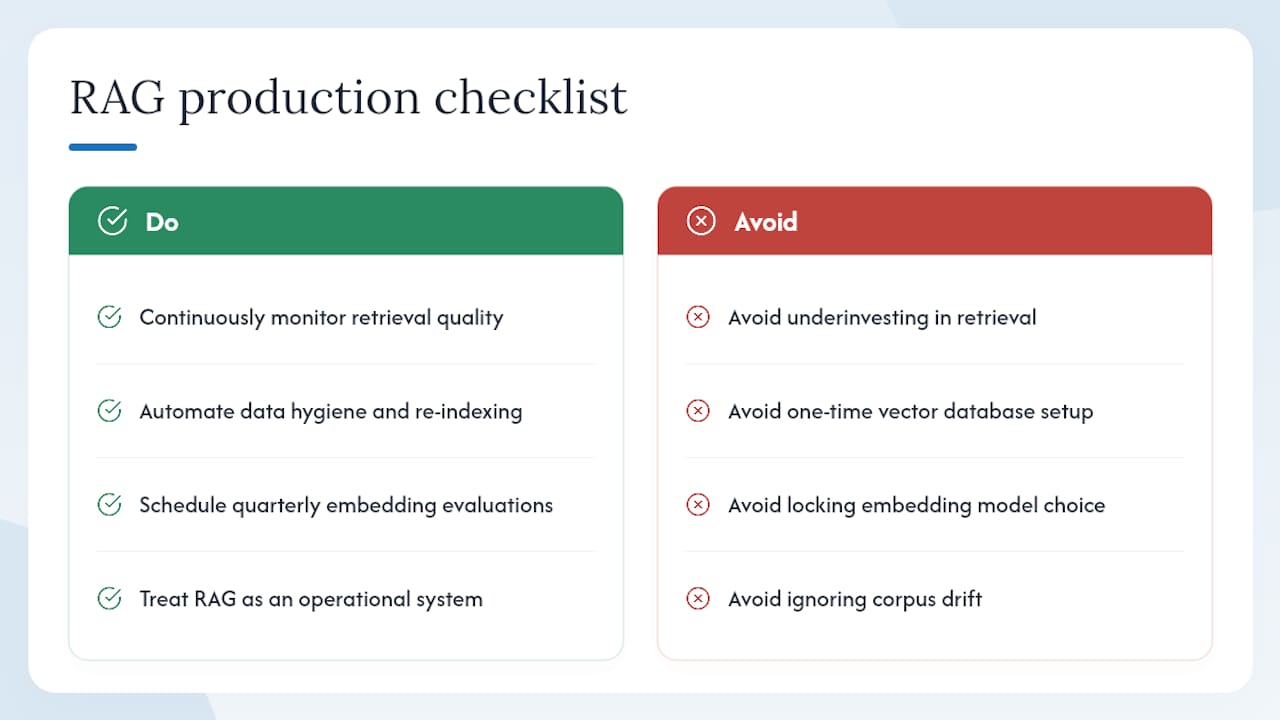
The retrieval step gets underinvested. The generation layer cannot compensate for a broken retriever.
The second consistent mistake is treating the vector database as a one-time setup. Corpora drift. Documents get updated, deprecated, or contradicted by newer versions. Without an automated data hygiene pipeline that flags stale content and triggers re-indexing, the system degrades quietly over months. Users notice before the engineering team does.
One pattern that comes up repeatedly in enterprise deployments: teams launch with a single embedding model and never revisit that choice. Six months later, a domain-adapted model that did not exist at launch time would outperform the original by a meaningful margin on their specific corpus. Building in a periodic embedding model evaluation — even a quarterly benchmark on a held-out query set — catches this before it becomes a user experience problem.
The deeper issue is that RAG is not a product you deploy once. It is an operational system that requires ongoing retrieval quality monitoring, corpus maintenance, and periodic re-evaluation of every component in the stack. Teams that treat it as a one-time build consistently underperform teams that treat it as a living system.
Digitalfractal turns RAG complexity into a working system
Most enterprise teams know what RAG should do. The gap is between a working prototype and a production system that handles real document volumes, access controls, latency SLAs, and ongoing corpus maintenance. Digitalfractal’s AI Audit and Opportunity Assessment maps your existing data, systems, and workflows to identify exactly where a RAG implementation creates the most value — before you commit to a build. From there, the engagement moves to a scoped prototype and full implementation, with a 90-day delivery timeline and measurable success criteria defined upfront.
If your team is evaluating RAG for a support, search, or compliance use case, start with the audit. It takes the guesswork out of architecture decisions and gives you a concrete roadmap. Use the Digital Transformation Roadmap Generator to get a first-pass view of where RAG fits in your broader AI adoption plan.
Primary sources and further reading
The sources below are the authoritative starting points for anyone who wants to go deeper on RAG theory, implementation, and tooling — from the original research paper through vendor documentation and practical framework comparisons.
| Source | What it covers |
|---|---|
| Lewis et al. (2020) — original RAG paper | Foundational architecture: parametric LM + non-parametric retrieval at inference time |
| Microsoft Learn — RAG overview | Pipeline stages, building blocks, and Azure implementation patterns |
| Google Cloud — To tune or not to tune | RAG vs. fine-tuning decision framework and hybrid guidance |
| Databricks — RAG vs. fine-tuning | Enterprise decision framework; when to start with RAG and when to combine approaches |
| Arxiv | Empirical accuracy gains from fine-tuning and RAG in combination |
| LangChain vs. LlamaIndex — BytePointer | Framework tradeoffs for retrieval-first vs. orchestration-first architectures |
| LangChain vs. LlamaIndex 2026 — PremAI | Production RAG comparison with guidance on combining both frameworks |
| Wikipedia — Retrieval-augmented generation | Balanced overview including limitations and common failure modes |
Sources
- Retrieval-augmented generation overview (Microsoft Learn)
- RAG vs Fine Tuning: Enterprise Decisions for AI Models and AI Systems | Databricks Blog
- Arxiv
Recommended
- Importance of Creating a Generative AI Strategy | Digital Fractal
- Generative AI in Mobile UX Design
- Case Study Archive – AI Automation & Intelligent Systems in Canada | AI Agents, Workflow Automation & App Development | Digital Fractal Edmonton, Alberta, Canada
- Ultimate Guide to Software Documentation with AI