
Legal Insights into Blockchain DRM in Media

Blockchain DRM can track licences and payments. It cannot replace legal checks. Before launch, I would verify rights, keep personal information off-chain and check that the code follows the signed agreement.
My Canadian launch checklist covers five areas:
- Rights and proof: Check ownership, permitted uses, moral rights and territory limits. A ledger record alone does not prove ownership.
- Contracts: Set licence terms, correction rules and a process for complaints. Owning a token does not transfer copyright.
- Privacy: Identify the laws that apply, limit data collection and plan for access requests, deletion and breaches.
- Royalties: Confirm payees, payment splits, taxes and usage data. Test payment errors and disputed amounts before sending funds.
- Governance: Name who can pause access, correct records and resolve disputes. Test provider exits and recovery.
My bottom line: <u>clear the rights, protect the data and assign responsibility before switching on access or payments</u>. This is general information; get Canadian legal advice for your project.
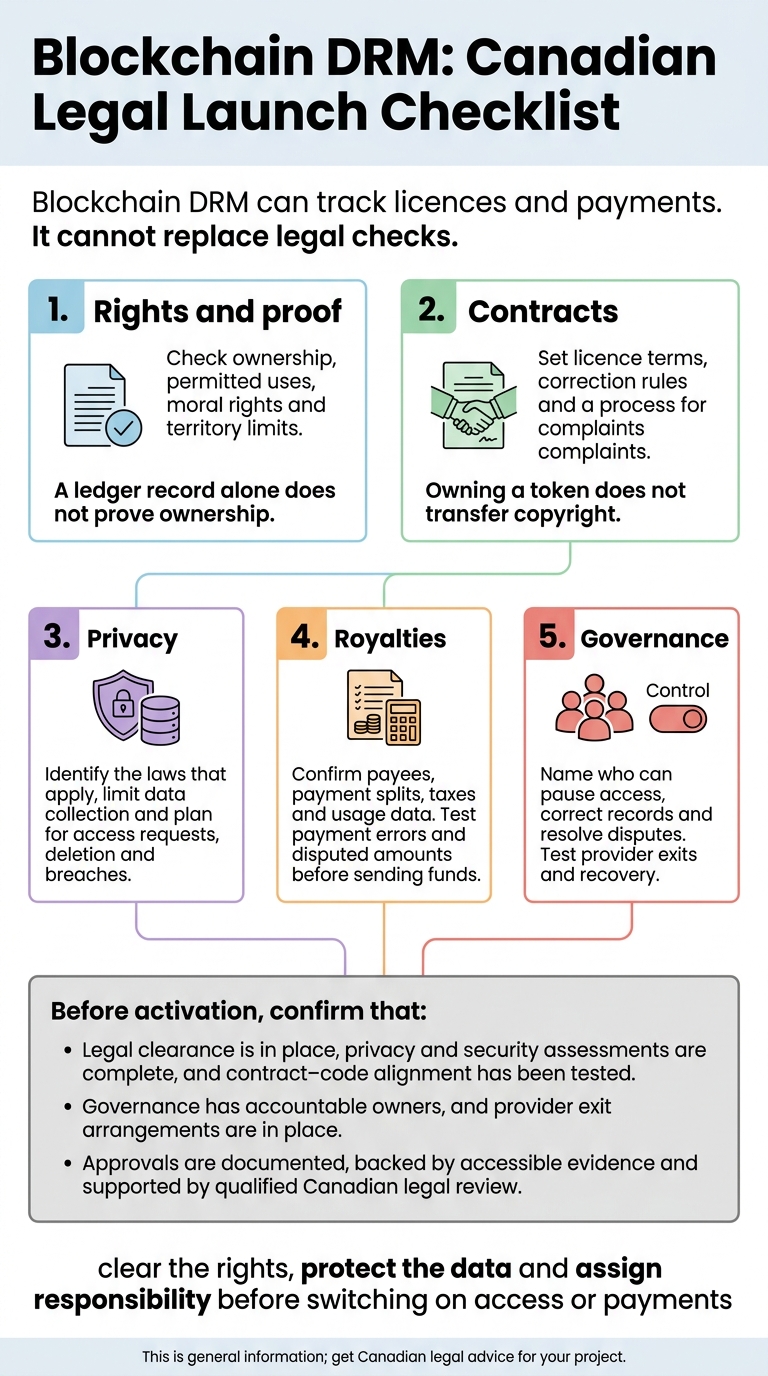
Blockchain DRM: Canadian Legal Launch Checklist
Canadian Copyright and Licensing Rules
Verify Rights and Permitted Uses
A ledger entry records a claim; it does not prove that a use is licensed. Clear the rights for each component separately: music, artwork, performances, recordings and broadcast-related rights. Check assignments, licences, releases and collective-management mandates for conflicting grants or restrictions. Record the confirmed rights holder and renewal date before enabling access.
Back code rules with written terms covering reproduction, streaming, downloads, public performance, broadcasting, territory, term, audience, exclusivity, sublicensing and assignment. Owning a token does not, by itself, transfer copyright. An assignment requires a written agreement that meets applicable formalities – not just token metadata. Before distributing across borders, get legal review in each target jurisdiction. Canadian clearance and geolocation controls do not establish permission elsewhere.
Moral Rights, Access Limits and Complaints
Even a valid licence can fall short if it leaves out attribution, integrity or complaint handling. Address attribution, integrity and consent as separate licence terms. Moral rights cannot be assigned, and any waiver must specify its scope and beneficiaries. Assess fair dealing and other statutory exceptions without assuming they allow users to bypass a technological protection measure. Fair dealing depends on the purpose and circumstances. Criticism or review also requires the prescribed source and attribution information.
Blockchain records may be disputed after launch. Set up separate workflows for ownership disputes, infringement complaints and metadata corrections. Collect evidence, preserve records, notify affected parties and allow counter-evidence before suspending or restoring access. Under Canada’s notice-and-notice regime, qualifying providers forward notices and keep records; they have no automatic duty to take content down.
Align Smart Contracts with Legal Agreements
Back the code with a written agreement covering rights, limits, warranties, remedies, termination, governing law and dispute resolution. Automate only clearly defined obligations. Before users agree, disclose expiry, territory limits, recurring charges and refund terms. Keep evidence of the version they accepted.
Specify whether the written text or code takes priority, who can pause execution, how errors are corrected and how amendments are approved. Review applicable electronic-commerce, consumer-protection and language requirements. Version the agreement and code together so code updates cannot silently change the licence.
Once the licence text and code match, check what data the workflow collects and stores.
sbb-itb-fd1fcab
Privacy Duties and Blockchain Data
Identify the applicable privacy law before collecting production data for blockchain DRM. This includes viewing data, wallet addresses, payment details and rights metadata. PIPEDA usually applies to commercial collection, use and disclosure, including many interprovincial and cross-border transactions. Substantially similar provincial private-sector laws may apply instead to activity within a province.
Public-sector bodies must check the relevant federal, provincial or territorial privacy and access-to-information laws, along with any employment, health or education rules. Record the operator, activity, jurisdiction and data flows, and confirm which rules are in force at publication.
Map Personal Information and Data Flows
Map every blockchain DRM data field that affects access, rights and payment. Your data inventory and flow diagram should cover creator identities, rights metadata, tax and payment details, audience accounts, viewing histories, wallet addresses, device identifiers, IP addresses and location data.
For each field, record its purpose, source, legal authority or consent basis, recipients, storage location, retention period and deletion method. Also show who can see ledger records, where nodes are located, and how overseas processing, backups and vendor access work.
Complete a privacy impact assessment (PIA) before deployment where required. If it isn’t mandatory, use it to document your risk review. Federal government policy requires PIAs in specified circumstances, including certain uses of personal information for administrative decisions.
Assess whether collection is needed, along with consent, safeguards, access and correction, retention, breach response and public-sector records duties. Notices should explain viewing-event tracking and wallet visibility. Accepting a platform’s terms does not authorise unrelated behaviour tracking.
Under PIPEDA, outsourcing processing does not remove accountability. Contracts should cover permitted uses, subcontractors, security, breach notification, audit rights, help with access requests, deletion and exit support. Assess foreign access risk and disclose material overseas processing.
Set up an incident process for containment, evidence preservation, risk assessment and required notifications. Logs should identify affected databases, wallets, nodes and vendors.
Keep Personal Information Off-Chain
| Approach | Legal benefit | Residual privacy risk | Recommended control |
|---|---|---|---|
| Personal information directly on-chain | Shared integrity and auditability | Lasting exposure; difficult correction or deletion | Avoid unless a documented need and legal review justify it |
| Protected off-chain records | Supports correction, deletion and retention limits | Breaches, insider access and vendor dependence | Minimise fields; encrypt; restrict and audit access |
| Hashes of off-chain records | Verifies integrity without publishing source records | Linkability and guessing attacks against predictable inputs | Assess re-identification; use keyed or salted constructions where appropriate |
| Pseudonymous wallet identifiers | Reduces direct exposure of names | Accounts, payments and activity patterns can identify users | Restrict linking records and unnecessary metadata |
| Access-controlled ledger | Limits participation and visibility | Members and vendors can still copy or combine records | Define read permissions, node locations and retention responsibilities |
Hashes and wallet addresses may still be personal information. Keep an authoritative off-chain record, and test access, correction and deletion with test identities before launch. Revoke linked access and address vendor copies and backups.
For existing on-chain data, assess linkability and the lawful basis for retention. Immutable records cannot simply be erased, and encryption or key destruction does not meet every deletion duty. Document exceptions, response timelines and escalation routes. These controls shape what data can be used for royalty calculation and payment.
Royalty Automation and Payment Contracts
Royalty automation turns licensed use into payment triggers – but only for rights already cleared in the contract. It applies the contract; it doesn’t settle disputed rights or fix invalid usage data. Once the licence scope is clear, link each payment trigger to the approved uses.
Set Royalty Calculations and Payment Terms
Define the royalty base: gross receipts, net receipts, per-use fees, or a minimum guarantee plus usage charges. Set out permitted deductions, approved rights holder splits, taxes, withholding, payment thresholds, statement dates and payment deadlines. Record the settlement currency, exchange-rate source and conversion date.
Use Canadian-dollar reporting, such as CAD $1,250.00.
Give rights holders audit access to supporting records. Set reserve limits and release dates, failed-transfer retry rules, and the point at which a payment counts as received.
Before activating payouts, check applicable Copyright Board tariffs, collective licences and statutory remuneration rights. A wallet address doesn’t bypass those obligations.
For token or cryptoasset settlement, get Canadian tax, payments and financial-regulatory advice. Specify valuation timing, network fees, custody responsibilities and any right to CAD payment. The CRA generally treats cryptoasset payments for goods or services as barter transactions; GST/HST valuation may also apply. These payment rules depend on accurate usage data.
Manage Usage Data and Off-Chain Inputs
An oracle is a trusted feed of off-chain facts, such as usage counts or exchange rates. Use the off-chain usage records already covered by your privacy controls. Inaccurate, late, manipulated or incomplete inputs can produce wrong payments – even when the code works correctly.
Assign reporting, reconciliation, validation and settlement to named roles. Define outage and force-majeure procedures, fallback sources, holds for disputed inputs and applicable contract versions.
Authorised human corrections should require approval, supporting evidence, a timestamp and an audit log. Even irreversible transfers may require repayment or an offset.
Royalty Checks Before Activation
Use a signed launch checklist to confirm rights and territories, documented split approvals, verified payees and reconciled usage records. Test calculations, rounding, refunds, withholding, failed payments, feed outages and contract-version changes. Keep a payment log linked to the governing clause.
Before activation, agree on correction and overpayment-recovery procedures, dispute notice and response deadlines, continued payment of undisputed amounts, escalation roles and the payment-dispute forum.
If a provider fails or a record is disputed, the controls must already specify who can act. The next control point is who can pause, correct or recover the system when inputs, vendors or payments fail.
Governance, Provider Risks and Launch Checks
Assign Governance and Dispute Roles
Put responsibilities in writing before launch. Create a matrix with one accountable owner for each area: rights, data, payments, security and dispute response.
Identify who approves rights and metadata, runs the DRM service, controls administrator keys, approves upgrades, suspends access and corrects records. Also assign responsibility for validating usage data, processing payments, investigating incidents and preserving evidence.
Include licensors, distributors, operators, developers, infrastructure providers, payment processors, identity providers and auditors. For each role, name the organisation, authorised personnel, backup approver, response deadline and escalation route.
Signed agreements should set out governing law, dispute forums, liability and evidence-preservation duties. Specify which chain and contract version apply after a fork, who approves migration and what happens when an agreement ends. Governance rules and provider exit terms must line up. Don’t promise reversals or suspensions across the entire network: independent participants may not comply.
Provider Contracts and Exit Plans
Turn the responsibility matrix into contract duties, recovery steps and exit rights. Cover service levels, security, subcontractors, processing locations, incident notices, audit rights, indemnities and liability caps.
Map dependencies across hosting, wallets, identity services, oracles and media distribution platforms. Require arrangements to keep services running, help during termination, and exports of rights records, payment history, logs and off-chain evidence links. Test exports and recovery before launch.
Use the checklist below as the final launch gate.
Conclusion: Legal and Technical Launch Checklist
Before activation, confirm that:
- Legal clearance is in place, privacy and security assessments are complete, and contract–code alignment has been tested.
- Governance has accountable owners, and provider exit arrangements are in place.
- Approvals are documented, backed by accessible evidence and supported by qualified Canadian legal review.
FAQs
Who is liable if blockchain DRM blocks a lawful use?
Liability depends on the legal agreements governing the deployment. Smart contracts run automatically, but they can contain bugs or produce unintended results. They also don’t carry the same legal weight as conventional signed contracts.
Each deployment should have a formal written agreement that sets out the governing law, liability and dispute resolution under Canadian law. Without one, blockchain records that cannot be changed can leave errors and financial losses permanent and hard to resolve.
How can I handle deletion requests for on-chain data?
Blockchain records are immutable and permanent. That creates a conflict with privacy regulations like PIPEDA, which allow individuals to request deletion of their personal information.
Digital Fractal Technologies Inc recommends a hybrid approach: keep all personally identifiable information (PII) off-chain in secure, conventional systems. Store only cryptographic hashes on-chain, or use zero-knowledge proofs. This approach maintains privacy compliance while retaining blockchain functionality and transparency.
What can I do if a smart contract mispays royalties?
Back every smart contract deployment with a written legal agreement. Smart contracts don’t carry the same legal weight as signed agreements, and blockchain records can’t be changed. The agreement sets out governing law, liability and dispute resolution under Canadian rules.
Digital Fractal Technologies Inc’s expertise in custom software development and workflow automation helps organizations build strong security frameworks into their digital systems and align those systems with clear, enforceable legal terms.