
90 Day Vendor Neutral Roadmap to AI Purchase Order Matching for AP

Purchase order matching AI automates the reconciliation of invoices against purchase orders and goods receipts, pushing match rates higher while cutting the volume of exceptions that land on someone’s desk. Instead of a clerk manually checking every line, the system flags only genuine discrepancies. You’ll learn how the technology works, which matching type fits which spend category, and how to roll it out without breaking your AP process.
TL;DR:
- AI purchase order matching improves line-item accuracy and inference of matches when invoices lack clear PO references, reducing manual review.
- Three-way matching is standard for inventory and tangible goods, with AI inferring matches from delivery timing and vendor history when receipts are missing.
- Most exceptions stem from price, quantity, or missing receipt discrepancies, which are minimized through configurable tolerance rules and targeted exception routing.
- Data quality, vendor master consistency, and procurement habits heavily impact AI matching effectiveness and project success timelines.
- Implementation typically takes around 90 days from audit to rollout, with measurable gains in cycle time, exception closure rate, and dollars saved from overpayments.
Table of Contents
- How Does AI Purchase Order Matching Actually Work?
- Two-Way, Three-Way, or Four-Way: Which Matching Type Fits?
- What Exceptions Come Up Most, and How Does AI Resolve Them?
- What Systems Need to Connect for AI Matching to Work?
- How Do You Evaluate an AI PO Matching Solution?
- What Does a Realistic Implementation Timeline Look Like?
- Where Does the Real ROI Come From?
- Get Your PO Matching Roadmap Built Right the First Time
- Sources
How Does AI Purchase Order Matching Actually Work?
The process starts with getting data into a structured, comparable format. Invoices arrive as PDFs, scanned images, or EDI feeds, and the system has to turn that mess into fields it can act on before any comparison happens.
- Document capture and extraction: OCR pulls raw text off scanned or image-based invoices, while ML and LLM-based extraction models identify structured fields (vendor, PO number, line items, unit price, quantity) even when layouts vary wildly between suppliers. This is the same extraction discipline covered in invoice data extraction work.
- Fuzzy matching and normalization: Vendor names get standardized, unit-of-measure conversions get applied, and line items get aligned even when descriptions don’t match word for word.
- Reasoning over ambiguity: This is where AI earns its keep over older rule-based systems. Some AI models can identify matching purchase orders and order lines even when a vendor’s invoice omits a clean PO reference, effectively inferring the right match from context clues like vendor, amount, and delivery date, according to Microsoft’s documentation on its Payables Agent feature.
- Business rules and tolerance thresholds: Once fields are extracted and aligned, configurable rules decide what counts as a match, what falls within acceptable variance, and what needs a human.
Document-model approaches take this further by extracting invoice, PO, and delivery-note lines together and aligning them directly for three-way matching, which supports near-real-time reconciliation and posting into the ERP, according to Data Alchemy’s technical overview. The practical difference from legacy rule engines is that AI systems don’t just check if field A equals field B. They weigh probability across several signals at once, which is why they catch matches that exact-string logic would reject outright.
Two-Way, Three-Way, or Four-Way: Which Matching Type Fits?
Not every purchase needs the same level of scrutiny, and forcing every transaction through the strictest check just creates unnecessary bottlenecks.
- Two-way matching compares the invoice against the purchase order only, checking price and quantity. It works well for services, subscriptions, or anything without a physical delivery to verify.
- Three-way matching adds the goods receipt into the comparison, confirming that what was ordered, invoiced, and physically received all line up. This is the standard for tangible goods and inventory purchases, and automated three-way matching flags discrepancies at the line level before payment, which helps finance teams avoid overpayments and catch fraud risk early, according to Stampli’s explainer on the process.
- Four-way matching layers in a quality inspection step, typically reserved for regulated industries or high-value capital goods where a receipt alone doesn’t confirm the item met spec.
AI adds real value on the receipt side specifically: when a receipt hasn’t been logged yet, or a blanket PO covers multiple partial deliveries, the system can often infer a probable match from delivery timing and vendor history rather than stalling the invoice entirely. That inference is what separates AI-driven matching from a static rules engine, and it’s also why approval workflows need to route inferred matches differently than confirmed ones. Someone should still eyeball the low-confidence calls.
What Exceptions Come Up Most, and How Does AI Resolve Them?
Exceptions are the whole reason PO matching exists as a discipline. The goal isn’t zero exceptions. It’s making sure the ones that surface actually deserve human attention.
- Price variance: The invoiced unit price doesn’t match the PO price, often due to a supplier rate change that never got updated in the system.
- Quantity variance: Partial shipments, back orders, or a receiving error create a mismatch between ordered and invoiced units.
- Missing receipt: The invoice arrived before receiving logged the goods, which is one of the most common holdups in three-way matching.
- Mismatched or absent PO reference: The invoice cites the wrong PO number, or none at all, forcing a manual hunt through open orders.
Configurable tolerance rules solve most of the volume here. When something does need review, the routing matters as much as the flag itself. Good systems send the reviewer the linked PO, the invoice image, and a suggested resolution, so the person fixes the actual problem instead of just closing the ticket and letting the same supplier error repeat next month.
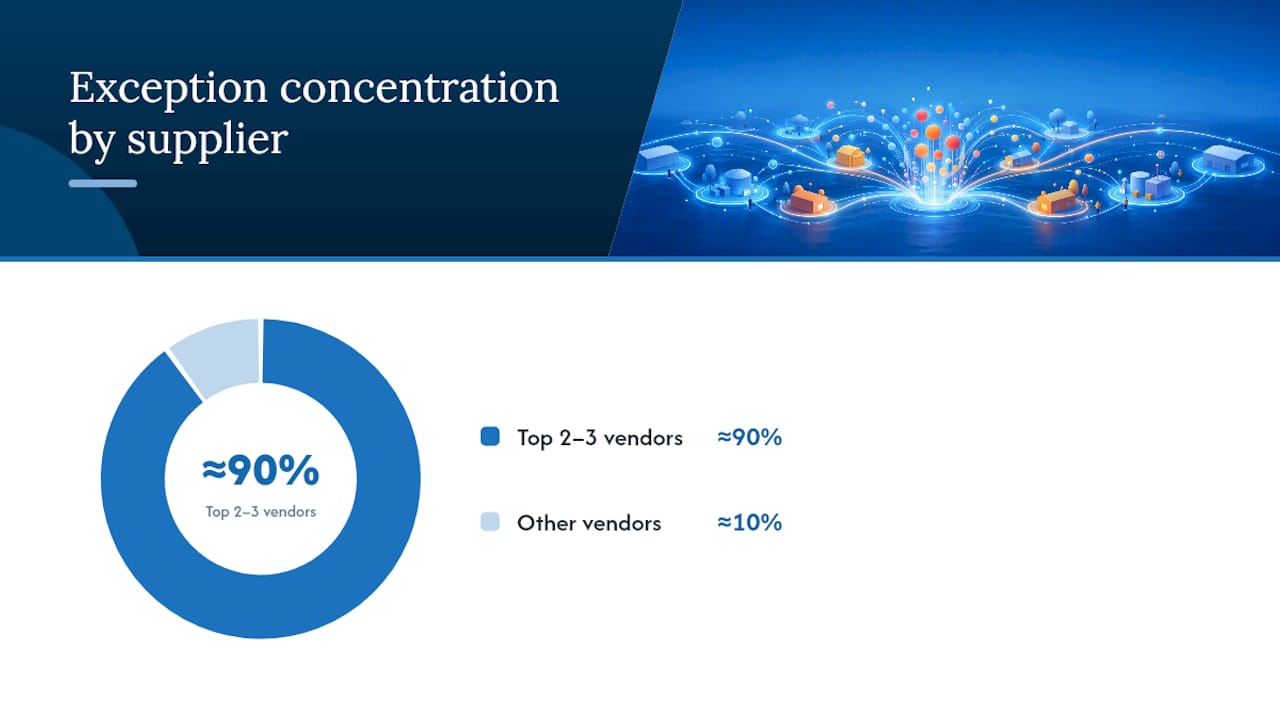
Pro Tip: Track which suppliers generate the most exceptions over a quarter. Nine times out of ten, it’s two or three vendors driving most of your exception queue, and a five-minute conversation with their AP contact fixes more volume than any tolerance-rule tweak.
What Systems Need to Connect for AI Matching to Work?
AI matching is only as good as the data feeding it, and that data lives across several systems that don’t always talk to each other cleanly.
- ERP or financial system: holds the PO registry, approval history, and the general ledger coding that determines where the payment ultimately posts.
- Receiving or warehouse management system: confirms what physically arrived and when, which is the backbone of three-way matching.
- Vendor master data: standardizes supplier names, payment terms, and banking details so the fuzzy-matching layer has a clean reference point.
- Document intake: email inboxes, EDI feeds, or supplier portals where invoices actually originate.
Connector quality varies a lot between native ERP plugins, general APIs, and middleware layers, and that choice affects both setup time and long-term maintenance. Native integrations, like the AI matching features built directly into platforms such as Microsoft Dynamics 365, tend to be faster to deploy but limit you to that ecosystem’s roadmap. API-based connections offer more flexibility across a mixed tech stack but need more upfront engineering. The most common failure point isn’t the connector technology at all. It’s messy vendor master data or inconsistent PO creation habits upstream, which no amount of AI sophistication fully compensates for.
How Do You Evaluate an AI PO Matching Solution?
Before committing to any platform or project, procurement and finance leads should hold vendors and internal builds to the same checklist.
- Match-rate improvement: ask for a realistic target increase over your current baseline, not a vague “significant improvement” claim.
- Line-level accuracy: confirm the system matches at the individual line item, not just invoice totals, since totals can match while individual items are wrong.
- Missing-PO inference: test how the system handles an invoice with no clean PO reference, since this is where AI reasoning separates itself from rule-based tools.
- Tolerance configurability: verify you can set different thresholds by category, vendor, or dollar amount rather than one blanket rule.
- Audit trail completeness: every automated decision needs a record of what matched, what didn’t, and why, for both internal controls and external audit.
- False-match handling: ask what happens when the system auto-approves something it shouldn’t have, and how fast that gets caught.
Purchase order automation done well doesn’t just speed up processing. It automates PO field creation, flags anomalies, and strengthens the underlying procurement controls at the same time, according to IBM’s overview of the space. That control angle matters as much as speed when you’re presenting this to an audit committee.
What Does a Realistic Implementation Timeline Look Like?
Most AI PO matching projects fail on data, not technology. An audit phase should measure your actual match-rate baseline, PO creation discipline, and current exception volume before anyone talks about a pilot.
- Weeks 1 to 3: readiness audit covering data quality, PO governance, and integration mapping.
- Weeks 4 to 8: pilot on a single high-volume, low-risk category (office supplies, MRO, recurring services work well) with clear KPIs.
- Weeks 9 to 12: rules tuning based on pilot exception patterns, staff training, and phased rollout to additional categories.
**The gating issue almost every project hits is purchase orders created after invoices already arrived. No AI model reasons its way around a PO that doesn’t exist yet, so fixing that sequencing problem upstream matters more than any matching algorithm downstream.
A 90-day window from audit to full rollout is realistic for a single business unit, provided the data cleanup happens honestly in weeks 1 through 3 rather than getting rushed.
Where Does the Real ROI Come From?
The technology gets most of the attention, but the organizational decisions around it usually determine whether a project pays off. Tolerance rules need one clear owner, usually a controller or AP manager, not a committee that revisits thresholds every quarter. Exception routing works best when it’s tied to the person who can actually fix the root cause, not just the person available to clear the queue.
Track three numbers over the first two quarters: cycle time from invoice receipt to payment, the percentage of exceptions closed without escalation, and dollars saved from caught overpayments. Everything else is noise dressed up as a KPI.
— Souhail
Get Your PO Matching Roadmap Built Right the First Time
Most teams don’t need another software demo. They need someone to look honestly at their PO data, their exception volume, and their ERP setup before recommending anything. That’s the gap Digitalfractal’s AI Readiness Audit is built to close.
The audit maps your current match rates, flags where PO governance is breaking down, and produces a pilot plan with real KPI targets instead of vague promises. For teams weighing build-versus-buy on the AI layer itself, Digitalfractal’s AI Integration Consulting service handles the connector work between your ERP, receiving system, and vendor master data so the matching engine actually has clean inputs to work with. If you’re further along and thinking about legacy system constraints specifically, the legacy systems integration guide covers common blockers worth ruling out early. Book an audit conversation and get a data-backed pilot plan instead of a sales deck.
Sources
- Match purchase invoices to orders with Payables Agent | Microsoft Learn
- Purchase order automation | IBM
- GPT invoice reconciliation software | Data Alchemy