
AI Agents in Enterprises: Success vs. Failure

Most AI agent projects do not fail because of the model. They fail because the workflow, controls, or system links are weak. In the source article, 64% of firms report productivity gains from AI, but only 30% turn that into new revenue. That gap tells me one thing: if you want results, you need a tight use case, direct links to business systems, clear ownership, and rules for review.
If I had to boil the article down into a few plain points, it would be this:
- Start small and specific. Pick one job, one goal, and one metric, perhaps using a workflow automation benefits calculator to track ROI.
- Build agents into actual business workflows. Standalone tools tend to stall.
- Set rules before launch. Guardrails, logs, version control, and human review matter.
- Make ownership cross-functional. Legal, HR, ops, and IT all need defined roles.
- Plan for Canadian rules early. PIPEDA, data residency, bilingual service, and sector rules can block rollout.
The article also makes a clear contrast: firms that embed AI into workflows see more value, while firms that bolt it onto weak processes often get more rework, more risk, and less trust. In short, AI agents work when the process is clear; they struggle when the process is messy.
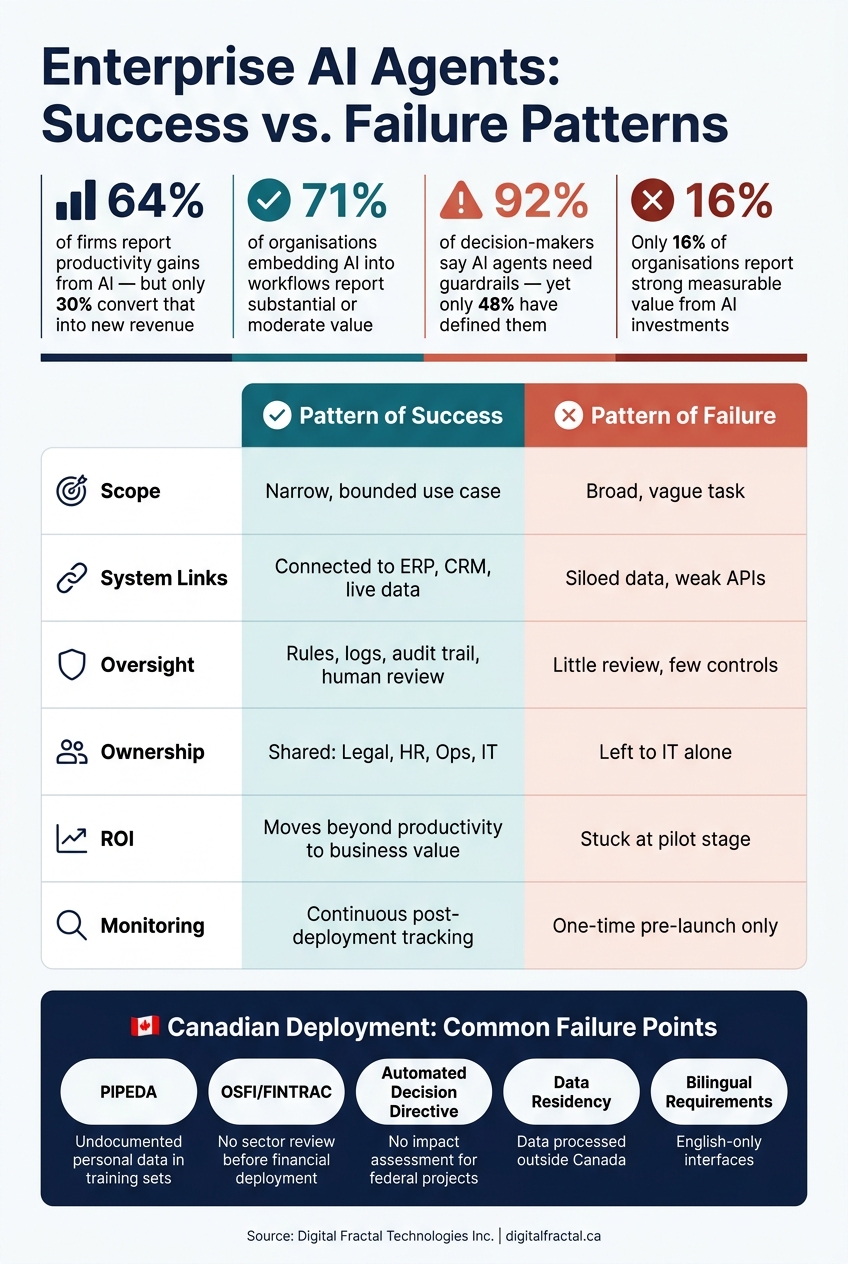
Enterprise AI Agent Success vs. Failure: Key Patterns & Stats
Enterprise Adoption is the Biggest Bottleneck for AI Agents | Randy Bias, Mirantis
sbb-itb-fd1fcab
Quick Comparison
| Area | Success Pattern | Failure Pattern |
|---|---|---|
| Scope | Narrow, defined use case | Broad, vague task |
| System links | Connected to ERP, CRM, docs, and live data | Siloed data and weak API links |
| Oversight | Rules, logs, audit trail, human checks | Little review and few controls |
| Ownership | Shared across business teams | Left to IT alone |
| Canadian fit | Privacy, residency, and language needs handled early | Compliance gaps found too late |
| ROI | More likely to move past productivity into business value | Often stuck at pilot stage |
So if you’re judging an AI agent project, I’d ask four basic questions right away: What exact job is it doing? Which systems does it touch? Who owns the risk? And how will we measure the result?
What successful enterprise AI agent deployments get right
Clear business goals and bounded use cases
The biggest factor in a good rollout is scope, not ambition. Teams that do this well start with one clear business problem and one measurable result. They set targets for cost, speed, or revenue before they build anything.
Just as important is risk-based tiering. That means sorting each AI use case by the level of impact it could have. High-stakes decisions need formal review. Low-risk assistants need lighter controls. Using the same oversight for every use case burns time, drains effort, and slows delivery.
Strong teams also write down the intended use, known limits, and possible harms early. Many use the NIST AI Risk Management Framework (AI RMF) for this. In Canada, it still serves as the main practical standard while AIDA remains paused as of July 2026.
Integrated workflows, data quality, and governance
Agents need solid API links to ERP, CRM, core business systems, and document repositories. If those connections are weak, the agent works with stale or incomplete information. And then the whole thing starts to look good in a demo but falls apart in day-to-day use.
This is why direct workflow integration matters so much. Organisations that build AI into their processes and workflows see more upside. 71% of organisations that do this report substantial or moderate value, while standalone tools deliver much lower returns. That’s the difference between an isolated tool and a system people can use at work.
Governance matters just as much as connectivity. Logging, monitoring, version control, and audit trails are not add-ons. They are part of the system. For Canadian operations, that also means dealing with PIPEDA compliance, data residency rules, and bilingual service delivery for any customer-facing workflow. Certifications such as SOC 2 and ISO 27001 also act as baseline trust signals for auditors and procurement teams. Governance isn’t a box to tick once. It needs steady attention.
Internal ownership supported by specialised delivery partners
Once the workflow is set, ownership often decides whether the project holds up after rollout. One pattern shows up again and again: shared ownership across legal, HR, operations, and IT. When each group has a clear role, accountability gets much easier to manage. A practical move is to assign a named risk owner from outside IT for every high-impact system. Many teams skip that step, and it comes back to bite them later.
"AI risk management is not an IT problem alone. It requires cross-functional governance spanning legal, HR, operations, and IT." – Digital Fractal Technologies Inc
For Canadian organisations in sectors like construction and logistics, internal ownership works even better when paired with a delivery partner that knows local rules. That kind of partner can flag operational and regulatory risks before deployment, not after the damage is done.
A simple way to test any delivery partner is to ask which Canadian regulatory instruments they’ve worked with. Good answers should include items such as OSFI‘s technology risk guidance or the federal Directive on Automated Decision-Making.
Why enterprise AI agent initiatives fail
Poor problem selection and broken process design
What works in a controlled pilot can fall apart fast once the use case gets fuzzy.
A lot of failures start with picking the wrong job for the agent. Teams often choose work that’s too broad, too reliant on human judgement, or too tied to context the agent can’t read with any consistency. When the goal isn’t tight and specific, there’s no clean way to judge whether the agent is doing the job well.
Then the process itself breaks things further. A poorly designed workflow can turn an agent into a fast error multiplier.
Only 16% of organisations report realising strong measurable value from their AI investments. One common reason is simple: the work was never narrowed into a clear, bounded use case.
And even when the use case makes sense on paper, it can still fail if it doesn’t connect cleanly to live systems.
Weak integration, oversight, and rollout planning
Even a solid use case can stall when integration is treated like a side issue. 69% of business leaders agree that legacy systems remain a major barrier to scaling AI. Siloed data, missing API connections, and rigid older platforms make the agent unreliable.
Oversight matters just as much. Without guardrails, escalation paths, and human review, agents can become unsafe and hard to predict. 92% of decision-makers agree that AI agents need rules-based guardrails to operate safely, yet only 48% of organisations have actually defined them. If no one sets clear intervention points, one bad action can spread before anyone steps in.
In Canada, these technical gaps don’t stay technical for long. They often become deployment blockers once privacy rules and sector obligations enter the picture.
Ignoring Canadian operating and regulatory requirements
Canadian rollouts often fail when teams ignore privacy, data residency, and sector rules. In federally regulated sectors, missing alignment with OSFI’s technology risk guidance or the federal Directive on Automated Decision-Making can stop a deployment outright.
| Canadian Compliance Anchor | Common Failure Point |
|---|---|
| PIPEDA | Personal data in training sets undocumented |
| OSFI / FINTRAC | No sector-specific review before financial services deployment |
| Directive on Automated Decision-Making | No mandatory impact assessment for federal public-sector projects |
| Data Residency Requirements | Data stored or processed outside Canada in violation of residency rules |
| Bilingual Service Requirements | English-only interfaces or workflows |
Put side by side, these patterns make it much easier to see why some deployments stall while others move ahead.
Success vs. failure: side-by-side enterprise patterns
Once you’ve seen the failure modes, the next step is to compare the operating patterns behind them. Side by side, the gap is hard to miss.
Workflow scope, architecture, and governance compared
The biggest split comes down to one thing: is the agent built into core workflows, or just bolted on beside them?
| Criterion | Pattern of Success | Pattern of Failure |
|---|---|---|
| Workflow Scope | Bounded use cases embedded directly in core processes | Ambiguous tasks handled by standalone tools outside the workflow |
| Architecture | Integrated data sources; modernised legacy infrastructure | Siloed data; disconnected tools constrained by older platforms |
| Governance | Cross-functional ownership across Legal, HR, Operations, and IT; rules-based guardrails in place | IT-only oversight; uncontrolled experimentation with no defined rules |
| Monitoring | Continuous post-deployment tracking; live risk logs updated after each change | One-time pre-launch assessment only; no review after initial launch |
This same split carries through to results. Systems tied into day-to-day operations tend to generate measurable value. Detached tools usually struggle to move past surface-level utility.
ROI and operational outcomes compared
When deployments are embedded, efficiency gains are more likely to turn into measurable business value. Standalone tools, by contrast, often stall at simple productivity lifts.
| Outcome Metric | Pattern of Success | Pattern of Failure |
|---|---|---|
| Measurable Value | 71% of embedded deployments realise substantial or moderate value | Pilot stagnation; 8% report no measurable value at all |
| Operational Impact | Reduced handling time; lower cost per case; high-value task automation | Rising exception rates; manual rework caused by hallucinations |
| Auditability | Documented training data provenance; live risk logs | Transparency gaps; "black box" operations leading to reputational risk |
| Adoption | Sustained use across core operations such as procurement and supply chain | Limited to low-complexity areas |
In Canada, weak auditability can increase regulatory exposure. If an organisation lacks documented training data provenance and a current risk register, model drift can chip away at trust and drive more manual rework.
These contrasts point straight to the implementation playbook in the conclusion.
Conclusion: A practical playbook for better AI agent outcomes
Enterprise AI agents work best when they tackle a narrow business problem inside a governed workflow. That thread ran through the earlier sections: embedded, governed agents beat bolt-on pilots. Put simply, success tends to come from clear ownership, while failure often starts with side-of-desk testing that never ties back to how the business runs.
Key points decision-makers should take forward
The signal is pretty clear: 71% of organisations that embed AI directly into workflows realise substantial or moderate value. For leaders, the next step isn’t complicated. Start with the business outcome, then build the workflow, controls, and ownership around that goal.
A few practical anchors matter here:
- Assign a named risk owner outside IT
- Use the NIST AI RMF for governance and mapping
- Monitor for drift after launch
In Canada, privacy, sector rules, and reputational risk still shape deployment decisions.
"AIDA’s pause does not eliminate regulatory exposure. PIPEDA obligations, sector-specific rules, and reputational risk remain active." – Amy S, Digital Fractal Technologies Inc
Digital Fractal Technologies Inc can support AI readiness audits and workflow automation ROI.
FAQs
How do we choose the right first AI agent use case?
Start with an AI readiness audit and an opportunity assessment. The goal is simple: find 3–5 high-ROI use cases worth testing first.
Then narrow your focus. Go after workflows that are:
- low-risk
- internal-facing
- repetitive
- predictable
- easy to measure
- easy to monitor
That usually gives you the best shot at early wins without creating a mess.
Before you scale anything, get the basics in place. Define ownership and governance, map the full workflow from start to finish, and set clear KPIs and success criteria inside a short, versioned pilot.
Why does that matter? Because AI projects often look good on paper and fall apart in practice. A tight pilot helps cut failure risk, shows what’s working, and gives you proof of value early.
What controls should be in place before launch?
Before launch, get specific about business goals and the KPIs you’ll use to judge success. If you skip this step, it gets hard to tell whether the agent is helping or just making noise.
Set clear boundaries too. That means strict input and output rules, plus approval gates for irreversible or high-stakes actions. For riskier work, keep a human-in-the-loop. On top of that, use rule-based guardrails, action budgets, and a kill switch. Think of it like giving a new hire access to the office: you don’t hand over every key on day one.
Security matters just as much. Use least-privilege access so the agent can only do what it needs to do. Keep immutable audit logs, and make sessions time-bounded so access doesn’t stay open longer than it should.
You’ll also want to complete any required Canadian privacy steps before anything goes live. After that, test in a staging or sandbox setup first, then roll things out in phases with monitoring thresholds in place. That way, if something starts to go sideways, you can catch it early instead of dealing with a bigger mess later.
What Canadian compliance issues can delay deployment?
In Canada, AI agent rollouts often slow down because privacy and governance rules need to be sorted out first. The usual sticking points include Privacy Impact Assessments (PIAs), PIPEDA, provincial rules like Quebec’s Law 25, and data residency requirements.
Then there’s the extra work around compliance. Teams often need to add audit trails, data anonymization, identity-based access controls, legal sign-offs, bias assessments, and updates to legacy systems that don’t have encryption or logging. That work isn’t small. It can push development costs up by 10% to 25% and stretch project timelines.