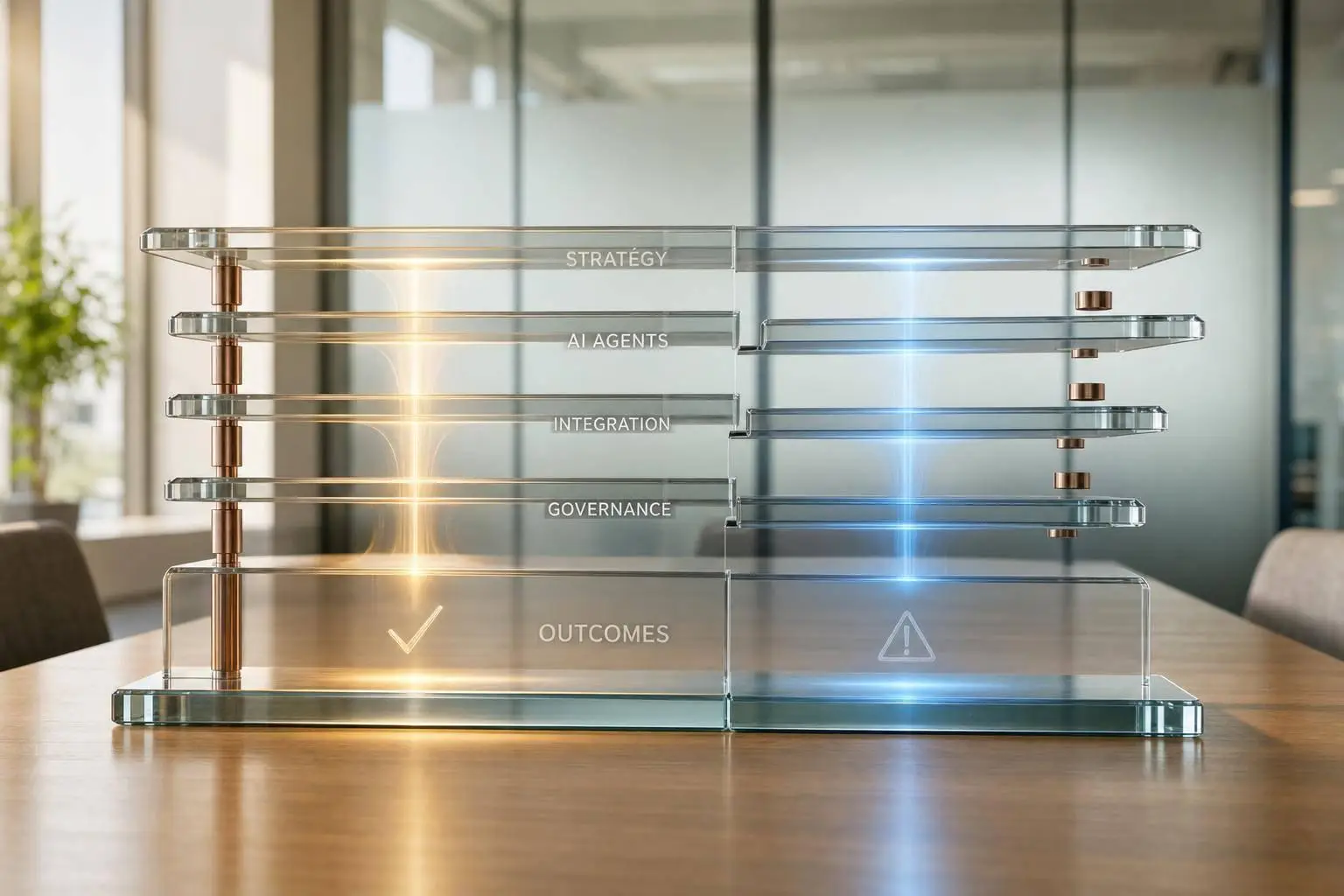
AI Readiness Assessment Cost: A Buyer’s Pricing Guide

AI readiness assessments run from $0 for a vendor self-assessment to $500,000 or more for a Big-Four strategy engagement, and most mid-market companies should budget for an independent, evidence-backed audit in the typical mid-market price range described by Elevated Signal’s pricing analysis. That range buys a scored maturity assessment, prioritized use cases, and a costed roadmap, not just a slide deck for cloud access governance. The single factor that pushes a quote from the low end to the high end is data complexity: how many systems, how clean the records, how many business units feed into the review.
- Free tier: vendor self-assessments, directional only
- SMB/boutique: a price range typical for independent and evidence-backed assessments
- Enterprise: a higher price tier, reflecting multi-site or regulated scope
- Big-Four/strategy-plus-build: the highest pricing tier, often including strategy and implementation
Quick stat: Gartner projects that a substantial share of generative AI projects will be scrapped after proof-of-concept, largely because the underlying data was never AI-ready in the first place. That is exactly the failure a well-scoped assessment is supposed to catch before you spend six figures building something.
Key Takeaways
The most reliable AI readiness assessment costs between $15,000 and $75,000 for mid-market companies, and price scales primarily with data complexity, not brand name.
| Point | Details |
|---|---|
| Match tier to real need | Free tools work for orientation; independent audits at $15K–$75K fit most mid-market buyers. |
| Data complexity drives cost | Messy or disconnected systems expand data-prep hours more than any other single factor. |
| Insist on named deliverables | A maturity score, prioritized use cases, and a costed roadmap should always be explicit line items. |
| Avoid credit-back pricing | Fee rebates tied to future builds create a conflict of interest in the vendor’s recommendations. |
| Digitalfractal fits the checklist | Its AI Readiness Audit delivers scored, evidence-backed artifacts within a 90-day engagement window. |
Table of Contents
- What Does an AI Readiness Assessment Actually Cover?
- How Much Should You Budget by Tier?
- What Actually Drives the Price Up?
- What Should You Actually Receive?
- How Long Does an Assessment Take?
- How Do You Evaluate a Quote Without Getting Burned?
- Why Digital Fractal’s AI Readiness Audit Fits This Checklist
- What Are the Actual Cost Components in a Quote?
- Should You Build an Internal Team or Hire Outside Help?
- Does a Deeper, More Custom Assessment Cost More?
- Does Company Size or Industry Change the Price?
- What’s the Real Value Question Behind the Price Tag?
- Ready to Get a Real Number for Your Business?
- Sources
What Does an AI Readiness Assessment Actually Cover?
Every credible assessment is built from the same core modules. What varies is depth, and depth is what drives the invoice.
- Process review: mapping current workflows to find where automation or AI genuinely fits
- Data and pipeline audit: checking data quality, storage, access, and integration points
- Technology stack review: auditing existing software, APIs, and infrastructure compatibility
- Team capability assessment: gauging internal skills, gaps, and change-readiness
- Use-case discovery: identifying and ranking candidate projects by feasibility and return
- Governance and risk review: compliance, data privacy, and model-risk considerations, often mapped against the NIST AI Risk Management Framework
Optional add-ons push the price up fast. A proof-of-concept or working prototype, multi-site reviews across several facilities or regions, and deep regulatory audits (health data, financial compliance, safety-critical systems) each add distinct line items. Of these, the data and pipeline audit and any bundled prototyping tend to add the most cost, because both require hands-on technical work rather than interviews and documentation review. If a quote lumps a POC into the base fee without a separate number, that is worth flagging before you sign anything.
How Much Should You Budget by Tier?
Pricing splits cleanly into four bands, and each one buys a different level of rigor.
- Free self-assessment. Vendor tools and questionnaires that take a few hours. Useful for orientation, but shaped around whatever that vendor sells, and not a substitute for an independent audit.
- SMB/boutique, $15,000–$75,000. Covers one to three business units, a real data audit, prioritized use cases with rough ROI, and a roadmap. This is where most mid-market buyers land.
- Enterprise, $40,000–$120,000. Multiple business units, deeper compliance review, and more stakeholder interviews across departments.
- Big-Four/strategy firm, $100,000–$500,000+. Brand-name consulting, broader organizational scope, often bundled with change-management work.
- Strategy-plus-implementation, $500,000–$2,000,000+. The assessment becomes the first phase of a multi-year build, priced accordingly.
Three quick scenarios show how this plays out. A single-location logistics firm with one core system typically fits the SMB tier, closer to $20,000. A mid-market manufacturer with four plants and disconnected ERP systems usually lands at $60,000 to $90,000. An oil and gas operator with safety compliance obligations across multiple sites often needs the enterprise tier or above, simply because the governance workstream alone requires more specialized hours.
Pro Tip: Get a written breakdown of hours by module before comparing quotes. A $75,000 proposal that spends 60% of its hours on data cleanup is a very different product than one spending 60% on interviews and slide preparation.
What Actually Drives the Price Up?
Five factors explain nearly every gap between a $15,000 quote and a $150,000 one.
- Data complexity and cleanup. Disconnected systems, missing metadata, and inconsistent formats mean more hours before anyone can even evaluate use cases.
- Number of business units or sites. Each additional site usually means new stakeholder interviews, new systems, and new governance questions.
- Regulatory and compliance scope. Health, financial, and safety-critical industries require legal and risk review that generalist assessments skip.
- Senior practitioner involvement. A partner-led engagement costs more per hour than one staffed by junior analysts, but it usually catches more.
- Inclusion of a proof-of-concept. Building something, even a small prototype, is technical work billed separately from analysis.
Data preparation deserves special attention here. Industry analysis on why most AI projects fail notes that data prep frequently costs as much as, or more than, the AI implementation itself. When two or three of these drivers stack, such as a multi-site company in a regulated industry wanting a POC, costs don’t add, they multiply, since each added dimension touches every other workstream.
What Should You Actually Receive?
A serious assessment produces artifacts you can hand to your board, not a generic slideshow.
- A scored maturity assessment benchmarking your organization against defined readiness criteria
- Prioritized use cases with rough ROI estimates and feasibility scoring
- A data and systems gap analysis naming specific fixes required before any build
- A governance and risk review, ideally mapped to a recognized framework like NIST’s
- A costed roadmap sequencing projects with budget ranges attached
- An executive presentation built to support an internal go/no-go decision
The gap between a thin deliverable and an evidence-backed one usually shows up in specificity. A weak report says “improve data governance.” A strong one names the three systems with the worst data quality and estimates the remediation hours.
Pro Tip: Ask for a sample deliverable excerpt and the CV of the practitioner who will lead the engagement before you sign. If the vendor hesitates to share either, that tells you something about who is actually going to do the work.
How Long Does an Assessment Take?
Duration scales with tier, and so does the internal time your team needs to set aside.
- Free tools: a few hours of self-reported input, no real stakeholder time.
- SMB/boutique: typically 2 to 4 weeks, with 15 to 25 stakeholder hours across interviews and document sharing.
- Enterprise: 4 to 8 weeks, often 40 to 60 stakeholder hours spread across multiple departments.
- Big-Four/strategy engagements: 8 to 16 weeks, with far heavier internal coordination and steering-committee involvement.
Calendar time almost always runs longer than actual consulting hours, because scheduling interviews, pulling data access approvals, and coordinating across departments creates dead time between work sessions. You can compress this by naming a single internal point of contact upfront and pre-gathering data access credentials before kickoff, rather than discovering mid-project that someone in IT needs two weeks to approve a data pull.
How Do You Evaluate a Quote Without Getting Burned?
Run every proposal through the same checklist before comparing prices.
- Who is actually doing the analysis, and can they provide a CV showing senior-level experience?
- Will the assessment be tested against your real data, or only against a questionnaire?
- Is any prototype or proof-of-concept priced as a separate line item with clear acceptance criteria?
- Does the proposal name exact deliverables, not just process descriptions?
- Who owns the intellectual property and data generated during the engagement?
A few patterns should end the conversation immediately. Credit-back models, where the assessment fee gets refunded against a future build contract, create an obvious incentive for the vendor to recommend more work regardless of whether you need it, a conflict practitioners specifically warn against. So does any “assessment” priced under $2,000 that turns out to be a questionnaire with an automated report attached. Long paid discovery phases that produce no concrete deliverable, and recommendations that conveniently always point back to the vendor’s own services, are the same red flag wearing different clothes.
| Point | Details |
|---|---|
| Get named practitioners | Request the CV of whoever leads the engagement, not just the sales team pitching it. |
| Separate the POC pricing | Any prototype work should be its own line item with acceptance criteria attached. |
| Avoid credit-back deals | Fee rebates tied to future build contracts create a conflict of interest in the recommendation. |
Why Digital Fractal’s AI Readiness Audit Fits This Checklist
Digitalfractal built its AI Readiness Audit around exactly the procurement concerns above: independent scoring, prioritized use cases, and a costed roadmap rather than a generic slide deck. The service focuses on operational efficiency for industries like construction, logistics, and oil and gas, where messy data and multi-site operations tend to drive costs the highest. Digitalfractal’s readiness audit guide lays out scope and artifacts, and the firm’s transformation work runs on a 90-day timeline rather than an open-ended discovery phase…
What Are the Actual Cost Components in a Quote?
Every assessment invoice breaks down into four buckets, and understanding each one helps you spot padding.
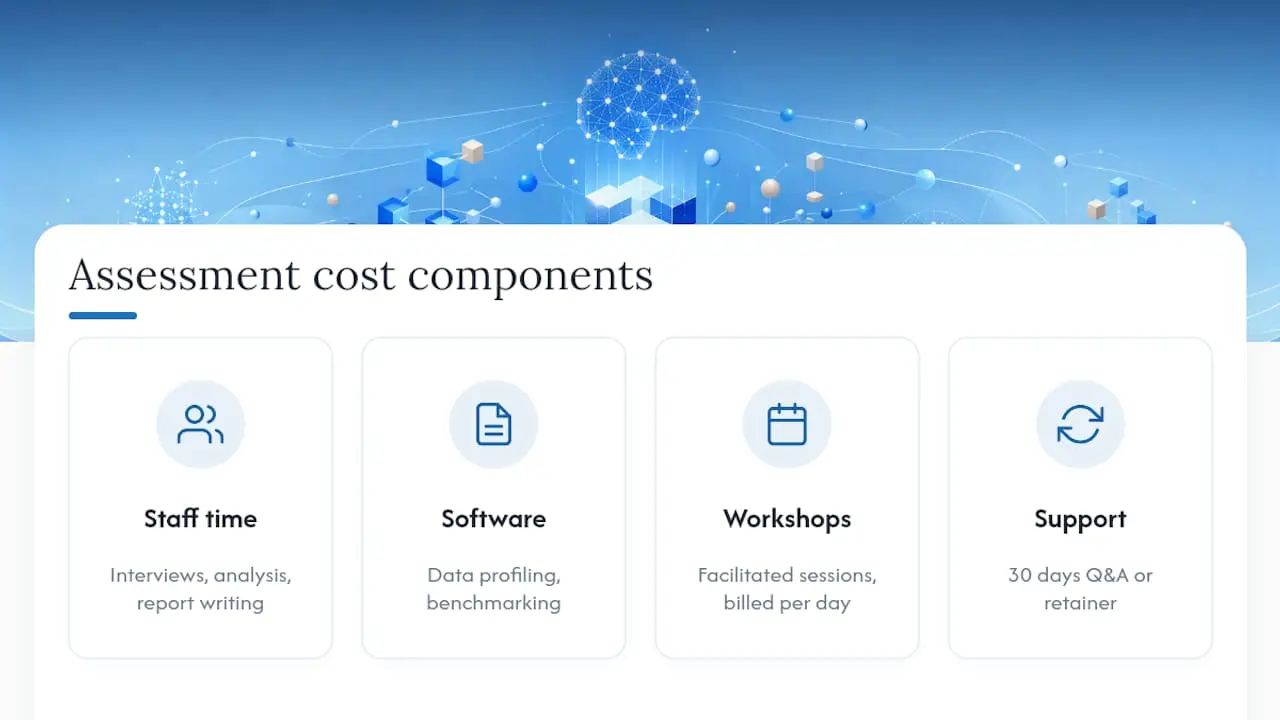
This covers interview time, analysis, and report writing, and it scales directly with how senior the staff running the engagement are.
Software and tools cover any data profiling, diagnostic, or benchmarking platforms the assessment team uses to analyze your systems. For smaller engagements this is often folded into the consulting fee. For enterprise-scale audits touching dozens of systems, expect a distinct line item, sometimes licensing fees for specialized data-quality software.
Workshops cover facilitated sessions with your leadership and technical teams, usually priced by day rather than by hour. A single half-day workshop with five stakeholders costs meaningfully less than a full week of cross-departmental sessions across multiple sites.
Ongoing support is the wildcard. Some vendors include 30 days of post-report Q&A in the base price. Others charge a separate retainer for implementation guidance after the roadmap is delivered. Ask explicitly whether the quote includes any follow-up, and for how long, because “the assessment is done” and “you’re on your own now” often arrive at the same moment.
Understanding this breakdown matters most when two quotes look similar on the surface but allocate hours completely differently between these four buckets.
Should You Build an Internal Team or Hire Outside Help?
Running the assessment in-house looks cheaper on paper, but the comparison rarely holds up once you count the real costs.
An internal team needs someone who already understands data architecture, AI use-case evaluation, and change management, skills that rarely sit inside one department. Even if you have a capable analytics lead, pulling them off their regular work for four to six weeks has an opportunity cost that never shows up on the assessment invoice itself. There’s also an objectivity problem: internal staff have organizational incentives and blind spots that make it hard to deliver an honest maturity score, especially when the finding is “this department isn’t ready.”

External providers bring a structured methodology they’ve run dozens of times, benchmark data from other engagements, and no internal political stakes in the outcome. The tradeoff is the consulting fee itself, plus onboarding time for the outside team to learn your systems.
The realistic middle ground many mid-market companies land on: hire external help for the assessment and initial roadmap, then use internal staff for ongoing execution once the roadmap translates into an implementation budget. That split captures the objectivity and methodology of an outside team while keeping day-to-day execution costs internal.
Does a Deeper, More Custom Assessment Cost More?
Yes, and the relationship is close to linear. A standardized assessment using a fixed questionnaire and template report costs less because the vendor is reusing the same framework across clients. A fully customized assessment, built around your specific industry regulations, unique tech stack, and multiple business units, costs more because almost none of the analysis is reusable.
The depth question usually comes down to three variables: how many systems get audited, how many stakeholders get interviewed, and how detailed the final roadmap needs to be. A light-touch assessment might interview five people and review two core systems. A deep one might interview thirty people across six departments and audit a dozen integrated systems, plus produce department-specific sub-roadmaps rather than one company-wide document.
Customization for regulatory scope adds cost in a different way; it requires legal or compliance-specialized reviewers rather than general business analysts, and that expertise commands a premium rate. A construction company assessing readiness for scheduling automation needs far less regulatory depth than an oil and gas operator assessing readiness for automated safety monitoring.
The practical guidance here is straightforward: match depth to actual stakes. A single-department pilot project doesn’t need the same rigor as a company-wide automation initiative touching regulated operations, and paying for the deeper version when you only need the lighter one is money spent on analysis you’ll never act on.
Does Company Size or Industry Change the Price?
Both do, and not always in the direction you’d expect. Company size drives cost mostly through the number of systems and stakeholders involved, more employees usually means more departments, more software, and more interviews required to get an accurate picture. A 50-person company with one unified system can get a thorough assessment for less than a 50-person company running five disconnected legacy tools.
Industry matters more than headcount in some cases. Regulated industries, health care, financial services, and increasingly oil and gas around safety systems, require reviewers with domain-specific compliance knowledge, and that expertise costs more per hour regardless of company size. A 30-person fintech startup can end up paying enterprise-tier rates because of regulatory complexity alone, while a 200-person construction firm with straightforward operational data might fit comfortably in the SMB tier.
Logistics and construction, two industries Digitalfractal works with directly, tend to sit in a favorable spot: substantial operational data worth analyzing, but generally lighter regulatory overhead than health care or finance. That combination often means a meaningful automation opportunity without the compliance-driven cost premium that pushes other industries toward the enterprise tier.
What’s the Real Value Question Behind the Price Tag?
Most procurement teams shop for the lowest defensible quote. That’s the wrong instinct here. The right question isn’t “what’s the cheapest assessment that checks the box,” it’s “will this assessment actually change what we decide to build.”
The conventional advice, get three quotes and pick the middle one, ignores that price mostly tracks data complexity and regulatory scope, not vendor prestige. A well-scoped boutique engagement can outperform a pricier brand-name firm on a mid-market use case simply because the boutique team spent more hours on your actual data instead of your logo on a case study slide.
If I had to pick one thing for a procurement lead to prioritize, it’s this: insist on seeing the practitioner’s CV before signing anything. Not the sales deck, the actual person doing the data audit. A junior analyst running your governance review against a regulated dataset is a different risk profile entirely than a senior practitioner doing the same work, and that difference rarely shows up in the price until it’s too late to matter.
— Souhail
Ready to Get a Real Number for Your Business?
Digitalfractal’s AI Readiness Audit skips the generic questionnaire model entirely: you get a scored maturity assessment, prioritized use cases with ROI estimates, and a costed roadmap built from your actual data, delivered inside a 90-day engagement window instead of an open-ended discovery process.
Before booking a discovery call, pull together three things: a rough inventory of the systems and data sources you’d want reviewed, a list of stakeholders across the departments involved, and a plain statement of the business objectives you’re weighing AI against, whether that’s cutting manual scheduling work or catching equipment issues before they become downtime. Digitalfractal’s team uses that starting point to scope the engagement accurately instead of guessing at hours.
If you’re weighing this against building a business case first, the AI ROI benchmarks guide is worth reading beforehand. When you’re ready, request a quote directly through the AI Readiness Audit page and get a scoped proposal instead of a generic price range.
Sources
- Why do 4 in 5 AI projects fail? (industry analysis)
- Gartner press release (2024) on generative AI project abandonment
- NIST AI Risk Management Framework