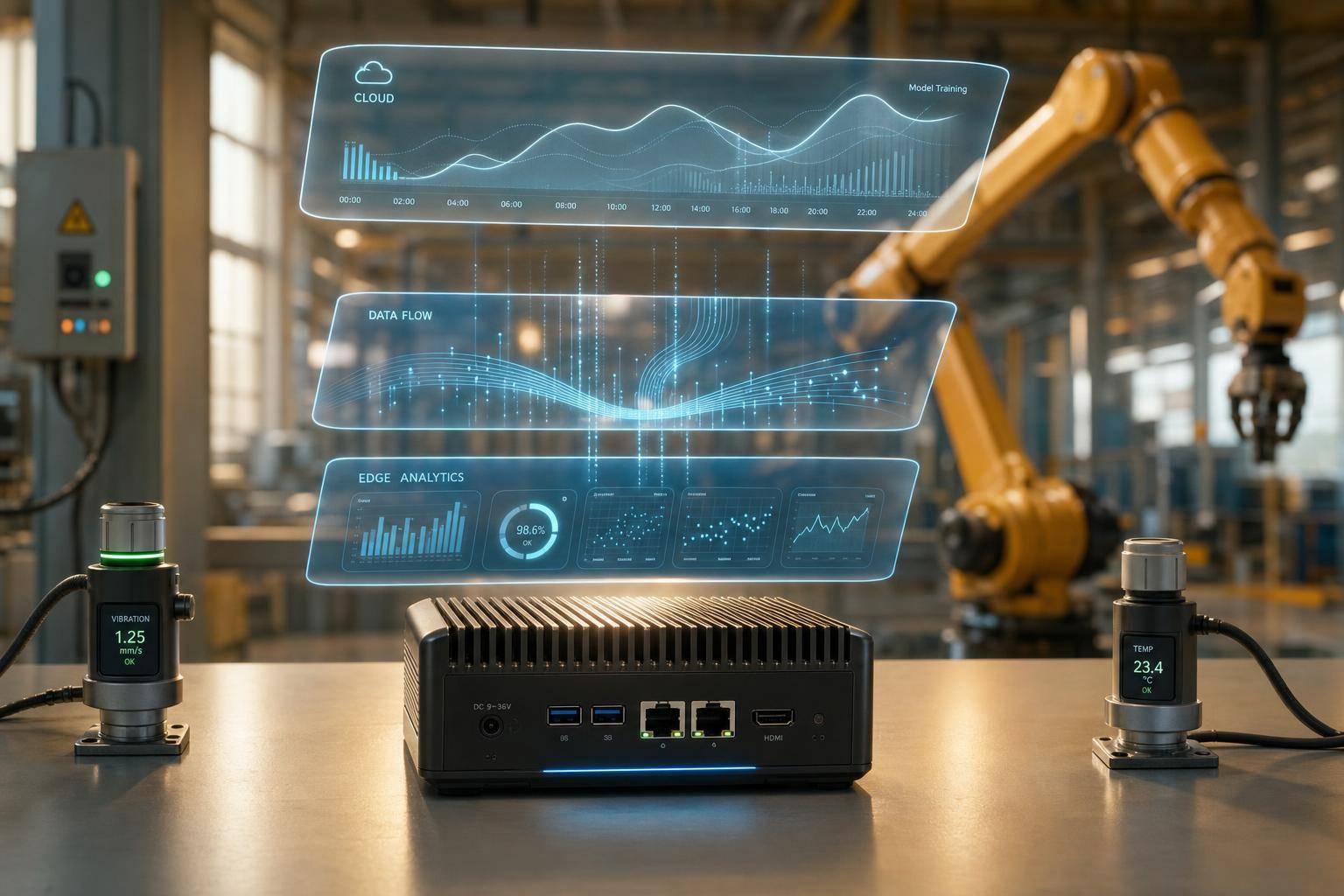
Edge Computing for Real-Time IoT Analytics

If a machine needs a response in milliseconds, the cloud is often too far away. My take is simple: put time-sensitive analytics close to the asset, send only the data that matters upstream, and keep the cloud for long-term storage, cross-site review, and model training.
Here’s the article in plain English:
- Edge computing means processing IoT data near the source: on a device, gateway, site server, or vehicle.
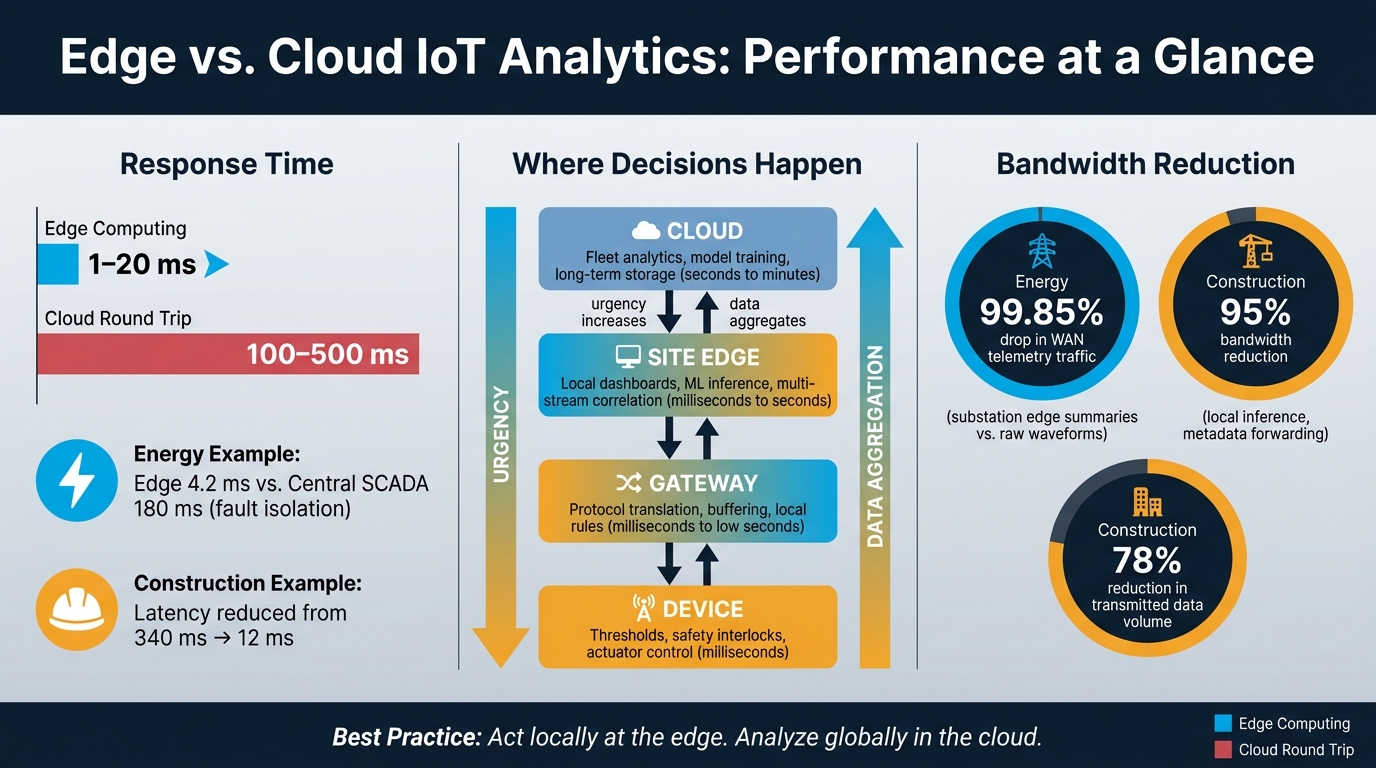
- It helps cut delay. The article cites rough ranges of 1–20 ms at the edge versus 100–500 ms for a cloud round trip.
- It also cuts data use by sending summaries, alerts, and event windows instead of every raw reading.
- A good setup splits work by layer:
- Device: local control, thresholds, safety logic
- Gateway: protocol translation, buffering, filtering, local rules
- Site edge: local dashboards, multi-stream inference, short-term storage
- Cloud: long-term records, fleet analysis, reporting, retraining
- The best pattern is usually hybrid: local action first, cloud analysis later.
- The article also shows where this fits in energy, public sector, and construction, especially where links are weak or sites are remote.
- Security and governance still matter: device identity, encryption, secure boot, signed updates, network separation, audit trails, and tested outage recovery.
A few numbers stand out:
- Edge workloads: ~1–20 ms
- Cloud IoT round trip: ~100–500 ms
- Energy example: 4.2 ms fault isolation at the edge vs 180 ms in central SCADA
- Construction example: latency dropped from 340 ms to 12 ms
- Some remote video setups cut transmitted bandwidth by up to 95%
The main point: I’d use edge computing when delay, outage tolerance, bandwidth cost, or on-site control matters. I’d keep the cloud for the jobs that need more history, more compute, or cross-site context.
This section gives you the short version before the article moves into architecture, routing rules, security, and sector use cases.
Edge vs. Cloud IoT Analytics: Latency, Bandwidth & Real-World Performance
Real-Time Edge Analytics | Transforming Data at the Source
sbb-itb-fd1fcab
Core edge-to-cloud architecture patterns
Edge architectures work best when you split decisions by urgency and impact. The big call is simple: decide which decisions belong on the device, at the gateway, on the site edge, or in the cloud.
Device, gateway, and site-edge roles
A good rule of thumb is to split work by urgency and complexity.
Devices handle the fastest and simplest tasks. That includes sampling sensors, checking thresholds, triggering alerts, and running safety interlocks. This logic should stay local, so it still runs when connectivity drops.
Gateways sit one level up. They translate protocols such as Modbus, OPC UA, MQTT, and Bluetooth. They also normalise data, buffer it during outages, and apply local event rules to support immediate analytics outcomes. For many smaller sites, a gateway is all you need.
A site-edge server or cluster adds more local computing power. It can support local dashboards, multi-stream inference, and computer-vision workloads across several gateways. Use a site edge only when local correlation, vision, or multi-stream inference is worth the added cost.
Layered architecture for larger deployments
For larger deployments, a four-layer model keeps responsibilities clear:
| Layer | Typical location and latency | Primary responsibilities | Connectivity needs |
|---|---|---|---|
| Device | On or inside the asset; milliseconds | Sampling, threshold detection, actuator control, safety interlocks | None needed for local control |
| Gateway | Near a group of devices; milliseconds to low seconds | Protocol translation, normalisation, buffering, local rules, short-term storage | Intermittent or metered connectivity |
| Site-edge | On-site server or small cluster; milliseconds to seconds | Local dashboards, multi-device correlation, ML inference, longer local retention | Local network plus resilient cloud connection |
| Cloud | Regional data centre; seconds to minutes | Fleet-wide analytics, long-term storage, model training, governance, cross-site reporting | Reliable internet or private network |
Once those roles are set, the next step is deciding what data should move upstream and when.
Cloud handoff and data-routing rules
Before deployment, define five routing rules.
- Immediate transmission for safety events and critical alarms
- Interval uploads for routine telemetry
- Event-triggered uploads for raw samples around anomalies
- Store and forward during outages: queue data locally with timestamps and sequence numbers, then synchronise after reconnection
- Privacy-controlled routing that keeps sensitive or residency-restricted data in an approved Canadian environment, or strips identifying fields before transmission
Each rule should spell out the destination, the maximum delay, retry behaviour, and what happens if local storage fills up. You should also define buffering limits, replay behaviour, and data-loss handling for outages that last longer than the planned retention window.
Once routing is mapped out, the next call is which workloads belong at the edge.
Designing reliable real-time IoT analytics
The next step is making the edge design hold up across sites, outages, and security review.
Choose workloads by latency, consequence, and data value
Once routing is set, the next call is simple: what should run at the edge at all?
Classify workloads by latency, consequence, and data value. In plain terms, sort each workload with three questions: How fast does a decision need to happen? What happens if it’s late or wrong? Does the data need to travel at all?
A practical model has five categories. Immediate control – safety interlocks, emergency shutdowns, collision avoidance, and closed-loop equipment control – should stay on the device, with response targets set through hazard analysis. Operational monitoring is split: edge systems handle anomaly detection and status displays, while the cloud stores trends and supports fleet-level comparison. Exception management should run at the edge so it can spot abnormal conditions and send alerts with a short evidence window. Historical optimisation fits best in centralised environments, where compute, storage, and governance tools are available. Model lifecycle management should keep training in a central location, while inference runs locally when fast decisions or disconnected operation make that worth it.
Write these distinctions down in a clear way. Treating “real time” like one number for every workload is a classic mistake, and good documentation helps stop it.
Build the edge analytics pipeline
A pipeline is a controlled sequence. At each stage, the design question stays the same: what breaks if the next stage is unavailable, slow, or fed bad data?
It begins with device identity. Each sensor, gateway, and edge server needs its own identity and lifecycle status before it handles data. After that, telemetry is collected with source timestamps, quality indicators, and calibration state. Protocol translation then turns field protocols and legacy interfaces into one event format without losing source metadata. Time synchronisation also matters a lot here. Event ordering and cross-stream correlation both depend on accurate, traceable timestamps, so clock quality should be stored with the data itself.
Next comes schema normalisation and data-quality checks. That means rejecting impossible values, flagging missing readings, and removing duplicates. From there, the pipeline can aggregate and process streams close to the source. Local storage should keep a bounded buffer of raw or summarised data, alerts, configuration, and audit records. Only validated events, summaries, and approved samples should be transmitted. Signed updates should return through controlled deployment channels, with staged rollout and rollback support built in.
These controls decide whether the design stays dependable once it leaves the lab and hits production.
Security, governance, and operational resilience
Security has to cover devices, software, data, identities, and physical assets.
Start with certificate-based device identity, ideally backed by a trusted platform module, secure element, or hardware security module. Encrypt data in transit and at rest, including local caches. Apply least-privilege permissions to devices, services, and operators. Use secure boot so each device verifies approved software before execution, and require signed firmware, rules, and model updates. Segment operational technology, IT, and cloud-connected networks; NIST guidance specifically recommends logical separation when a device cannot provide all required security capabilities on its own.
Governance across a distributed fleet needs a central process with approved local execution. Every data product, rule, and model should have an owner, version, deployment scope, and rollback version. For Canadian deployments, that also includes regional controls for privacy legislation, public-sector records requirements, and data residency where needed.
The requirements matrix below maps each workload class to its main operational attributes. Replace the sample descriptors with targets based on your own process and risk assessment.
| Workload | Placement | Response basis | Routing | Security and governance | Offline and recovery |
|---|---|---|---|---|---|
| Immediate control / safety shutdown | Device, local controller, or site edge | Hazard analysis | Send event and audit evidence; retain raw context locally | Secure boot, signed updates, least privilege, local audit trail | Fail-safe state, local operation during outages, tested manual override |
| Operational monitoring | Site edge with cloud visibility | Operator needs and acceptable alert delay | Filter and aggregate locally; transmit alarms and trends | Device identity, encryption, data-quality checks, least-privilege access | Buffer during outages, replay with deduplication, health dashboards |
| Exception management | Edge detection, centralised workflow | Time required to investigate or intervene | Send alert plus evidence window; suppress duplicates | Traceable rule/model version, alert audit trail, privacy controls | Local alerting continues; queued events retain priority |
| Historical optimisation | Cloud or centralised analytics | Planning cycle and decision cadence | Upload summaries and selected historical records | Data catalogue, retention policy, access governance, lineage | Local summaries retained until upload; reconciliation after reconnect |
| Model lifecycle management | Central training; edge inference where justified | Retraining, validation, and deployment risk | Centralise training data subject to privacy and residency rules | Signed models, approval records, drift monitoring, version control | Continue last approved model; automatic rollback if health checks fail |
Operational resilience also means defining offline mode before deployment and testing it under conditions that feel real: power loss, network loss, corrupted storage, and bad updates. Monitor edge health metrics beyond business telemetry. Message throughput, queue depth, processing latency, certificate expiry, clock drift, storage use, model version, and last successful cloud synchronisation all show whether the fleet is healthy in practice. Track uptime, time to detect, time to recover, and successful telemetry reconciliation after outages.
The same design choices play out differently in energy, public sector, and construction deployments.
Where edge computing fits across energy, public sector, and construction
The same edge-to-cloud rules play out in different ways across energy, public sector, and construction. All three deal with the same trade-offs around latency, connectivity, and auditability. The difference is what matters most in each setting.
Energy: distributed assets and time-sensitive operations
Canadian energy infrastructure often stretches across long distances. Substations, wind turbines, solar inverters, battery storage systems, and remote generation sites are often in rural, northern, or weather-exposed areas where connectivity can be limited. That changes the design from the start. When edge nodes sit at or near those assets, voltage, current, frequency, vibration, temperature, and inverter-status data can be analysed on site instead of being sent back to a central cloud for every decision.
In practice, this is about immediate control and exception handling. The edge can deal with fault isolation and power-quality events before they spread. A 2025 embedded edge power architecture study recorded 4.2 ms for fault isolation and 8.5 ms for voltage-sag mitigation at the edge, compared with 180 ms and 320 ms, respectively, for central SCADA systems. That same study reported a 99.85% drop in wide-area-network telemetry traffic by sending locally processed summaries and anomaly alerts instead of raw waveforms. UK Power Networks‘ Constellation initiative takes a similar path, treating substations as interoperable edge-computing platforms and using a 5G network slice to achieve substation-to-substation communication latency below 10 ms.
For Canadian utilities, the split is fairly clear. The edge is well suited to power-quality analysis, transformer-overheating alerts, turbine condition monitoring, and anomaly detection. The cloud is better for fleet comparisons, forecasting, model training, and asset-planning analysis.
Public sector: auditable services and legacy integration
In the public sector, speed matters, but continuity and audit trails often matter just as much. Legacy integration also stays front and centre. Put simply, the main constraint is keeping services running, not just making them faster. Municipal operators such as water treatment plants, pump stations, traffic management centres, public buildings, and environmental-monitoring networks need systems that keep working during network outages, severe weather, or central-platform failures.
That is where the edge earns its keep. At a wastewater pump station, for example, an edge gateway can keep monitoring flow rates, chemical levels, pump status, and high-level alarms locally. If the network drops, it can buffer records and sync with the cloud once connectivity returns, without relying on a central SCADA system for every action.
Auditability matters too. Every alert, automated action, and configuration change should include a timestamp, asset identifier, software version, and responsible account. That recordkeeping is not a nice-to-have in government settings; it is part of how trust is maintained. Local video or environmental analytics can also flag an incident and send an event or count instead of a continuous stream of identifiable raw footage. That cuts bandwidth use and lowers privacy exposure at the same time.
For Canadian public-sector organisations, Digital Fractal Technologies Inc can connect edge data to existing operational and enterprise systems through custom software, API integrations, and workflow automation.
Construction: rugged sites, local alerts, and changing conditions
Construction puts the focus somewhere else again: rugged hardware, changing site conditions, and patchy connectivity. Sites are temporary. They shift week by week, sometimes day by day. And many are in places where the network is weak, inconsistent, or both.
In that kind of setting, local alerts and on-site inference matter a lot. A ruggedised gateway can pull in data from worker wearables, equipment sensors, environmental monitors, access-control readers, and cameras, then generate local alerts without waiting for a cloud round trip. That can make a big difference when the issue is worker safety or equipment proximity.
The bandwidth gains are also hard to ignore. Reported studies of remote-site AI monitoring show that local inference can cut transmitted bandwidth by up to 95% by forwarding metadata instead of full video streams. A construction-safety study reported edge processing reducing transmitted data volume by 78% and average latency from 340 ms to 12 ms.
The setup on these sites usually follows a simple logic: use local compute near the work front, long-range low-power sensors for broad site coverage, and resilient backhaul for whatever needs to move upstream. Hardware should also be rated for dust, moisture, vibration, and temperature swings that are common on Canadian worksites.
| Sector | Strong edge workloads | Why local processing matters | Typical cloud role |
|---|---|---|---|
| Energy | Substation monitoring, power-quality analysis, condition monitoring, anomaly detection | Assets are dispersed; response can be time-sensitive; raw waveforms are expensive to transmit | Fleet analytics, model training, reporting, asset-history storage |
| Public sector | Water and wastewater alarms, traffic operations, building controls, environmental sensing | Services must continue during outages; systems must be auditable and integrate with legacy infrastructure | Cross-department dashboards, records, long-term planning |
| Construction | PPE and fall detection, proximity alerts, equipment monitoring, local video analytics | Sites are temporary, rugged, and bandwidth-constrained; safety alerts cannot wait for cloud round trips | Project reporting, model management, cross-site comparisons, archival evidence |
Conclusion: A practical implementation sequence
Start with one measurable workload and expand carefully
The architecture choices above point to a practical rollout path. Start with one delay-sensitive workload that has a clear operating cost. Define it in plain terms: required latency, what happens when action is delayed, and the long-term value of the data it produces. Then record a baseline for current alert latency, network usage, incident frequency, and operating costs in CAD. If that baseline doesn’t exist, you can’t judge the pilot properly.
Next, map the full edge-to-cloud route. Assign ownership at each layer and set routing rules before deployment, so the cloud receives only what it needs. That keeps the pilot tied to the operating model instead of drifting into a one-off setup.
Use the same security controls already defined for the architecture. Then pressure-test outage and recovery behaviour during the pilot so local analytics keep running when connectivity drops. Don’t test only the happy path. Deliberately test:
- Network loss
- Power interruption
- Gateway restart
- Clock drift
Measure the pilot against clear targets: end-to-end latency, alert accuracy, uptime, recovery time, and bandwidth consumed. If it hits the target for latency, reliability, and cost, standardize the design before moving to the next site.
From there, expand with standardized deployment templates, approved hardware profiles, and version-controlled analytics packages instead of one-off site builds. Teams that need help can use Digital Fractal Technologies Inc. for custom software, workflow integration, and AI-enabled edge deployment.
Start small, measure hard, and expand only after the edge path proves it can act fast and recover cleanly.
FAQs
When should I use edge instead of cloud?
Use edge computing when your application needs response times measured in milliseconds. That matters for things like safety-critical control loops, autonomous robotics, and instant life-safety alerts.
It’s also the better fit for remote sites with unreliable or high-latency internet. The same goes for cases where sensitive data has to stay on-premises to meet Canadian privacy and data sovereignty rules.
What data should stay on-site?
For real-time IoT analytics, any data that needs a response in under a second should stay on-site at the gateway or regional edge. The same goes for data tied to life-safety operations. That includes safety-critical control loops, immediate safeguards, and priority alarms.
Some data also needs to stay on-premises for compliance reasons. In Canada, data sovereignty rules and other regulatory demands can limit what you send off-site. There’s also a practical issue: remote locations don’t always have stable connectivity, so relying on the cloud can be risky.
A common split looks like this:
- Raw sensitive data stays local
- Anonymized metadata can sync to the cloud
- Non-urgent analytics can also move to the cloud later
That way, time-sensitive actions happen where the data is created, while less urgent workloads can still be shared upstream.
How do I start an edge IoT pilot?
Start with a discovery phase. Define your latency budget, workload classes, data contracts, and failure modes up front.
Then run a focused 60- to 90-day pilot in one site or department, centred on the top three high-risk use cases. Add a silent run-in period before live alerts go on. That gives you time to tune models and cut false positives without putting extra noise in front of teams.
Digital Fractal Technologies Inc can help with architecture, prototyping, and deployment at scale.