Edge-to-Cloud Sync: Use Cases in Energy

If you run energy assets, sending all raw data to the cloud is often the wrong move. In the cases covered here, the better setup is simple: process urgent data at the site, sync selected data to the cloud, and keep systems running even when the link drops.
I see the article making one clear point: hybrid edge-to-cloud sync helps energy teams cut data load, keep local control fast, and use cloud data for planning across fleets. Across wind turbines, substations, DER sites, and pipelines, this model supports low-latency action at the asset and cloud-based reporting, forecasting, and history.
Here’s the full picture in plain language:
- Wind turbines: edge devices handle local fault checks, while the cloud gets alerts, summaries, and model updates
- Substations: edge gateways translate data from mixed protocols like IEC 61850, DNP3, and Modbus into OPC UA for local action and upstream sync
- DER and renewable sites: local control stays at the site, while cloud sync supports fleet reporting and forecasting
- Pipelines and remote facilities: edge nodes trigger local alarms from pressure, flow, and temperature data, then sync logs for records and reviews
- Offline periods: local buffering stores data and sends it later when connectivity returns
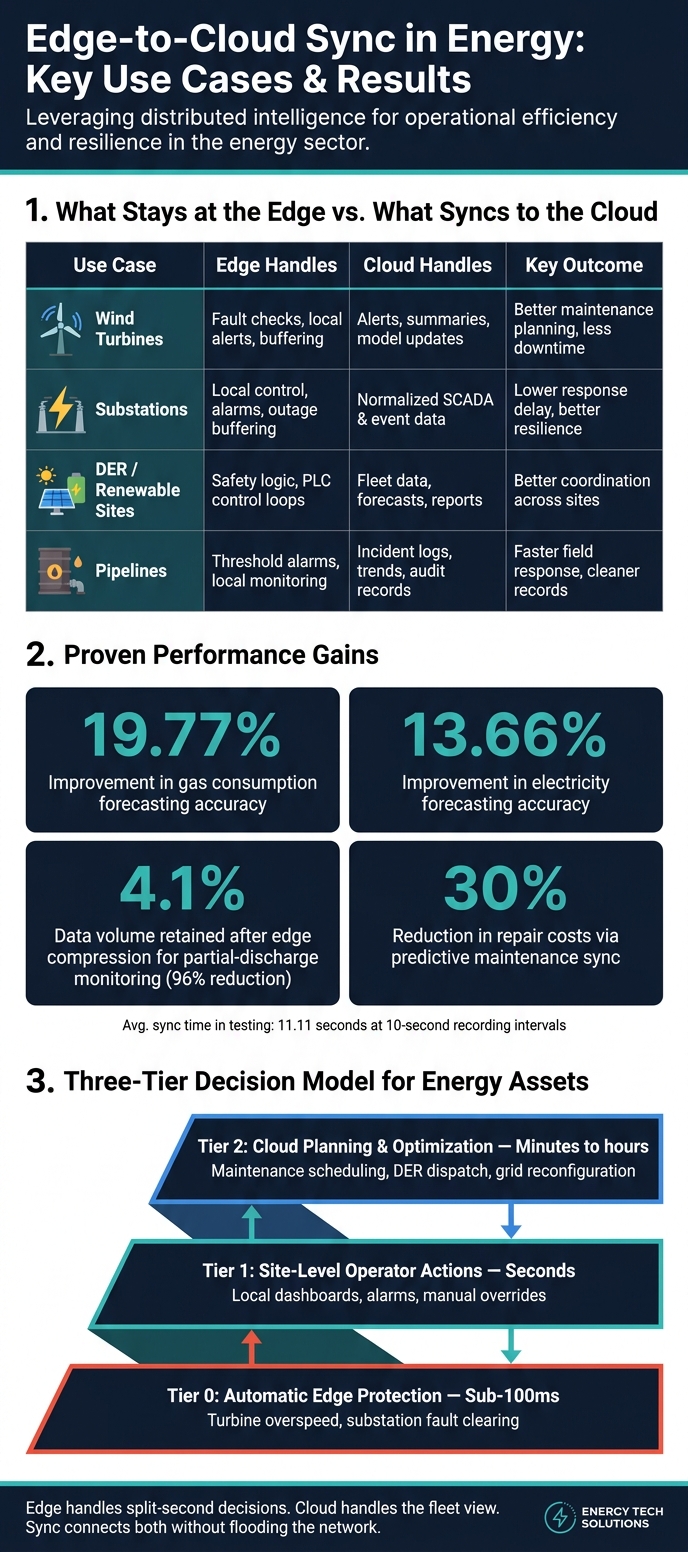
- Measured results: one cited deployment improved gas forecasting by 19.77% and electricity forecasting by 13.66%; another sync test showed an average sync time of 11.11 seconds
- Data reduction: for partial-discharge monitoring, edge compression cut data volume to 4.1% of the original size
- Planning and uptime: the article also points to a 30% drop in repair costs in one predictive maintenance case
What matters most is not where all data goes, but which decisions stay local and which data moves upstream. For Canadian energy groups, that means setting clear rules for latency, data location, security, and integration with SCADA, CMMS, EAM, and reporting systems.
Edge vs. Cloud vs. Hybrid: Energy Asset Monitoring at a Glance
Deploy Edge–Cloud Synchronization | Time-Series Database Essentials
sbb-itb-fd1fcab
Quick Comparison
| Use case | What stays at the edge | What syncs to the cloud | Main result |
|---|---|---|---|
| Wind turbines | Fault checks, local alerts, buffering | Alerts, summaries, model updates | Better maintenance planning and less unplanned downtime |
| Substations | Local control, alarms, outage buffering | Normalized SCADA and event data | Lower response delay and better resilience |
| DER sites | Safety logic, PLC control loops | Fleet data, forecasts, reports | Better coordination across sites |
| Pipelines | Threshold alarms, local monitoring | Incident logs, trends, audit records | Faster field response and cleaner records |
If you want the short version, it’s this: edge handles the split-second work, the cloud handles the fleet view, and sync connects the two without flooding the network.
2. Wind Turbine Predictive Maintenance
Wind turbines produce a nonstop flow of sensor data – vibration, temperature, wind speed, and power output. That data has to do two jobs at once: support instant action at the turbine and feed longer-term analysis across the fleet.
That’s where edge-to-cloud monitoring fits. Edge processing helps catch faults right away at the turbine. Cloud sync helps teams plan maintenance across the full site. For wind fleets, this means faster fault detection on location and better maintenance planning across assets.
Edge-to-Cloud Architecture at Turbine and Site Level
Each turbine uses an edge gateway or embedded controller to collect sensor readings and process them in real time. Instead of sending everything upstream, the system syncs only alerts, summaries, and scheduled data batches to the cloud on a daily or event-driven basis. Model updates can also move back down to the edge, so local fault detection keeps getting better.
A MindConnect gateway can work as an isolated intermediary. In plain terms, it helps protect local systems from direct internet exposure while sending structured data to the cloud platform. The sync goes both ways: updated machine learning models downloaded from the cloud improve local fault detection over time.
Measured Gains in Maintenance Planning and Uptime
A related energy-monitoring deployment showed what synchronised edge and cloud data can do for forecasting and asset visibility. In that case, OPC UA servers and a gateway synchronised eight heat sources to the cloud. Gas consumption prediction accuracy improved by 19.77%, and electricity prediction improved by 13.66%. That kind of gain feeds into better-planned maintenance cycles and fewer unplanned interventions.
Monitoring also expanded from three to eight heat sources, with secure web-based visualisation.
Bandwidth savings matter too. Instead of streaming raw high-frequency sensor data all the time, the setup sends only event summaries and scheduled summaries to the cloud. In a synchronisation test using a 10-second recording interval, the average sync time was 11.11 seconds, with a maximum timeout of 59 seconds.
That’s the sweet spot for hybrid monitoring. Edge-only setups react fast but stay siloed. Cloud-only setups can see the bigger picture, but they depend more on network links and add delay.
Edge-Only vs. Cloud-Only vs. Hybrid: A Turbine Monitoring Comparison
| Feature | Edge-Only | Cloud-Only | Edge-to-Cloud Hybrid |
|---|---|---|---|
| Latency | Milliseconds (local control) | Seconds to minutes (network dependent) | Milliseconds for control; seconds for analytics |
| Bandwidth Use | Minimal (local only) | High (continuous raw data stream) | Optimised (event-driven uploads) |
| Fault Detection | Immediate (local triggers) | Delayed (processing lag) | Immediate local + fleet-wide trend detection |
| Reliability | High (independent of WAN) | Low (vulnerable to link outages) | High (local autonomy with cloud buffering) |
| Fleet Scalability | Difficult (siloed assets) | High (centralised) | Very high (fleet-wide coordination) |
For remote sites, local buffering keeps data collection running even during link outages and synchronises once connectivity comes back.
The same edge-to-cloud pattern matters even more in substations, where response time and resilience have a direct effect on outcomes.
3. Real-Time Grid and Substation Monitoring
Where turbine monitoring protects individual assets, substation sync protects grid stability. In practice, that means substations need a tiered setup. Edge nodes deal with data in motion and handle immediate control, while SCADA logs and syncs that same data for later analysis.
Substation Data Flows, Standards, and Synchronization
At the substation level, edge gateways translate IEC 61850, DNP3, and Modbus into OPC UA before syncing data upstream. OPC UA gives teams one common layer across mixed devices and helps move data cleanly between systems. The result is simple: operators can act on issues locally without giving up cloud visibility.
That normalised edge data also supports local alarms and buffering during outages. This matters when links drop or central systems go quiet for a bit. The substation can still keep watch, hold data, and react where it needs to.
For high-frequency partial-discharge signals, edge-based autoencoder compression can cut data volume to 4.1% of its original size while keeping the features needed for fault analysis. That’s a huge drop in data load without stripping out the signal details engineers rely on. OPC UA also supports encrypted transport and certificate-based authentication.
Once these protocols are brought into one format, local response gets much faster when conditions shift.
Operational Outcomes for Outage Response and Resilience
Fault response depends on low latency. In May 2022, Agile Fractal Grid worked with InterSystems to deploy the IRIS Data Platform for a decentralised power grid initiative. The system supports millisecond response times for thousands of devices and the "Fractal Twins" model, which helps keep local logic and safety protocols running during temporary cloud or central network interruptions.
"We knew that to make an immediate and significant impact in how energy is delivered, we needed to work with a company that understood the importance of speed and scalability in managing energy data." – John Reynolds, CEO, Agile Fractal Grid
Traditional Centralized SCADA vs. Edge-Enhanced SCADA
| Feature | Traditional Centralized SCADA | Edge-Enhanced SCADA |
|---|---|---|
| Latency | High; dependent on polling cycles and backhaul bandwidth | Low; millisecond local decision-making |
| Central Load | High; all raw telemetry is processed centrally | Low; edge nodes filter and compress data locally |
| Resilience Offline | Low; visibility and control can be compromised during outages | High; local logic and buffering maintain operation |
| Scale | Limited by central server capacity and bandwidth | High; distributed architecture supports thousands of nodes |
4. DER, Renewable Assets, and Pipeline Monitoring
For DER and remote facilities, the same setup has to handle local control and cloud coordination at the same time. That split matters most when connectivity is weak and response time has a direct effect on safety.
DER and Renewable Assets: Local Control with Cloud Coordination
DER sites need local control for safety, plus cloud sync so teams can see what’s happening across the fleet. Edge nodes and PLCs keep control loops and safety protocols running even if cloud connectivity drops. The cloud layer adds forecasting and fleet reporting.
In the MIDIH Paufex-IOTandCI experiment, Python OPC UA servers and MindConnect IoT2040 gateways synced Firebird database data to MindSphere. Forecasting improved by 19.77% for gas and 13.66% for electricity, while monitoring expanded from 3 to 8 heat sources.
Pipelines and Remote Facilities: Faster Alerts and Safer Operations
This same pattern matters even more in remote pipeline facilities, where delays can create safety risk. Edge nodes placed along a pipeline capture pressure, flow, and temperature data on a continuous basis. If an anomaly crosses a threshold, the edge device can trigger a local safety alarm right away, without waiting for cloud latency. That cuts response time for field crews.
Synced edge logs also support warranty and compliance records. When incidents and historical trends are synchronised to the central cloud system, operators get a continuous, audit-ready record for compliance.
Minimal Edge Presence vs. Full Edge-to-Cloud Synchronization
| Feature | Minimal Edge Presence (Cloud-Only) | Full Edge-to-Cloud Synchronization (Hybrid) |
|---|---|---|
| Control Latency | High; dependent on cloud round-trip and network stability | Low; real-time local control loops operate at the site |
| Event Visibility | Delayed; events are only visible when the network is active | Immediate; local dashboards provide real-time site status |
| Offline Resilience | Poor; control and monitoring fail during connectivity loss | High; local control continues and data is buffered for later sync |
| Audit Trail Quality | Limited for historical gaps | High when edge events are synchronised to cloud storage |
For Canadian energy organisations, these trade-offs shape the implementation priorities in the next section.
5. Key Lessons for Canadian Energy Organizations
Implementation Priorities: Latency, Governance, and Integration
These use cases boil down to three priorities: latency, governance, and integration.
Start with latency. A practical setup is to use three decision tiers across turbines, substations, DER sites, and pipelines:
- Tier 0 for automatic edge protection, with sub-100 ms protective actions for jobs like turbine overspeed protection or substation fault clearing
- Tier 1 for site-level operator actions
- Tier 2 for cloud-supported planning and optimisation, including maintenance scheduling, DER dispatch, and grid reconfiguration
That structure keeps the fast, high-stakes decisions close to the asset. The slower, fleet-level work can then sit in the cloud, where teams can look across more data without getting in the way of site operations.
Once latency is set, governance draws the line around what data can move. In practice, that means deciding which datasets must stay in Canada, who gets access to OT data, and how sync rules are written down. For grid assets covered by NERC CIP, those choices feed straight into the security architecture. That includes network segmentation between control and corporate networks, mutual authentication for edge gateways, and encrypted channels between sites and cloud platforms.
After that, the job is to fit edge data into the systems teams already use every day. Integration with SCADA, CMMS, EAM, and regulatory reporting tends to work best when edge gateways normalise data into a standard data schema before synchronisation, instead of sending raw vendor-specific tags to the cloud. That one move helps keep dashboards, predictive models, and compliance reports consistent across asset types without ripping out established systems. It also carries forward the same normalisation already done at the edge through OPC UA and gateway translation.
Summary of Case Study Findings
Across all asset types, selective synchronisation – not full-cloud transfer – improves response time, cuts data load, strengthens resilience, and supports better analytics. One study reported a 30% reduction in repair costs from centrally syncing vibration signatures and power-curve deviations for predictive maintenance models. The pattern is pretty clear: know which decisions have to happen at the asset, and which insights only show up when data is viewed across the full fleet.
FAQs
How do I decide what stays at the edge?
What belongs at the edge comes down to two things: real-time performance and data sovereignty.
Some workloads need to stay local, especially in remote places with weak or limited internet. In those cases, on-site processing can cut latency, lower bandwidth costs, and support fast decisions when every second counts. A good example is equipment monitoring in rural areas, where waiting on a cloud round trip just doesn’t make sense.
Sensitive data may also need to stay on-premises to meet Canadian data sovereignty and regulatory rules. Digital Fractal Technologies Inc. can help assess which workloads make sense at the edge and which are better suited for the cloud.
What happens during a network outage?
During a network outage, advanced synchronization solutions help keep the business running, even when connectivity in the field drops in and out. Instead of bringing work to a halt, they process data locally so teams can keep real-time visibility and stay in control of day-to-day operations.
With edge computing, organisations can monitor equipment and handle critical tasks on-site, then sync the data once the connection comes back. That cuts the risk of data loss and helps limit disruptions to service reliability.
How hard is it to connect this with SCADA and EAM?
It can get messy fast. Legacy SCADA and EAM systems often run on proprietary protocols, which makes them harder to connect to modern edge-to-cloud and cloud-based AI platforms. On top of that, they can struggle with real-time analytics, data quality, and data consistency.
Digital Fractal Technologies Inc helps close that gap with custom integration work, including API wrappers and modular approaches that connect legacy systems securely without ripping out the core infrastructure.