Canadian Bill of Lading OCR: Traceable, Customs Ready for Logistics

Bills of lading OCR converts scanned or photographed shipping documents into structured shipment data, including shipper, consignee, container numbers, weights, and commodity descriptions, ready for a TMS, ERP, or spreadsheet. It pays off once document volume, turnaround speed, or error rates make manual keying too costly. Even strong systems still need human validation for customs filings and any question involving title or release.
TL;DR:
- OCR systems excel at capturing header, routing, and cargo fields, but handwritten amendments and free-text declarations often require manual review.
- Confidence scoring, bounding box data, and page references enable quick verification and reduce re-keying errors during validation.
- Ensuring secure storage, metadata retention, role-based access, and adherence to customs regulations is essential for legal and compliance purposes.
- A focused pilot with representative documents, clear mapping, and traceability from day one improves implementation speed and long-term accuracy.
- OCR cannot replace legal titles or contractual documentation, and document format diversity demands layout-agnostic models for multi-modal freight operations.
Table of Contents
- Which bill-of-lading fields reliable OCR systems capture
- How bill-of-lading OCR works behind the scenes
- Getting OCR data into your TMS, ERP, or spreadsheet
- Accuracy, validation, and exception handling: how to trust extracted values
- Data governance and compliance considerations for electronic documents
- Implementation checklist: from pilot to production
- Handling handwritten notes and signatures beyond stamps
- Common OCR errors and how to catch them
- Security considerations for storing and processing extracted data
- Real-world use cases and the benefits teams report
- Why governance and a short audit beat a rushed rollout
- How we help logistics teams pilot and scale BOL OCR
- FAQ
- Sources
Which bill-of-lading fields reliable OCR systems capture
A mature OCR system extracts data at three levels: header, routing, and line item. Header fields identify the parties and the shipment itself, routing fields track movement, and line-item fields describe what is actually being carried.
- Header fields: shipper, consignee, notify party, BOL number, and issue date.
- Routing fields: port of loading, port of discharge, vessel or carrier name, and ETD/ETA.
- Container and cargo fields: container numbers, seal numbers, gross and net weights, package counts, and commodity descriptions.
- Special declarations: hazmat codes, temperature requirements, and freight terms.
Beyond the raw values, a well-built pipeline also returns extraction metadata: a confidence score per field, a bounding box locating the value on the page, and a page reference for multi-page documents. That metadata is what lets a reviewer check a flagged field in seconds instead of re-reading the whole document.
Some fields resist full automation no matter how good the model is. Handwritten amendments, rubber-stamp endorsements, hazmat declarations written in free text, and ambiguous commodity descriptions (a one-line phrase covering a mixed pallet, for example) commonly need a human pass before the data is trusted downstream.
How bill-of-lading OCR works behind the scenes
The pipeline starts with capture: documents arrive through a watched email inbox, a carrier portal download, or a manual scan upload. From there, an OCR engine reads the raw text, a layout analysis step identifies where each block sits on the page, and machine learning field parsers (often built on named-entity recognition) map that text to the fields a logistics team actually needs. A normalization step then standardizes units, dates, and codes so the output matches internal formats.
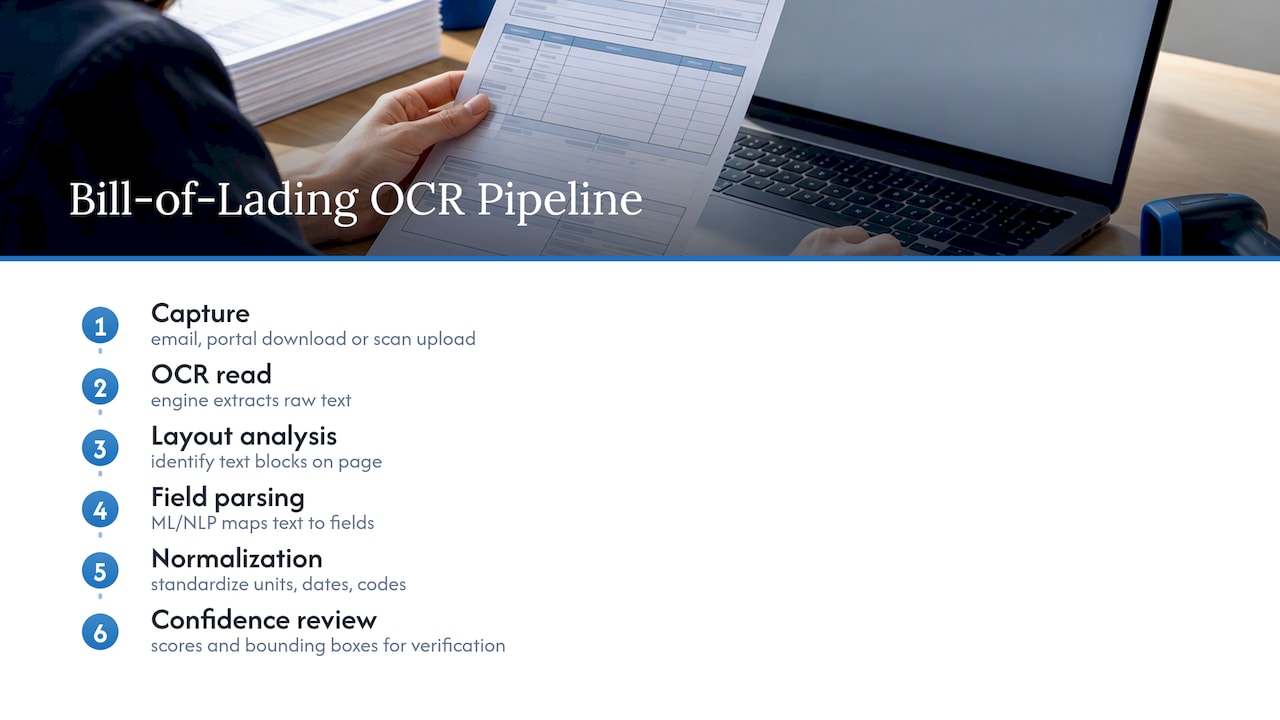
Two broad approaches exist. Template-based systems work well when a carrier’s layout rarely changes, but they break the moment a new carrier or document version appears. Layout-agnostic, model-driven systems read the document by meaning rather than position, which handles the wide variety of bill-of-lading formats that come through a typical freight desk, including scanned, faxed, and handwritten versions.
Confidence scoring and bounding boxes matter here too: they are what turns a black-box extraction into something a reviewer can verify field by field rather than re-keying the whole form.
Getting OCR data into your TMS, ERP, or spreadsheet
Extracted data is only useful once it lands cleanly in the system your team actually works in. Most implementations support three output shapes: a CSV or Excel file for manual or semi-automated import, a JSON or XML payload for direct API integration, and a direct TMS/ERP connector that skips the file step entirely. A practical detail that trips up many pilots: decide early whether your export is one row per shipment or one row per container, since multi-container bills of lading produce very different spreadsheets depending on that choice.
- Normalize units and codes first: convert weights and dimensions to one standard and map commodity text to your internal commodity codes before import.
- Keep a source-image reference on every row: a link back to the original document page saves hours when a reconciliation question comes up later.
- Choose the right automation pattern: a watched folder for low-volume operations, a direct API for high-volume flows, and pre-import validation rules in both cases to catch malformed rows before they hit production.
Our AI OCR for document automation overview covers how these integration patterns apply across document types beyond bills of lading.
Accuracy, validation, and exception handling: how to trust extracted values
Accuracy claims from any OCR vendor need context. Header fields on a clean, typed bill of lading are usually extracted at high confidence; line-item detail, handwritten amendments, and multi-page documents are where error rates concentrate. Treat a vendor’s headline accuracy number as a ceiling, not a guarantee, and measure it against your own document mix.
- Set confidence thresholds: route anything below your chosen threshold to a human reviewer automatically.
- Automate cross-checks: flag mismatches between container count and listed containers, or between gross weight and the sum of line items.
- Track exception types over time: a recurring error pattern usually points to one carrier’s document format, not a model problem.
- Log every correction: a change log turns one-off fixes into training signal for the next model update.
A practical operational pattern for OCR review: preserve the full traceability chain, meaning the source image, extracted value, confidence score, bounding box, reviewer change, and final posted value, according to automation practice for BOL-to-TMS workflows. That chain is what lets a team reopen a shipment months later and reconstruct exactly what was extracted, corrected, and why.
Essential KPIs worth tracking from week one: straight-through pass rate, average review time per exception, exception type distribution, and the volume of changes logged per reviewer.
Data governance and compliance considerations for electronic documents
OCR is a capture layer, not a legal substitute for the underlying document. Whether a digital bill of lading can replace a paper negotiable instrument depends on contract terms, carrier practice, and jurisdiction, so any question touching title or release of goods belongs with legal counsel or the carrier, not an extraction pipeline.
For operations touching Canadian customs processes, two reference points matter. The Electronic Documents and Electronic Information Regulations (SOR/2014-117) set out requirements for preserving document integrity and for the proper sending, receiving, and metadata handling of electronic documents, which means an OCR pipeline needs to retain originals and an auditable transformation history alongside the extracted data. Separately, the CBSA’s Electronic Commerce Client Requirements Document chapter on the Image Interchange Document describes how image references are submitted for customs processing and notes that submitted images must remain accessible to appropriately cleared CBSA and PGA staff. OCR can support that workflow, but extracted values still need operational review before they go into a filing.
Practical controls worth building into any pipeline:
- Tamper-evident storage: keep originals in a system that logs every access and edit.
- Full metadata retention: capture timestamps, source, and transformation history alongside each extracted value.
- Role-based access controls: limit who can view or edit source images and extracted data.
- Accessibility for cleared staff: make sure customs-relevant images remain retrievable on request.
Escalate to customs brokers, legal counsel, or the carrier directly whenever a question involves title, release authority, or filing accuracy rather than simple data capture.
Implementation checklist: from pilot to production
A focused pilot beats a sprawling rollout. The sequence below reflects how we scope and run BOL OCR pilots for logistics clients.
- Scope the project with an audit: identify document sources, monthly volume, and the exact integration points into your TMS or ERP before writing any code.
- Select a representative document sample: include your messiest carrier formats, not just the clean ones, so the pilot reflects real conditions.
- Map output fields to your TMS import format: agree on the one-row-per-shipment or one-row-per-container convention up front.
- Define exception SLAs: decide how fast a flagged field needs human review before it blocks downstream processing.
- Build the traceability matrix: record source image, bounding box, extracted value, confidence score, reviewer edit, and final value for every field that gets touched.
- Operationalize monitoring: set up a dashboard for pass rate and exception volume, schedule periodic retraining or relabeling, and track ROI metrics such as hours saved per week.
Pro Tip: Run the traceability matrix from day one of the pilot, not after go-live. Retrofitting an audit trail onto six months of processed shipments is far harder than building it in from the start.
Our guide on workflow automation for logistics walks through how capture, OCR, validation, and TMS integration connect end to end.
Handling handwritten notes and signatures beyond stamps
Rubber stamps are the easy case. Handwritten notes, margin corrections, and signatures are where most OCR systems still need a human backstop. A handwritten weight correction scrawled next to a printed figure, a carrier’s handwritten container substitution, or a signature confirming an amendment all carry operational meaning that a model can misread or miss entirely.
The practical approach is to treat handwriting as a flag, not a failure. A layout-agnostic model can usually detect that handwriting is present in a region even when it cannot confidently transcribe it, which is enough to route that field to a reviewer with the bounding box already highlighted. That cuts review time dramatically compared to a reviewer re-reading the entire document looking for changes.
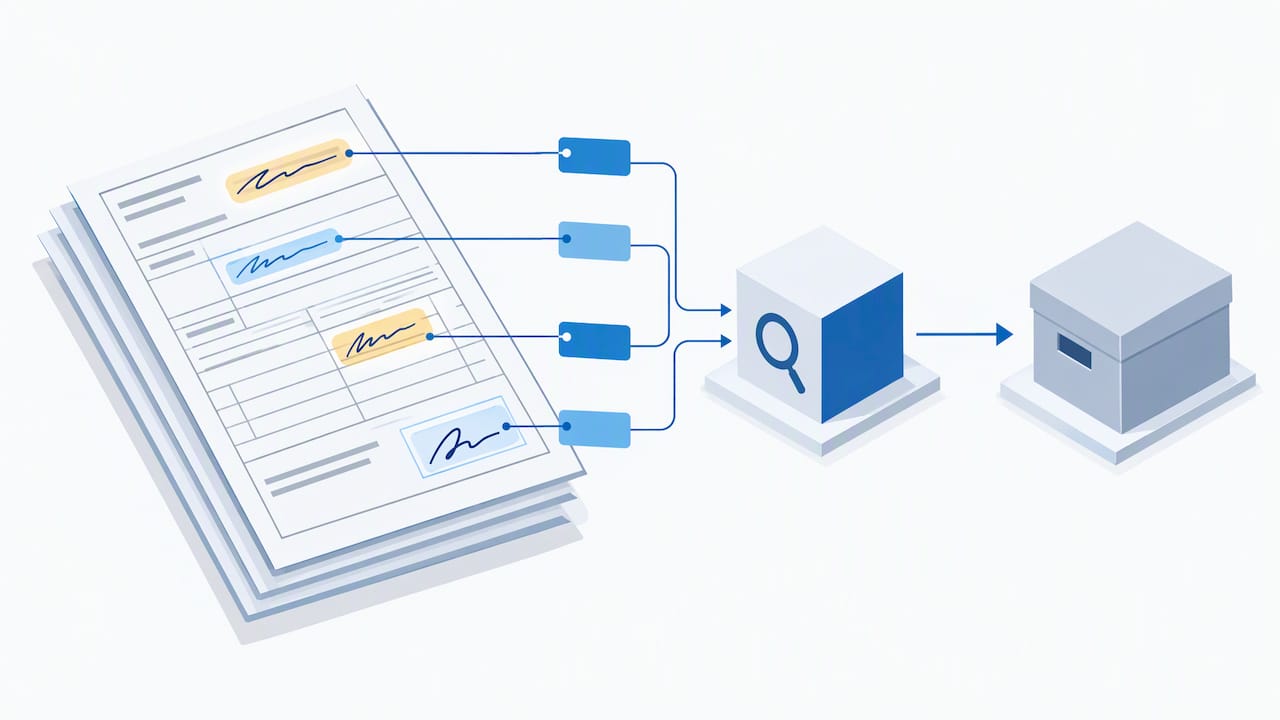
Signatures deserve a different treatment than text fields. Rather than trying to extract or validate a signature’s content, the useful output is simply confirming presence or absence, since a missing signature on a document that requires one is itself an exception worth flagging. Some pipelines also capture the signature region as an image crop attached to the record, which preserves evidence without pretending to interpret it.
Multi-page bills of lading complicate this further when a handwritten amendment appears on an addendum page rather than the main document. A good pipeline tracks page references so a reviewer knows exactly where to look, rather than treating the bill of lading as a single flat block of text. Carrier-specific patterns also tend to repeat: a carrier that routinely adds handwritten weight corrections on one document type is worth flagging for targeted review rules rather than generic low-confidence routing.
Common OCR errors and how to catch them
A few error patterns show up repeatedly across bill-of-lading OCR deployments, and most are predictable enough to build detection rules around rather than treating as random noise.
Character-level misreads are the most common: a container number digit misread (0 for O, 1 for I) or a transposed digit in a weight figure. These are best caught with checksum validation, since container numbers follow a standard check-digit format that can confirm or reject a reading automatically without any human involved.
Field misalignment is the second major pattern, where a value extracted correctly gets mapped to the wrong field, often when a document’s layout differs slightly from what the model expects. Cross-field logic catches this well: if the extracted gross weight is listed as 12 and the unit shows as “containers” instead of “kilograms,” something has shifted.
Truncation errors happen on multi-page documents when a value spans a page break or when a scan cuts off a page edge. Tracking page references and flagging any field extracted near a document boundary helps catch these before they reach a TMS.
Commodity description errors are subtler and harder to catch automatically, since a plausible-sounding but wrong description can pass basic validation. The fix here is less technical and more procedural: route any commodity description below a set confidence threshold to a reviewer who knows the shipment, rather than trusting a model’s best guess on open-ended text.
Building a change log that records every correction over time turns these one-off fixes into a feedback loop, since a recurring error tied to one carrier’s format is a signal to retrain or adjust parsing rules for that specific case.
Security considerations for storing and processing extracted data
Bill-of-lading data includes commercially sensitive details: shipper and consignee identities, cargo values implied by commodity type and volume, and shipping routes that competitors would find useful. Treating extracted data with the same security posture as the original document is the baseline expectation, not an afterthought.
Encryption in transit and at rest is table stakes for both the source images and the extracted data, particularly when documents move through a cloud OCR service before landing in an internal system. Role-based access controls matter just as much: not every team member who touches a TMS needs to see underlying shipping documents, and limiting that access reduces both accidental exposure and the blast radius of a credential compromise.
Retention policy deserves explicit attention. Keeping every source image and extracted record indefinitely is rarely necessary and increases exposure if a breach occurs, so setting a retention period tied to regulatory and audit requirements, rather than defaulting to “keep everything,” is the more defensible approach.
API integrations connecting OCR output to a TMS or ERP need the same scrutiny as any other system-to-system connection: authenticated endpoints, logged access, and scoped permissions rather than a single broad API key shared across tools.
Finally, vendor due diligence matters when using a third-party OCR service, since shipping documents are leaving your own infrastructure. Confirming where data is processed and stored, how long a vendor retains copies, and whether the vendor’s own access controls meet your internal standard are reasonable questions to ask before signing on.
Real-world use cases and the benefits teams report
Freight brokers processing bills of lading from dozens of carriers see the clearest benefit from layout-agnostic OCR, since no two carriers format their documents the same way and template-based systems break constantly in that environment. Replacing manual re-keying with automated extraction removes the slowest, most error-prone step in the quote-to-cash cycle.
Warehousing and 3PL operations benefit most from the container-level and line-item extraction, since discrepancies between what a bill of lading states and what actually arrives are easier to catch automatically when the data is structured rather than buried in a scanned PDF. Operational benefits reported around BOL-to-TMS automation commonly include reduced reconciliation time and fewer customs delays when the extraction pipeline is tied directly to pre-clearance checks, according to practical automation implementations.
Import-heavy operations handling customs documentation see a related benefit: faster turnaround on filing preparation when extracted data flows directly into pre-clearance checks rather than waiting for manual entry. That said, the extraction step itself does not replace the verification that customs filings require.
Multi-modal logistics operations, where a shipment’s bill of lading changes format depending on whether it moves by ocean, rail, or truck, benefit from a single extraction pipeline that handles format variation rather than maintaining separate manual processes per mode. Growing global adoption of electronic bills of lading suggests this kind of format diversity will persist for some time as paper and electronic documents coexist across different trade lanes.
Why governance and a short audit beat a rushed rollout
The biggest mistake we see in bill-of-lading OCR projects is treating raw extraction as the finish line. A high accuracy number on a demo document means little if nobody has mapped where errors cluster or built a traceability trail for when a customs question comes up six months later.
A short, focused audit before any pilot forces the real questions early: which document formats actually come through, what the TMS needs, and who reviews exceptions. That upfront clarity is usually what separates a 90-day pilot that reaches production from one that stalls in review limbo.
— Souhail
How we help logistics teams pilot and scale BOL OCR
Piloting bill-of-lading OCR without a clear scope often means months of trial and error before a team sees real time savings. Our AI Readiness Audit starts by mapping your actual document sources, volumes, and integration points, so the pilot targets the carriers and fields causing the most manual work today.
From there, we run the pilot around the same practices covered in this guide:
- Sample selection drawn from your messiest real-world documents, not clean examples.
- Field mapping to your TMS or ERP import format before extraction begins.
- A traceability matrix built in from day one, covering source image, confidence, and reviewer edits.
- KPI definitions agreed upfront, so pass rate and review time are measurable from week one.
Our solutions are built around your existing workflows rather than a generic template, aiming to deliver results in a timely manner. If document processing is slowing your logistics operation down, book an AI Readiness Audit to see where automation fits.
FAQ
What accuracy can I expect from bills of lading OCR?
Accuracy varies significantly by field type: header fields like shipper and consignee on clean, typed documents extract reliably, while line-item detail, handwritten amendments, and multi-page documents carry more risk of error. Measuring accuracy against your own document mix, rather than trusting a vendor’s headline number alone, gives a more realistic picture.
Can OCR replace the paper bill of lading for legal purposes?
No. OCR is a capture layer that extracts data from a document, but whether an electronic version can legally replace a paper negotiable bill of lading depends on contract terms, carrier practice, and jurisdiction. Any question involving title or release of goods should go to legal counsel or the carrier directly rather than being resolved by the extraction pipeline.
What is the Image Interchange Document and how does OCR relate to it?
The Image Interchange Document is a CBSA mechanism described in the ECCRD chapter on IID for submitting image references as part of customs processing, with a requirement that images remain accessible to appropriately cleared CBSA and PGA staff. OCR can support this workflow by extracting and organizing document data, but extracted values still need operational review before use in an actual filing.
How long does a bills of lading OCR pilot typically take to show results?
A focused pilot that includes document mapping, a representative sample, and defined exception handling can reach measurable results within a few months when scoped tightly around a specific document set and integration point. Rollouts that skip upfront scoping tend to take longer because exception handling and mapping get resolved reactively instead of planned in advance.
What should I store for traceability when processing bills of lading with OCR?
A practical traceability record includes the source image, the extracted value, a confidence score, the bounding box location, any reviewer correction, and the final posted value for each field. Preserving this chain, as recommended in BOL-to-TMS automation practice, supports customs audits and makes it possible to reconstruct exactly what happened with a shipment months after the fact.
Sources
- Electronic Commerce Client Requirements Document (ECCRD) — Chapter on IID
- Electronic Documents and Electronic Information Regulations (SOR/2014-117)
- BOL data extraction for TMS upload | Lido
- ICC WBO: Survey shows steady rise of global adoption of electronic bills of lading