
25% Time Savings with Managed AI Services for Enterprise Leaders

Managed AI services deliver measurable gains in efficiency, governance, and speed to production for enterprises that adopt them. Forrester’s Total Economic Impact study on generative AI deployments on AWS found roughly 25% time savings for impacted employees and faster pilot-to-production timelines when organizations worked with managed partners. The sections below break down those benefits, the operating-model case against building alone, and how to evaluate a provider.
TL;DR:
- Continuous monitoring, lifecycle governance, and security are essential components managed by providers, addressing common operational gaps of in-house AI.
- Costs shift from fixed infrastructure and salaries to variable spend linked to actual usage, providing more predictable and flexible budgeting.
- Evaluation should prioritize provider transparency on governance, performance evidence, SLAs, and compliance, while avoiding vendors with vague data handling practices.
- Starting with an AI Readiness Audit can identify the highest-value automation opportunities and set a practical 90-day path to measurable efficiency gains.
Table of Contents
- Efficiency, Cost Control, and Speed to Value
- The Operating-Model Case for Managed Services Over In-House Builds
- What Managed AI Services Actually Cover
- Measurable Outcomes You Can Put in a Business Case
- Choosing a Managed AI Provider: Checklist and Red Flags
- How a Readiness Audit Shapes a Practical Managed AI Path
- What I’d Tell a Leader Starting This Process
- Start With an AI Readiness Audit
- FAQ
- Sources
Efficiency, Cost Control, and Speed to Value
The core value of managed AI comes from three connected shifts: less manual work, more predictable spending, and faster movement from pilot to production.
On the efficiency side, document processing, data validation, and agentic workflows are the most common starting points for workflow automation for small business. A managed team configures these systems, tunes them against real data, and keeps them running without pulling your staff away from their core jobs. Workflow automation coverage walks through how this plays out across document handling, analytics pipelines, and service desk triage.
On cost, managed AI converts a chunk of what would be fixed internal investment, salaries, infrastructure, and tooling, into variable operational spend tied to actual usage. That matters because cloud compute costs for AI workloads swing hard depending on model choice and scaling decisions, and a managed provider is positioned to adjust those levers continuously instead of leaving them set once and forgotten.
These are the kinds of figures that hold up in an internal business case because they come from a named, structured study rather than a vendor claim.
Speed to value is the third piece, and it is often underweighted. Organizations that lean on partners for implementation typically move from pilot to production within a shorter timeframe than is typical for solo builds, according to the same Forrester research. That timeline compression is where a lot of the financial case for managed services actually lives, since a stalled pilot produces zero return no matter how promising the underlying model is.
Putting these together, the practical benefits leaders can expect are:
- Lower manual workload on repetitive document, data entry, and triage tasks handled by automated workflows.
- Variable cost structure that scales with usage instead of locking in fixed headcount and infrastructure spend.
- Faster production timelines, often months instead of a year or more, when partners handle implementation.
- Reduced operational risk through continuous monitoring rather than one-time setup and walk-away delivery.
The Operating-Model Case for Managed Services Over In-House Builds
Running AI well is less a project than an ongoing operating model: continuous monitoring, retraining, security patching, and governance updates that never really stop. A one-time internal build treats AI like a software project with a finish line, and that mismatch is where most in-house efforts stall.
Three structural problems tend to show up when companies try to run AI entirely on their own:
- Talent scarcity. Specialized roles like MLOps engineers and AI governance leads are hard to hire and harder to retain, especially outside major tech hubs.
- Operational gap. Building a model is different from operating one at scale; few internal teams have experience with drift detection, retraining cadences, or incident response for AI systems.
- Cost structure mismatch. Fixed salaries and infrastructure commitments do not flex with usage the way managed, outcome-based arrangements do, so costs stay high even when AI workloads are light.
A few signals suggest an organization is not ready to run AI alone: no one owns AI governance full time, there is no monitoring in place beyond initial testing, or the last AI pilot never made it past a demo. Our decision-maker’s guide to managed AI services covers this operating-model argument in more depth, including how to frame the build-versus-partner decision internally.
Gartner’s forecast for worldwide AI spending in 2026 points to continued heavy investment in AI platforms and operations, which is consistent with more enterprises choosing managed or partner-supported models over fully internal builds as the spending forecast shows.
What Managed AI Services Actually Cover
A managed AI engagement typically bundles a specific set of operational capabilities rather than a single deliverable. Knowing what belongs on that list helps you compare providers on substance instead of marketing language.
Core capabilities usually include:
- MLOps and deployment pipelines that move models from testing into production reliably.
- Monitoring and observability that catch model drift, performance drops, or unexpected outputs before they cause damage.
- Lifecycle governance covering retraining schedules, version control, and documentation.
- Security and compliance controls tailored to the data types and regulatory context involved.
- Data integration connecting AI systems to the existing tools and databases your teams already use.
- Cost controls that track and adjust compute spend as usage patterns change.
Delivery models vary and they affect both pricing and accountability. A retainer model pays for ongoing operations and support, an outcome-based model ties fees to specific results, and an audit-plus-pilot model starts small and scales once value is proven. Vendors like Microsoft support this kind of managed delivery through tools such as Copilot Studio, which lets managed teams build and deploy conversational assistants without starting from scratch.
Integration patterns matter too. Cloud SaaS deployments are fastest to launch, hybrid setups balance speed with data control, and private cloud suits organizations with strict compliance requirements. Confirm which pattern a provider defaults to before signing anything, since switching later is expensive.
Pro Tip: Ask a prospective provider to show you a live monitoring dashboard from an existing client engagement, not a slide deck, before you sign anything.
Measurable Outcomes You Can Put in a Business Case
Business cases for managed AI succeed or fail on whether the numbers behind them are real and attributable. The Forrester TEI study on generative AI on AWS remains one of the clearest public sources for this, and it is worth citing directly rather than paraphrasing loosely.
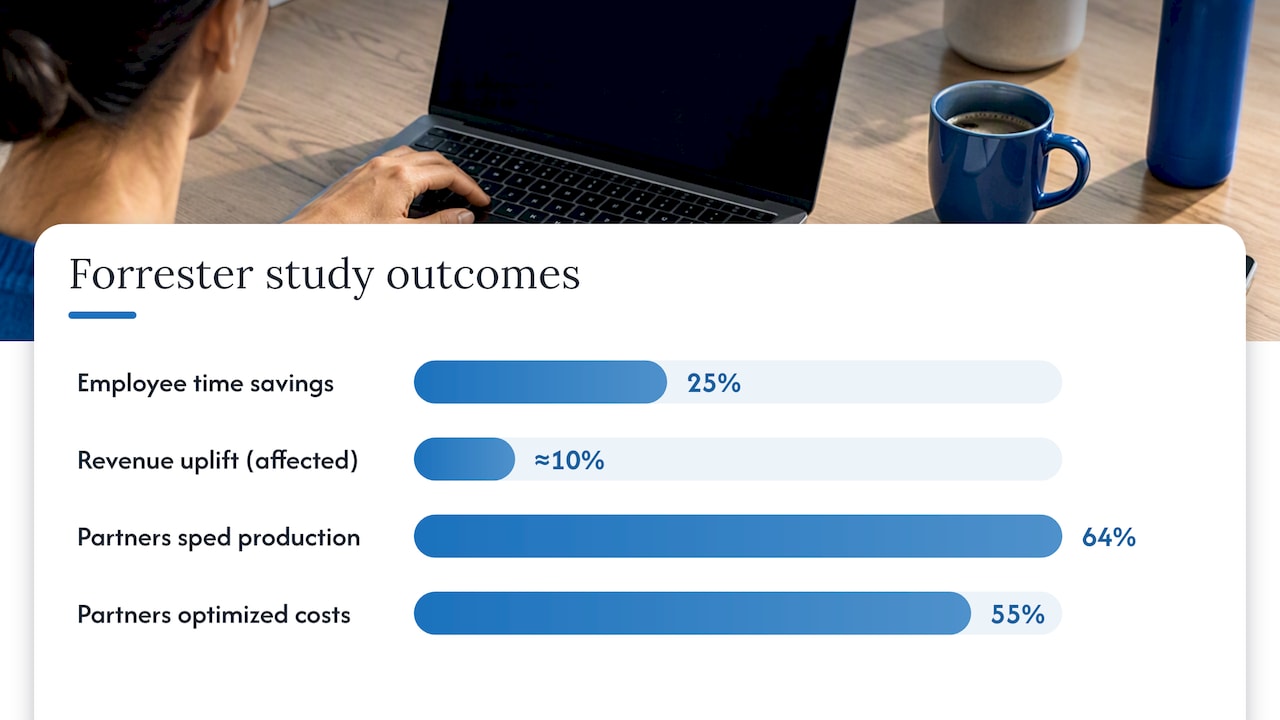
Forrester’s research found that interviewed organizations saw around 25% time savings for impacted employees, revenue uplift near 10% in affected streams, and pilot-to-production timelines compressed to within six months when partners were involved. The same study found that 64% of respondents said partners accelerated time to production, and 55% said partners helped optimize costs, numbers that make a strong case for why the operating partner matters as much as the technology itself.
When building your own internal case, a few practices keep the numbers credible:
- Use a conservative estimate for efficiency gains in your first-year projection, then show the optimistic Forrester-reported figures as upside.
- Tie time savings to specific roles rather than claiming blanket productivity gains across a department.
- Separate one-time implementation costs from ongoing operational spend so the comparison to current-state costs is apples to apples.
- Reference the accelerated timeline explicitly, since a six-month path to production changes the payback period calculation significantly.
Choosing a Managed AI Provider: Checklist and Red Flags
Evaluating a managed AI provider comes down to verifying that governance and accountability are built into the engagement, not bolted on afterward. Canada’s Implementation Guide for managers of AI systems frames this well: responsible AI governance needs continuous monitoring, audit trails, and incident response built into the operating model, not a one-time checklist completed at launch.
Run through these steps before signing a contract:
- Confirm governance practices. Ask how monitoring, audit trails, and incident response work day to day, not just at kickoff.
- Request performance evidence. Ask for sample monitoring dashboards, runbooks, or anonymized outcome data from existing clients.
- Clarify SLAs. Pin down specific commitments on model performance thresholds and how drift gets detected and corrected.
- Check security and compliance alignment. Confirm the provider understands the regulatory context relevant to your data and industry.
- Ask for references tied to measurable outcomes, not general testimonials.
Watch for these red flags:
- Vague answers about data handling or reluctance to explain where your data lives and who can access it.
- No mention of ongoing monitoring once the system goes live.
- Pricing that is not tied to clear deliverables or SLA terms.
- No familiarity with regulatory guidance relevant to your market, including the kind of lifecycle governance Canadian guidance describes.
Our security considerations guide covers the monitoring and incident-response checklist in more detail for security teams evaluating vendors.
How a Readiness Audit Shapes a Practical Managed AI Path
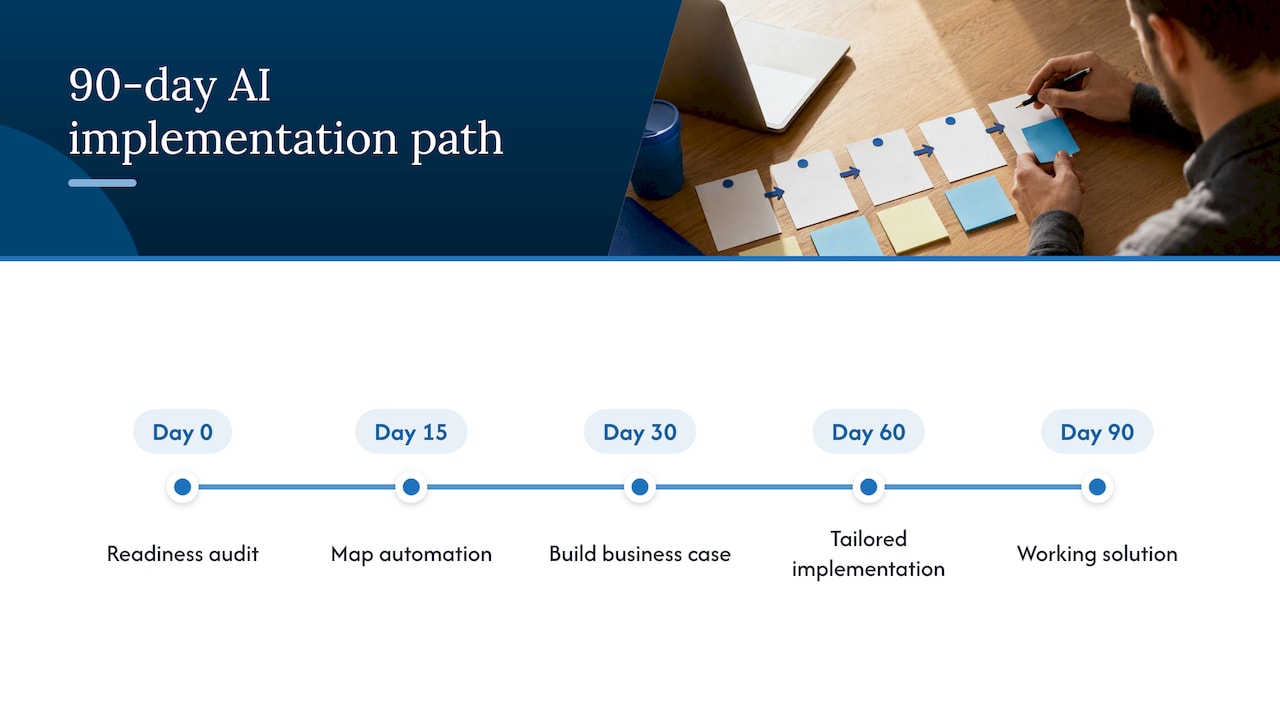
A structured readiness audit identifies where automation will produce the clearest return before any build work starts, mapping repetitive tasks, data quality gaps, and integration points across a business. That mapping becomes the business case: specific processes, estimated time savings, and a realistic sequence for implementation.
AI integration projects can be structured to deliver solutions within a 90-day path from audit to working implementation. This timeline reflects a focus on tailored automation for actual workflows rather than generic, off-the-shelf consulting applied the same way to every business.
What I’d Tell a Leader Starting This Process
The leaders who get the most out of managed AI treat it as a staged bet, not a single decision. Run a readiness audit first, test one well-scoped pilot, and measure the actual time and cost impact before committing to a broader rollout.
Governance-first pilots with a narrow scope reduce risk because you find out what breaks, where data quality falls short, and how staff actually use the system before the stakes get bigger. Skipping that step is the most common reason ambitious AI initiatives stall after an expensive first year. Start with the audit, not the rollout, and let the evidence decide what comes next.
— Souhail
Start With an AI Readiness Audit
We built our AI Readiness Audit to answer the question every leader in this article has been asking: where exactly does automation pay off in your business, and how fast. The audit costs between $2,500 and $10,000 depending on scope, and it maps automation opportunities across your workflows into a concrete, prioritized business case rather than a generic recommendation list.
From there, our managed delivery model keeps governance, monitoring, and lifecycle management on our side so your internal team stays focused on running the business instead of babysitting a model. What that looks like in practice:
- A scoped audit that identifies the highest-value automation targets in your operations.
- A pilot built around your actual systems and data, not a generic template.
- Ongoing monitoring and governance handled by our team once the pilot moves to production.
If you want a clear, tailored path to measurable efficiency gains within 90 days, start with an AI Readiness Audit.
FAQ
What is AI?
Artificial intelligence refers to computer systems built to perform tasks that normally require human judgment, such as recognizing patterns, processing language, or making predictions from data. In an enterprise context, this usually means machine learning models trained on business data to automate decisions or workflows.
What are managed services in IT?
Managed services describe an arrangement where an outside provider handles the ongoing operation, monitoring, and maintenance of a system on a client’s behalf, typically under a retainer or service agreement. For AI specifically, that includes monitoring model performance, managing updates, and handling governance tasks so internal teams do not have to build that capacity themselves.
What is the 30% rule in AI?
There is no single, widely recognized “30% rule” in AI governance or deployment that we can point to with a clear primary source; definitions of this term vary depending on context. If you have seen it referenced for a specific framework or vendor, it is worth confirming the original source before citing it in a business case.
What are 7 types of AI?
Common classifications of AI types vary by source, typically distinguishing systems by capability (such as narrow AI versus general AI) or by function (such as reactive machines, limited memory systems, and others). Since there is no single authoritative list of exactly seven types used consistently across the industry, it is best to treat any such list as one of several competing frameworks rather than a fixed standard.
Sources
- Implementation guide for managers of artificial intelligence systems (Innovation, Science and Economic Development Canada)
- The Total Economic Impact™ of Generative AI Solutions on AWS (Forrester / AWS TEI)
- Gartner press release: Worldwide AI spending forecast (2026)
- Microsoft Copilot Studio and Power Virtual Agents integration announcement