
AI Change Management: A Practical Playbook for Leaders

The most effective approach to AI change management is people-first, outcome-focused, and iterative: define what success looks like in business terms before you touch a single tool, run a scoped pilot, then measure whether decisions actually improved. That sequence sounds obvious. Most organizations skip at least one step, and 93% of them cite culture and change management as their greatest barrier to AI adoption.
The formal discipline behind this work is called organizational change management (OCM), and when applied to AI it adds two layers traditional rollouts don’t require: governance over model behavior and measurement of decision quality, not just usage.
Three things that separate successful AI programs from expensive experiments:
- A North Star that names the business outcome, not the technology
- A scoped pilot that observes real usage before any scaling decision.
- Baseline metrics captured before go-live so you can prove value afterward
Pro Tip: Write your North Star as a single sentence a frontline manager can repeat from memory: “By Q4, our logistics team will cut manual dispatch errors by 30% using AI-assisted routing.” Vague vision statements don’t survive the first governance review.
Key Takeaways
Successful AI change management requires a people-first, outcome-focused approach that pairs a structured five-step framework with scoped pilots, adaptive governance, and decision-quality measurement from day one.
| Point | Details |
|---|---|
| Start with a North Star | Define the business outcome before selecting any tool; name an owner and a deadline. |
| Pilot before scaling | Run a 30–45 day scoped pilot with baseline metrics captured before go-live. |
| Measure decision quality | Track override rates, decision cycle time, and error rates, not just adoption percentages. |
| Governance is ongoing | Assign a named governance owner and schedule quarterly reviews; a static checklist decays. |
| Digitalfractal accelerates the first 90 days | The AI Readiness Audit delivers a prioritized pilot plan, baseline KPIs, and a governance checklist within a fixed engagement. |
Table of Contents
- What does a strong AI change management framework look like?
- What barriers actually stop AI adoption, and how do you fix them?
- How do you design a pilot that actually de-risks AI adoption?
- How does AI actually change workflows, roles, and team structures?
- What should your first 90 days of AI change management look like?
- What does the research say about people-first AI change programs?
- When should you run an AI readiness audit before starting?
- What leaders consistently underestimate about AI change
- Digitalfractal helps you move from audit to pilot in 90 days
- Sources
What does a strong AI change management framework look like?
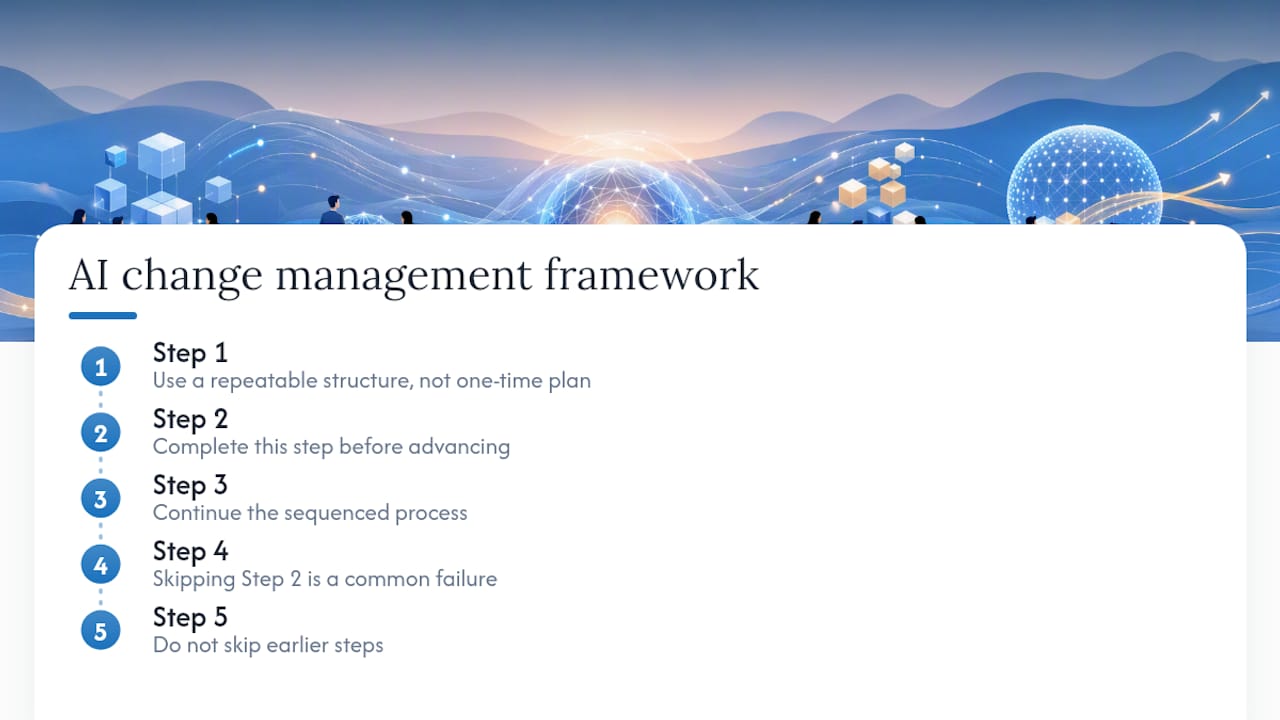
Artificial intelligence in change management requires a repeatable structure, not a one-time project plan. The five steps below are sequenced deliberately. Skipping ahead to Step 4 without completing Step 2 is one of the most common failure modes in enterprise AI programs.
Step 1: Define outcomes and your North Star
Objective: Anchor every decision to a measurable business result, not a feature list.
- Identify two or three processes where AI could change throughput, error rates, or decision speed.
- Write the North Star as a measurable outcome statement with a named owner and a deadline.
- Validate it with the executive sponsor before any vendor or tooling conversation begins.
Common trap: Letting the IT team define the North Star. The business unit that owns the outcome must write it.
Step 2: Segment your workforce and align roles
Objective: Map who is affected, how, and what each group needs to succeed.
CIO guidance recommends segmenting the workforce into at least five groups: executives, compliance and legal, subject matter experts (SMEs), end users, and innovators. Each group has different concerns, different training needs, and different governance responsibilities. AI rollouts are nonlinear. Treating all employees as one audience is how you get compliance theater instead of real adoption.
- Assign a named change agent in each segment.
- Brief compliance and legal before the pilot begins, not after.
- Give SMEs a formal role in validating AI outputs, not just consuming them.
Step 3: Pilot and iterate
Objective: Test the AI in a constrained environment before committing to scale.
Giving teams AI tools without redesigning workflows produces no net business value and can increase risk. A pilot is not a soft launch. It is a structured experiment with defined success criteria, a feedback loop, and a go/no-go decision gate.
- Limit the pilot to one function, one team, and a fixed duration (typically 30–45 days).
- Capture baseline metrics before day one.
- Observe actual usage patterns rather than assumed ones. Process owners often discover the AI is being used differently than designed.
Step 4: Build governance and earn trust
Objective: Create the guardrails that let the organization scale safely.
Trust in AI is built through repeated interaction, transparency, and continuous training, not a one-time validation exercise. Governance should be a feedback-driven process with adaptive guardrails, not a static checklist signed off at launch. Assign a data steward, a governance owner, and a process owner for every AI system in production.
- Define escalation rules and human override protocols before go-live.
- Publish a plain-language explainability summary for end users.
- Schedule quarterly governance reviews, not annual ones.
Step 5: Measure and scale
Objective: Prove value against the baseline, then expand deliberately.
Adoption success depends on workflow integration, decision quality, and trust, not raw usage numbers. Track override rates, decision quality scores, and process cycle times alongside adoption percentages. When the pilot clears its success criteria, build a scale plan that includes updated role responsibilities, a revised training curriculum, and a communication cadence for the broader organization.
Pro Tip: Before the scale decision, run a one-hour cross-functional debrief with the pilot team, a compliance representative, and the executive sponsor. The three questions that matter: Did the AI change how decisions were made? Did it create new risks? Would the team use it without being required to?
Leader’s checklist for the framework:
- [ ] North Star written, owned, and approved by the executive sponsor
- [ ] Workforce segmented with named change agents per group
- [ ] Pilot scoped with baseline metrics and a go/no-go date
- [ ] Governance roles assigned (data steward, process owner, governance owner)
- [ ] Scale criteria defined before the pilot begins
What barriers actually stop AI adoption, and how do you fix them?
Most AI programs don’t fail because the technology doesn’t work. They fail because the organization wasn’t ready for what the technology would change.
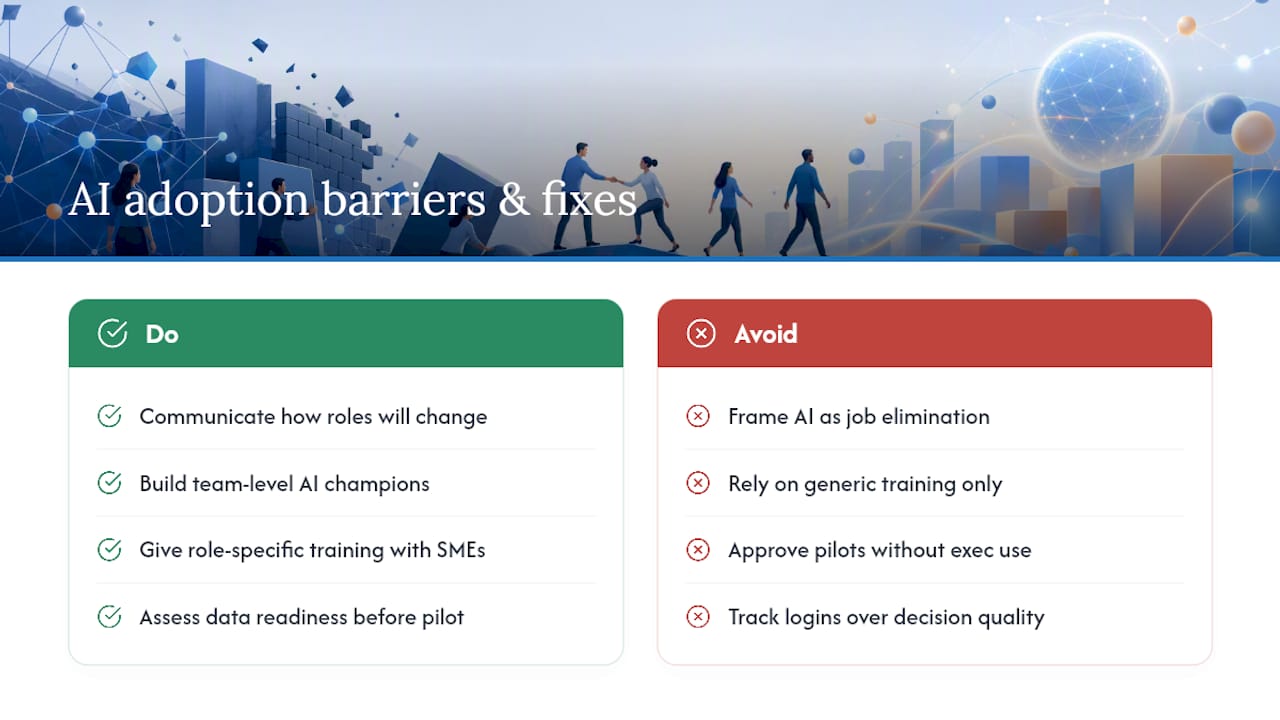
Culture and fear of job displacement are the most pervasive barriers. Red flags include employees avoiding the tool, managers quietly reverting to manual processes, and HR fielding questions about layoffs. The immediate fix is a leadership communication that separates “AI will change your role” from “AI will eliminate your role,” with specific examples of what will change and what won’t. The medium-term fix is building AI champions at the team level who model the new behaviors.
Skills gaps show up as low adoption rates in specific cohorts, high override rates without documented rationale, and training completion that doesn’t translate to usage. Remediate with role-specific training (not generic AI literacy modules) and pair it with SME validators who can coach peers in context.
Leadership misalignment is often invisible until a pilot stalls. Executives approve the program but don’t change their own workflows or ask for AI-informed outputs in their reviews. The fix is executive co-design: require the leadership team to use the AI tool in at least one recurring meeting before the pilot ends.
Legacy systems and data quality create technical blockers that no amount of change management can paper over. If the data feeding the AI is incomplete, inconsistent, or siloed, the model’s outputs will be wrong often enough to destroy trust. Conduct a data readiness assessment before the pilot, not during it.
Governance blind spots emerge when compliance and legal are brought in after the fact. Leaders must align compliance and communication strategies with human-centered workforce needs before production deployment. Integrating AI-driven HR compliance practices early prevents costly rework.
Mismeasured success is the quietest killer. Tracking logins and completion rates instead of decision quality and process outcomes makes programs look successful while the business value evaporates. Define behavioral metrics before the pilot starts.
Pro Tip: Run a 30-minute “barrier mapping” session with your pilot team at the end of week two. Ask: “What is slowing you down?” and “What would make you trust the AI more?” The answers will tell you more than any dashboard.
How do you design a pilot that actually de-risks AI adoption?
A well-designed pilot answers three questions before you scale: Does the AI improve the outcome we targeted? Do users trust it enough to change their behavior? Does it create risks we didn’t anticipate?
Pilot design essentials
- Scope tightly. One function, one team, 30–45 days. Broader pilots produce noisier data and make it harder to isolate what worked.
- Capture the baseline first. Measure the current state of every KPI you plan to track before the AI touches a single workflow. No baseline means no proof of value.
- Define the user segments. Who will use the AI daily? Who will review its outputs? Who has override authority? Document this before go-live.
- Set data and tooling constraints. Confirm what data the AI can access, what it cannot, and who approves exceptions. This is a governance decision, not an IT decision.
- Build a feedback loop. A weekly 30-minute debrief with pilot users and the process owner is more valuable than a monthly survey.
Sample KPIs for an AI pilot
Measuring AI adoption beyond raw usage means tracking decision quality, override rates, and workflow integration. Here are the metrics that matter most:
| KPI | What it measures | Why it matters |
|---|---|---|
| Override rate | % of AI recommendations rejected by users | High rates signal trust gaps or model errors |
| Decision cycle time | Time from input to final decision | Shows whether AI is actually accelerating work |
| Error rate (post-AI) | Error rate after AI adoption | Validates quality improvement against baseline |
| Adoption depth | % of eligible tasks routed through AI | Distinguishes real usage from compliance theater |
| User confidence score | Self-reported trust in AI outputs (1–5 scale) | Leading indicator of sustained adoption |
Governance checkpoints
Assign sign-off authority before the pilot begins. A clean governance structure for a 30-day pilot looks like this:
- Week 1: Process owner confirms data access and escalation rules are in place.
- Week 2: Compliance reviews any outputs flagged by users.
- Week 3: Legal and security review any unexpected data flows.
- End of pilot: Executive sponsor, process owner, and compliance lead make the go/no-go decision together.
Go/no-go criteria for scaling:
- Override rate is trending down (users are accepting more AI recommendations over time)
- At least one primary KPI improved versus baseline
- No unresolved compliance or security flags
- Process owner endorses the redesigned workflow
How does AI actually change workflows, roles, and team structures?
HBR’s analysis of agentic AI makes the point plainly: leaders must manage changes to role identity, decision authority, and the patterns of human-AI collaboration, not just the technical deployment. This is a different kind of change than installing new software.
Here is what that looks like in a common function. Take a customer support team before and after AI-assisted triage:
Before: Agent receives ticket, reads history, categorizes manually, drafts response, supervisor reviews escalations. Average handle time: 12 minutes. Escalation rate: 18%.
After: AI categorizes and suggests a response draft in under 30 seconds. Agent reviews, edits, and sends. Supervisor reviews only edge cases flagged by the AI. Average handle time drops. The agent’s job shifts from drafting to judgment.
That shift is the change management problem. The agent now needs different skills: evaluating AI outputs, knowing when to override, and documenting why. The supervisor’s role changes too. Neither of those transitions happens automatically.
Role checklist for AI-augmented teams:
- Process owner: Defines the workflow, owns the escalation rules, signs off on AI output quality standards.
- AI champion: Frontline advocate who models the new behavior and coaches peers.
- SME validator: Reviews AI outputs in high-stakes or edge-case scenarios; codifies exceptions.
- Data steward: Owns data quality, access controls, and model input integrity.
- Governance owner: Monitors compliance, tracks override patterns, escalates risks.
Pro Tip: Create a sandbox environment where SMEs can test the AI against historical cases without affecting live operations. Pair it with a small incentive (recognition, not cash) for SMEs who document edge cases the model gets wrong. That knowledge becomes your model improvement backlog.
For teams exploring AI workflow automation, the role redesign conversation should happen before the automation is configured, not after.
What should your first 90 days of AI change management look like?
The initial months determine whether your AI program builds momentum or stalls in committee. Structured change approaches increase adoption rates and measurable business outcomes. Here is a sequenced playbook with owner assignments.
Days 0–30: Align and scope
- Executive sponsor briefs the leadership team on the North Star and their individual roles in the program.
- Change lead conducts workforce segmentation and identifies change agents in each group.
- Process owner and data steward complete a data readiness assessment for the pilot function.
- Baseline metrics are captured and locked before any AI tool is introduced.
- Compliance and legal review the pilot scope and sign off on data access rules.
Communication snippet for executives: “We are running a 30-day pilot in [function] to test whether AI can [specific outcome]. Your role is to ask for AI-informed outputs in your next review of that team’s work.”
Days 31–60: Run the pilot
- Pilot launches with the defined user segments, KPIs, and feedback loop in place.
- Weekly debriefs with the pilot team surface friction points and unexpected usage patterns.
- Change agents report adoption depth and user confidence scores weekly.
- Governance checkpoints at weeks 2 and 3 (compliance, legal, security).
- AI tools can draft training materials, generate communication updates, and power employee Q&A chatbots during this phase, always with human review before distribution.
Days 61–90: Decide and scale
- Go/no-go decision meeting with executive sponsor, process owner, and compliance lead.
- If go: publish the scale plan with updated role responsibilities and a revised training curriculum.
- Update the measurement cadence (weekly during scale, monthly once stable).
- Brief the broader organization on pilot results using specific numbers, not just “it went well.”
- Schedule the first quarterly governance review.
Communication snippet for the scale announcement: “The pilot in [function] reduced [metric] by [X%] in 30 days. We are expanding to [next team] starting [date]. Here is what will change for you and what support is available.”
A 2026 survey found 93% of organizations name culture and change management as their top AI adoption barrier. The 90-day structure above is designed specifically to address that gap before it becomes a program failure.
What does the research say about people-first AI change programs?
The evidence for investing in change management is not soft. Organizations that invest in change management are significantly more likely to see AI initiatives exceed expectations. That multiplier holds across sectors and organization sizes.
Three research lines are worth citing in internal briefings:
- Culture as the primary barrier. The FranklinCovey survey of senior data and AI leaders found 93% of organizations name culture and change management as the top impediment, ahead of data quality, budget, and technical complexity.
- Workflow redesign as a prerequisite for value. Practitioner research shows that deploying AI without adapting processes produces no net business value and can increase operational risk. The technology is necessary but not sufficient.
- Decision quality as the real metric. MIT Sloan research on reshaping business with AI argues that adoption success should be measured by changes in decision-making behavior, including override rates and decision cycle times, not by seat licenses or training completion.
A fourth signal: Springer’s synthesis of AI change management research found that governance structures and iterative pilots consistently outperform big-bang deployments on both adoption rates and sustained value realization.
For leaders building the business case for change management investment, these findings translate directly: the cost of a structured change program is almost always lower than the cost of a failed deployment and a second attempt.
Real-world AI transformation case studies consistently show the same pattern: organizations that treated change management as a core workstream, not a communications add-on, achieved measurably better outcomes.
When should you run an AI readiness audit before starting?
An AI Readiness Audit is the right starting point when your organization has identified AI as a priority but hasn’t yet mapped which processes to target, what data is available, or where the governance gaps are. It is also the right move when a previous AI initiative stalled and you need an honest external assessment of why.
What a thorough audit covers:
- Process mapping across candidate functions to identify automation and augmentation opportunities
- Data quality and availability assessment for each candidate use case
- Risk review covering compliance, security, and model explainability requirements
- Change readiness assessment: leadership alignment, skills gaps, and cultural readiness
- Prioritized use-case list ranked by value potential and implementation complexity
What you get out of it:
- A prioritized shortlist of two to four pilot candidates with estimated value ranges
- A pilot plan with defined scope, KPIs, and governance checkpoints
- A governance checklist tailored to your industry and regulatory environment
- Baseline KPIs captured before any AI tool is introduced
When an internal team can self-run: If you have a dedicated change management function, a data engineering team, and an executive sponsor with bandwidth, a self-run audit is feasible for a single, well-scoped function. Budget six to eight weeks.
When to bring in a specialist: If the program spans multiple functions, involves regulated data, or follows a previous failed attempt, an external consultant accelerates the first 90 days by bringing a structured methodology, an external perspective on organizational readiness, and a network of implementation patterns from comparable organizations. Sequencing matters: engage the consultant before procurement and security reviews begin, not after, so the audit findings can inform those conversations.
Pro Tip: Ask any consultant you evaluate to show you the specific questions they use in their change readiness assessment. A generic maturity model is not the same as a change readiness assessment. The questions should probe leadership alignment, communication channels, and the organization’s history with previous technology rollouts.
Digitalfractal’s AI Readiness Audit is structured around exactly these deliverables, with a 90-day engagement model designed to move from assessment to pilot launch without the delays that typically come from open-ended consulting scopes.
What leaders consistently underestimate about AI change
The conventional wisdom says the hard part of AI adoption is the technology. Get the model right, integrate the APIs, and the organization will follow. That framing is wrong, and the data makes it hard to argue otherwise.
The harder problem is that AI changes the nature of expertise. When a logistics planner has spent 15 years building routing intuition and an AI system now produces a better route in 30 seconds, the question isn’t whether to use the AI. The question is what that planner’s expertise is now for. Organizations that answer that question well, by repositioning expertise as quality control and exception handling, retain their best people and get better AI outputs. Organizations that don’t answer it lose their SMEs and end up with a model nobody trusts.
There is a second thing leaders underestimate: governance decay. Most programs build governance for the AI system they deploy at launch. Six months later, the model has been updated, the use cases have expanded, and the original governance checklist no longer covers what the system is actually doing. Governance must be a feedback-driven process, not a one-time checklist. That requires a named governance owner with a recurring review cadence, not a document in a shared drive.
The leaders who get this right share one habit: they treat the first AI program as a capability-building exercise for the organization, not just a project to deliver. The pilot is real, the metrics are real, but the deeper goal is teaching the organization how to adopt AI at all. That lesson compounds. Every subsequent program moves faster because the change management muscle is already there.
Digitalfractal helps you move from audit to pilot in 90 days
Most organizations know they need AI. The gap is between knowing and moving. Digitalfractal closes that gap with a structured engagement that starts with an AI Readiness Audit and ends with a running pilot, a governance framework, and a scale plan, all within 90 days.
The audit identifies your highest-value automation and augmentation opportunities, maps your data readiness, and produces a prioritized pilot plan with baseline KPIs already captured. From there, Digitalfractal’s AI integration consulting team works alongside your process owners and change agents to configure, test, and iterate, so the first pilot is designed to succeed, not just to launch. The difference from generic consulting is specificity: every engagement is scoped to your industry, your workflows, and your governance requirements, not a templated playbook dropped into your org chart.
If you are ready to move from strategy to execution, start with the audit. It takes less time than a failed pilot and costs less than a second attempt.
Sources
The sources below are the strongest references for leaders building an internal case for AI change management investment or preparing briefing materials.
- How Leaders Drive Successful AI Change Management | FranklinCovey
- Preparing your workforce for AI agents: A change management guide | CIO
- Reshaping business with artificial intelligence | MIT Sloan
- What is agentic AI and how will it change work | HBR