
AI Customer Support for Retail: Guide 2026

I’d start retail AI support with one rule: use approved business data, not guesses. Partnering with AI consulting and machine learning solutions can help ensure your data infrastructure is ready for this transition. For your first pilot, choose one channel and limit the bot to store hours, product questions and read-only order lookups. Keep a person available when records conflict or a request needs review.
For Canadian retailers, I’d focus on five checks before launch:
- Data: Connect current prices, stock, policies and order records, with a named owner for each source.
- Access: Verify identity before sharing account details. Keep viewing records separate from changing them.
- Privacy and service: Review Canadian privacy duties, vendor data use, retention, French-language needs and accessibility.
- Risk: Test errors, fraud, outages and human transfers. <u>Starting a refund request is not approving a refund.</u>
- Results: Compare accuracy, completed tasks, customer satisfaction and cost per resolved interaction in CAD against your pre-launch baseline, or use a workflow automation benefits calculator to estimate potential savings.
My approach is simple: start small, measure outcomes and expand only when the checks pass. Faster replies alone don’t prove better service – and this guide makes no promise of a fixed percentage saving.
Some retailers use AI chatbots to help with online shopping
sbb-itb-fd1fcab
How AI Chatbots Work in Retail
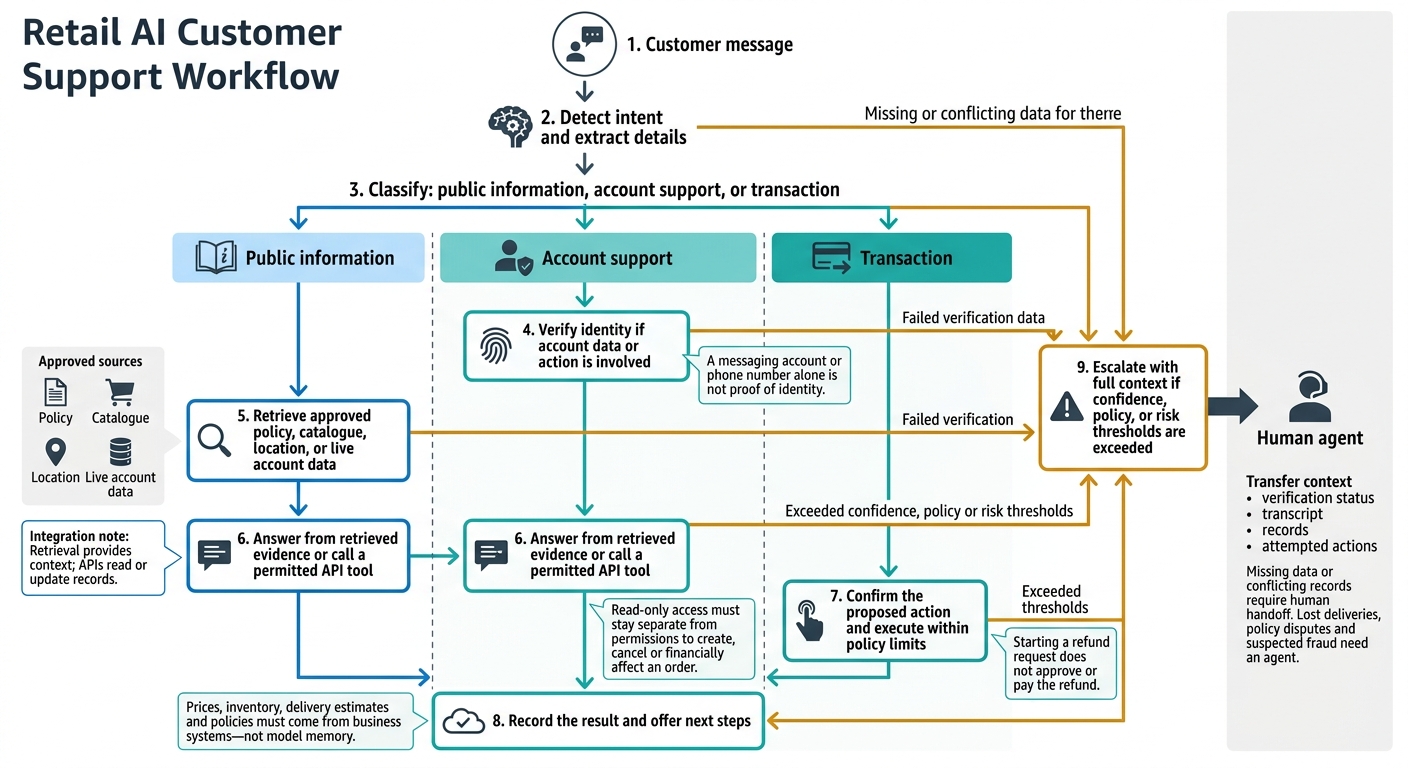
Retail AI Customer Support Workflow
A retail AI chatbot connects shoppers with business systems. Unlike a fixed FAQ, it can interpret different ways of asking a question and retrieve the information needed to answer it. It can work across websites, mobile apps, messaging channels and voice channels. A verified app session can support account enquiries, but a messaging account or phone number alone is not proof of identity.
For general questions, the chatbot uses approved public content, such as store hours and size guides. Before accessing orders or loyalty records, it must verify the customer’s identity. Transactions require more checks: explicit tool permissions, eligibility checks, customer confirmation and audit logging.
The chatbot doesn’t need broad system access. It needs clean retail data and permissions limited to the task.
From Customer Request to Resolution
Retrieval provides context; APIs read or update records. For example, a policy search finds return rules, while an order API provides the purchase and fulfilment details needed to apply those rules.
Prices, inventory, delivery estimates and policies must come from business systems – not model memory. Read-only access must stay separate from permissions to create, cancel or financially affect an order.
Customer message ↓ Detect intent and extract details ↓ Classify: public information, account support, or transaction ↓ Verify identity if account data or action is involved ↓ Retrieve approved policy, catalogue, location, or live account data ↓ Answer from retrieved evidence or call a permitted API tool ↓ Confirm the proposed action and execute within policy limits ↓ Record the result and offer next steps ↓ Escalate with full context if confidence, policy, or risk thresholds are exceeded The chatbot should answer only from approved sources and escalate when certainty drops. If data is missing or records conflict, it should hand the conversation to a human agent, along with the verification status, transcript, records and attempted actions. This handoff needs accurate records, defined permissions and clear routing rules.
Order Tracking, Returns, and Refunds
Starting a refund request does not approve or pay the refund. A chatbot may create a return case or label, but approval still depends on inspection, policy and payment controls. Lost deliveries, policy disputes and suspected fraud need an agent – not an improvised exception.
| Customer request | Required data | Automated action | Escalation condition |
|---|---|---|---|
| Fulfilment status | Verified order, fulfilment status | Report the latest fulfilment stage | Missing order or conflicting records |
| Carrier tracking | Verified order, tracking number, latest scans, delivery estimate | Provide the tracking link and delivery updates | Suspected lost delivery, contradictory scans or compensation request |
| Return eligibility | Verified order line, purchase or delivery date, policy, condition, final-sale flags | Explain eligibility and deadline; create a request if permitted | Policy dispute, damaged or unsafe item or shipment requiring review |
| Exchange initiation | Verified order, item and replacement SKU, inventory by location, exchange rules, price difference, return method | Submit an authorised exchange request; reserve stock where supported | Replacement unavailable, price exception or fraud signal |
| Refund status | Verified order, return case, payment method, refund status | Report whether the refund is pending, approved, issued or completed; provide the expected processing window | Status mismatch, failed payment, chargeback or partial-refund dispute |
Product Questions, Store Information, and Loyalty
Product answers should draw from approved catalogue fields and make uncertainty clear.
A product described as water-resistant must not be promoted as waterproof.
For sizing, the chatbot should use the retailer’s size chart, garment measurements, fit notes and customer-provided measurements, if available. Incomplete information is no basis for promising a perfect fit.
When helping shoppers find products, it can filter by documented insulation, materials, size, price in Canadian dollars and current availability. Inventory answers should name the store or fulfilment location and include a timestamp where possible. Store schedules should use local time and account for holiday exceptions.
Public loyalty rules don’t require a login. Balances and transaction history require authentication, while redemptions need stronger controls.
| Customer request | Required data | Automated action | Escalation condition |
|---|---|---|---|
| Product specifications | Approved catalogue, care and safety documentation | Explain documented features and limitations | Missing safety information, defects or disputed claims |
| Sizing | Product size chart, garment measurements, fit notes | Explain measurements without guaranteeing fit | Missing or conflicting sizing data |
| Availability | Live inventory by SKU and location | Report stock at the location | Stale data or inventory mismatch |
| Product discovery | Catalogue attributes, current prices and inventory | Filter by stated needs | Unsupported performance or safety requirements |
| Store hours and holiday schedules | Location, time zone, regular hours, holiday overrides, closures | Provide location-specific opening times | Conflicting schedules or uncertain closure status |
| Pickup services | Store services, inventory, verified reservation where needed | Explain pickup options and readiness | Pickup eligibility or readiness unclear despite available stock |
| Loyalty balance | Authenticated account, live balance and transactions | Display balance and explain activity | Disputed points or suspected account takeover |
| Redemption rules | Approved programme terms; authenticated account for eligibility | Explain conditions; process only explicitly authorised actions | Redemption requiring review, manual adjustment or rule dispute |
The data supporting these answers must be clean, with defined permissions and secure system connections.
Retail Data, System Connections, and Canadian Privacy
Order status, returns, inventory and loyalty support depend on well-managed data, controlled system connections and clear ownership. The chatbot also needs to handle that data in ways that protect customer privacy.
Prepare and Manage Retail Data
Create a data-governance register before connecting systems. Use consistent customer, order, SKU and store identifiers. Record update timestamps, effective dates, region, language and policy version. Name an owner for every role, including responsibility for approved support content and required French content. Work with privacy counsel to document a retention period for each dataset.
Every answer must trace back to one authoritative system.
| Data category | Authoritative source | Sensitivity | Permitted use | Retention period to document | Owner role | Access controls |
|---|---|---|---|---|---|---|
| Catalogue, prices and promotions | Product and commerce systems | Low–moderate | Published product answers | Product lifecycle and required support archive | Merchandising lead | Published fields; read-only |
| Inventory | Inventory or warehouse system | Moderate | Location-specific availability | Business and legal requirements | Inventory lead | Location-scoped read access |
| Orders and shipments | Order system and carrier APIs | High | Verified order and delivery updates | Customer-service, accounting and legal requirements | E-commerce lead | Customer- and order-scoped access |
| Returns and refunds | Returns and payment systems | High | Verified status and authorised workflows | Transaction and audit schedule | Returns or finance lead | Separate read/write roles; approval limits |
| Refund and return policies | Approved policy repository | Low–moderate | Eligibility explanations | Effective period plus dispute archive | Legal-policy lead | Approved versions only |
| Locations and hours | Location-management system | Low | Public store information | Current records; defined archive period | Retail operations lead | Public read-only fields |
| CRM profiles | CRM | High | Necessary support fields | Purpose-based privacy schedule | CRM owner | Field-level restrictions; masking |
| Loyalty records | Loyalty system | High | Verified balances and eligible actions | Programme and privacy schedule | Loyalty lead | Member-scoped permissions |
| Help-centre content | Knowledge-management system | Low–moderate | Approved support answers | Publication period plus version archive | Customer-service or legal owner | Editorial approval; published-only retrieval |
Set retention periods based on purpose, legal duties and accounting needs – not convenience. PIPEDA principles require businesses to keep personal information only as long as needed for its stated purpose, protect it according to its sensitivity and dispose of it securely when it is no longer needed. Confirm these periods with privacy counsel. Requirements vary by province, record type and business activity.
Once owners and data classifications are in place, connect the systems with controlled permissions.
Connect Systems and Set Action Permissions
A chatbot needs the right integrations and permissions to complete a workflow. Map secure APIs for commerce, orders, inventory, CRM, carriers, returns and loyalty. Route calls through a controlled service layer, rather than giving the model database or admin access.
Keep read-only credentials separate from action credentials. Require identity checks, least privilege, input validation and customer confirmation, with extra verification for sensitive changes.
Set API timeouts, rate limits and circuit breakers. Retry only safe or explicitly idempotent requests. Use idempotency keys and status checks to prevent duplicate actions after failures or timeouts.
Keep a tamper-resistant audit trail that records the session, tool, inputs, policy version, approval, result and timestamp. Leave out unnecessary personal data. If completion cannot be confirmed, explain the uncertainty and hand the request to a human.
Map the full data flow through the chat channel, retail APIs, AI provider, transcript storage, analytics and agent tools. Document what each service receives and stores.
Pair these controls with rules for privacy, consent and disclosure.
Protect Customer Data and Support Shoppers
Ask privacy counsel to determine which PIPEDA and provincial private-sector privacy requirements apply, including laws in Alberta, British Columbia and Quebec. Have counsel review data flows and any required privacy impact assessments.
Obtain meaningful consent where required and collect only the fields needed. Redact sensitive content before model processing, encrypt stored and transmitted data, and set deletion schedules. Provide processes for access and correction, along with breach-response procedures.
Review vendors, subprocessors, processing locations and deletion terms. Cross-border processing does not remove retailer accountability. By default, prohibit providers from using customer data for model training. Any exception must be expressly authorised, transparent and legally reviewed.
Tell shoppers that the interaction is automated and give them an accessible route to human support. Explain why data is collected, how third parties process it and how to contact the privacy officer.
Review French-language and accessibility obligations, including French policies, keyboard access, screen-reader support and non-chat options. Use Canadian spelling, explicit time zones, metric units and °C where relevant. Make dates and amounts unambiguous:
October 1, 2026
CAD $1,250.50
Test regional holidays, postal codes, and English and French responses before launch.
Rollout Steps, Risk Controls, and Success Measures
Once data, permissions, and privacy controls are in place, begin with a tightly scoped pilot.
Start with a Low-Risk Pilot
Record your baseline before launch. Measure contact volume, response and resolution times, first-contact resolution, transfer and abandonment rates, CSAT, customer effort score, complaints, handle time, cost per contact, and transaction outcomes. Assign owners for product, operations, privacy, security, accessibility, analytics, and support.
Keep the first release small: one channel, a small group of stores, store hours only, basic product questions, and read-only order lookups. Leave refunds, return exceptions, and loyalty changes for later.
Before launch, test ambiguous requests, expired promotions, requests for another customer’s order, bilingual paths, keyboard and screen-reader access, prompt injection, and service outages in a sandbox. Review redacted transcripts under restricted access.
Set written release gates for accuracy, policy compliance, accessibility, reliable transfers, and customer satisfaction. No critical privacy or security defects should remain. Assign a rollback owner who can disable individual intents, tools, channels, or the entire bot. Add returns and loyalty actions only after control tests pass.
Reduce Errors, Fraud, and Handoff Failures
During the limited release, test failure controls as well as successful customer journeys. Confidence is not accuracy: check pilot answers against approved records and completed outcomes.
Escalate payment disputes, suspected fraud, repeated misunderstandings, and tasks outside the bot’s permissions. Transfer only the issue, verification status, steps already attempted, and what remains unresolved. Tell shoppers the expected wait or callback process, and let agents correct the bot’s work.
Once the pilot is live, track failures as closely as outcomes.
| Risk | Control to test | Accountable owner | Monitoring signal |
|---|---|---|---|
| Bad answers | Answers based on approved sources; independent accuracy audits | Customer-service product owner | Error rate; repeat contacts |
| Stale inventory or policy data | Data-age checks; block stale or conflicting sources | Retail-operations owner | Data-age check failures; reported mismatches |
| Privacy breach | Test redaction, access restrictions, and deletion | Privacy officer | Access without permission; retention exceptions |
| Prompt injection | Treat messages and retrieved text as untrusted; restrict tools and validate inputs | Security and engineering lead | Unsafe tool calls; attack alerts |
| Account takeover | Step-up verification; fraud rules; human review of sensitive actions | Fraud lead | Failed verification; unusual sessions |
| Mismatched outcomes | Versioned eligibility rules; scenario tests across stores and languages | Operations lead | Unexplained outcome differences |
| Failed handoff | Required transfer fields; agent override; queue testing | Contact-centre lead | Failed transfers; repeat explanations |
| Over-automation | Visible human option; review unresolved and repeated contacts | Customer-experience lead | Complaints; effort scores; unresolved rate |
| Outage | Health checks; tested fallback support; incident runbook | IT operations lead | Timeouts; failed transactions; recovery time |
Measure Resolution, Service Quality, and Cost
Use one scorecard to compare pilot results across channels, stores, and languages. These measures help determine whether the bot is ready to move safely beyond the pilot.
Define successful resolution as a correct answer or completed task with no related repeat contact or unresolved escalation within a documented observation window.
Containment counts only verified resolutions without an agent – not abandoned or timed-out chats. First-contact resolution counts issues resolved during the first contact, including those completed by an agent. Keep definitions and observation windows identical, and use measured results rather than assumed benchmarks.
| Metric and definition | Baseline result | Pilot result | Target or release rule | Data source |
|---|---|---|---|---|
| Correctly answered eligible order-status requests | Measure before launch | Measure in pilot | Agreed journey threshold | Order platform and conversation audit |
| Return starts completed without rework | Measure existing workflows | Measure when enabled | Pass before expansion | Returns system |
| Loyalty actions completed without rework | Measure existing workflows | Measure when enabled | Pass before expansion | Loyalty system |
| Audited answer accuracy | Audit existing support | Audit pilot support | Agreed minimum accuracy | Stratified transcript review |
| Verified containment | Measure existing automation, if any | Measure verified outcomes | No increase in unresolved contacts | Conversation analytics |
| First-contact resolution | Measure before launch | Measure in pilot | Agreed service target | CRM and contact-centre records |
| Median first useful response time | Record medians | Record medians | Service commitments | Chat platform |
| Median resolution time | Record medians | Record medians | Service commitments | CRM and case system |
| CSAT and customer effort score | Record scores and response counts | Use identical surveys | No material deterioration | Post-contact surveys |
| Policy-violation rate | Audit existing workflows | Audit pilot workflows | No critical breaches; agreed failure ceiling | Compliance and transaction logs |
| Failed or reversed transactions | Audit existing workflows | Audit pilot workflows | No critical breaches; agreed failure ceiling | Commerce and payment systems |
| Cost per successful resolution | Calculate in CAD | Calculate in CAD | Approved business case | Finance; usage; vendor and labour records |
| Completed escalations and repeat explanation rate | Measure before launch | Measure in pilot | No material worsening | Contact-centre records and transcript audit |
Track agent handle time, after-contact work, and escalation workload together.
Review results weekly during the pilot, monthly after stabilisation, and after major incidents or changes. Compare results by intent, channel, language, and store. Analyse customer segments only where lawful, useful, and statistically meaningful.
Include integration, usage, maintenance, training, security, privacy, review, and fallback staffing in CAD costs. Calculate ROI as (measured benefits − total programme costs) ÷ total programme costs. Separate recovered staff capacity from actual cash savings, and retest changed workflows before expanding.
Conclusion: Retail AI Support Readiness Checklist
Approve a workflow, not just a chatbot. Use this checklist to assess readiness for launch, expansion, and rollback – and turn rollout metrics into a go/no-go decision. Expand only when measured outcomes meet the agreed release criteria.
Plan a Custom Implementation
Bring monthly contact volumes broken down by intent, channel, season, and language to the scoping discussion, along with a system inventory, security requirements, and pilot objectives.
For custom implementation, Digital Fractal Technologies Inc can support AI consulting, chatbot development, workflow automation, CRM and API integrations, and legacy-system modernisation.
Before approving the pilot or its next phase, complete this readiness checklist:
- [ ] Data owners: Name an owner for each data source.
- [ ] System inventory: List all connected platforms.
- [ ] Integration access: Confirm credentials, environments, mappings, and read/write scope.
- [ ] Canadian privacy and HR compliance obligations: Confirm applicable obligations, notices, retention, deletion, vendor terms, cross-border transfers, and privacy-owner approval.
- [ ] Pilot scope: Define included workflows, channels, customer segment, languages, operating hours, launch dates, and exclusions.
- [ ] Human escalation: Assign queues, service targets, and ownership for unresolved, accessibility, fraud, and unverified cases.
- [ ] Rollback: Set decision rights and document steps to disable automation, revoke credentials, restore the prior flow, reconcile pending actions, and preserve records.
- [ ] Success criteria: Set baselines, targets, and guardrails for accuracy, containment, escalation, CSAT, cost per contact, and business impact.
FAQs
Is my retail data ready for an AI chatbot?
Your retail data is ready when it’s clean, consistent, and joined across systems, with 12 to 18 months of order history, web traffic, and product details.
Your ERP, CRM, and storefront must connect through secure, real-time APIs or middleware. You’ll also need data governance that covers PIPEDA privacy controls, data residency, and bilingual support.
Digital Fractal Technologies Inc can provide an AI Readiness Audit to pinpoint infrastructure gaps and plan deployment.
How long should my AI support pilot run?
Use a 30-day pilot as a standard benchmark to measure impact and performance. Track baseline KPIs for at least four weeks before the pilot, then use A/B testing to compare results with manual workflows.
For specific interactions, such as after-hours support, test for at least two weeks before extending use. Watch performance closely during the first 90 days, aiming for two to three meaningful prompt updates per month to help stabilize the system.
Can AI support handle seasonal demand spikes?
Yes. AI customer support can provide 24/7 coverage and handle thousands of conversations at once without adding staff. During busy periods, scalable systems can automate routine tasks, including order status updates, FAQs, and returns.
To maintain service quality, businesses should set tiered permissions and escalation triggers. These route issues to human staff when the AI encounters complex problems or reaches its confidence limits.