
Future Trends in Virtual Shopping Assistants

Virtual shopping assistants are moving from simple support tools to sales tools. I’d sum it up like this: if you run a Canadian retail business in 2026, the big shift is toward assistants that can recommend products, handle voice requests, support AR, and work in both English and French – but only if they’re built on clean data and strong privacy controls.
Here’s the short version:
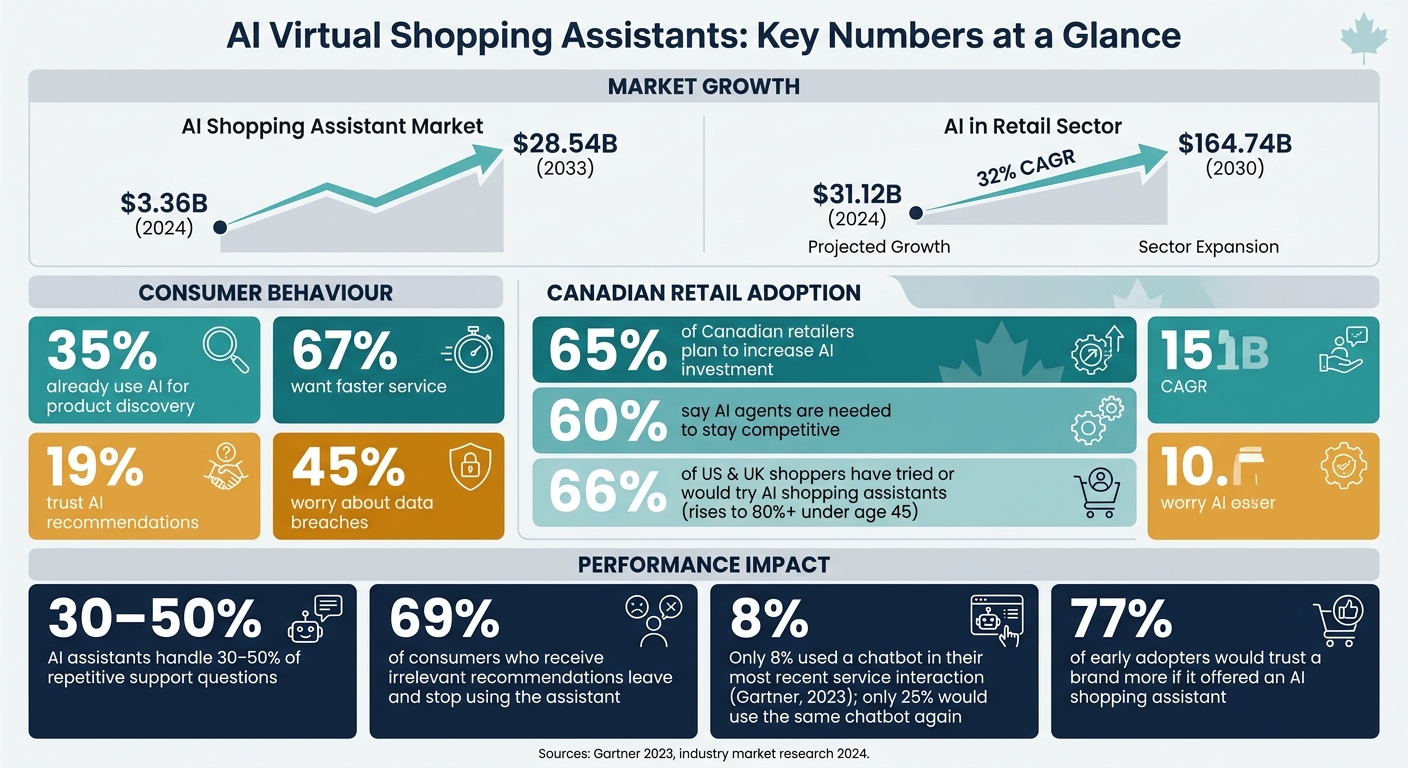
- The market is growing fast, with AI shopping assistants projected to jump from US$3.36 billion in 2024 to US$28.54 billion by 2033.
- Canadian retail is moving with it: 65% of retailers plan to increase AI investment, and 60% say AI agents will be needed to stay competitive.
- Shoppers want help, but they’re cautious: 35% already use AI for product discovery, 67% want faster service, yet only 19% trust AI recommendations and 45% worry about data breaches.
- Basic chatbots can answer simple questions. Newer assistants can compare products, build shortlists, track prices, and help finish purchases.
- Voice works well for low-effort tasks like reorders and stock checks.
- AR helps most when shoppers need to judge fit, size, placement, or look – like with furniture, eyewear, cosmetics, and clothing.
- In Canada, rollout needs to include French and English support, CAD pricing, metric units, °C, and privacy rules such as PIPEDA.
If I had to reduce the whole article to one point, it would be this: the winners won’t be the stores with the fanciest assistant, but the ones with the cleanest data, the clearest controls, and the best local fit for Canadian shoppers.
A few things matter most:
- Start narrow
- Use live product and inventory data
- Track conversion, cart abandonment, and support deflection
- Add human handoff for harder cases
- Make French support feel native, not translated
- Use AR where visual proof helps the sale
This article looks at where these tools are heading, what research says about shopper behaviour, and what Canadian businesses should do next, including using an AI implementation planner to map out their strategy.
AWS re:Invent 2024 – Building an AI-powered shopping assistant (RCG204)
sbb-itb-fd1fcab
Research Overview and Market Adoption Trends
AI Virtual Shopping Assistants: Market Growth & Consumer Behaviour Stats 2024–2033
What Recent Studies Say About Business Impact
The research points in a good direction, but adoption is still patchy. Recent reviews show that AI virtual assistants can improve engagement and purchase decisions when they feel useful, interactive, and natural in conversation. Meta-analyses also connect adoption with usefulness, trust, and ease of use.
In day-to-day use, AI assistants can cut response times from minutes to seconds and handle 30–50% of repetitive support questions, which gives staff more time for harder cases. One point stands out: chatbot communication quality – clarity, relevance, tone, and responsiveness – has a stronger effect on satisfaction and buying intent than a shopper’s starting level of interest.
Still, use in the market is uneven. A 2023 Gartner survey of 497 customers found that only 8% had used a chatbot in their most recent service interaction, and just 25% of those said they would use the same chatbot again. That gets to the heart of it: does the assistant help the shopper get where they want to go?
That uneven uptake helps explain why the market is moving past basic support bots and toward assistants that can take action for shoppers.
Market Growth, Mobile Commerce, and Agentic Shopping
Adoption is growing because assistants are no longer just answering questions. They’re starting to do the work, too. The AI in retail sector is projected to grow from US$31.12 billion in 2024 to US$164.74 billion by 2030, with a compound annual growth rate of 32%. That growth comes from mobile-first behaviour, messaging as a discovery channel, and the rise of agentic assistants – tools that compare options, build shortlists, track price changes, and complete purchases on a user’s behalf.
For Canadian retailers, that shifts the focus to mobile-first assistants that can support bilingual discovery and checkout without making the process feel clunky.
Consumer interest is moving up as well. In the US and UK, 66% of shoppers have tried or would try AI shopping assistants, and that figure climbs to over 80% among shoppers under 45. Among early adopters, 77% said they would trust a brand more if it offered an AI shopping assistant.
But there’s a catch. If the assistant gives poor suggestions, people don’t stick around. In fact, 69% of consumers who get irrelevant product recommendations stop using the assistant entirely and leave. So availability alone isn’t enough. Recommendation quality carries just as much weight.
Basic Chatbots vs. Advanced AI Shopping Assistants
Not all virtual assistants do the same job. The gap between a basic rule-based chatbot and a modern AI shopping assistant is large, both in what each one can do and in the business results they tend to drive.
| Dimension | Basic Rule-Based Chatbot | Advanced AI Shopping Assistant |
|---|---|---|
| Core Capabilities | Scripted FAQs, menu-driven flows, simple order status | Open-ended conversations, multi-turn dialogue, cross-selling, purchase shortlists |
| Personalisation | None or minimal | Dynamic recommendations based on user profile and live data |
| Language & Localisation | Separate static English and French flows | Dynamic language switching; adapts to Canadian spelling, CAD pricing, and metric units |
| Data Sources | Static knowledge base, hard-coded intents | Live inventory, pricing feeds, CRM, and analytics systems |
| Typical Outcomes | Faster response times, modest support cost savings | Higher conversion, larger baskets, deeper engagement |
For Canadian businesses trying to decide where to begin, this table shows a plain trade-off. Basic chatbots can deliver quick wins with lower upfront cost. Advanced assistants take more planning and stronger integration, but they are more closely tied to measurable revenue and engagement gains – especially in product categories where discovery and comparison take more effort.
That’s the line that matters in 2026: reactive support on one side, and assistants that guide, compare, and complete purchases on the other.
The next step isn’t just better chat. It’s more natural voice, stronger personalisation, and less effort for the shopper.
AI, Voice, and Personalisation Advances
From Product Recommendations to Goal-Driven Shopping Agents
Shopping assistants are starting to do more than answer questions. They’re moving toward completing shopping tasks.
That means the focus is shifting from reactive chatbots to goal-driven shopping agents. Instead of waiting for one-off prompts, a goal-driven agent can take a request like a warm winter coat for −20 °C Toronto weather under $300 CAD, turn it into a set of constraints, ask follow-up questions, narrow the field, and produce a shortlist.
That kind of flow depends on a few things working together: intent classification, conversation memory that keeps track of earlier turns, and multimodal inputs. So a shopper might upload a photo of a chair they like, ask for a similar style in black, and get visually matched options back. That matters most in categories like fashion, home goods, and beauty, where style is hard to describe with keywords alone.
Reinforcement learning is also playing a bigger part in these longer shopping conversations. It helps the assistant judge when to ask another question, when to make a recommendation, and when to guide the shopper toward purchase. The catch is that training gets hard fast. Reward design is difficult, and it’s easy to drift toward optimising for engagement instead of shopper satisfaction. Still, for retailers, the upside is plain: faster product discovery and cleaner shortlists.
Voice Commerce and Bilingual Conversational Interfaces
Voice works best in shopping when the task is simple, frequent, and low effort. Think reordering household staples, checking whether a size is in stock, or adding items to a list while making dinner. Research on voice AI shopping points to time savings and reduced effort as the main reasons people use it.
In Canada, voice support has an extra layer. Retailers need systems that can detect the customer’s language, adjust vocabulary and level of formality to local norms, and store language preferences in CRM systems so later follow-up stays consistent. In practice, that means voice assistants need real-time English and French support, not two separate scripts bolted together.
Core AI Methods and Their Practical Limits
No single AI method can handle every shopping job. These tools work best when they’re backed by clean product data and clear rules for when to hand the customer off to a person. The table below shows the main methods, where they fit, and where they fall short.
| AI Method | Primary Shopping Use Cases | Evidence-Backed Benefits | Key Limitations |
|---|---|---|---|
| NLP / LLMs | Intent detection, free-form dialogue, FAQ handling | More natural interactions; handles open-ended queries beyond keyword search | Can hallucinate product details; needs clean product data for grounded answers |
| Reinforcement Learning | Dialogue sequencing, recommendation timing, long-session optimisation | Improves multi-turn outcomes; balances exploration vs. certainty | Harder to train; reward design is difficult; risk of optimising engagement over satisfaction |
| Multimodal Models | Image-plus-text search, visual product matching, voice input | Captures richer intent signals; improves relevance for fashion, home goods, and beauty | Depends on product data quality; ambiguous inputs reduce accuracy |
| Multi-Agent Systems | Parallel task handling, such as text query + image match + inventory check | Specialised agents can produce more precise, context-aware results | Higher integration complexity; latency risk; governance across agents is harder to manage |
Data quality and governance set the ceiling here. If product data is incomplete, inventory is out of date, consent controls are weak, or escalation paths are messy, trust starts to fall apart fast.
Augmented Reality and Immersive Shopping Experiences
What the Evidence Shows About AR-Assisted Shopping
AR adds something text and voice assistants simply can’t: a visual decision layer. It lets shoppers see a product in their home or on their face before they buy. That matters a lot when the decision depends on fit, scale, or placement.
Research points in the same direction. Interactivity, realism, and informativeness improve ease of use, usefulness, and purchase intention. And in categories like furniture and fashion, usefulness matters more than novelty.
That said, AR isn’t foolproof. It can hurt trust if the experience feels off. In cosmetics try-on, for example, poor calibration or overly playful interfaces can make shoppers doubt what they’re seeing. AR can also create a sense of ownership that leads to decision conflict when the experience feels intrusive or mismatched. The takeaway is pretty simple: focus on accurate, easy visualisation, not flashy tricks.
For Canadian retailers, AR tends to work best in categories where shoppers want proof before they commit, including:
- Apparel
- Footwear
- Eyewear
- Cosmetics
- Furniture
- Large appliances
These are all cases where buyers want to know whether something will work in their space or on their body.
In Canada, results also depend on localisation, device support, and language fit.
Localization Requirements for Canadian Users
AR shopping in Canada should default to metric units. Imperial can still appear where people expect it, but metric should lead. Prices should be shown in CAD with standard Canadian formatting, such as $1,299.00.
Temperature context matters too. For outerwear, HVAC systems, and smart thermostats, the experience should refer to degrees Celsius (°C). It should also reflect normal Canadian seasonal conditions, such as −20 °C winters and 25 °C summers.
Bilingual support isn’t optional. Labels, prompts, onboarding, and overlays need full English and French localisation, with Québec French taking priority where required. Where Québec language laws apply, French must appear prominently. Voice assistants should either default to French or present a clear language option right away.
Device support is uneven across the country, so fallback matters. Newer iPhones and Android flagships tend to run AR well, but older or lower-cost devices may not support ARKit or ARCore. Rural and remote regions can also face bandwidth limits that slow 3D asset loading. That’s why graceful degradation matters: 2D visualisation, performance settings, and preloaded assets for popular products can help keep the experience usable across Canada.
Text and Voice Assistants vs. AR-Enhanced Assistants
Text and voice interfaces are good at discovery and support. AR is strongest at the visual decision stage. So in practice, AR works best as a complement to text and voice, not a replacement.
| Aspect | Text / Voice Assistants | AR-Enhanced Assistants |
|---|---|---|
| Customer experience impact | Best for information, guidance, and convenience; weak for visual fit and placement confidence. | Best for visual realism, fit, scale, and placement; increases trust and purchase intention when well designed. |
| Hardware requirements | Runs on most devices; needs only a screen, microphone, and network connection. | Requires AR-capable camera and sensors, good lighting, and enough processing power; works best on newer smartphones and tablets. |
| Implementation complexity | Moderate: chatbot or NLP integration, knowledge base, and voice support. | High: 3D modelling, spatial tracking, asset optimisation, and integration with product data and UX testing. |
| Types of empirical evidence | Conversational commerce studies, customer satisfaction metrics, and support efficiency data; limited visual-confidence metrics. | Controlled experiments and field studies on trust, enjoyment, confidence, and purchase intention for virtual try-on and in-situ visualisation. |
The strongest retail journeys tend to move from search, to shortlist, to visual confirmation.
Implementation Priorities and Conclusion
Research-Backed Design Principles for Deployment
The research shows a simple pattern: results depend less on the chat interface itself and more on the data behind it, the controls around it, and how well it connects with the rest of the stack. Start with clean product data. That means accurate attributes, live inventory, current pricing, and active promotions available through standard APIs and middleware. The first job is building a middleware layer that shields core systems from direct conversational traffic. Begin with read-only use cases like catalogue search and order status. Then, once governance is set, move into cart creation and returns.
After the data layer is ready, governance becomes the next limit. Give the assistant tiered permissions, with separate approval rules and logging for browsing, carting, payment initiation, and subscription renewals. High-value orders, new shipping addresses, and first-time merchants need step-up verification – SMS, email, or multi-factor – plus a confirmation summary before any high-risk action goes through. For Canadian deployments, this setup should also reflect PIPEDA and provincial privacy rules, with clear consent flows, defined data-retention windows, and cross-border transfer policies documented up front.
Measurement needs to be built in from day one, not bolted on later. Track assisted conversion, average order value, cart abandonment, support deflection with quality scoring, P95 response latency, and CSAT against a holdout group. Break results down by region, language, and device so weak spots show up early.
Where Digital Fractal Technologies Inc Fits
For Canadian teams that need custom build and integration support, Digital Fractal Technologies Inc fits at the implementation layer. Digital Fractal Technologies Inc can build bilingual shopping assistants, connect them with product, CRM, and fulfilment systems, and automate returns, pickup, and booking workflows.
Key Takeaways on the Future of Virtual Shopping Assistants
The strongest deployments start narrow, localise well, connect to live data, and measure incremental impact. For Canadian businesses, bilingual support, CAD formatting, metric units, and provincial compliance need to be part of the design from the start, not patched in later. The framework below turns the research into a practical deployment checklist.
| Priority Area | Key Actions |
|---|---|
| Data and Infrastructure | Standardise product schemas; build real-time API integrations for catalogue, inventory, and pricing; use multi-region Canadian hosting. |
| AI and Personalisation | Start with high-volume, narrow use cases; evolve toward goal-driven agents; apply guardrails, bias audits, and consent-based personalisation controls. |
| UX and Localisation | Build bilingual (English/French) interfaces; use Canadian currency and date formats; support accessible design; integrate text, voice, and AR where appropriate. |
| Governance and Measurement | Define KPIs before launch; use control groups; implement tiered permissions and step-up verification; align with PIPEDA and provincial privacy laws; review conversations regularly. |
FAQs
How can retailers improve trust in AI recommendations?
Retailers build trust in AI recommendations by being open about how the system works, setting clear rules, and keeping people involved where it matters.
For example, explainable AI tools can show why a system made a certain recommendation instead of turning it into a black box. That matters. If a retailer can’t explain an automated decision, it’s much harder for customers to feel at ease with it.
Clear guardrails also help keep AI from drifting into odd or inconsistent behaviour. On top of that, human oversight for high-stakes decisions gives retailers a backstop when judgment calls need more than automation alone.
A few practices help keep customer confidence steady over time:
- Regular bias audits
- A/B testing
- Clear AI disclosures
- Strong privacy practices
- Human review for key decisions
Taken together, these steps help retailers use AI in a way that feels more accountable, more predictable, and easier for customers to trust.
Which retail categories benefit most from AR shopping assistants?
AR shopping assistants work best in product categories where people need to see how something will look or fit before they buy. That’s especially true in visually complex areas where placement, size, or compatibility can make or break the decision, including:
- home improvement and furniture
- consumer electronics
- fashion and footwear
They can also help with at-shelf decisions in categories where stockouts or misplaced items happen often. In those cases, AR guidance works alongside real-time inventory data and shelf condition signals, so shoppers get a clearer picture of what’s actually available and where to find it.
What should a Canadian retailer launch first?
Start with AI-driven personalization. Focus first on personalized product recommendations and, when it fits, customer support use cases. This is often one of the fastest ways to improve product discovery, lift engagement, and increase conversions with payback you can measure pretty early.
For Canada, make sure the assistant supports en-CA localization, bilingual English/French interactions, CAD, Canadian date and number formats, and privacy requirements such as PIPEDA.