AI-Driven VR for Personalized Luxury Shopping

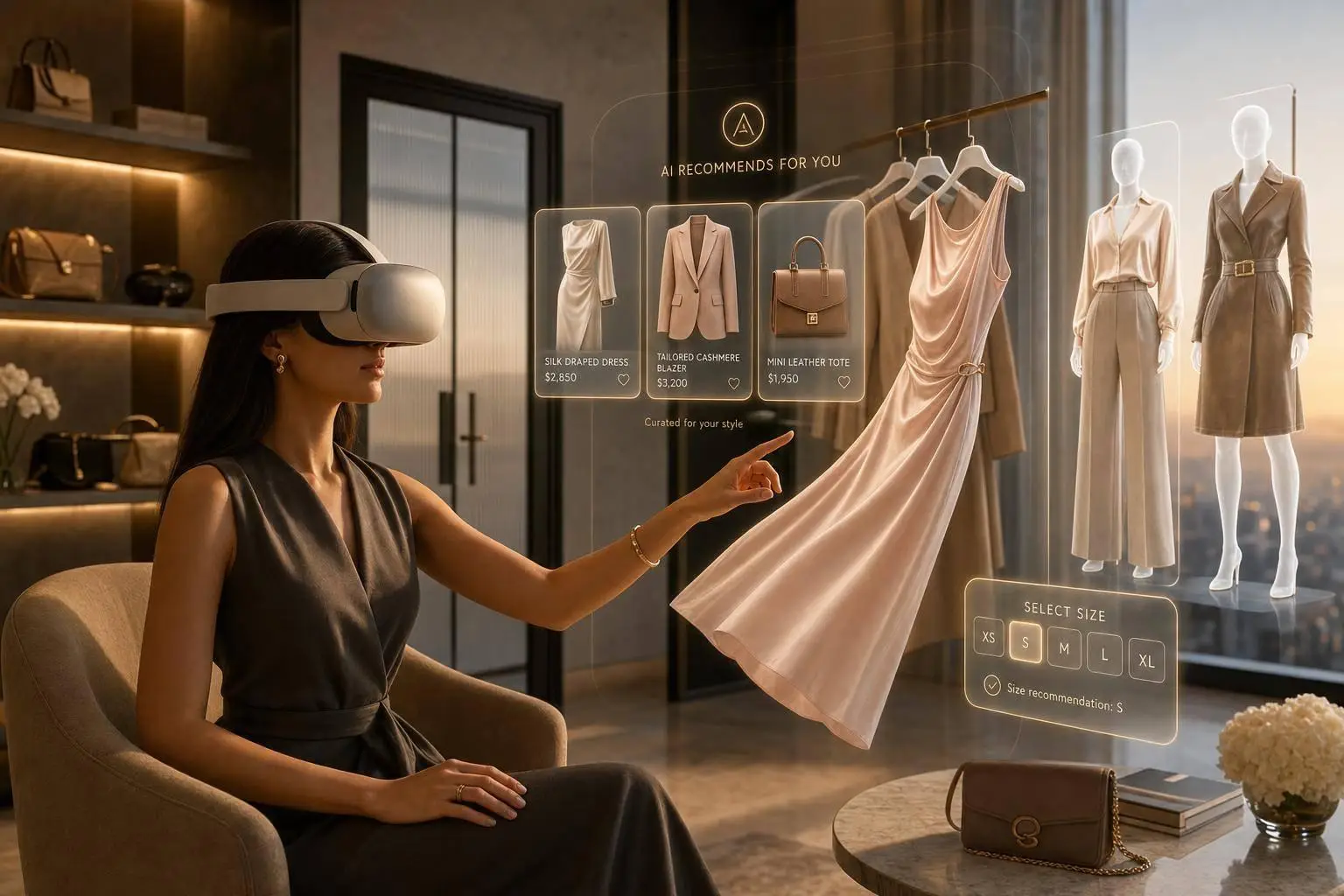
If luxury retail wants better online sales, it needs more than a product grid. I see the main point like this: AI can use shopper signals to tailor the journey, and VR can make online shopping feel more like a boutique visit.
In plain terms, this article says luxury brands should focus on three things:
- Personalisation: use browsing, past purchases, saved items, and in-session behaviour to show the right products first
- Immersion: use photoreal visuals, spatial audio, and, where possible, sensory cues like lighting and airflow
- Control: build with consent, opt-outs, and accessibility checks from day one
That matters because digital luxury is not just about checkout. I’d measure success through dwell time, repeat visits, shares, and conversion, not sales alone.
Here’s the short version:
- AI reads shopper interest and updates product suggestions during the session
- VR recreates the feel of a boutique in a digital space
- Better product relevance can lead to more engagement and stronger retention
- Rollout should start with a pilot, then testing, then scale
- Tools like Unity and Unreal Engine can support the build, while CRM and API links help move customer data where it needs to go
My takeaway: luxury retailers should start small, connect personalisation to privacy rules, and prove results before putting more budget behind it.
This is less about flashy tech and more about making online luxury shopping feel personal, calm, and worth returning to.
How AI-Driven VR Shapes a Personalized Luxury Shopping Journey
AI and VR rebuild the boutique around each shopper’s signals. AI uses browsing history, past purchases, saved items, and product interactions to shape a tailored experience. When consent is in place, repeat interest in a product category and even the device someone is using can help decide what the virtual boutique shows first.
Done well, this feels helpful, not crowded. The goal isn’t to throw more products at the shopper. It’s to show the right ones at the right moment. Those signals shape what appears first, how the space is laid out, and which items come next.
Immersive features that matter in luxury retail
Once the boutique is personalised, the visual and sensory design needs to live up to that setup. High-fidelity rendering builds a branded world through sight, sound, and tactile detail. In plain terms, that means photorealistic products, high-resolution settings, and carefully planned spatial audio.
"Hearing is a sense that has been neglected. We want to surprise people and show them that when you listen intently, sound can tell many stories and generate unique emotions." – Nathalie Chopra, Head of International Marketing and Communications, Devialet
Curated soundscapes strengthen brand identity and make the experience feel more exclusive. And when the hardware allows for it, AI can sync scent, temperature, airflow, and lighting to pull the shopper further into the space.
How the experience adjusts during a shopping session
After the space is built, the session should keep shifting in real time. This is where AI does some of its best work. As a shopper moves through the virtual environment, the system reads behaviour as it happens.
If someone lingers on a certain style or comes back to a category, the AI updates its recommendations and shows more relevant options right away. For high-consideration purchases, these live behavioural signals help the system guide the shopper without pushing too hard. The result is a calmer, more deliberate path to purchase. This approach is part of broader comprehensive development solutions that integrate AI into the retail journey. The experience responds to both the shopper’s profile and what they do in the moment.
sbb-itb-fd1fcab
Business Impact: Engagement, Conversion, and Brand Loyalty
Once the journey is personalised, the next step is simple: does it lead to measurable business results?
Why immersive shopping can lift engagement
In luxury retail, success shouldn’t be judged by sales alone. It also comes down to the quality of attention a brand earns. Bas Van De Poel, Cofounder and Innovation Director, Modem, put it plainly:
"The productivity of stores will be measured not by the amount of merchandise shifted, but by the experiences they deliver."
That idea matters for digital leaders watching performance closely. In an AI-driven VR setting, it’s smart to look past pure transaction numbers and track engagement depth, dwell time, repeat visits, and shares. Those signals show whether the experience is landing with people and whether the brand is holding attention inside its own space.
And those same signals can hint at something more: purchase intent and repeat interest.
How personalisation supports conversion and retention
When a luxury shopping journey feels tailored to the person, it often feels more relevant and easier to remember. Personalised VR can deepen emotional connection and strengthen brand affinity. It can also create shareable moments, which helps the relationship continue after the visit.
Digital takeaways stretch the experience beyond a single session. They also support sharing and return visits, which can help with retention.
Getting these results depends on the right mix of data, rendering, and privacy controls.
Implementation Requirements and a Practical Rollout Plan
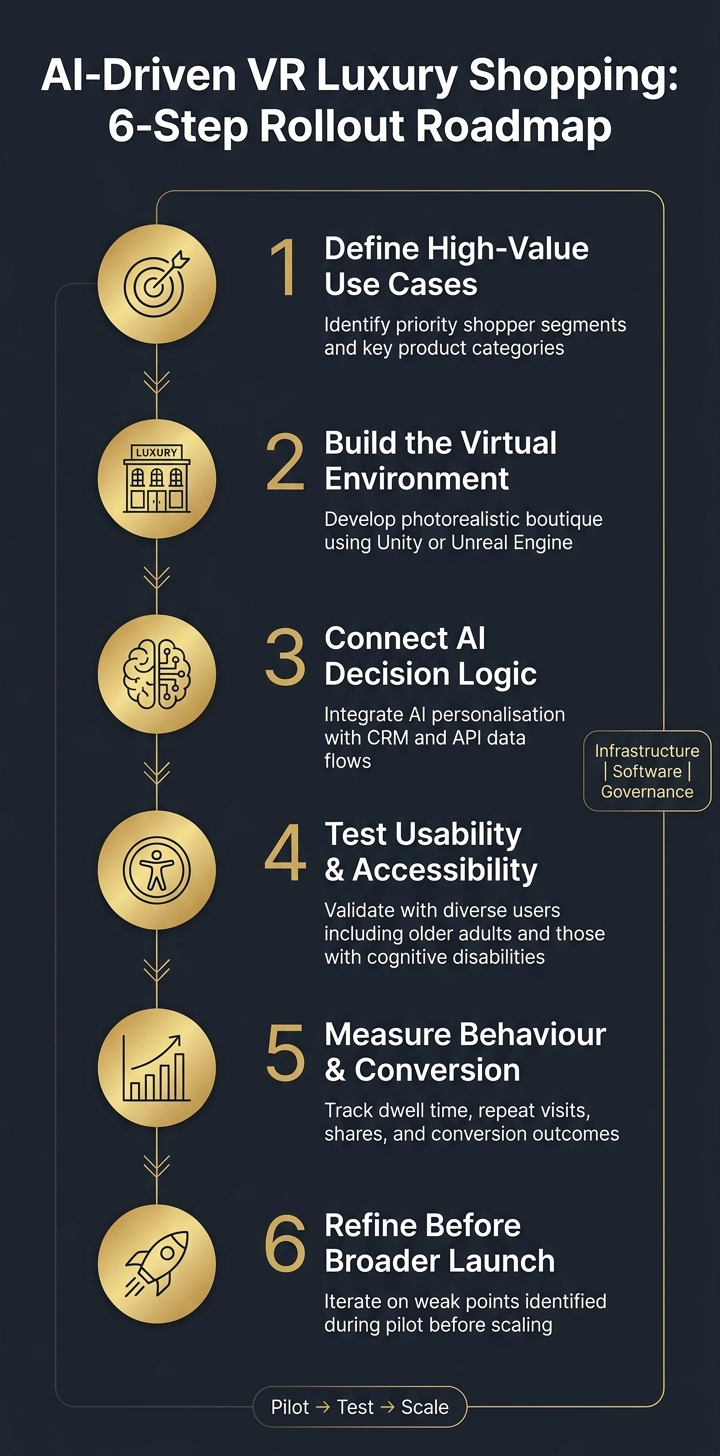
AI-Driven VR Luxury Shopping: 6-Step Rollout Roadmap
To turn engagement into conversion, you need a rollout plan that works in practice.
The move from static e-commerce to personalised VR rests on three layers: infrastructure, software, and governance.
Core technical and operational requirements
At the base level, the setup needs high-resolution displays, real-time rendering, tracking hardware, and low-latency integration. Together, these parts make realistic product scale, spatial presence, and guided product discovery possible inside the virtual boutique.
On the software side, Unity and Unreal Engine are practical starting points for building virtual environments. Their SDKs support real-time rendering and adaptive AI logic. Just as important, these systems need clean API integrations so data can move where it needs to go without friction.
Responsible deployment also means putting guardrails in place from the start. That includes clear consent, opt-out controls, and accessibility testing. That testing should include older adults and people with cognitive disabilities before launch.
A phased deployment from pilot to full launch
The safest path is to roll out in stages. That gives teams time to check usability, data flow, and conversion before a broader launch.
A typical rollout follows six steps:
- define high-value use cases
- build the virtual environment
- connect AI decision logic
- test usability and accessibility
- measure behaviour and conversion outcomes
- refine before broader launch
This kind of phased approach helps teams spot weak points early. If the data flow is messy or the experience feels clunky, it’s far better to fix that during a pilot than after launch.
Where Digital Fractal Technologies Inc fits
This support matters most when personalisation data needs to flow cleanly into CRM and service workflows. Digital Fractal Technologies Inc builds custom systems that connect AI personalisation, CRM data, and operational workflows through custom software development, AI consulting, CRM integration, API integrations, and workflow automation.
For teams that are still early in the process, Digital Fractal Technologies Inc also offers AI consulting to help define the right architecture before major investment is committed.
What Luxury Retail Leaders Should Take Forward
The business case is clear. The next move is deciding what to do first.
Luxury leaders should use AI enhanced mobile and web apps using VR to carry the service, atmosphere, and sense of exclusivity of the boutique into the online space. The best digital experiences extend brand identity instead of flattening it.
Strong rollouts start with brand identity first. Then they build around sensory cues like sound, lighting, and tactile detail. That’s what helps an online boutique feel less like a product page and more like a place.
But none of that lands if customers don’t feel safe. Privacy needs to be part of the experience design from the start, not treated like a legal box to tick later. Clear consent and opt-out controls matter when personal data powers tailored experiences, because trust makes the experience feel welcome, not intrusive.
A smart way to roll this out is in pilot stages. Measure engagement and conversion, then expand. Start small, prove the case, and scale from there.
FAQs
How does AI personalize a VR boutique?
AI personalizes a VR luxury boutique by reading shopper signals in real time, like clicks and hover behaviour, then turning those actions into dynamic customer profiles. As that profile changes, the VR experience changes with it.
That means each shopper can see product picks, prompts, and timing shaped by their intent and level of engagement. And with a unified customer view behind the scenes, that personalization stays consistent across channels instead of feeling random from one touchpoint to the next.
What data is needed for this experience?
You need customer profile data to personalise well. That includes purchase history, browsing and search behaviour, engagement signals, preferences, brand affinity, and, when it makes sense, demographics or location.
You also need product data, like SKU catalogue details, images, and VR or AR interaction data. And if you want AI recommendations to stay on track, your data needs to be clean, consistent, and pulled together in one system.
If that sounds basic, it is. But it matters a lot. When customer and product data are scattered, messy, or out of date, recommendation quality slips fast.
How can luxury brands test VR before scaling?
Start with a small pilot in a high-impact area. Then track performance against baseline KPIs for at least a few weeks, and run controlled A/B tests between the AI/VR experience and your current workflow.
Use clean, clearly labelled customer and content data. Put guardrails in place before you turn on automation, and watch performance closely for issues. Once the pilot is stable and ROI is clear, move fast: improve what works, then scale through API-first deployments and microservices.