
Enterprise Data Readiness: What It Means and How to Assess It

Enterprise data readiness means your data is accurate enough, traceable enough, and governed well enough for AI systems to use reliably in production. Most companies are not there yet: Gartner’s guidance on AI-ready data makes clear that clean spreadsheets and tidy databases are not the same thing as data an AI model can trust.
If you manage data or lead a digital initiative, do three things this week:
- Run a 15-minute pulse check on your current data maturity, borrowing the structure from DataCamp’s IPTOP framework.
- Name one person as the data owner or steward for your top AI use case, even if it’s a part-time assignment.
- Pick a single pilot use case, small enough to prove value in 90 days, and align data work to that use case alone.
Everything else, the frameworks, the checklists, the governance models, exists to help you execute those three moves well.
Key Takeaways
Enterprise data readiness succeeds when organizations pair a use-case-aligned assessment framework with continuous lineage tracking and named data ownership, not a one-time cleanup project.
| Point | Details |
|---|---|
| Readiness beats mere quality | Clean data still fails AI without provenance, representativeness, and semantic context behind it. |
| Failure rates are climbing | Reported AI project failure rates rose from 17% to 42% between 2024 and 2025, largely tied to weak data readiness. |
| Unstructured data is the gap | A very small fraction of enterprise unstructured data is directly usable by AI systems without preparation. |
| Assess in two speeds | Run a 15-minute pulse check first, then a deeper IPTOP audit on your top use case, reassessing every 1 to 2 years. |
| Start narrow, then scale | Score use cases on value, feasibility, readiness, and regulatory risk before committing to a 90-day pilot. |
| Digitalfractal executes the audit | Digitalfractal’s AI Readiness Audit delivers a prioritized dataset list, governance plan, and 90-day roadmap. |
Table of Contents
- Defining Enterprise Data Readiness for AI
- Why Data Readiness Drives Real Business Outcomes
- Common Barriers That Stall AI Data Projects
- The Six Dimensions of Enterprise Data Readiness
- How to Run a Practical Data Readiness Assessment
- Prioritizing Datasets and Use Cases for Maximum Impact
- Governance and Observability Keep Readiness From Decaying
- How Digitalfractal’s AI Readiness Audit Executes This Plan
- Data Readiness Now Shapes Compliance Outcomes, Not Just Model Accuracy
- Culture and Change Management Determine Whether Readiness Sticks
- What the Readiness Conversation Keeps Getting Backward
- Get a Prioritized Roadmap Instead of a Vague Checklist
- Frequently Asked Questions
- Sources
Defining Enterprise Data Readiness for AI
Enterprise data readiness is not a synonym for data quality. Data quality asks whether a human could read a spreadsheet without wincing: are the fields filled in, are the dates formatted consistently, are duplicates removed. AI readiness asks a harder question: can a model consume this data, trust its lineage, and generalize from it without quietly absorbing bias or breaking in production.
Gartner’s framework on AI-ready data draws that line sharply. Readiness requires data aligned to a specific use case, tagged with provenance, described with metadata, and sampled in a way that actually represents the population the model will see in the real world. A dataset can pass every traditional quality check and still fail an AI project, because “clean” says nothing about whether the data is representative, current, or explainable after the fact.
Consider a lending model trained on five years of loan approvals. The records might be perfectly formatted, no nulls, no typos, but if the historical approvals reflect a biased lending pattern, the model learns that bias as ground truth. Or take a maintenance dataset where sensor readings are accurate but nobody tracked which firmware version produced them. Model performance drifts, and no one can say why.
What separates readiness from basic quality work:
- Provenance: where did this record originate, and what transformations touched it along the way
- Representativeness: does the sample reflect the full population the model will encounter
- Semantic context: does a business term mean the same thing across every system that uses it
- Operational accessibility: can the model actually pull this data at inference speed, not just in a quarterly report
Why Data Readiness Drives Real Business Outcomes
The stakes are higher than most roadmaps acknowledge. Industry reporting cited by TechTarget found that AI project failure rates jumped from 17% to 42% between 2024 and 2025, and the common thread in failed projects is rarely the model. It’s the data underneath it.
A sobering number: less than 1% of enterprise unstructured data sits in a format directly usable by AI systems, according to IBM. That includes the contracts, call transcripts, inspection photos, and maintenance logs that most companies assume are “available” simply because they exist somewhere on a server.
Low readiness carries specific, expensive risks:
- Biased outcomes from unrepresentative training data, the kind that surfaces in an audit long after deployment
- Data leakage between training and test sets, which inflates confidence in a model that then underperforms live
- Failed compliance reviews when nobody can reconstruct how a decision was made
Get readiness right, and the payoff compounds. Projects move from pilot to production faster. Results are reproducible instead of a one-time fluke. And when a regulator or auditor asks how a model reached a conclusion, you have an answer instead of a shrug.
Common Barriers That Stall AI Data Projects
Most enterprises hit the same handful of obstacles, and recognizing them early saves months of wasted effort.
- Fragmentation and silos. Customer data lives in the CRM, operational data lives in an ERP, and nobody built a reliable way to join them. Every AI use case that spans departments stalls here first.
- Chasing volume over representativeness. Teams collect terabytes of historical data assuming more is better, then discover the sample overrepresents one region, one product line, or one time period.
- Missing lineage and metadata. Nobody documented where a field came from or what transformations it passed through, so debugging a model’s bad output becomes forensic archaeology.
- Legacy infrastructure and access latency. Data sits in systems built for quarterly reporting, not the low-latency queries an AI application needs at inference time.
- People and governance gaps. No named data steward, no clear escalation path when quality issues surface, and no training for the teams entering data in the first place.
As TechTarget’s reporting on AI data readiness puts it, executives frequently mistake a cleaning sprint for actual readiness, when readiness is really strategic alignment plus governance and observability working together.
The Six Dimensions of Enterprise Data Readiness
Assessing readiness means walking through six dimensions, each with its own diagnostic questions. Treat this as a working checklist, not a one-time report.
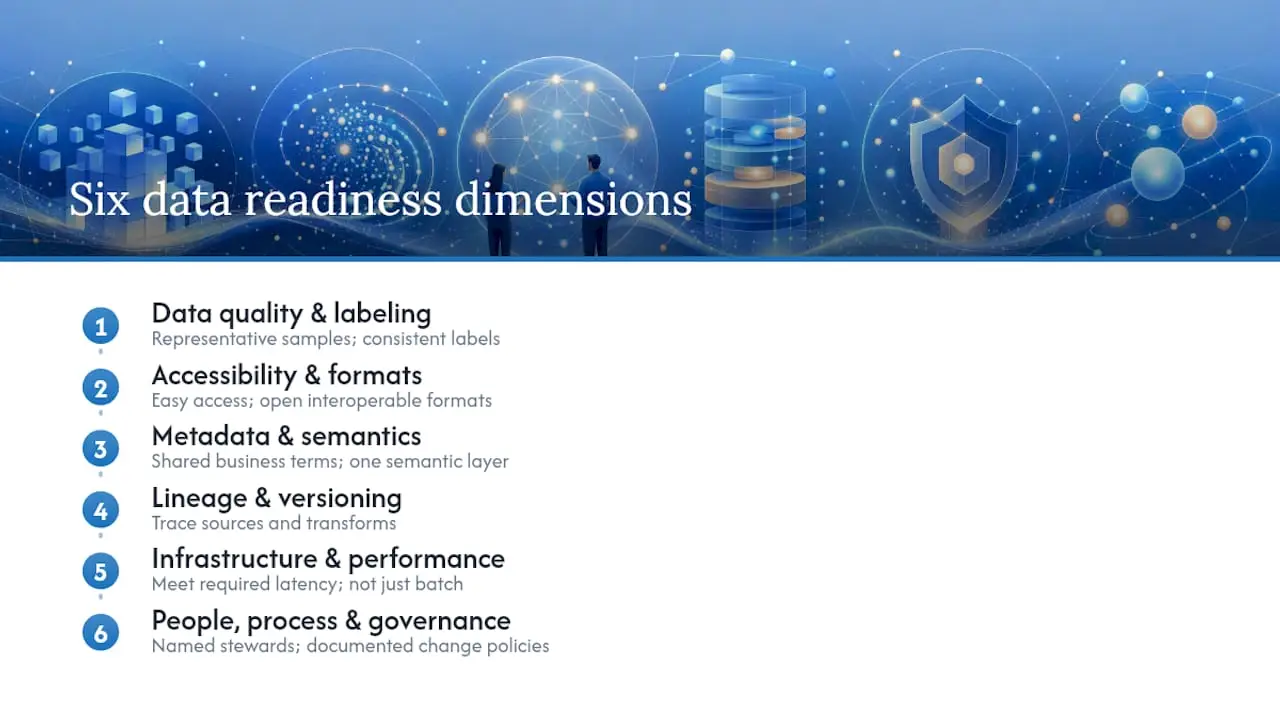
Data quality and labeling. Does the sample represent the population the model will actually see? Are labeling standards documented and consistent across annotators? Is there a process for handling missing or ambiguous values, or does someone just guess?
Accessibility and formats. Can systems and teams pull the data without a two-week ticket queue? Cloudera’s guidance on data readiness points to open table formats like Apache Iceberg as a practical way to make data interoperable across engines instead of locked into one vendor’s format.
Metadata and semantics. Does “customer” mean the same thing in sales, support, and finance? A semantic layer that defines business terms once and reuses them everywhere prevents the classic problem of three departments reporting three different revenue numbers.
Lineage and versioning. Can you trace a data point back to its source and every transformation in between? Without that, reproducing a model’s output six months later is close to guesswork.
Infrastructure and performance. Does your storage and compute layer support the latency an AI application needs, or was it built for nightly batch jobs?
People, process, and governance. Is there a named steward for each critical dataset, and a documented policy for who can change what?
Pro Tip: Run this checklist against your single highest-priority use case first, not your whole data estate. A narrow, honest assessment beats a broad, superficial one every time.
How to Run a Practical Data Readiness Assessment
Start small, then go deep. A useful assessment has two speeds.
The 15-minute pulse check. Answer a handful of direct questions: Who owns this dataset? When was it last validated? Can you trace where a given field originated? What percentage of records are missing key fields? This mirrors the quick-diagnostic approach in DataCamp’s data maturity assessment, which is designed to be completed in under 15 minutes and hands you a snapshot, not a dissertation.
Once the pulse check flags where the gaps are, run a deeper audit using the IPTOP framework, covering five areas:
- Infrastructure — storage, compute, and integration pipelines supporting the use case
- People — who owns data quality, who can be escalated to, who is trained
- Tools — the ETL and integration platforms moving data from source to model
- Organization — how decisions about data get made and funded
- Processes — the documented steps for validation, lineage tracking, and access requests
The output of a full audit should be concrete: a prioritized list of datasets ready for AI use, a roadmap of governance fixes, and a realistic timeline. Digitalfractal’s AI Audit & Opportunity Assessment follows this same structure when working with logistics, construction, and energy clients.
Reassess on a cycle, not a whim. A 1 to 2 year cadence, with lighter pulse checks in between, keeps your readiness score honest as systems and use cases change.
Prioritizing Datasets and Use Cases for Maximum Impact
Not every dataset deserves equal attention, and trying to fix everything at once is how readiness initiatives stall before they start.
Score each candidate use case against four criteria:
- Business value — what does success actually save or generate
- Feasibility — does the data and infrastructure exist today, or does it need to be built
- Data readiness — how far is this dataset from the six-dimension checklist above
- Regulatory risk — does this use case touch protected classes, financial decisions, or safety outcomes
Rank candidates from high value and high feasibility down to low value and low feasibility, and let that ranking drive a staged roadmap: a 90-day pilot on the top-scoring use case, a 180-day expansion once that pilot proves out, and a 360-day push into harder, lower-readiness datasets.
Before greenlighting a pilot, confirm it clears a short checklist:
- Scope is narrow enough to finish in one quarter
- Success is defined by a specific, measurable KPI
- A rollback plan exists if the model underperforms in production
Gartner’s research backs this approach directly: prioritizing one small, “good enough” pilot dataset with solid lineage tends to produce faster business results than chasing enterprise-wide perfection, as detailed in this conversational AI platform guide.
Governance and Observability Keep Readiness From Decaying
Readiness is not a one-time certification. Data drifts, systems change, and yesterday’s clean pipeline becomes tomorrow’s silent failure without ongoing monitoring.

TechTarget’s reporting is blunt on this point: without automated lineage and observability, enterprises cannot reliably audit AI outputs or troubleshoot errors after something goes wrong. That is not a hypothetical risk; it’s the reason so many post-mortems end with “we don’t actually know why the model did that.”
Build these operational habits into any AI program:
- Automated lineage tracking that logs where every field originated and what touched it along the way
- Drift detection that flags when live data starts diverging from training data
- Versioned datasets and models, so a bad output can be traced to a specific snapshot
- Regression tests that run before any retraining goes live
- Clear retraining triggers tied to observed performance decay, not a fixed calendar date
NIST’s AI Risk Management Framework offers the clearest public reference for tying these operational practices to broader governance and risk management, and it’s worth building your internal policy around its structure rather than reinventing one from scratch.
How Digitalfractal’s AI Readiness Audit Executes This Plan
Digitalfractal’s AI Readiness Audit takes the framework above and applies it to your business in weeks, not quarters. The audit measures your data across the six readiness dimensions, scores your top candidate use cases, and delivers:
- A prioritized dataset list ranked by business value and feasibility
- A governance action plan covering lineage, access controls, and stewardship gaps
- A staged roadmap built for a 90-day pilot timeline
Companies in logistics, construction, and energy typically start with the Digital Transformation Readiness Checker as a quick pulse check, then move into the full audit once the pilot use case is clear.
Data Readiness Now Shapes Compliance Outcomes, Not Just Model Accuracy
Regulators are no longer just asking whether an AI system works. They are asking whether the organization running it can explain how it reached its conclusions, and that question is fundamentally about data readiness.
An audit trail depends entirely on lineage. If a regulator asks why a model denied a loan or flagged a shipment for inspection, “the model decided” is not an answer. You need to show which data fed the decision, where that data came from, and how it was transformed. Without documented lineage, that reconstruction is often impossible, which turns a routine compliance review into a legal exposure.
NIST’s AI Risk Management Framework treats this connection explicitly, framing data governance as inseparable from AI risk management rather than a separate checkbox exercise. Sectors already under heavy scrutiny, financial services, healthcare, energy, feel this most acutely: an unrepresentative training sample is not just a modeling problem there, it’s a fair-lending or safety violation waiting to surface.
The practical implication for decision-makers is straightforward: build lineage and metadata capture into your data pipelines before a regulator asks for them, not after. Retrofitting an audit trail onto a model already in production is far more expensive than building the capability in from the start. Treat governance documentation as a deliverable of your readiness audit, not an afterthought bolted on once legal gets nervous.
Culture and Change Management Determine Whether Readiness Sticks
The technical checklist matters, but plenty of enterprises with excellent lineage tools and modern infrastructure still fail at readiness because nobody outside the data team believes it matters.
Data stewardship only works if the people entering data day to day understand why accuracy and consistency affect a model they will never see run. A warehouse worker logging inventory counts, a field technician noting equipment status, a sales rep updating a CRM field: each one is, in effect, training a future AI system, whether their job description says so or not. Change management means making that connection visible, not assuming it’s obvious.
Executive sponsorship shortens the distance between a readiness audit and actual budget for fixing what it finds. Gartner’s guidance on AI-ready data specifically recommends securing board-level buy-in before evolving data management practices, because governance fixes that require new tooling or new hires stall without leadership backing.
The most common cultural failure is treating readiness as an IT initiative rather than a business one. When data quality ownership sits only with a technical team, with no stake for the business units generating the data, quality regresses the moment attention moves elsewhere. The fix is unglamorous: named stewards in the business units themselves, incentives tied to data quality metrics, and leadership that treats a readiness score the way it treats a revenue number, worth reviewing regularly, not once a year.
What the Readiness Conversation Keeps Getting Backward
Most advice on this topic treats readiness like a certification you earn once and file away. That’s backward, and it’s the reason so many “readiness initiatives” produce a binder nobody opens again. The evidence points somewhere more useful: readiness is a cycle, and the organizations that get value from AI treat the IPTOP-style audit as a recurring pulse check, not a milestone.
The bigger mistake I see in conventional guidance is scope. Companies try to make their entire data estate AI-ready before touching a pilot, which guarantees the project stalls in committee for a year. The smarter path, and the one the evidence actually supports, is scoring use cases first and pouring readiness effort into whichever one clears the bar on value, feasibility, and risk together.
If you take one thing from this piece, take this: assign a data owner to your top use case before you build another dashboard. Governance without an accountable person is theater. Everything else, the lineage tools, the semantic layers, the metadata standards, works only once someone is actually responsible for keeping it true.
Get a Prioritized Roadmap Instead of a Vague Checklist
A generic consulting engagement hands you a maturity score and a slide deck. Digitalfractal hands you a prioritized dataset list, a governance action plan, and a working pilot timeline, built around the same 90-day horizon the rest of this article has walked through.
The AI Readiness Audit measures your data across the six dimensions covered above, scores your candidate use cases, and tells you exactly which pilot to run first and what needs fixing before you scale it. It’s built for logistics, construction, and energy operators who need a specific answer, not a framework to interpret on their own. If you want the quick version before committing to the full audit, start with the Digital Transformation Readiness Checker to see where your biggest gaps sit. From there, book the AI Audit & Opportunity Assessment and get a roadmap built around your top use case, not a generic template.
Frequently Asked Questions
What does “enterprise data readiness” actually mean?
It means your organization’s data is accurate, traceable, and governed well enough for AI systems to use reliably, not just clean enough for a human to read comfortably.
How is data readiness different from data quality?
Data quality checks formatting and accuracy. Readiness adds provenance, representativeness, semantic consistency, and operational accessibility, the layers that determine whether a model can actually trust and use the data.
How long does a data readiness assessment take?
A pulse check runs about 15 minutes using a framework like DataCamp’s IPTOP model. A full audit, covering infrastructure, people, tools, organization, and processes, typically takes several weeks and should be repeated every 1 to 2 years.
What’s the biggest barrier to enterprise data readiness?
Fragmentation and silos consistently top the list, followed closely by missing lineage documentation and unclear data ownership.
Should we fix all our data before starting an AI pilot?
No. Prioritize one high-value, feasible use case and get that dataset genuinely ready first. Waiting for enterprise-wide perfection is the most common reason readiness initiatives never launch a pilot at all.
Sources
- DataCamp — Data maturity assessment (IPTOP)
- Gartner — AI-ready data
- IBM — What is AI-ready data?
- TechTarget — What enterprises are getting wrong about AI data readiness