Computer Vision Forklift Safety: Why Warehouse Pilots Need CSA KPIs

Computer vision gives forklift safety programs something radar and telematics never could: a live, contextual view of pedestrians, blind spots, and unsafe behavior as they happen. Cameras paired with detection models can trigger alerts and, in integrated systems, automated deceleration before a collision occurs. This capability works best as one layer inside a written traffic-management plan aligned with CSA B335-15 (R2020) guidance, not as a standalone fix.
TL;DR:
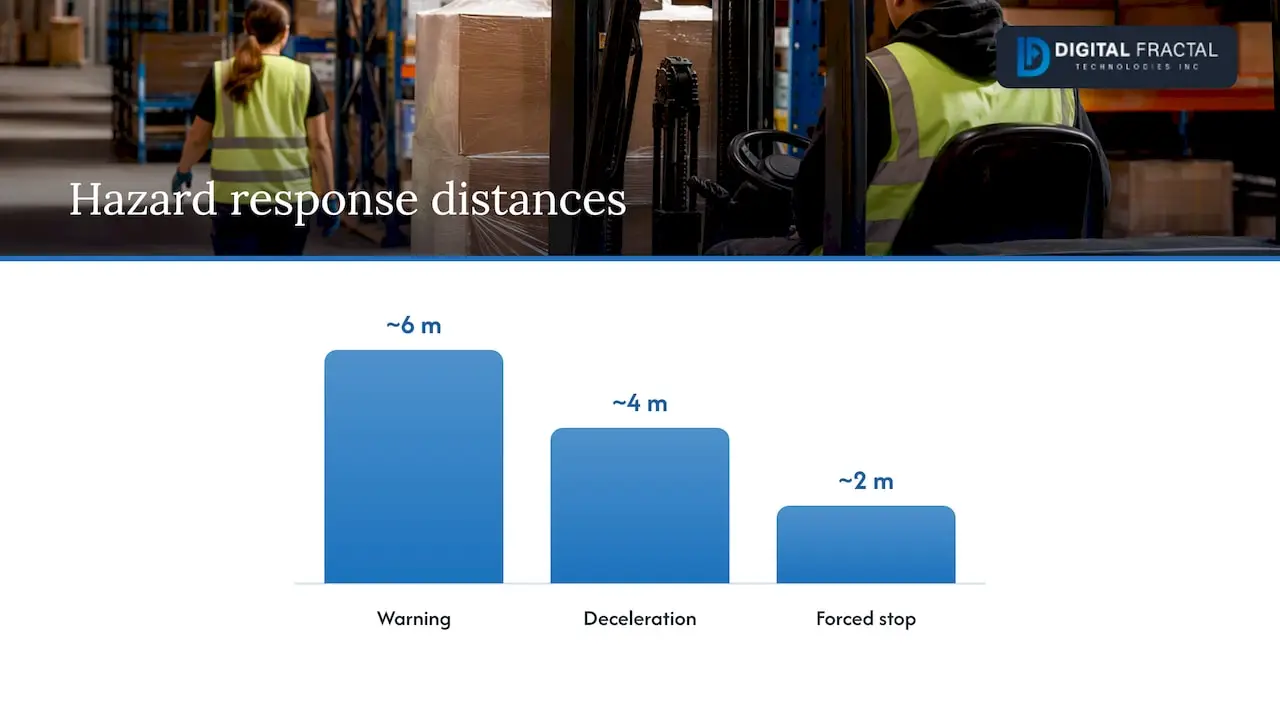
- A layered alert model can warn near 6 meters, decelerate near 4 meters, and stop within about 2 meters, with thresholds tested on site.
- Telematics records speed, impacts, and engine hours for fleet and maintenance decisions, while cameras catch stationary pedestrians and near misses before contact.
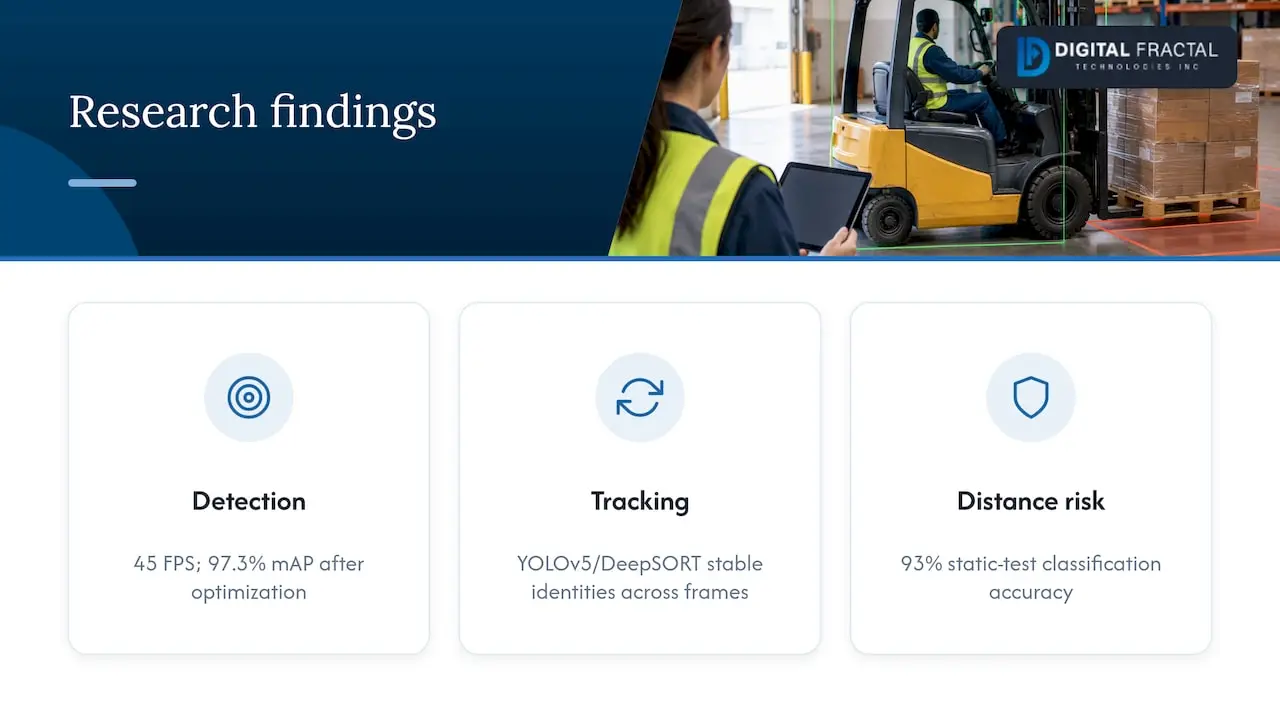
- A controlled YOLOv8 study reported about 45 frames per second and 97.3% mean average precision after optimization, but facility trials remain essential.
- Run the pilot through a full seasonal lighting cycle, and measure false alarms, missed hazards, and alert latency on footage from your facility.
- Limit worker footage to hazard prevention, set retention and access rules, and consider edge processing that transmits alerts instead of continuous video.
Table of Contents
- How computer vision detects forklift hazards
- Vision AI versus telematics: complementary strengths
- Core features and safety workflows computer vision enables
- Integrating computer vision into a lift-truck safety program
- Performance metrics and technology choices that matter
- Common challenges and how to mitigate them
- Future trends in computer vision for forklift safety
- Data privacy and security considerations for forklift vision systems
- Hardware and sensor options for forklift vision systems
- Case studies showing computer vision’s impact on forklift safety
- Practical takeaway for safety managers
- Getting started with a computer vision safety pilot
- FAQ
- Sources
How computer vision detects forklift hazards
A forklift vision system is built to recognize several classes of risk at once: pedestrians, other forklifts, loads and pallets, static obstacles like racking legs, and breaches of exclusion zones marked on the warehouse floor. Most systems also flag posture and movement patterns, so a worker stepping backward into a blind aisle gets treated differently than someone walking a known path.
The underlying methods borrow from a few well-established techniques:
- Object detection models from the YOLO family identify and classify people, vehicles, and obstacles frame by frame.
- Pose estimation adds body-position context, helping distinguish a bent-over worker from one about to step into a travel lane.
- Multi-object tracking, often using DeepSORT alongside YOLO, keeps a consistent identity on each person or vehicle across frames rather than re-detecting them from scratch.
- Safe-distance estimation calculates closing speed and separation to decide when an alert should fire.
Tracking and behavior classification together surface leading indicators that a single snapshot misses, like a near-miss pattern or a forklift repeatedly entering a lane against the marked direction of travel. A practical alerting model might sound a warning around 6 meters, begin automatic deceleration near 4 meters, and force a stop within about 2 meters of a detected hazard, mirroring the layered response that CSA B335-15 (R2020) guidance recommends for lift truck safety programs.
On the performance side, research published through IOPscience describes a YOLOv8-based blind-spot detection model that reached roughly 45 frames per second with a mean average precision near 97.3% after pruning and quantization, showing that real-time detection accuracy and edge-friendly speed are not mutually exclusive in controlled testing.
Vision AI versus telematics: complementary strengths
Telematics measures what a forklift is doing: speed, impact events, engine hours, and idle time, logged after the fact for fleet management and maintenance scheduling. Computer vision measures what is happening around the forklift, in the moment, before an impact occurs.
That distinction shapes how each technology earns its place in a safety program:
- Telematics is retrospective: it tells you a hard brake or impact happened, usually after the event.
- Vision AI is proactive: it can detect a pedestrian in a blind corner or a near-miss pattern before contact.
- Telematics reports numbers (speed, g-force); vision AI reports scene context (who, where, how close).
- Vision catches hazards telematics structurally cannot see, like a worker standing still in a blind spot with no forklift motion to trigger a sensor.
The practical answer for most warehouses is not choosing one over the other. Telematics remains useful for utilization data, maintenance triggers, and fleet-wide reporting, while vision AI takes the lead on collision avoidance and pedestrian protection, where seeing the scene matters more than measuring the vehicle.
Core features and safety workflows computer vision enables
A deployed system does more than detect objects. It turns detections into actions and data that a safety team can use every week, not just when something goes wrong.
- Real-time visual and audio alerts warn the operator the moment a pedestrian or obstacle enters a danger zone.
- Operator-facing warnings, whether on a dashboard display or a cab beacon, give the driver a direct, immediate cue.
- Software-triggered deceleration or stop commands intervene when a driver does not react in time, integrated with the forklift’s control system.
- Exclusion-zone enforcement flags or logs every breach of a marked pedestrian or no-go area.
- Fleet-level dashboards aggregate alerts and near-misses across every truck and shift.
These outputs feed directly into safety workflows: an immediate in-cab warning for the operator, automated incident logging for the record, and coaching conversations built on near-miss frequency rather than guesswork. Over time, the same data produces exposure-time reports and hotspot maps that point to where a layout change, a new mirror, or a widened aisle would do more good than another warning light.
Pro Tip: Review near-miss hotspot maps monthly, not just after an incident. Patterns show up long before a collision does.
Integrating computer vision into a lift-truck safety program
Rolling out vision technology works best when it slots into an existing safety structure rather than running alongside it as a separate project.
- Start with a hazard assessment and a written traffic-management plan that defines exclusion zones, pedestrian routes, and responsibilities, consistent with CSA B335-15 (R2020) program requirements.
- Design a pilot with clear KPIs before installing anything: detection accuracy, false-positive rate, end-to-end alert latency, and a target reduction in logged near-misses over a defined pilot window.
- Plan camera placement around known blind corners, intersections, and dock doors, with mounting height and lighting checked on site rather than assumed from a spec sheet.
- Consult staff and, where applicable, union representatives before installation, since cameras on equipment raise legitimate questions about monitoring and scope.
- Roll out with operator training, a regular coaching cadence based on alert data, and scheduled reviews to tune thresholds as real-world performance data comes in.
A literature review of computer vision applications in logistics notes that pilot trials measuring real-world latency and false-positive rates under actual lighting and occlusion conditions produce far more reliable procurement decisions than vendor lab demonstrations alone.
Pro Tip: Run the pilot for at least one full seasonal lighting cycle before locking in thresholds. Winter glare and dock-door backlighting behave very differently from a summer afternoon.
Performance metrics and technology choices that matter
Vendor claims vary widely, so it helps to know what to actually ask for. Detection models in this space typically come from the YOLOv5 or YOLOv8 families, often compressed through pruning or quantization to run on edge hardware mounted on the truck itself rather than relying on a constant cloud connection.
Key metrics worth requiring in any trial:
- Frames per second, with edge-optimized systems commonly targeting a range in the 24 to 45 FPS band for smooth real-time tracking.
- End-to-end alert latency, measured from detection to the operator’s warning, not just model inference time.
- Mean average precision and recall, since a system tuned purely for precision can miss real hazards to avoid false alarms.
- False-positive and false-negative rates measured on footage from the actual facility, not a vendor’s demo warehouse.
A study published through Taylor & Francis reported 93% classification accuracy for a computer vision-based safe distance-estimation method using YOLOv8 and a SafeDEM module in static test conditions, a useful benchmark when evaluating tip-over risk detection specifically.
Edge inference reduces network dependence and latency but adds on-site maintenance; cloud processing simplifies updates but introduces connectivity risk and raises more privacy questions, since footage leaves the building.
Common challenges and how to mitigate them
Occlusion, poor lighting, and loads blocking a driver’s sightline are the most common reasons a detection gets missed, and reflective surfaces on dock floors can confuse distance estimation.
- Overlapping coverage from multiple cameras closes gaps that a single angle cannot see around a loaded pallet.
- Sensor fusion, combining vision with proximity sensors, RFID, or LIDAR, catches hazards outside any one camera’s field of view.
- Temporal aggregation, requiring a detection to persist across several consecutive frames, cuts nuisance alerts without dulling sensitivity to real hazards, an approach reflected in warehouse tracking research using YOLOv5 and DeepSORT.
- Targeted retraining on site-specific footage closes the gap between lab accuracy and real warehouse conditions.
Vision AI lowers risk exposure, but it works within layered controls, not instead of them.
Future trends in computer vision for forklift safety
Model efficiency is improving quickly enough that edge devices mounted directly on a forklift can now run detection pipelines that once needed a server room. That trend toward smaller, faster models trained specifically on warehouse footage, rather than generic datasets, should keep narrowing the gap between lab-reported accuracy and real-site performance over the next few years.
Sensor fusion is likely to deepen rather than disappear. Pairing cameras with LIDAR, ultra-wideband tags, or proximity sensors gives a system redundancy when a camera angle alone cannot resolve an occluded hazard, and that layered approach is already showing up in the research on blind-spot detection for industrial environments.
Tighter integration with the forklift’s own control system is another direction worth watching: moving from alert-only systems toward direct deceleration and stop commands, which requires closer coordination between vision vendors and equipment manufacturers. As that integration matures, expect more systems to log structured near-miss and exposure data automatically, feeding directly into the kind of hotspot analysis safety teams already use for layout decisions.
None of this replaces the fundamentals. A written traffic-management plan, worker consultation, and physical controls like mirrors and exclusion zones remain the foundation that any new detection technology sits on top of.
Data privacy and security considerations for forklift vision systems
Cameras on forklifts capture footage of real employees in a workplace, which raises legitimate questions before a single unit goes live. Workers reasonably want to know what is recorded, how long footage is kept, who can access it, and whether it will be used for performance monitoring beyond safety purposes.
Clear answers to those questions, documented before rollout, tend to prevent most pushback. Retention limits, access controls restricted to safety and operations staff, and a stated policy that footage is used for hazard prevention rather than individual discipline all help. Where processing happens matters too: edge inference that only transmits alert events, rather than continuous video, reduces the amount of personal data stored or transmitted off site. Facilities weighing recording architecture often compare NVR and VMS approaches when deciding how footage is stored, retained, and accessed across a fleet of cameras.
Consulting staff and union representatives, as part of the same process used to build the traffic-management plan, surfaces privacy concerns early rather than after installation.
Hardware and sensor options for forklift vision systems
A forklift vision deployment typically combines a few hardware elements rather than relying on a single camera. Wide-angle or fisheye cameras mounted at the mast or rear cover blind corners that a driver cannot see directly; mounting height and angle need site-specific testing rather than a generic spec.
Edge computing units, often a compact GPU or dedicated inference chip mounted on the truck, run the detection model locally so alerts fire without waiting on a network round trip. Lighting conditions in a given facility, including dock-door glare and dim storage aisles, should be tested before final placement, since a camera that performs well in one lighting zone can struggle in another just a few aisles over.
Many deployments add proximity sensors, RFID tags on pedestrians or equipment, or LIDAR units as a fusion layer, which helps cover gaps when a camera’s view is blocked by a load. For teams weighing physical layout changes alongside sensor upgrades, facility guidance on bollard installation is a useful companion to camera placement when hardening intersections and blind corners.
Case studies showing computer vision’s impact on forklift safety
Published research gives a clearer picture of what these systems achieve than vendor marketing alone. The blind-spot detection study from IOPscience demonstrated a YOLOv8 model running at roughly 45 FPS with 97.3% mean average precision after optimization, evidence that real-time detection at warehouse scale is achievable with current hardware, at least in controlled testing.
Separately, the YOLOv5 and DeepSORT tracking study applied to a warehouse setting reported real-time tracking performance with reliable detection accuracy and stable identity tracking across frames, which matters for near-miss analytics since a system that loses track of a pedestrian mid-frame cannot reliably flag a repeated close call.
The safe distance-estimation study focused on a different failure mode entirely: tip-overs from unstable loads, reporting 93% classification accuracy in static testing. Together, these three lines of research point at a consistent pattern: detection, tracking, and geometric risk assessment each address a distinct hazard, and a mature safety program benefits from treating them as complementary tools rather than picking just one.
Practical takeaway for safety managers
Treat computer vision as one layer, not a silver bullet. Pilot it with clear KPIs, measure false positives and latency on your own floor, and fold findings back into your written traffic-management plan with worker input at every stage. For teams unsure where to start, an AI readiness assessment is a reasonable first step before committing to a full deployment.
— Souhail
Getting started with a computer vision safety pilot
We built our AI Readiness Audit for teams in exactly this position: ready to explore computer vision for forklift safety but not sure where a pilot should start or what it should measure. We assess your current layout, data, and systems, then scope a pilot built around the KPIs that actually matter for your floor.
- Scope camera placement, exclusion zones, and KPI targets against an existing traffic-management plan.
- Tailor recommendations to a facility’s layout and workflows rather than a generic template.
- Aim to deliver a working path to deployment within a 90-day timeline.
If you manage safety for a warehouse or logistics operation and want a clear next step, start with an AI Readiness Audit and get a scoped plan for your facility.
FAQ
What does computer vision detect in forklift safety systems?
Computer vision systems detect pedestrians, other forklifts, loads, static obstacles, and breaches of marked exclusion zones using object detection and tracking models. Advanced systems also flag behavior patterns like near-misses or wrong-direction travel that indicate rising risk before a collision happens.
How is computer vision different from forklift telematics?
Telematics tracks vehicle data like speed and impact events after they occur, while computer vision observes the surrounding scene in real time to catch hazards before contact. A study on YOLOv8-based blind-spot detection reported close to 45 FPS performance, illustrating how fast proactive detection can run compared to telematics’ after-the-fact reporting.
What accuracy should I expect from a forklift vision system?
Published research shows meaningful variation by use case: one blind-spot detection study reported high mean average precision with real-time frame rates, while a separate study on tip-over prevention noted strong classification accuracy in static testing. Always ask vendors for accuracy figures measured on footage from your own facility rather than lab conditions.
How does computer vision fit with CSA B335-15 safety requirements?
CSA B335-15 (R2020) requires a written lift truck safety program with defined exclusion zones and traffic controls, and computer vision supports that program by automating detection and alerting within those defined zones. It works as one control layer alongside the administrative and physical controls the standard already calls for, not as a replacement for them.
What causes false positives in forklift vision systems?
False positives typically come from occlusion, poor lighting, reflective floor surfaces, or loads blocking the camera’s view of the full scene. Mitigations include overlapping camera coverage, fusing vision with proximity or LIDAR sensors, and using temporal aggregation so a detection must persist across several frames before triggering an alert.
Sources
- Forklift operator safety — CCOHS
- Deep Learning-driven Blind Spot Detection for Forklifts in Industrial Environments — IOPscience
- Smart logistics warehouse moving-object tracking based on YOLOv5 and DeepSORT — MDPI Applied Sciences
- Computer vision-based safe distance-estimation method to prevent forklift tip-overs — Taylor & Francis