What an AI Maturity Model Tells You (and What to Do Next)

An AI maturity model is a structured framework for scoring how well an organization’s AI capability, from data infrastructure to governance to talent, matches its business ambitions. It matters because it turns a vague sense of “we should be doing more with AI” into a scored, prioritized list of gaps that leadership can actually fund. Gartner and MITRE both publish widely used versions, and firms like Digitalfractal apply the same logic hands-on through readiness audits for logistics, construction, and oil and gas operators.
Here’s the immediate move, in order:
- Pick a model (Gartner’s five stages or MITRE’s six pillars both work) and score your current state honestly, pillar by pillar.
- Identify the two or three gaps blocking the most value, not the ones that are easiest to talk about in a board meeting.
- Either run the assessment internally or commission a readiness audit if you want an outside, evidence-based baseline within weeks rather than quarters.
Key Takeaways
Organizations that score AI maturity by pillar and function, then prioritize gaps by business impact, move faster and waste less budget than those chasing a single overall score.
| Point | Details |
|---|---|
| Score by pillar, not one number | Strategy, data, technology, governance, talent, and performance each need their own evidence-based score. |
| Match targets to mission | Not every pillar needs top-level maturity; align targets with actual business risk and objectives. |
| Segment by function | Predictive maintenance and customer personalization need different pillar priorities entirely. |
| Govern before you scale | Ownership, approval gates, monitoring, and adversarial resilience checks come before production, not after. |
| Digitalfractal executes the audit | Its AI Readiness Audit scores pillars with evidence and targets prioritized wins within 90 days. |
Table of Contents
- Understanding the AI Maturity Framework and Its Stages
- How Do You Assess Your Current AI Maturity Level?
- Setting Target Maturity Levels and Building a Roadmap
- What Pitfalls Should You Avoid When Scaling AI?
- Applying the Model Across Different Business Functions
- How Digitalfractal Applies This Model in Practice
- Why Most Maturity Assessments Miss the Point
- Get a Readiness Audit Instead of a Generic Strategy Deck
- Sources
Understanding the AI Maturity Framework and Its Stages
Most frameworks describe a similar arc, even when the labels differ. An organization moves from ad hoc experimentation, where a handful of employees tinker with tools nobody governs, through pilot projects, into scaled production, and eventually into a state where AI decisions run embedded in core operations. Gartner names these five stages Foundational, Emerging, Operational, Scaled, and Transformational. MIT Sloan uses a simpler four-stage version: Experiment/Prepare, Build Pilots, Industrialize, and Become AI Future-Ready, which reads better to executives who don’t want jargon.
The stage labels matter less than the pillars underneath them. Across the major frameworks, six dimensions keep showing up:
- Strategy. Is AI tied to specific business objectives, or is it a side project with no budget line?
- Data. Is data accessible, clean, and governed, or scattered across systems that don’t talk to each other?
- Technology and enablers. Do you have the infrastructure, MLOps tooling, and integration capacity to move a model from a laptop to production?
- Governance and ethics. Are there approval processes, monitoring, and accountability structures for AI decisions?
- Talent. Do you have people who can build, deploy, and maintain AI systems, or are you dependent on one contractor?
- Operating model and performance. Are outcomes measured against real KPIs, or does “success” mean the demo worked?
MITRE’s model breaks these into six pillars and 20 sub-dimensions, and it makes a point worth repeating: your target level should match your mission and resources, not chase a maximum score on every pillar. A construction firm doesn’t need cutting-edge MLOps infrastructure if its highest-value use case is predictive maintenance scheduling. SEI/CMU’s Adoption Maturity Model adds a useful lens on top of this: it scores organizational change and system lifecycle engineering separately, because a company can have great data and still fail at deployment discipline.
How Do You Assess Your Current AI Maturity Level?
Start by deciding scope. An enterprise-wide assessment answers “where are we overall,” but it tends to average out real problems, hiding a strong data team behind a weak governance function. A function-level assessment, run separately for logistics operations, finance, and customer service, gives you numbers you can actually act on. Most organizations get more value assigning a senior operations or IT leader to own each function’s scorecard rather than centralizing everything under one committee.
The assessment itself works like a structured interview plus document review. You’re not asking “do you use AI,” you’re asking for evidence: policy documents for governance, pipeline architecture diagrams for technology, production monitoring dashboards for performance, org charts for talent allocation, and training logs for literacy. Evidence-based scoring beats self-reported confidence every time, because leaders consistently overestimate their own governance maturity when nobody asks them to show the paperwork.
Score each pillar on a simple scale, then plot the results as a heat map. A gap analysis chart, current state versus target state per pillar, makes it immediately obvious where the biggest distance sits. Run this exercise annually at minimum, and more often for pillars you’re actively investing in.
- Score every pillar with documented evidence, not verbal assurance.
- Build a heat map showing current versus target maturity per pillar.
- Repeat the assessment at least once a year, more frequently for active initiatives.
Pro Tip: Never publish a single enterprise-wide maturity score without the underlying function breakdown attached. A “Level 3 overall” score hides the fact that your data pillar might be Level 4 while governance sits at Level 1, and that’s the gap that actually gets you in trouble.
Setting Target Maturity Levels and Building a Roadmap
Target levels come from business objectives, not from a desire to look sophisticated. If your risk profile includes regulated data (health records, financial transactions, safety-critical equipment monitoring), your governance pillar needs a higher target than a marketing team running content experiments. Rank initiatives using impact against effort, and weight anything with regulatory or safety exposure higher regardless of its raw ROI score.
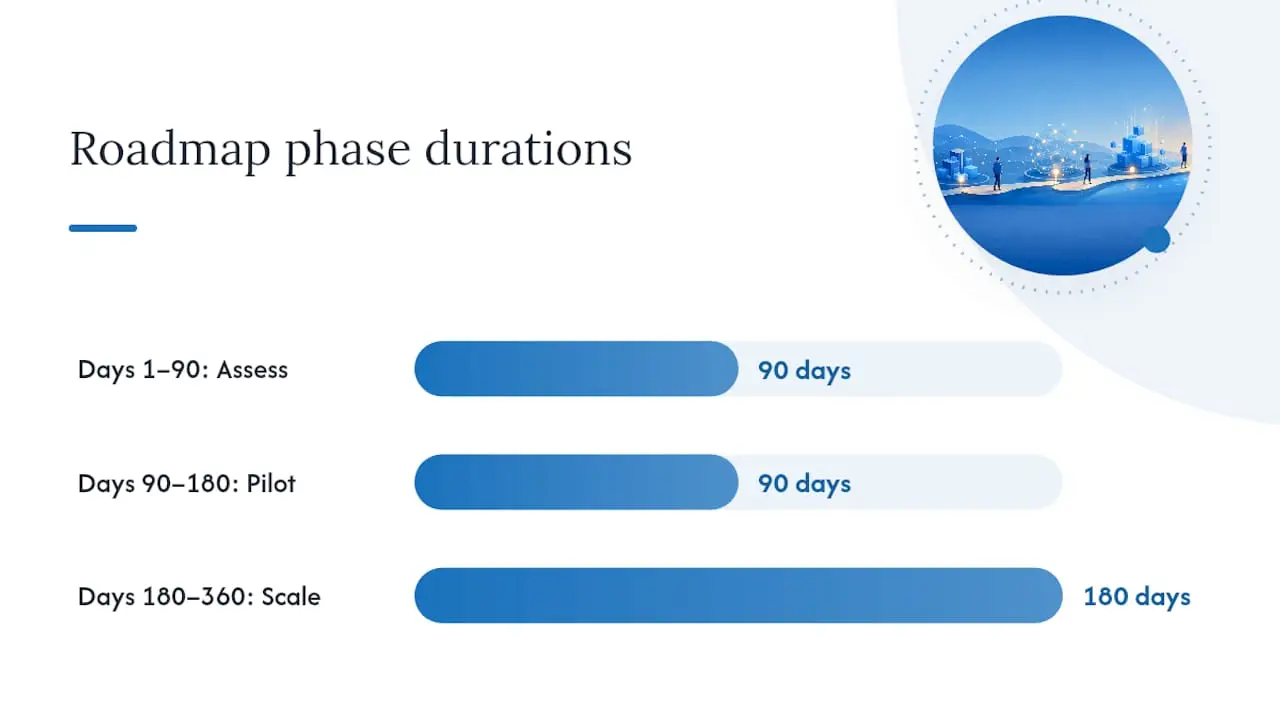
A realistic roadmap breaks into three checkpoints:
- Days 1 to 90: Complete the assessment, publish a governance charter, and launch one automation quick win with measurable time savings.
- Days 90 to 180: Move the top-priority pilot into production with monitoring and alerting in place, and close the largest governance gap identified in the heat map.
- Days 180 to 360: Scale the working pilot to a second function, formalize training programs, and reassess maturity to confirm movement.
Success metrics should be concrete: reduction in manual task hours, model uptime percentage, and number of governance artifacts completed on schedule. SEI/CMU’s research points to automating repetitive tasks and establishing monitoring as the fastest, most measurable early wins, precisely because they show ROI before anyone has to defend a bigger investment.
What Pitfalls Should You Avoid When Scaling AI?
The most common failure isn’t lack of ambition. It’s over-investing in a pillar that doesn’t matter for your use case while starving the ones that do, or pushing a pilot into production without the lifecycle engineering to keep it stable. SEI/CMU’s research is blunt about this: deployment speed without engineering discipline builds technical debt, not returns. Ignoring culture and AI literacy is the quiet killer, since a technically mature system still fails if the people using it don’t trust or understand it.
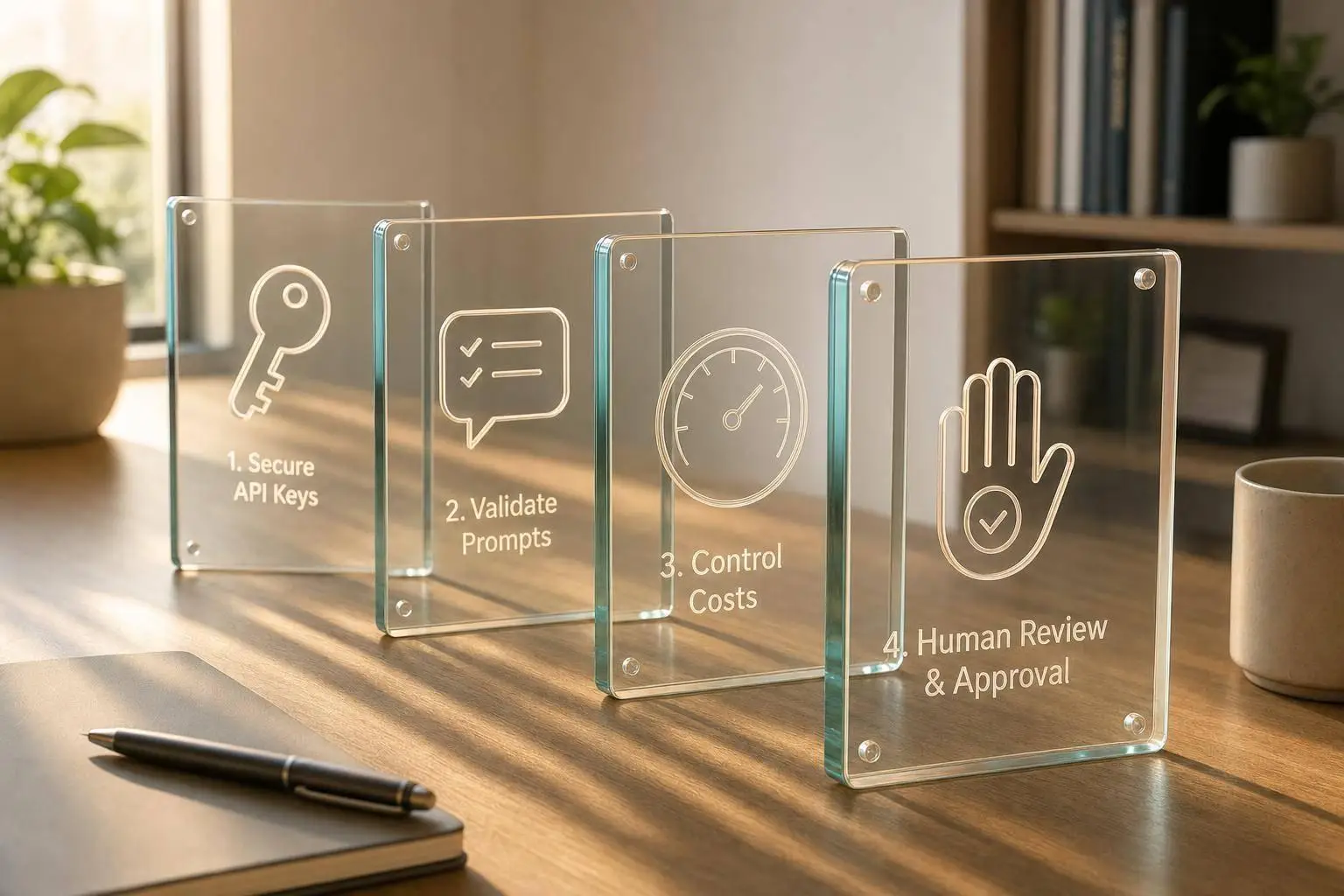
A short governance checklist covers the essentials:
- Assign clear ownership for every model in production, not just at launch.
- Require approval gates before a pilot moves to production status.
- Set up ongoing model monitoring and a documented incident response process.
- Run an ethical review for any system making decisions that affect customers or employees.
- Build in adversarial resilience checks, a priority OWASP’s AI Maturity Assessment flags directly. Digitalfractal’s own guidance on AI vulnerability management covers this in more depth.
Applying the Model Across Different Business Functions
Maturity is almost never uniform across an organization, and treating it as one number is how leaders miss the real gaps. Gartner’s research recommends assessing by domain, then rolling those scores up into an enterprise view rather than starting from the top down.
Two quick templates show the difference in practice:
- Predictive maintenance (logistics or construction equipment): prioritize the data pillar (sensor feeds, historical failure logs) and technology pillar (real-time pipelines); talent and governance can sit at a lower target level early on.
- Customer personalization (marketing or retail): prioritize governance and ethics (consent, bias review) alongside data quality; technology infrastructure matters less than clean, permissioned customer data.
Once each function has a score, rank the gaps by combined business impact and consolidate them into one enterprise roadmap, so the maintenance team’s data investment and the marketing team’s governance fix compete for the same prioritized budget line rather than running in silos. Teams building this kind of repeatable operating model often benefit from established patterns for scaling AI products responsibly.
How Digitalfractal Applies This Model in Practice
Digitalfractal’s AI Readiness Audit maps directly onto the pillar structure described above: strategy, data, technology, governance, and talent, scored with the same evidence-based approach MITRE and SEI/CMU recommend. The audit is built for companies in logistics, construction, and oil and gas that need a prioritized list of automation opportunities, not a generic strategy deck.
- Delivers a scored gap analysis per pillar, not just a single maturity number.
- Targets tangible business transformation within a 90-day window.
- Focuses on automating repetitive, high-friction tasks first, where ROI shows up fastest.
Readers who want a self-guided starting point can run the Digital Transformation Readiness Checker before committing to a full AI Audit & Opportunity Assessment.
Why Most Maturity Assessments Miss the Point
The conventional advice treats maturity models as a scoring exercise you complete once and file away. That’s backwards. The real value sits in what happens after the score, when a leader has to decide which gap gets funded first and which one waits another year. Most organizations never get that far, because they treat the assessment itself as the deliverable.

The bigger blind spot is governance. Companies pour budget into flashy pilots while their approval processes, monitoring, and incident response stay at whatever ad hoc state they started in. SEI/CMU’s research backs this up directly: deployment speed without lifecycle discipline produces technical debt, not returns. I’d go further. A company at “Level 2” maturity with strong governance is in a better position than one at “Level 4” with none, because the second company is one bad model decision away from a real incident.
If you take one thing from this guide, take this: score your governance pillar first, honestly, before you score anything else. Everything downstream depends on whether that foundation holds.
Get a Readiness Audit Instead of a Generic Strategy Deck
Digitalfractal is the alternative to hiring a generalist consultant to explain maturity models to you in a slide deck. Instead of theory, you get a scored, evidence-based audit of your own pillars, matched to your industry, and a prioritized list of automation opportunities you can fund starting this quarter.
That’s the practical difference between Digitalfractal and a traditional strategy engagement: less framework education, more automated tasks and monitored production systems inside 90 days. The audit covers the same ground as the models discussed above, strategy, data, technology, governance, and talent, but every finding comes with a specific recommendation tied to your operations, not a generic maturity chart, reflecting how AI is transforming software development. Companies in construction, logistics, and oil and gas use it to find the two or three automation opportunities that pay for the engagement fastest, rather than spreading investment thin across every pillar at once.
If you want the self-guided version first, run the Digital Transformation Readiness Checker to see where your gaps sit. If you’re ready for a scored, evidence-based baseline, request an AI Audit & Opportunity Assessment and get a prioritized roadmap built around your actual operations.
Sources
- Gartner AI Maturity Model and AI Roadmap Toolkit
- The MITRE AI Maturity Model (PDF)
- AI Adoption Maturity Model | CMU Software Engineering Institute
- OWASP AI Maturity Assessment (AIMA)
- What’s your company’s AI maturity level? | MIT Sloan