
API Gateway Design for ML Microservices

If I had to sum this up in one line: an ML API gateway should do more than route traffic – it should control risk, cost, access, and failure before a request reaches a model.
ML endpoints are not like simple CRUD APIs. A single request can use GPU time, large files, long-running jobs, or streaming output. That means I need gateway rules that cover routing, versioning, identity, tenant isolation, payload limits, quotas, timeouts, retries, and audit logs from day one.
Here’s the short version:
- I keep gateway duties and model-service duties separate.
- I use clear routes for prediction, metadata, health checks, and async jobs.
- I treat API version, model version, schema version, and deployment revision as four separate IDs.
- I use stable aliases for normal traffic and immutable model versions for audit and traceability.
- I apply traffic splits, tenant-based routing, and region rules with hard residency checks first.
- I enforce authentication, authorisation, quotas, concurrency caps, and payload limits at the gateway.
- I keep request validation at the boundary, but leave model-specific checks to the model service.
- I return stable response formats and map internal failures to public error codes.
- I set route-level timeouts, tight retry rules, circuit breakers, and fallback paths.
- I assign named owners across platform, ML, app, and security teams.
- I track gateway health and model quality on separate dashboards.
A few points stand out. For example, a sync image call may need a 2-second timeout, while document extraction should return 202 Accepted with a job ID instead of holding the connection open. And a 90:10 canary split may help with release control, but it does not replace model evaluation.
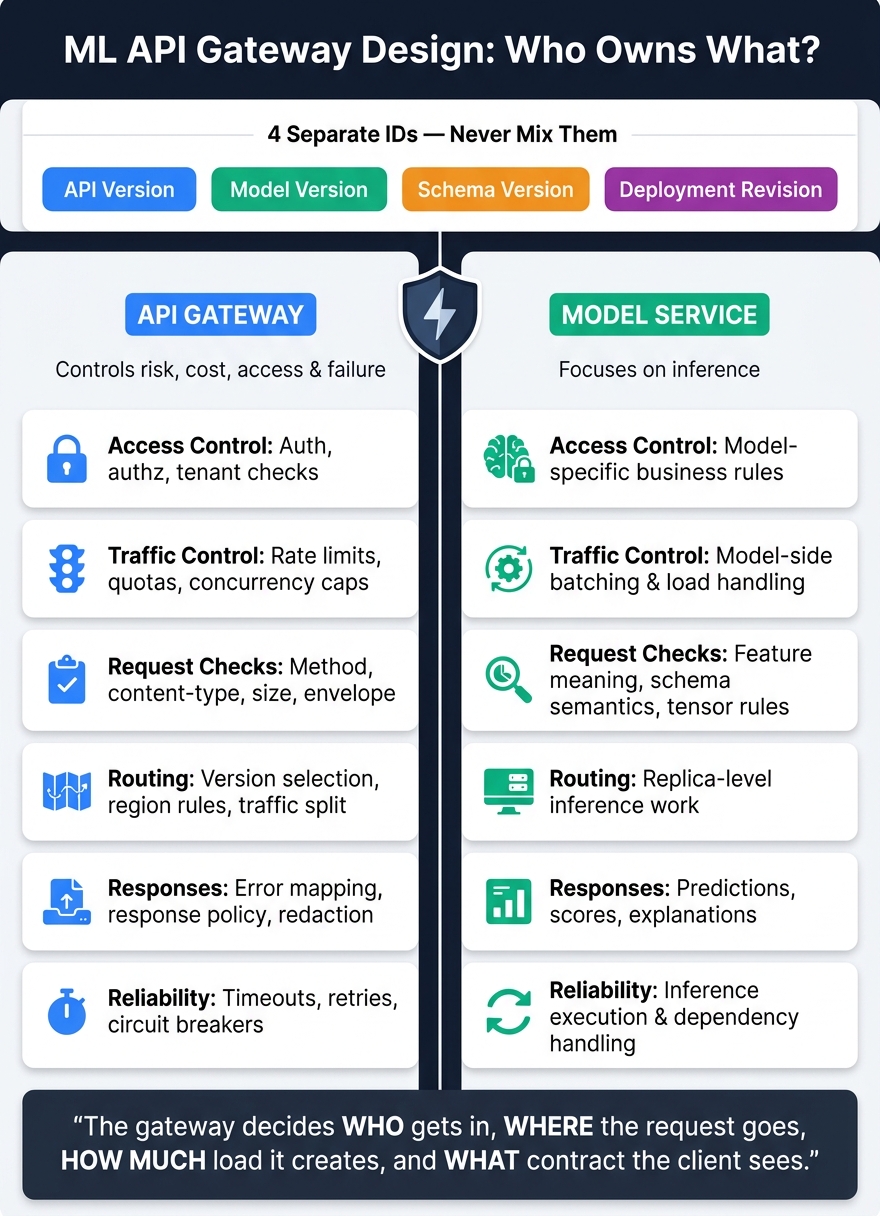
ML API Gateway vs Model Service: Responsibility Split
Designing with API Gateway: Microservices Unleashed
sbb-itb-fd1fcab
Quick comparison
| Area | What I put at the gateway | What stays in the model service |
|---|---|---|
| Access control | Auth, authz, tenant checks | Model-specific business rules |
| Traffic control | Rate limits, quotas, concurrency caps | Model-side batching and load handling |
| Request checks | Method, content type, size, envelope | Feature meaning, schema semantics, tensor rules |
| Routing | Version selection, region rules, traffic split | Replica-level inference work |
| Responses | Error mapping, response policy, redaction | Predictions, scores, explanations |
| Reliability | Timeouts, retries, circuit breakers | Inference execution and dependency handling |
If you want a simple rule, this is it: the gateway should decide who gets in, where the request may go, how much load it may create, and what public contract the client sees. The model service should focus on inference.
That’s the frame I’d use before putting any ML route into production.
Routing and Versioning Patterns for Model Endpoints
Once the gateway owns the public surface, the next step is to make routes, versions, and rollout rules explicit.
Route design for prediction, metadata, health checks, and async jobs
A clean route structure gives clients one stable entry point, while the gateway deals with replica selection, regional placement, and internal service resolution.
In practice, the route structure should separate four different jobs: inference, metadata, health, and async work.
| Route | Method | Purpose |
|---|---|---|
/v1/models/{model}:predict |
POST | Synchronous inference via the current stable alias |
/v1/models/{model}/versions/{version}:predict |
POST | Inference pinned to a specific immutable model version |
/v1/models/{model} |
GET | Model metadata, input limits, and available versions |
/v1/models/{model}/liveness |
GET | Whether the serving process is running |
/v1/models/{model}/readiness |
GET | Whether model weights, adapters, GPU resources, and dependencies are available |
/v1/models/{model}:submit |
POST | Submit a long-running or batch inference job |
/v1/jobs/{jobId} |
GET | Job status |
/v1/jobs/{jobId}:result |
GET | Completed job output |
Liveness and readiness checks must stay separate from prediction routes. A successful prediction does not prove that a service is live or ready. The gateway may still be routing across CPU, GPU, or regional pools behind a single public route.
For long-running jobs, return a job ID right away instead of keeping the connection open.
Route shape tells clients how to enter the system. Versioning tells them exactly what they hit.
Model version paths, aliases, and safe release controls
API version, model version, schema version, and deployment revision are four different things. Mixing them together is one of the most common causes of confusion in ML API design.
- API version: public contract
- Model version: trained artefact
- Schema version: payload structure
- Deployment revision: deployment build and configuration
A model can change weights without changing the API version. A deployment revision can change without touching the model at all. If you record all four identifiers in response metadata and logs, incident review and rollback decisions get much more precise.
For most application traffic, use stable aliases such as stable or production that point to an immutable model version behind the scenes. That keeps client URLs unchanged during routine model releases. For audit, reproducibility, or regulated traceability, expose the immutable version path directly, such as /v1/models/fraud-detector/versions/2026-09-15:predict.
| Versioning method | Rollback safety | Client impact | Governance requirements |
|---|---|---|---|
Path-based immutable version (/versions/42) |
Very high | Higher; clients must update paths | Registry, access controls, retention policy, deprecation process |
Stable alias (stable) |
High when alias changes are atomic | Low; clients keep the same URL | Release approvals, audit trails, rollback ownership |
| Header-based version selection | High if headers map to immutable versions | Moderate; clients must set and maintain headers | Header validation, signing, observability, policy enforcement |
| Gateway-managed percentage rollout | High when traffic shifts quickly to prior target | Low; clients use one stable route | Statistical evaluation, guardrails, approval records |
Never silently reuse an immutable version identifier for different weights. If the model changes in a material way, create a new version. Enforce deprecation windows at the gateway, return migration guidance in responses, and keep old versions only for as long as clients, contracts, and governance controls require.
After routes and versions are fixed, the gateway can control who sees each model release.
Traffic splitting and inference-aware routing
Kubernetes Gateway API HTTPRoute rules support weighted backends, where relative weights determine the share of traffic sent to each backend. A 90:10 split between a stable pool and a candidate pool is a documented pattern for canary testing.
Weighted routing controls release exposure; it does not replace model evaluation. Start with a small canary allocation, compare latency, error rate, and model-quality metrics, then increase the weight only when acceptance criteria are met. For tenant-specific rollouts, route a designated pilot tenant to 100% of the candidate version while all other tenants stay on stable. That keeps the canary group predictable and avoids exposing a version header to every client.
Canadian data residency rules add a hard constraint before any capacity-based routing decision. Requests subject to residency rules, which is common in public-sector or regulated workloads, must first be limited to approved Canadian regions. Only after that check should the gateway apply canary percentages or load-based backend selection. Canadian residency rules belong in gateway policy as hard constraints, not soft preferences.
For GPU-backed or large-model workloads, inference-aware routing goes beyond round-robin. Signals such as queue depth, GPU memory, adapter availability, and KV-cache utilisation can change which replica should handle a request. These signals help most when paired with hard safeguards, like maximum queue time and overload rejection, so you don’t end up with oscillation or cascading overload. For more complex scheduling, let the gateway identify the eligible pool, then let a model-serving scheduler choose the replica within that pool.
| Routing approach | Rollout control | Client complexity | Best suited for |
|---|---|---|---|
| Fixed weighted routing | High | Low | Canary, blue-green, emergency cutover |
| Tenant-specific routing | Very high | Low for ordinary clients | Pilots, contractual model versions, segmented releases |
| Queue- or capacity-aware routing | Moderate | Low | Uneven GPU capacity, large-model serving, latency-sensitive workloads |
| Region-constrained routing | Moderate within allowed regions | Low | Canadian residency, disaster recovery, jurisdictional requirements |
| Header-based routing | High | Moderate to high | Internal testing, tenant policies, controlled deployment rings |
Security, Tenant Isolation, and Traffic Protection
Set security, privacy, audit, retention, and residency policy at the gateway before traffic reaches model services. That way, the rules are enforced at the front door, not after a request is already inside the system.
Once routes and versions are in place, the gateway needs to control two things: who can call each model and how much traffic each tenant can send. Both matter. If identity checks are weak, the wrong party may reach a model. If traffic controls are weak, one tenant can eat up shared inference capacity and slow everyone else down.
Authentication flow and forwarded identity context
Forward tenant ID, user ID, and request scope only after authentication and authorisation succeed. Until then, that context should not move downstream.
This keeps identity data tied to a verified request instead of passing it around too early. It also gives the gateway a clean point to apply policy checks before model services see the call.
For Canadian personal information, enforce PIPEDA handling. For Quebec residents, tag requests for Law 25 residency and privacy-impact controls. In practice, that means the gateway should attach the right policy markers as part of the verified request context, so downstream services can follow the correct privacy and residency rules from the start.
Rate limits, quotas, and concurrency controls for inference workloads
After identity is verified, the next control is how much inference traffic each tenant may send. This is where gateways protect shared capacity from spikes, misuse, or noisy-neighbour behaviour.
Use per-tenant and per-model limits so one client cannot exhaust shared inference capacity. A tenant might be allowed a certain request rate for one model but a different limit for another, depending on cost, latency, or service tier.
Apply residency checks before routing, then enforce tenant quotas and concurrency caps at the gateway. That order matters:
- Residency checks first make sure requests are allowed to go to the target location.
- Quotas and rate limits next control total usage over time.
- Concurrency caps limit how many in-flight inference requests a tenant can hold at once.
Put simply, the gateway should decide where a request may go, whether it may proceed, and how much capacity it may consume before model infrastructure takes the load.
Request Shaping, Response Handling, and Reliability Controls
After routing, versioning, and access controls, the gateway shapes payloads and normalises responses.
Request validation, payload limits, and protocol handling
The gateway’s job at the request boundary is fairly tight. It should verify the HTTP method, Content-Type, required headers, envelope shape, field types, basic ranges, and array counts. It should also enforce maximum body size, reject decompressed payloads that go past configured limits, and block decompression bombs before buffering the body.
What it should not do is just as important. The gateway shouldn’t validate tensor dimensions, feature ranges, or model-specific preprocessing rules. That work belongs in the model service, where the model contract is known in detail.
After validation, the gateway removes any untrusted identity or routing headers sent by the caller, injects verified tenant context, and adds a correlation ID. It should then pass a bounded deadline downstream so the model service can stop work when the caller can no longer use the result. Protocol translation fits here as well. For example, the gateway can present a stable HTTPS/JSON interface while forwarding internally over gRPC, as long as deadlines, correlation IDs, and error semantics survive the translation cleanly.
Set limits per route. Large batch workloads should go through async jobs or object-storage references.
These checks help keep the public contract stable before machine learning solutions begin.
Stable response schemas, error mapping, and sensitive output handling
The gateway should return a consistent, versioned response envelope no matter which model version, serving framework, or internal protocol handled the request. A common prediction response includes request_id, model_alias, model_version where disclosure is approved, predictions, (often defined during AI consulting), and any approved timing or explanation fields.
Some things should never appear in the response: stack traces, internal hostnames, feature values, credentials, or unapproved explanations.
Here’s a clean split of duties:
| Concern | Gateway action | Model-service action |
|---|---|---|
| Content type and basic schema | Validate media type and structural envelope | Validate model-specific fields and semantics |
| Payload and response limits | Enforce maximum sizes; reject oversized data | Apply model-aware batching or output constraints |
| Headers and identity | Remove caller-supplied headers; inject verified context | Use verified identity for permitted business decisions |
| Error exposure | Map internal errors to stable public codes | Produce typed internal errors with internal diagnostics |
| Model output | Filter approved metadata; enforce response policy | Generate predictions, scores, explanations, and model-specific warnings |
A steady error structure makes the public contract easier to work with:
{ "error": { "code": "INVALID_REQUEST", "message": "The request does not match the published schema.", "request_id": "7f2c..." } } Detailed exception data should stay in protected server-side logs. The gateway should also cap response size. If a result is unusually large, it can reject it, truncate it under an explicit contract, or return a retrieval reference instead.
Once the contract is fixed, the next controls are time budget and failure policy.
Timeouts, retries, circuit breakers, and graceful degradation
Set a gateway deadline that is shorter than the client timeout, then pass the remaining budget downstream. For synchronous inference, a strict per-route limit is usually more useful than one global setting. A route for interactive prediction, for example, might have a 2-second cap. For streaming routes, the gateway should forward chunks as they arrive instead of buffering the full response first.
Retries need tight guardrails. Keep retries to a small capped attempt count, add exponential backoff and random jitter, use an idempotency key for job submission, and never retry validation, authentication, or authorisation failures. Retrying expensive GPU inference or non-idempotent operations can drive up resource use and create duplicate side effects.
Circuit breakers matter too. Open the circuit after a threshold of timeouts or upstream 5xxs, fail fast while the circuit is open, and test recovery with limited traffic before closing it again. Every open circuit should have a clear fallback, such as:
- a cached result
- an older approved model
- asynchronous acceptance
- a stable
503
Readiness checks should show whether the model is loaded and whether dependencies are available, not just whether the process is running. A process can be live and still not be ready to serve inference.
Ownership, Operations, and Implementation Checklist
Team ownership across platform, ML, application, and security functions
Once routing, security, and reliability rules are set, the next step is simple: name the people who own them. Do that before launch, not after something breaks.
Before any ML route reaches production, assign one person who is accountable for that route, plus named support roles around it. The cleanest way to handle this is with a route ownership matrix. Each route should map to owners across four functions.
Platform engineering owns the gateway runtime, networking, certificates, deployment configuration, autoscaling, policy enforcement, and infrastructure incident response. ML engineering owns model contracts, model versions, inference dependencies, performance targets, validation evidence, and rollback readiness. Application teams own client integration, workflow semantics, user-facing error handling, and compatibility testing. Security and governance stakeholders own identity standards, tenant-isolation requirements, privacy controls, audit policy, retention, incident escalation, and approval gates.
For example, POST /v1/document/classify should have named owners for platform, ML, application, and security. Review that ownership at every major model release, team restructure, or shift in data sensitivity. Those same owners should also be responsible for the alerts, dashboards, and review cadence tied to each route.
Observability and audit requirements for production ML APIs
Use separate dashboards for gateway health and model quality. They answer two different questions. Gateway metrics show whether traffic is healthy. Model metrics show whether predictions are healthy.
Monitor request rate, p95/p99 latency, error rate, timeouts, queue depth, active requests, saturation, throttling, auth failures, and dependency errors. Include trace IDs, request IDs, route IDs, tenant identifiers in protected or pseudonymised form, and model versions so an incident can be followed from the client request, through the gateway decision, to the model response.
Gateway metrics tell you whether traffic is flowing. Model metrics tell you whether the model is still doing its job. Track input drift, output distributions, confidence, ground-truth performance, and subgroup performance on separate dashboards. A gateway can look perfectly healthy while a model quietly slips after a data-source change. NIST guidance calls for continuous monitoring, AI incident response, defined responsible personnel, and auditable records of system processes and outcomes.
Log enough metadata to rebuild an authorised request path without storing raw personal or confidential data. That usually means logging:
- timestamp
- trace ID
- route ID
- API version
- model version
- tenant or service identity
- policy decision
- status code
- latency
- throttling
- retry count
- deployment ID
Payload logging should stay off, or be redacted, unless there is a documented diagnostic need and an approved retention rule. Retention, access controls, encryption, deletion, legal hold, and residency requirements should follow the organisation’s risk classification and any Canadian privacy duties that apply. Public-sector services should also document classification, records management, procurement or sovereignty constraints, and any provincial or federal duties.
Conclusion: A practical checklist for gateway design in ML systems
Use the checklist below to confirm the gateway is ready for production traffic.
- Routes, route IDs, API versions, model versions, aliases, and deprecation dates are documented, with named platform, ML, application, and security owners assigned to each route.
- Authentication, authorisation, tenant isolation, certificate management, and audit access have been tested.
- Rate limits, quotas, concurrency caps, payload limits, and backpressure protect inference capacity.
- Request and response schemas, error mappings, redaction rules, and compatibility expectations are versioned.
- Timeouts, retries, circuit breakers, fallback behaviour, and rollback procedures are tested under failure conditions.
- Dashboards cover gateway traffic, p95/p99 latency, errors, saturation, throttling, auth failures, and model versions; separate model-quality dashboards cover drift, confidence, subgroup performance, and verified prediction quality.
- Retention, privacy, residency, incident response, and change-management requirements are approved.
- A production review records open risks, approvers, launch criteria, and the next review date.
FAQs
When should an ML API use async jobs instead of sync inference?
Use async jobs for background work like file processing or overnight batch runs when you don’t need an immediate response. They’re also handy during traffic spikes because they separate producers from consumers, which lets each service scale on its own.
A message broker can buffer requests, ease bottlenecks, and help systems stay steady during high-volume periods. For latency-sensitive applications that need immediate, consistent responses, use synchronous inference.
Why should API, model, schema, and deployment versions stay separate?
Keeping API, model, schema, and deployment versions separate makes it much easier to see what changed, when it changed, and where it changed. That matters for traceability, auditability, and system stability. Each layer can move on its own without creating hidden links that come back to bite you later.
It also makes decisions easier to repeat and rollbacks more exact. You can track the model version, prompt setup, and deployment revision as separate pieces instead of lumping them together. That gives you a clear audit trail and helps contract testing spot drift between what the system was meant to do and what it actually does.
What should the gateway validate versus the model service?
The API gateway should handle the common checks that sit closest to the client: authentication/authorisation, rate limits, basic request schema or shape, and routing details like the expected model version in the path.
The model service should handle checks tied to the ML workload itself. That includes input validation for the model, parameter ranges, readiness for that specific model build, and any domain or business rules that need to run before inference.