
AI-Powered Dynamic Pricing for Retail

If your prices only change during manual reviews, you’re likely losing margin, missing sales, or both.
I’d sum it up like this: AI-driven retail pricing uses demand, inventory, competitor prices, and channel data to change prices more often and with tighter control. For Canadian retailers, that can mean fewer stockouts, less dead stock, less manual pricing work, and better tracking of margin impact over time.
Here’s the article in plain language:
- Dynamic pricing means prices change based on current market and stock conditions
- The main problems are overstock, stockouts, weak forecasting, slow reviews, and promo-driven margin loss
- AI helps by estimating demand and price elasticity at the SKU, region, and channel level
- Price decisions improve when inventory, lead times, competitor moves, and channel rules are used together
- Human review still matters through guardrails, override rules, audit logs, and scenario testing
- Rollout starts small with a pilot by category, region, or store group
- Results should be tracked through gross margin, revenue, sell-through, stockouts, and promo performance
- At scale, governance matters because model drift, uneven regional logic, and poor data can hurt results
- Long-term impact should be measured with revenue growth, margin growth, staff time saved, and deployment speed
A few numbers stand out:
- 1–3% annual revenue growth
- 5–7% annual margin growth
- 50–70% less manual pricing effort
- 30–50% faster deployment across categories or regions
- 2–5% business impact in data-rich retail settings
If I were reading this to make a pricing decision, my takeaway would be simple: AI pricing is not just about changing prices more often. It’s about linking pricing to inventory, demand, and governance so teams can protect margin without losing control.
Below, the article explains where pricing breaks down, how AI pricing engines work, what deployment needs, and how Canadian retailers can track results safely.
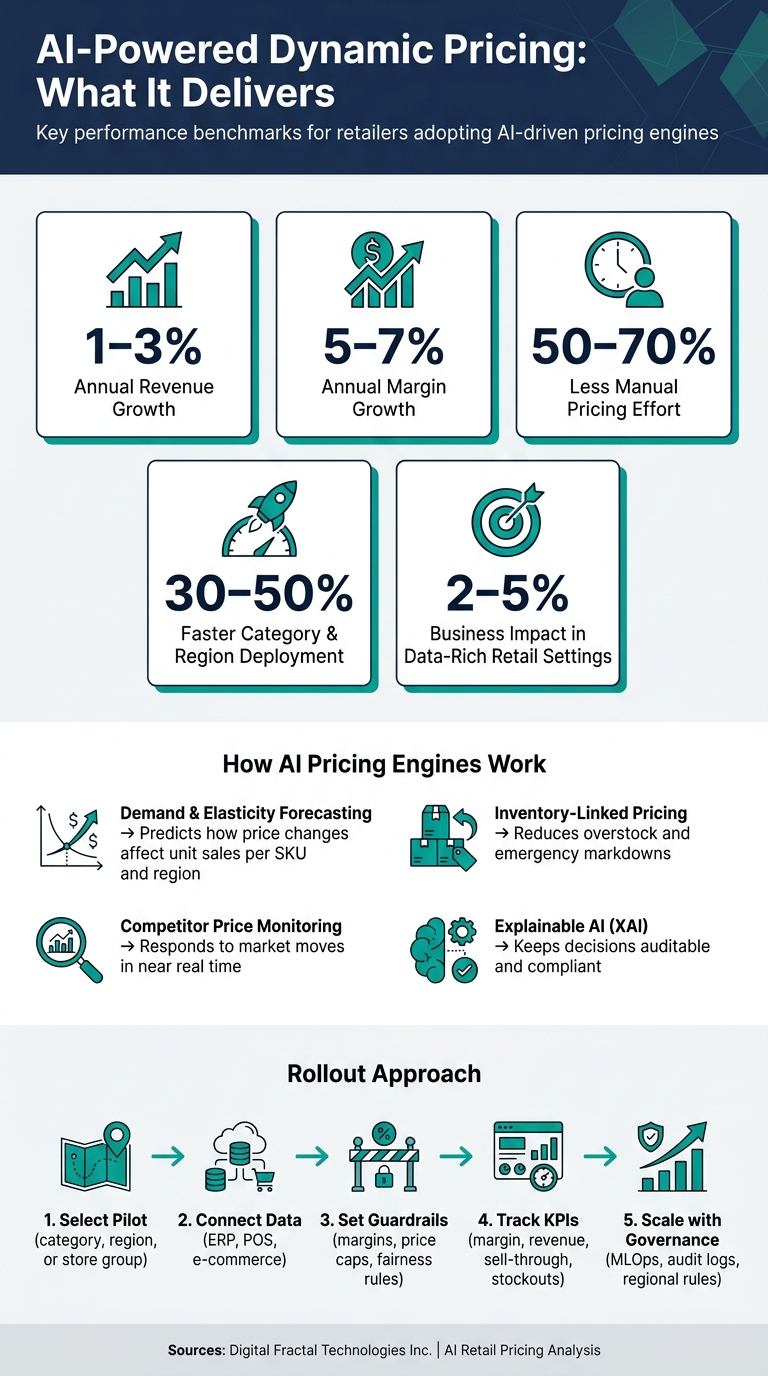
AI-Powered Retail Pricing: Key Benefits & Performance Metrics
AI Dynamic Pricing Software Explained: The New Necessity for Retail Success
sbb-itb-fd1fcab
Where Retail Pricing Goes Wrong
Pricing problems often begin in quiet, easy-to-miss ways: slow decision-making, systems that don’t talk to each other, and prices that stay still while the market keeps moving. Over time, those small gaps turn into three common issues.
Manual Pricing Cannot Keep Up with Fast-Changing Retail Conditions
Manual pricing just can’t move fast enough when retail conditions shift by the hour. By the time someone reviews the data, updates a spreadsheet, and pushes a new price live, the moment may already be gone.
It also eats up staff time that could be spent on work with more impact.
Fixed Prices Lead to Overstock, Stockouts, and Margin Loss
When prices stay fixed, they miss changes in demand and supply. That creates a familiar retail mess.
Slow-selling products sit on shelves too long and tie up custom inventory systems. Fast-selling products disappear too early and leave money on the table. Either way, margin takes a hit.
Forecasting and Competitor Monitoring Have Clear Limits
Forecasts can help, but they fall short when they aren’t tied directly to pricing and inventory. The same goes for competitor tracking.
Each input has its place. But on its own, neither can line up demand, inventory, and pricing fast enough to support better decisions.
How AI Addresses Retail Pricing Problems
AI helps fix a common retail mess: data sits in different systems, teams work from partial info, and pricing calls get made without the full picture. It pulls those inputs together and turns them into pricing decisions that cut markdown waste, reduce stockouts, and give teams tighter control over margin.
AI Forecasts Demand and Price Elasticity More Accurately
Machine learning can pull together transaction history, seasonality, weather, and price signals. That gives retailers a better read on demand patterns and how those patterns can shift at different price points.
Price elasticity shows how much unit sales change when price changes. When a model can estimate that relationship for a specific SKU in a specific region, pricing teams get a much clearer view of the trade-off between margin and sales velocity.
That same model can also feed price recommendations based on inventory and market conditions. So instead of pricing in a vacuum, teams can act on what’s happening on the shelf, in the market, and across the region.
AI Sets Prices Using Inventory, Competitor Prices, and Channel Data
AI pricing engines combine inventory, supplier lead times, competitor prices, and channel rules into one recommendation. The result is a price suggestion based on the full retail context, not just one input at a time.
Core AI capabilities at a glance:
| AI Capability | Business Problem Solved | Required Data | Expected Benefits | Key Constraints |
|---|---|---|---|---|
| Demand & Elasticity Forecasting | Inaccurate sales predictions and margin loss | Transaction history, seasonality, weather, price signals | Balanced unit sales and gross margin | Data quality and historical depth |
| Inventory-Linked Pricing | Overstock and frequent stockouts | Inventory levels, service targets, lead times | Reduced excess stock; fewer emergency markdowns | Supply chain lead times |
| Competitor Monitoring | Responding to competitor price changes | Competitor pricing feeds, web scraping data | Competitive positioning | Competitor data latency |
| Explainable AI (XAI) | Lack of trust in automated decisions; compliance risks | Model weights, decision logs, business rules | Governed pricing; transparency for Canadian compliance requirements | Complexity of model explanation |
Explainable AI Keeps Pricing Decisions Auditable and Usable
Automation only works when the people in charge of pricing can understand it and step in when needed. That usually means putting hard guardrails in place, such as:
- minimum margins
- maximum daily price changes
- customer fairness thresholds
Scenario testing adds another layer of control. Teams can model pricing options before launch and compare the likely effect on unit sales and gross margin. It’s a simple idea, but it matters. If a team can see the trade-offs before a price goes live, bad calls are easier to avoid.
Digital Fractal Technologies Inc can build custom AI pricing tools and dashboards with audit trails, override rules, and Canadian compliance in mind. That makes governance something teams can use day to day, not just a policy on paper.
What Deployment Looks Like in Practice
Data, Systems, and Workflow Requirements
The same data gaps that slow manual pricing can also stop AI deployment in its tracks. Before an AI pricing model can do its job, you need sales history, product data, inventory, promotions, and channel data connected in one clean data layer.
That setup also needs to handle provincial pricing rules, bilingual product data, and local market conditions in a consistent way. On top of that, ERP, POS, and e-commerce systems should connect to a pricing engine so price updates can happen in near real time.
Pilot Testing, Human Oversight, and KPI Tracking
A pilot usually works best when it starts small. Pick one category, one region, or one store group, especially where margin pressure or stock swings are hitting hardest. That gives teams room to test the model, spot issues, and see how it performs before rolling it out more broadly.
Human review still matters here. Pricing teams should check and approve recommendations, while automated rules take care of routine decisions, which can be quantified using a workflow automation benefits calculator. In the early stages, people should handle exceptions and approvals, and rules should manage the repeatable changes.
From day one, track the numbers that show whether the pilot is working:
- Gross margin
- Revenue
- Sell-through
- Stockouts
- Promotion performance
Once the pilot shows results, the focus shifts to governance and risk control.
When a Custom Solution Makes Sense
A custom solution makes sense when demand planning, inventory optimisation, and pricing need to work together across categories, channels, and regions. In that case, a custom-built engine can bring demand planning, inventory optimisation, and pricing into one decisioning layer, so recommendations line up with current inventory positions and margin goals.
Digital Fractal Technologies Inc builds custom AI solutions that connect ERP, POS, and e-commerce systems into a single pricing layer. For complex retail operations, that kind of integration makes AI pricing usable at scale. From there, teams can measure impact against fairness, compliance, and margin targets.
Governance, Risk, and Measuring Results
Pricing Fairness, Transparency, and Canadian Compliance
As pricing moves from pilot to rollout, governance becomes the control layer that keeps recommendations explainable and compliant.
Once pricing goes live, governance stops being a nice-to-have and starts acting like the guardrail. AI pricing models can drift over time, create uneven results from one region to another, or produce price changes that are hard to explain to customers and auditors. In Canada, that matters even more because retailers often need to account for provincial rules and audit checks.
Here are the scaling risks that matter most for Canadian retailers and the steps that help keep them in check:
| Risk | Business Impact | Mitigation |
|---|---|---|
| Model drift | Prices gradually misalign with market conditions | MLOps monitoring to detect and correct drift continuously |
| Opaque pricing logic | Customers or auditors can’t understand price changes | Explainable AI tools that document why each price was recommended |
| Regional inconsistency | Different Canadian regions receive inconsistent pricing logic | Standardised regional pricing rules that apply consistent logic locally |
| Too much automation | Decisions drift away from human oversight | Human review and clear decision controls |
| Siloed data | Siloed systems produce conflicting pricing signals | Unified data foundation across pricing, inventory, and demand data |
MLOps helps keep drift, approvals, and audit logs under control as pricing scales.
How to Measure Pricing Impact Over Time
Measuring the impact of AI pricing gets messy fast when pricing, promotions, and portfolio mix all change at the same time. If one lever moves, the others usually do too. That’s why the cleanest setup links pricing, promotion, and inventory data, then tracks category profit pools and promotion performance on a continuous basis.
Use one measurement framework. Track rollout impact through business results, not just model scores. And keep these rollout metrics separate from the pilot KPIs above.
| Metric | Definition | Data Source | Frequency | Example Target |
|---|---|---|---|---|
| Annual revenue growth | Incremental revenue from AI-optimised pricing | POS/Sales data | Monthly/Quarterly | 1–3% |
| Annual margin growth | Profit improvement through optimised price and mix | ERP/Financial systems | Annual | 5–7% |
| Manual pricing effort saved | Reduction in manual pricing effort | Workflow/MLOps logs | Continuous | 50–70% |
| Deployment speed across categories or regions | Ability to deploy pricing models across new categories or regions using existing assets | Project management data | Per deployment | 30–50% |
| Category profit pool monitoring | Tracking the total available profit across a category or portfolio | Financial reporting | Continuous | Continuous |
Targeted pricing in mature, data-rich markets can deliver a 2–5% business impact when measurement is tight and decisions are connected across demand, inventory, and pricing.
Conclusion: The Case for AI-Driven Pricing in Retail
The real test is not whether AI can set prices, but whether it can do it safely at scale.
AI-powered pricing works best when demand, inventory, and competitor signals sit in one pricing layer instead of being split across separate systems. Canadian retailers that pair automation with governance can scale pricing without losing control.
FAQs
How much data do we need to start AI pricing?
Plan for at least 12 to 18 months of clean, labelled, AI-ready historical data. In most cases, that means orders, web traffic, and product details pulled together from your systems in a consistent way.
If the data is messy or split across tools, things can go sideways fast. AI needs a solid record of what happened before it can spot patterns that are worth acting on.
Set guardrails early. For example, define minimum margins and maximum price shifts before you test anything. Then start with a pilot in a high-impact area like demand forecasting, and scale from there.
How often should retail prices change?
Retail prices should change based on real-time signals, not a fixed timetable. Prices need to move when stock levels shift, shelf conditions change, demand spikes or cools off, or promo and competitor prices move.
The goal is simple: use current data so pricing can react fast enough to catch peak demand and help move slow-selling inventory before it sits too long.
In practice, that means putting a few guardrails in place first. Set minimum margins. Put limits on how far prices can move in a single change. Start with a pilot in one area, test what happens, and then expand automated dynamic pricing as more data starts flowing in.
How do we keep AI pricing fair and compliant in Canada?
Maintain fair, compliant AI pricing by being open about how pricing works and by following privacy rules such as PIPEDA. Set clear pricing criteria, stick to strict pricing ranges, and leave out sensitive attributes that could lead to bias or discrimination.
It also helps to run Algorithmic Impact Assessments and keep human review in place for key pricing decisions. Show prices in CAD, clearly label time-sensitive promotions, and explain automated decisions in plain language.