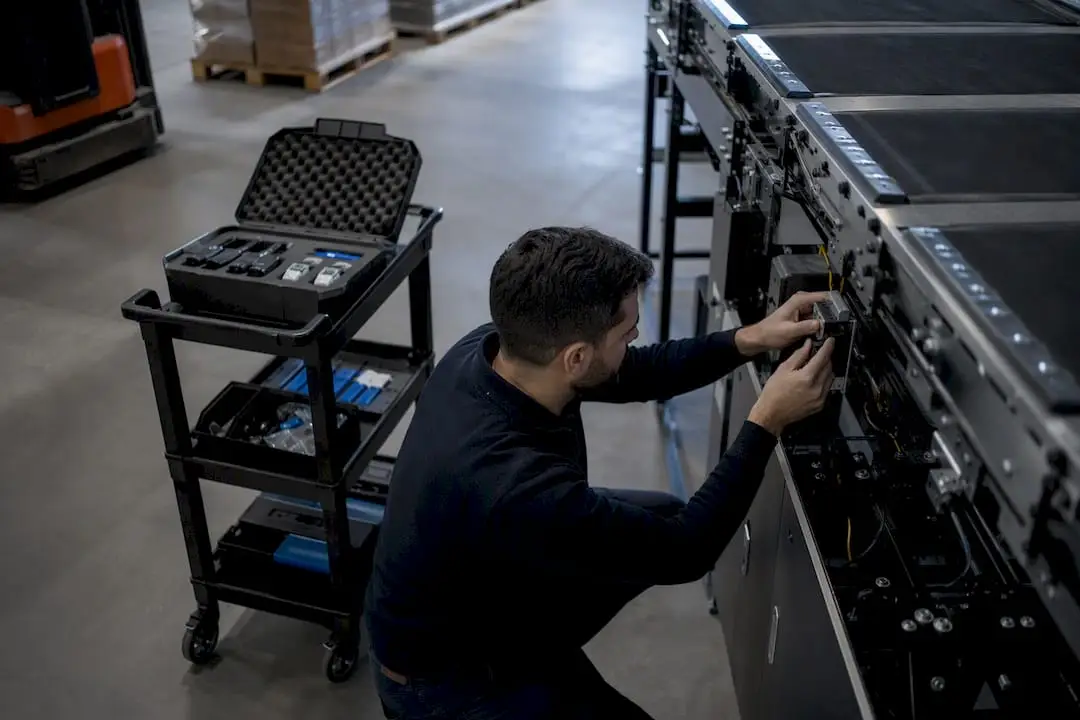
Predictive Maintenance Logistics: A Pilot-First Playbook

Predictive maintenance in logistics cuts unplanned downtime and maintenance spend while stretching equipment life, using sensor data and machine learning to flag failures before they happen. The right first move isn’t a company-wide rollout. It’s a scoped pilot on your highest-impact asset group, running long enough to prove the model against real breakdowns.
A well-run pilot should show you:
- Measurable uptime gains on the pilot fleet or line within a few months
- A drop in mean time to repair (MTTR) once alerts trigger pre-staged parts and work orders
- Early signal on maintenance cost as a percentage of asset value
Recommended pilot scope: a limited number of units in one asset class over a few months, with uptime as the primary KPI to track from day one.
Key Takeaways
Predictive maintenance works when a scoped pilot, clean data pipeline, and automated work orders combine to turn a failure prediction into a completed repair.
| Point | Details |
|---|---|
| Start with one asset class | Pick 8 to 12 units ranked by failure cost and sensor feasibility, not the whole fleet at once. |
| Track uptime first | Uptime typically moves within 30 to 45 days; MTBF and cost percentage lag by a full cycle. |
| Automate the work order | A prediction without an attached CMMS work order rarely gets acted on in time. |
| Plan for legacy hardware | An industrial IoT gateway handles protocol conversion without replacing working PLCs. |
| Scope the pilot with an audit | Digitalfractal’s AI Readiness Audit maps data gaps before you commit to sensors or a vendor. |
Table of Contents
- What Is Predictive Maintenance in Logistics?
- Which Logistics Assets Benefit Most From a Pilot?
- What Benefits and KPIs Should You Track?
- What Does the Technical Architecture Look Like?
- How Do You Implement Predictive Maintenance Step by Step?
- What Risks Should You Plan For?
- What ROI and Timeline Should You Expect?
- How Does Digitalfractal Approach a Predictive Maintenance Pilot?
- What Do Successful Predictive Maintenance Programs Do Differently?
- Ready to Scope Your Predictive Maintenance Pilot?
- Frequently Asked Questions About Predictive Maintenance in Logistics
- Sources
What Is Predictive Maintenance in Logistics?
Predictive maintenance uses sensor data, condition monitoring, and machine learning to estimate when a specific machine will fail, then schedules repair before it does. It’s fundamentally different from the two approaches most logistics operations still run on.
- Reactive maintenance: fix it when it breaks. Cheap to plan, expensive in downtime.
- Preventive maintenance: time-based servicing on a fixed calendar, regardless of actual wear.
- Predictive maintenance: condition-based, using live data to estimate remaining useful life (RUL) and flag anomalies before failure.
The technical building blocks are anomaly detection algorithms, RUL modeling, and increasingly a digital twin, a live virtual replica of the asset, that syncs sensor streams for more accurate predictions and feeds directly into your CMMS for work-order automation.
Which Logistics Assets Benefit Most From a Pilot?
Not every asset deserves sensors on day one. Rank candidates by failure cost, downtime impact, and how easy they are to instrument.
- Forklifts and AGVs: hydraulic and battery degradation are easy to catch with current/voltage and vibration sensors.
- Conveyors and sorters: bearing wear and belt misalignment show up early in vibration and acoustic signatures.
- Cranes and dock equipment: load sensors and motor current data catch overload stress before mechanical failure.
- HVAC systems: temperature and pressure drift predict compressor failure weeks out.
Mixed fleets with legacy PLCs complicate things. Plan for a protocol-conversion layer rather than ripping out working control systems.
What Benefits and KPIs Should You Track?
The core payoff is fewer surprise breakdowns, lower repair spend, longer asset life, and safer floors, since a machine that fails predictably rarely fails catastrophically.
Track these KPIs from day one:
- MTTR (mean time to repair): should drop once predictions trigger pre-staged parts.
- MTBF (mean time between failures): should climb as you catch issues earlier.
- Uptime percentage: your headline number for stakeholders.
- Maintenance cost as a percentage of asset value: the finance-facing metric.
- Parts inventory turnover: predictive alerts reduce emergency parts orders and overstocking alike.
A digital twin and machine learning pilot on logistics equipment including forklifts, conveyors, and AGVs reported downtime reductions of 30 to 50 percent and maintenance cost drops of 20 to 40 percent, using a mix of Isolation Forest, autoencoders, LSTM for RUL, and Random Forest for failure classification.
Before you launch, capture 60 to 90 days of baseline data on all five KPIs. Without a real baseline, you can’t prove the pilot worked.
Pro Tip: Uptime moves first and fastest, usually within the first 30 to 45 days. Set your initial success threshold there before expecting MTBF or cost metrics to shift, as those typically lag behind initial uptime improvements.
What Does the Technical Architecture Look Like?
Four layers make up a working predictive maintenance stack, and skipping one usually stalls the project.
- Physical sensors: vibration, temperature, acoustic, current/voltage, GPS, and load sensors depending on the asset.
- Edge gateway: an industrial IoT gateway handles protocol conversion for legacy PLCs and proprietary fieldbus systems, so you don’t rip out working control hardware.
- Cloud layer or digital twin: synchronizes sensor streams into a live model of the asset for more accurate anomaly detection and RUL estimation.
- ML layer: matched to the failure mode you’re chasing.
- CMMS integration: turns a prediction into an actual work order with parts and timing attached.
Match models to tasks rather than picking one algorithm for everything. Isolation Forest and autoencoders excel at flagging anomalies in noisy sensor data; LSTM networks handle time-series RUL estimation; Random Forest works well for classifying which failure mode is likely. The Scientific Reports digital twin study used exactly this combination across logistics equipment types.
World Economic Forum analysis notes that combining sensor streams with ML is what turns basic threshold alerts into actual business intelligence, prioritized, contextualized, and tied to a recommended action rather than just a beep. On security, endpoint hardening on gateways matters, and federated learning is worth evaluating if you’re handling sensitive operational data across sites without wanting to centralize raw sensor logs. If a private, on-prem deployment model matters to your risk profile, private AI systems built for business intelligence are worth scoping alongside cloud options.
How Do You Implement Predictive Maintenance Step by Step?
- Assess data readiness. An AI readiness audit maps what sensor data, historical maintenance logs, and systems you already have before you buy anything.
- Design the pilot. Pick one asset class, define KPIs, set the 90-day window.
- Deploy sensors and gateways. Install condition-monitoring hardware and the protocol-conversion layer for legacy equipment.
- Build the data pipeline and CMMS integration. Sensor data has to land somewhere your maintenance team already works.
- Activate models. Start with anomaly detection before layering in RUL prediction.
- Automate work orders. Predictions that don’t generate a work order with parts and instructions attached rarely get acted on in time.
- Scale to the next asset class once the pilot hits its KPI targets.
Vendor evaluation checklist:
- Interoperability with your existing telematics and CMMS via open APIs
- Prebuilt models for your equipment type versus custom-build-from-scratch
- Model explainability, not just a risk score with no reasoning behind it
- On-prem versus cloud deployment options and clear SLAs
- Support for federated learning if data residency is a concern
- Documented sample success metrics from comparable deployments
Watch for red flags: black-box predictions with no recommended action attached, no CMMS integration path, or a vendor that can’t describe how they’ll onboard your messy historical data.
What Risks Should You Plan For?
Every predictive maintenance rollout hits the same handful of obstacles.
- Data gaps: phase in sensors gradually and blend manual maintenance records while coverage builds.
- Legacy PLCs and proprietary protocols: an industrial IoT gateway solves this without replacing working hardware.
- Alert fatigue: prioritize alerts by severity and tie each one to an SLA-driven action, or technicians start ignoring them.
- Change management resistance: maintenance crews trust a wrench more than a dashboard until the dashboard proves itself.
Pro Tip: Run your first predictive alerts alongside the existing preventive schedule for one full cycle. Let technicians see the model catch something real before you ask them to trust it over their own judgment.
Cybersecurity and data governance deserve a policy pass too, especially around who can access sensor and location data across sites.
What ROI and Timeline Should You Expect?
30 days: baseline data consolidation, sensor installation on pilot assets, initial anomaly detection running.
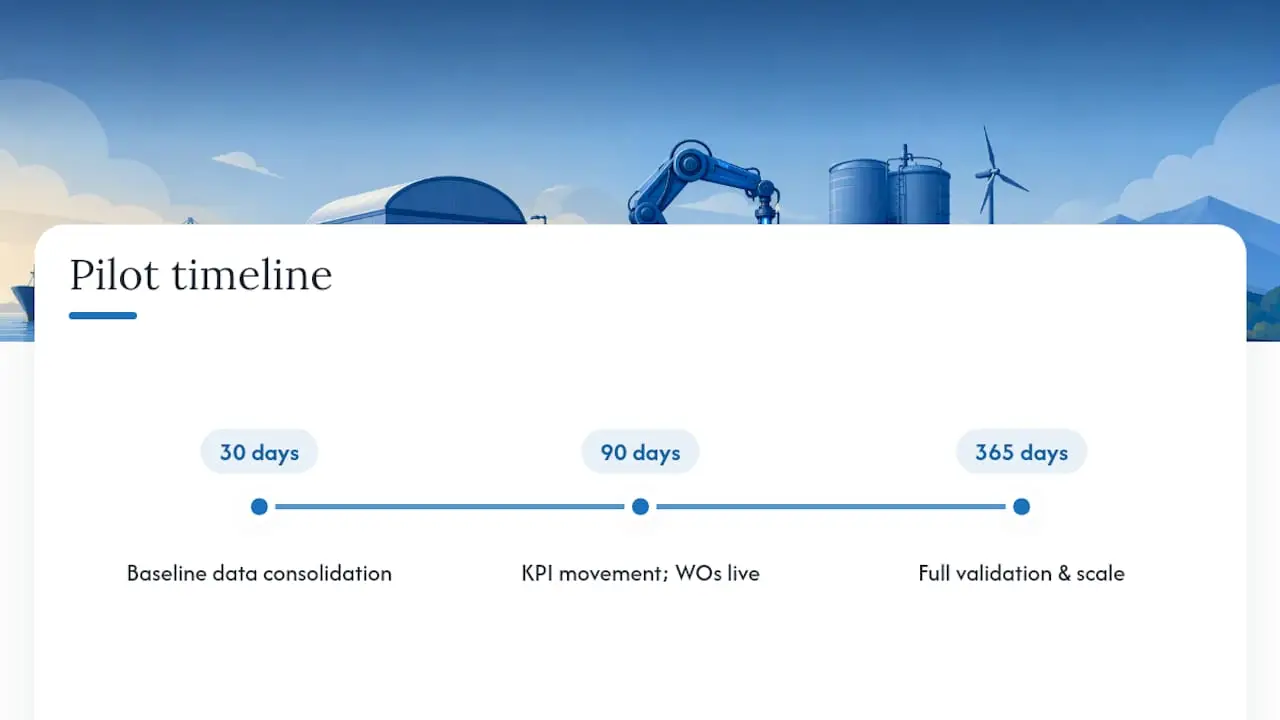
90 days: first measurable KPI movement, usually uptime first, with automated work orders live for at least one failure mode.
365 days: full-cycle validation against MTBF and maintenance cost percentage, with a scale plan for the next asset class.
Primary cost drivers are sensor hardware, gateway installation, integration labor for the CMMS connection, and cloud or modeling fees. A fleet optimization study on integrating preventive and predictive maintenance found that RUL prediction precision has a direct effect on total fleet operating costs, meaning a sloppier model doesn’t just miss failures, it costs you real money in misallocated maintenance workload.
How Does Digitalfractal Approach a Predictive Maintenance Pilot?
Digitalfractal’s methodology starts where most rollouts fail: data readiness. The sequence runs discovery and an AI readiness audit, scoped pilot design, sensor and data integration, model validation against real failure history, automated work-order generation, then a scale plan.
- Discovery: map existing sensor coverage, CMMS setup, and historical maintenance records.
- Pilot design: one asset class, defined KPIs, a realistic window.
- Data integration: connect sensor streams to a pipeline your maintenance team can actually use.
- Model validation: test predictions against real historical failures before trusting live alerts.
- Automated work orders: every prediction becomes an assigned task with parts attached.
Clients typically see uptime signals within the first pilot cycle and a clear cost baseline to justify scaling.
What Do Successful Predictive Maintenance Programs Do Differently?
The programs that work don’t stop at the alert. What separates a pilot that gets adopted from one that gets ignored is whether a prediction turns into a scheduled work order with parts and a technician attached, automatically, without someone manually chasing it down.

That operational discipline, tying every KPI back to a pilot scope small enough to prove and large enough to matter, is what turns a promising model into a program maintenance crews actually trust.
Ready to Scope Your Predictive Maintenance Pilot?
Most logistics teams don’t fail at predictive maintenance because the models are wrong. They fail because nobody mapped the data readiness gap before buying sensors. Digitalfractal’s AI Readiness Audit does that mapping first, so your pilot scope, asset selection, and KPI targets are grounded in what your systems can actually deliver, not a vendor’s generic rollout template.
The audit identifies which asset class gives you the fastest, most defensible pilot result, and where your CMMS and telematics can plug in without a rebuild. If you’re ready to scope a 90-day pilot instead of guessing at one, book an AI Audit & Opportunity Assessment and get a prioritized roadmap before you sign a vendor contract.
Frequently Asked Questions About Predictive Maintenance in Logistics
What is the difference between predictive and preventive maintenance in logistics?
Preventive maintenance follows a fixed calendar regardless of actual wear. Predictive maintenance uses live sensor data and machine learning to estimate remaining useful life, so repairs happen based on actual condition rather than a generic schedule.
How long does a predictive maintenance pilot usually take?
A focused pilot on one asset class typically runs 90 days: 30 days for data consolidation and sensor deployment, then a window to validate KPI movement, starting with uptime.
Which logistics assets should go into a first pilot?
Rank candidates by failure cost, downtime impact, and sensor feasibility. Forklifts, conveyors, and AGVs tend to be strong first candidates because vibration and current sensors catch common failure modes early.
What KPIs matter most for a predictive maintenance program?
Uptime percentage, MTTR, MTBF, and maintenance cost as a percentage of asset value. Uptime typically shows movement first; cost percentage lags by a full maintenance cycle.
What should I ask a predictive maintenance vendor before signing?
Ask about API interoperability with your CMMS and telematics, model explainability, on-prem versus cloud deployment, and whether predictions come with an automated, prioritized work order attached.
Sources
- Logistics equipment condition monitoring and prediction based on digital twin and machine learning | Scientific Reports
- AI is transforming the factory floor | World Economic Forum
- Dynamic fleet management: Integrating predictive and preventive maintenance with operation workload balance to minimise cost | ScienceDirect