
AI-Powered Contract Testing for Microservices

If you run many microservices using scalability design patterns, hand-written contract tests can slow teams down fast. From what I see, the choice is simple: use standard contract testing when your service count and change rate stay low; use AI-assisted contract testing when review time is cheaper than writing every contract by hand.
Here’s the article in plain language:
- Standard contract testing gives me clear pass/fail checks, low tool noise, and tight human control.
- AI-assisted contract testing helps me draft tests from docs, requirements, and user stories, which can cut authoring time.
- The trade-off is direct:
- standard = more manual writing
- AI-assisted = more human review
- The 4 areas that matter most are:
- test case generation
- schema change and drift detection
- false positives and review load
- fit for large microservice estates
- Even with AI, people still need to review outputs. That point comes up more than once in the source.
- For high-risk services, I’d apply stricter checks first and use lighter review for lower-risk ones.
Bottom line: if your estate is small and changes are less frequent, standard testing is often enough. If your teams ship often across many services, AI-assisted testing can help with scale, but it also adds triage work and model-watch duties.
Are AI Agents Replacing Contract Testing?
sbb-itb-fd1fcab
Quick Comparison
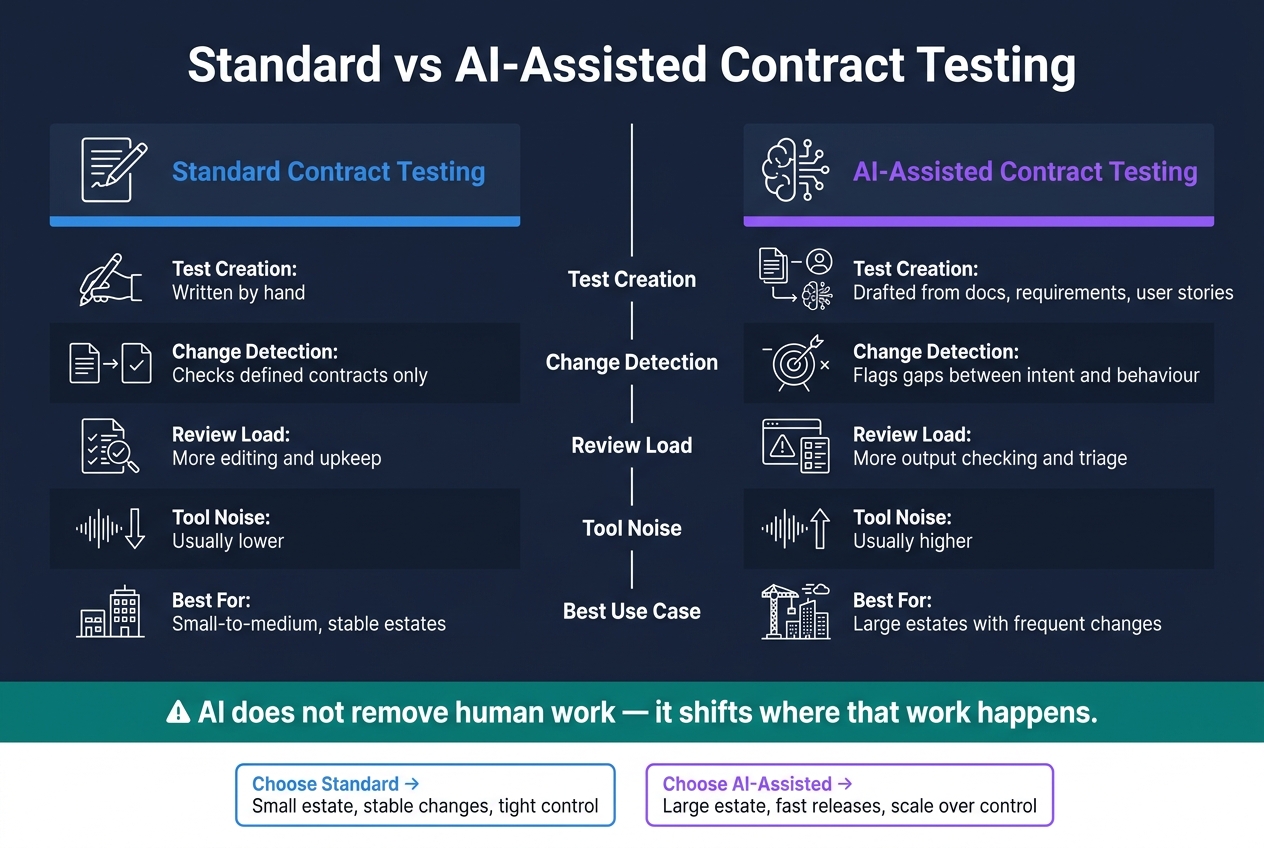
Standard vs AI-Assisted Contract Testing: Key Trade-offs
| Area | Standard contract testing | AI-assisted contract testing |
|---|---|---|
| Test creation | Written by hand | Drafted from source material |
| Change detection | Checks defined contracts | Can also flag gaps between intent and behaviour |
| Review load | More editing and upkeep | More output checking and triage |
| Tool noise | Usually lower | Usually higher |
| Best use case | Smaller or steadier estates | Large estates with frequent changes |
One fact stands out to me: AI does not remove human work; it shifts where that work happens.
1. Standard contract testing
As the starting point, standard contract testing uses consumer-provider contracts that teams write by hand and then enforce in CI/CD.
Test case generation
Manual contract writing can work well for smaller integrations. But it only covers what the team thinks sits at the boundary. If someone misses an edge case, it doesn’t make it into the contract.
Schema change and drift detection
Standard tooling only flags changes the contract already describes. If drift happens outside that model, it can slip through until someone updates the contract.
False positives and review overhead
Standard contract testing tends to create few tool-driven false positives. The tradeoff is steady manual review work. Even a small integration change can mean contract edits, checks, and another round of validation.
Fit for large microservice estates
At estate scale, manual contract upkeep becomes the bottleneck. More services mean more contracts, more reviews, and more cross-team coordination. That’s the point where AI-assisted contract testing starts to change the workflow.
2. AI-assisted contract testing
AI-assisted contract testing moves a big chunk of the work from manual setup to automated inference. Instead of asking teams to write contracts line by line, the system uses Natural Language Processing (NLP) to pull consumer expectations and provider states straight from existing docs, requirements, and user stories.
Test case generation
This is where the shift is easiest to see. AI can build test cases from source material on its own, then use predictive analytics and past data to sort out which cases matter most for a given change. That helps teams spend more time on the tests that are most likely to catch problems.
Risk also shapes how much scrutiny each service gets. High-impact services, such as those tied to credit or health, get stricter validation through risk materiality tiering, while lower-risk integrations get a lighter pass. On top of that, the system can use black-box test case minimisation to cut duplicate coverage and keep the suite tight.
Schema change and drift detection
AI models wired into CI/CD pipelines can help surface possible defects during continuous deployment. That sounds great on paper, but there’s a catch: AI models and service interactions can drift or wear down as data changes over time. So post-deployment monitoring still matters, and it needs clear thresholds rather than guesswork.
False positives and review overhead
AI-generated test cases bring a different kind of review load. Some flagged issues will matter. Some won’t. That’s why a human-in-the-loop review step still matters.
"Despite significant benefits, challenges remain – including ethical considerations, the need for human oversight, and ensuring the quality of AI-generated outputs." – Sheela Dubey, Wawa INC
If teams lean on AI output without human checks, they can end up with operational overreliance and single points of failure.
Fit for large microservice estates
AI-assisted testing works especially well in distributed networks and large microservice estates, where manual contract upkeep can turn into a bottleneck. It can also generate diverse synthetic test data while masking and anonymising sensitive values, which helps close data gaps in messy, complex setups.
Before rollout, it helps to catalogue and classify microservices by risk materiality. That way, the most critical contracts get the strictest validation from day one.
Where the Two Approaches Differ
The main gap isn’t just what each method tests. It’s also where the work lands.
With one approach, teams spend more time writing and maintaining test cases. With the other, they spend less time authoring tests but more time checking what the system produced. That split becomes easiest to see in four areas: how tests are written, how changes are spotted, how much review is needed, and how each method holds up as the number of services grows.
Test case generation
In a standard workflow, teams write contract examples by hand. The work grows with every new service and interaction, and edge-case coverage depends on what people think to add.
AI-assisted contract testing shifts that effort. Instead of hand-writing every example, teams review generated coverage. That can cut the setup work, but it doesn’t remove people from the loop. Human review is still needed to catch weak scenarios or cases that don’t matter.
Schema change and drift detection
Standard contract testing is deterministic: a contract either passes or it doesn’t. That’s simple to read and easy to trust, but it only checks what the team has clearly defined.
AI-assisted testing can flag gaps between documented intent and implemented behaviour, not just direct schema changes. In plain terms, standard testing catches known contract breaks. AI-assisted testing can spot places where intent and implementation drift apart earlier in the change cycle.
False positives and review overhead
AI-assisted testing adds model-scored alerts, so teams still need to validate outputs and triage AI-generated findings before acting on them. The upside is that more of the initial testing work can be automated. The downside is the extra review load that comes with those alerts.
Fit for large microservice estates
At scale, standard testing brings more manual upkeep. AI-assisted testing cuts authoring work, but it adds review and triage overhead.
Those workflow differences shape the trade-offs teams deal with day to day.
Pros and Cons
The right choice comes down to three things: estate size, release speed, and review capacity.
At its core, the gap is mostly operational.
| Approach | Strengths | Limitations | Best-fit Environment |
|---|---|---|---|
| Standard Contract Testing | Predictable outputs; strong human control; established governance | Manual upkeep; slow scaling; weaker fit for rapid releases | Small-to-medium microservice estates; highly regulated environments with stable, infrequent changes |
| AI-Assisted Contract Testing | Fast test generation; scales across distributed estates; supports synthetic test data; fits CI/CD | Needs human review; model drift risk; higher governance overhead | Large microservice estates; fast-paced Agile and DevOps pipelines; modernisation programmes |
Here’s the trade-off in plain terms: standard testing leans toward control, while AI-assisted testing leans toward scale.
In day-to-day use, that usually means standard testing gives up speed to keep tighter control. AI-assisted testing does the opposite. It gives up some control to handle scale better.
Conclusion
The choice comes down to scale, speed, and review capacity. Standard contract testing works well in stable setups where manual upkeep is still manageable.
AI-assisted contract testing starts to make sense when the number of changes and the pace of delivery push past what a team can comfortably maintain by hand. AI can support the process, but people still need to review generated tests and tie contracts back to clear requirements and user stories.
Use standard contract testing when change is manageable. Use AI-assisted testing when volume and velocity outgrow manual upkeep. Keep human judgment in the loop.
FAQs
When should I switch to AI-assisted contract testing?
Switch when your organization needs faster feedback and less upkeep in existing test suites. This is a good fit when your team is stuck with repetitive manual work, flaky tests that keep breaking CI/CD pipelines, or uneven test quality across large software estates.
Digital Fractal Technologies Inc can assess your readiness through an AI audit and pinpoint workflows where intelligent automation can cut manual upkeep by up to 90% while fitting into your current development lifecycle.
How much human review does AI-generated contract testing need?
AI can cut down repetitive testing, scripting, and maintenance. But human review still matters.
People are still the ones who bring business context, judge the user experience, and make hard calls on risk. AI can move through routine tasks fast, but it doesn’t understand priorities the way a person does.
That matters even more in regulated industries or when high-risk data is involved. In those cases, documented human oversight may be required under Canadian privacy and compliance standards.
The best setup is usually a hybrid one. Let AI take care of the routine work, while human testers handle complex logic and final validation.
How do I decide which microservices need stricter contract checks?
Start with the microservices that sit inside critical user journeys, especially the ones that can hold up deployments. Then look at technical complexity and operational risk. If a service fails and production takes the hit, it should move up the list.
Use test analytics and production data to find services with high change failure rates or low success rates. That gives you a clearer picture of where things tend to break, not just where people assume the risk is.
The test pyramid helps here too. Put heavier checks around the components that matter most, while keeping lighter checks for lower-risk areas. That way, testing effort goes where it can do the most good without slowing everything down.