A Predictive Maintenance Strategy That Pays Back in Months, Not Years

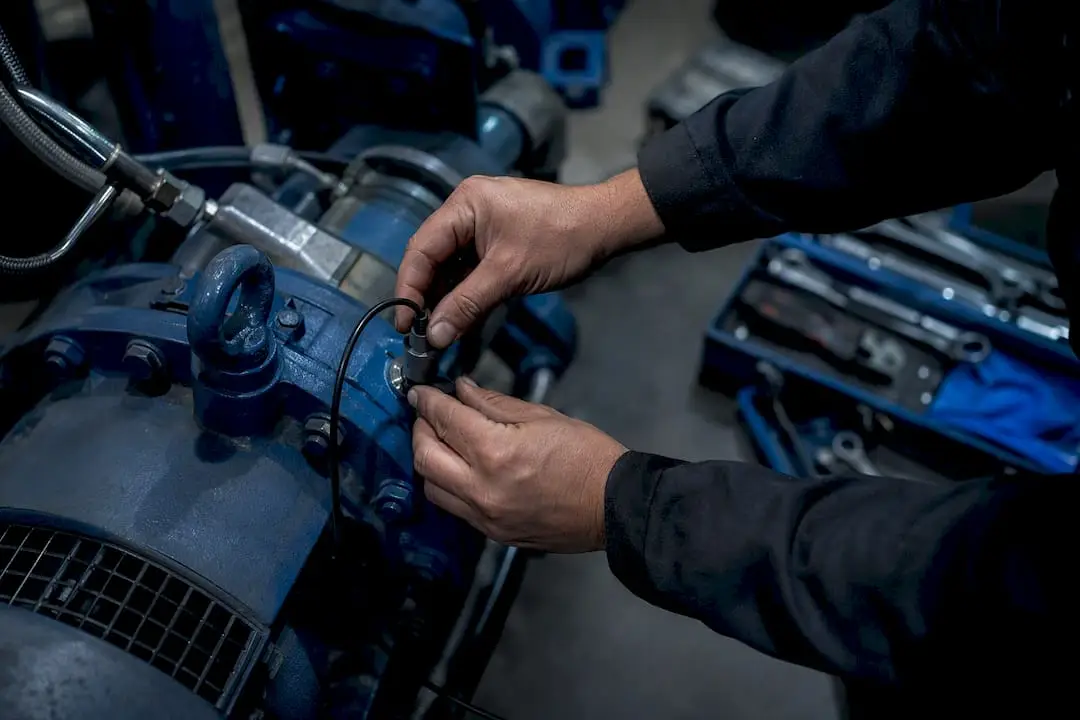
Predictive maintenance is worth pursuing now if you have assets where unplanned downtime is expensive and you already have some data connectivity to work with. If that describes your plant, don’t start with a company-wide rollout. Start with a two-to-three asset pilot, get sensors on those machines, and route every alert straight into your CMMS as a work order.
The math backs this up. Documented predictive maintenance programs report 30 to 50 percent reductions in unplanned downtime and 25 to 30 percent lower maintenance costs. Those gains don’t show up overnight.
- Baseline data: 3 to 6 months before your models mean anything
- Early wins: threshold alerts can catch obvious problems in 1 to 3 months
- Full ROI: a conservative 6 to 18 months, depending on asset complexity
Quick math: If unplanned downtime on one line costs $8,000 an hour and you avoid even two failures in your first year, a $40,000 to $60,000 pilot investment pays for itself before you’ve even finished the second phase of rollout.
TL;DR:
- Predictive maintenance pilots should focus on assets with high downtime costs, failure frequency, ease of instrumentation, and short parts lead times.
- Collect at least three to six months of baseline data before trusting the model, starting with threshold and trend alerts for rapid value.
- Route all sensor alerts directly into your CMMS to ensure technician trust and prompt action, with severity tiers and automated work orders.
- Use vibration sensors and infrared thermography as the initial sensing techniques before adding more complex analyses like oil or current signature analysis.
- An AI Readiness Audit from Digitalfractal can deliver a tested data pipeline, prioritized asset list, and pilot blueprint within 90 days, reducing internal setup burdens.
Table of Contents
- Deciding if a Predictive Maintenance Strategy Is Right for You
- How to Choose Pilot Assets and Prioritize Use Cases
- Matching Sensors to the Failure Modes That Actually Matter
- How Much Data Do You Actually Need Before Trusting the Model?
- Turning Sensor Alerts Into Work Orders Technicians Trust
- What a Realistic Pilot Timeline and ROI Case Look Like
- Why Adaptive Machine Learning Outperforms Static Models
- How Digitalfractal Structures a Predictive Maintenance Pilot
- Data Quality and Governance Nobody Wants to Deal With, But Should
- Keeping Predictive Maintenance Systems Secure
- Choosing a Predictive Maintenance Vendor You Won’t Regret
- What Actually Derails Predictive Maintenance Programs
- Your Fastest Path From Pilot to Full-Scale Predictive Maintenance
- Key Takeaways
- Sources
Deciding if a Predictive Maintenance Strategy Is Right for You
Not every plant is ready for this, and pretending otherwise wastes budget. Run through three checks before committing resources.
First, look at connectivity. Do your PLCs and SCADA systems already generate usable telemetry? Are there open ports for retrofit sensors, and does your CMMS have an API or import path for alert data? If you’re starting from paper logs and a maintenance whiteboard, you have more groundwork to do before sensors matter.
Second, quantify the business case in real numbers. What does an hour of unplanned downtime cost on your worst-offending line? What’s your current scrap rate, and how much do you spend on emergency parts versus planned procurement? Set a payback threshold before you start. Most pilots should target payback within 6 to 12 months, or the business case doesn’t hold up to scrutiny.
Third, confirm you have ownership. Someone needs to own the pilot day to day, someone needs to be responsible for data quality, and your spare-parts logistics need to keep pace with earlier warnings. A sensor that predicts a bearing failure three weeks out is useless if the replacement part still takes six weeks to arrive.
Pro Tip: Ask your technicians which three machines they’d fix first if they had unlimited budget. That informal list is often a better prioritization tool than any formal criticality matrix, because it captures failure patterns nobody’s documented yet.
How to Choose Pilot Assets and Prioritize Use Cases
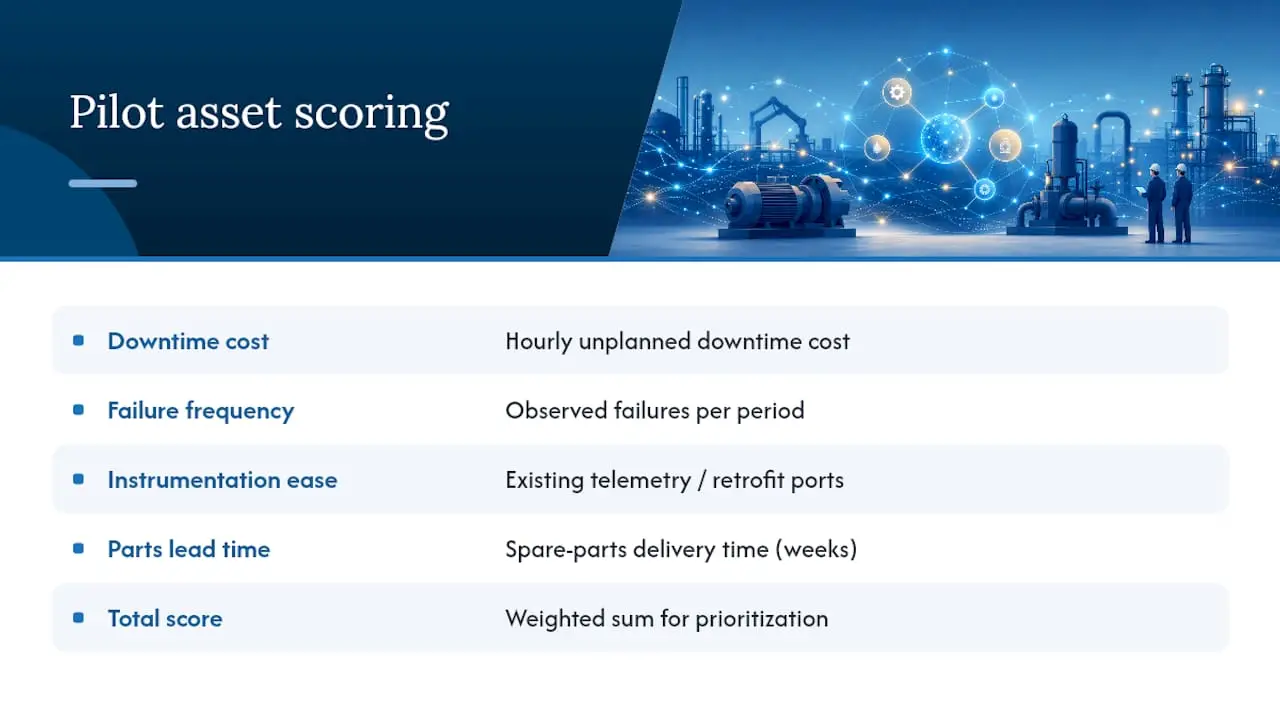
Pick the wrong pilot asset and you’ll spend a year proving a point nobody needed proven. The strongest candidates score well across four factors:
- Downtime cost — how much revenue or output is lost per hour the asset is down
- Failure frequency — how often it actually breaks, not how often it theoretically could
- Ease of instrumentation — can you get a sensor on it without a shutdown or major rework
- Parts lead time — how long it takes to get a replacement once you know trouble is coming
Here’s the counterintuitive part: your single most critical machine, the one everyone assumes should be the pilot, is often the wrong choice. A high-frequency, moderate-criticality asset, like a fleet of conveyor motors or a bank of pumps, tends to show measurable ROI faster because you get more failure events to learn from and more opportunities to demonstrate wins.
A basic scoring matrix works well here. Rate each candidate asset 1 to 5 on downtime cost, failure frequency, instrumentation ease, and parts lead time, then total the scores. A criticality analysis framework can formalize this if you’re managing a large asset portfolio, but for a first pilot, a spreadsheet and an hour with your senior technicians usually gets you to the same answer. Two strong example candidates: a bank of feed pumps with a documented history of bearing failures, or an HVAC compressor set with predictable seasonal load spikes.
Matching Sensors to the Failure Modes That Actually Matter
Different failure modes announce themselves differently, and choosing the wrong sensing technique for the wrong problem is the fastest way to waste a pilot budget. Here’s how the major techniques map to what they actually catch:
- Vibration analysis catches bearing wear, gear misalignment, and imbalance, often 2 to 8 weeks before failure depending on severity
- Infrared thermography spots electrical hotspots, loose connections, and overheating components, sometimes with only days of warning but very high accuracy
- Oil analysis tracks lubrication degradation and internal wear particles, giving weeks to months of lead time on gearbox and hydraulic system failures
- Motor current signature analysis detects winding degradation and rotor issues, typically weeks ahead of a full motor failure
- Acoustic monitoring picks up leaks, cavitation, and early-stage bearing defects, often before vibration sensors register anything unusual
Cost and complexity vary widely across these. Vibration sensors and infrared cameras are relatively cheap and easy to deploy on rotating equipment. Oil analysis requires either lab partnerships or on-site analyzers, which raises both cost and turnaround time. Current signature analysis needs electrical expertise to interpret correctly, which makes it a better second-phase addition than a starting point.
For most first pilots, a starter kit of vibration sensors plus a handheld or fixed thermal imaging setup covers the highest-value failure modes without overcomplicating the rollout. You can combine sensor streams into a unified maintenance signal once you’ve validated each technique individually, but resist the urge to instrument everything at once. Documented implementations show that phased sensor deployment, tied to prioritized assets, is what separates pilots that scale from pilots that stall out in year one.
How Much Data Do You Actually Need Before Trusting the Model?
This is where most pilots either stall or overreach. You need enough historical data to establish a reliable normal, but you don’t need years of failure history before getting value.
Plan on a minimum of 3 months of baseline data for trend detection, with 6 months giving you a much more stable picture across seasonal and load variations. Remaining-useful-life models, the kind that predict exactly how many days a bearing has left, need either multiple documented failure instances or augmentation strategies to make up for scarce failure data, and that typically pushes timelines toward 12 to 18 months.
The smart path is a progression, not a leap. Start with threshold and trend alerts, the equivalent of “vibration exceeded 4.5 mm/s, investigate now.” That’s Level 1 to 2 analytics, and it delivers value almost immediately because it doesn’t require any historical failure data at all, just a sensible baseline and a sensible threshold. As your data matures, move into pattern recognition, where the system flags anomalies that don’t match any single threshold but look wrong relative to historical behavior. Only once you have sufficient labeled failure events should you push toward RUL or prescriptive analytics, per the phased maturity approach industry guides recommend.
One architecture decision matters more than people expect: where you process the data. Edge preprocessing filters noise and reduces latency before anything reaches the cloud, which matters when you’re dealing with high-frequency vibration data streaming constantly. Cloud-based training works better for the heavier lifting, model retraining, cross-asset pattern comparison, and longer-term trend analysis. Most mature programs end up running both, and comparing edge-to-cloud architectures against your own use case early avoids a costly re-architecture later.
Turning Sensor Alerts Into Work Orders Technicians Trust
A predictive maintenance program that generates alerts nobody acts on isn’t a strategy, it’s a dashboard nobody watches. The single biggest driver of pilot failure is treating PdM as a monitoring layer instead of a maintenance layer, and the fix is integration from day one, not integration as an afterthought.
- Route every alert into your CMMS immediately. Don’t run a separate PdM dashboard alongside your existing work order system. The moment PdM data lives somewhere technicians don’t already check, it stops being useful.
- Define severity tiers with matching response times. A “monitor” alert might mean check it during the next scheduled round. A “critical” alert should trigger a work order within hours, with a clear owner assigned.
- Automate the work order itself. Where possible, have the system pre-populate the likely parts needed and an estimated repair window, so the technician isn’t starting from zero.
- Update your SOPs and retrain your team. Technicians who’ve spent years on calendar-based routines need a clear explanation of why alerts now override the old schedule, not just a new dashboard to log into.
- Run a fast validation cadence in the first weeks. Expect some false positives. Tune thresholds with technician feedback weekly at first, then monthly once the noise settles.
Pro Tip: Give technicians a simple way to flag “false alarm” on any alert, and review those flags personally for the first month. That feedback loop is what turns a skeptical maintenance team into your best source of threshold tuning. This mirrors what implementation research consistently finds: programs that treat CMMS integration as core infrastructure, not a nice-to-have add-on, are the ones that survive past the pilot phase. A CMMS built for AI-driven alerts makes this integration considerably less painful than retrofitting a legacy system.
What a Realistic Pilot Timeline and ROI Case Look Like
A pilot that drifts without milestones loses stakeholder patience long before it proves anything. Structure it in phases with a defined evaluation point.
- Month 1: Discovery and asset selection. Score candidate assets, confirm connectivity, and finalize your ROI threshold.
- Months 1 to 2: Sensor deployment. Install your starter sensor set, wire it into a data pipeline, and confirm data is flowing cleanly.
- Months 2 to 5: Baseline collection. Gather at minimum 3 months of normal operating data across varied conditions.
- Months 5 to 6: Threshold and model validation. Set initial alert thresholds, cross-check against maintenance logs, and refine.
- Month 6: CMMS integration goes live. Alerts start generating real work orders, not test notifications.
- Months 6 to 12: Evaluation. Compare against your baseline KPIs and decide whether to scale.
Track five numbers throughout: mean time to repair (MTTR), mean time between failures (MTBF), unplanned downtime hours, total maintenance spend, and your false-positive rate on alerts. That last one matters more than people expect. A pilot with a high false-positive rate burns technician trust faster than almost anything else.
For a rough ROI estimate, take your average cost per unplanned downtime hour, multiply by the hours you reasonably expect to avoid based on your failure history, and subtract your sensor, integration, and labor costs. If a pilot investment avoids multiple multi-hour outages on a line where downtime costs are substantial, payback can be achieved within about a year as documented across implementations source. Tools built for pilot planning and phased rollouts can help structure this timeline against your specific asset mix.
Why Adaptive Machine Learning Outperforms Static Models
Static threshold models work well for the first phase of any predictive maintenance strategy, but they have a ceiling. Industrial equipment operates in conditions that shift: load changes, seasonal effects, wear patterns that evolve. A model trained once and left alone drifts out of sync with reality.
Recent research quantifies that adaptive machine learning models in industrial internet of things predictive maintenance can improve recall and precision compared to static models, showing meaningful gains according to findings published in Scientific Reports source.
That’s a meaningful jump in catching real failures while cutting false alarms, but adaptive ML isn’t free. It requires a retraining pipeline, strategies for handling sensor noise and drift, and enough labeled failure events to actually learn from, which remains one of the persistent constraints in IIoT deployments. The practical guidance: don’t reach for adaptive ML on day one. Build a reliable threshold-based baseline first, confirm your data pipeline is clean, and introduce adaptive models once you have the retraining infrastructure to keep them current.
How Digitalfractal Structures a Predictive Maintenance Pilot
An AI Readiness Audit gives you the groundwork most predictive maintenance pilots skip and later regret skipping. It covers:
- A full data inventory across your existing sensors, PLCs, and historical maintenance logs
- A connectivity and sensor-gap assessment for your priority assets
- A CMMS integration plan, so alerts become work orders instead of another dashboard
- A prioritized list of PdM use cases scored against downtime cost and instrumentation feasibility
| Deliverable | What You Get |
|---|---|
| Pilot blueprint | A phased plan matched to your specific asset mix and data maturity |
| Data pipeline proof of concept | A working demonstration of sensor data flowing into a usable format |
| Analytics recommendation | A clear call on whether thresholds, anomaly detection, or adaptive ML fits your current data |
Within a 90-day engagement, Digitalfractal typically delivers all three, giving reliability teams a concrete starting point instead of another strategy document that sits unused.
Data Quality and Governance Nobody Wants to Deal With, But Should
Bad sensor data doesn’t just produce bad predictions, it produces confident bad predictions, which is worse. A vibration sensor mounted slightly off-axis, a thermal camera reading through dust buildup, or a current sensor calibrated for the wrong motor size will all generate data that looks legitimate right up until it triggers a false alarm or, worse, misses a real one.
Governance starts with ownership. Someone specific, not “the maintenance team” in the abstract, needs to be responsible for checking sensor calibration on a regular schedule and flagging when readings look inconsistent with physical reality. That person also owns the decision about what happens when data goes missing, whether a gap in the stream should pause alerting on that asset or fall back to a conservative default.
Standardize your naming conventions and units before you scale past the pilot. It sounds mundane, but a plant running vibration readings in mm/s on one line and in/s on another creates confusion the moment you try to build a cross-asset dashboard or compare failure patterns across sites.
Version control matters for your models too. When you retrain a threshold or an anomaly detection model, keep a record of what changed and why, so you can trace a sudden spike in false positives back to a specific model update rather than guessing. This becomes far more important once you’re running adaptive ML, where models update automatically and a bad retraining cycle can quietly degrade accuracy for weeks before anyone notices the pattern.
Keeping Predictive Maintenance Systems Secure
Every sensor you add to a machine is another device with network access, and that expands your attack surface in ways a lot of maintenance teams underestimate until it’s a problem. IIoT sensors often ship with default credentials, minimal encryption, and firmware that rarely gets patched once installed.
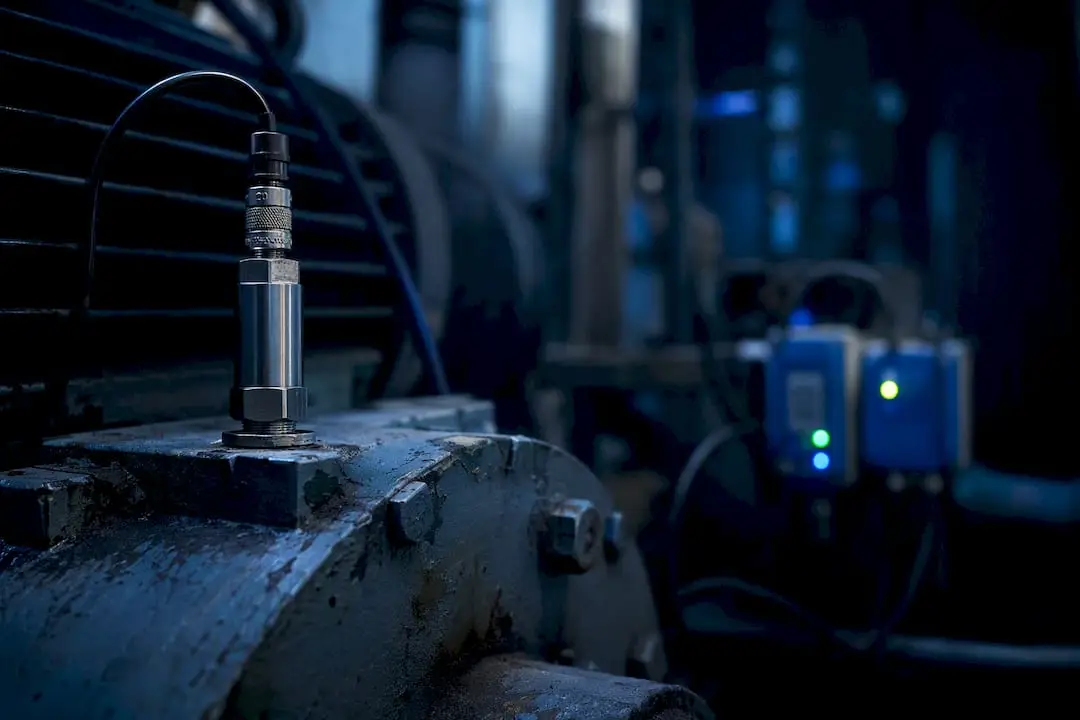
Segment your PdM network from your broader corporate IT infrastructure. A compromised vibration sensor should never be a path into your ERP system or your CMMS’s core database. Basic network segmentation, combined with changing default credentials on every deployed sensor, closes off the most common entry points attackers use against industrial IoT devices.
Data privacy matters here too, even though maintenance data feels less sensitive than customer records. Equipment performance data can reveal production volumes, operational patterns, and capacity constraints that competitors or bad actors could use against you. Encrypt data in transit between sensors and your CMMS or cloud platform, and be deliberate about who inside your organization, and which third-party vendors, actually need access to raw sensor streams versus aggregated reports.
If you’re working with a third-party PdM vendor, ask directly how they handle data residency, encryption standards, and what happens to your operational data if the contract ends. Vague answers on any of those three questions are a warning sign worth taking seriously before you sign anything.
Choosing a Predictive Maintenance Vendor You Won’t Regret
Not every plant has the internal bandwidth to build a PdM program from scratch, and bringing in a third-party provider is often the right call. The trick is evaluating vendors on criteria that actually predict long-term success, not just a polished sales demo.
Start with integration compatibility. Does the vendor’s platform genuinely connect to your existing CMMS, or does it require you to run parallel systems indefinitely? A vendor who can’t answer this clearly in the first conversation usually can’t deliver it later either.
Ask about their model transparency. Some vendors treat their analytics as a black box, which makes it nearly impossible for your engineers to understand why an alert fired or to trust it enough to act quickly. You want a vendor willing to explain, in plain terms, what’s driving each alert category.
Check their track record with businesses of a similar scale and industry to yours. A vendor whose experience is entirely in discrete manufacturing may not translate well to continuous process operations like oil and gas or logistics fleets, where failure modes and duty cycles look different.
Finally, clarify the exit terms before you start. Who owns the historical sensor data if you switch vendors? Can you export your baseline and model parameters, or does everything reset to zero? Vendors confident in their value shouldn’t hesitate to make data portability part of the contract.
What Actually Derails Predictive Maintenance Programs
The pilots that stall almost always share the same root cause: running PdM alongside calendar-based maintenance instead of replacing it. Technicians end up checking two systems, trusting neither fully, and the calendar wins by default because it’s familiar.
The second-biggest mistake is treating CMMS integration as a phase-two problem. If alerts sit in a separate dashboard for the first six months, you’re training your team to ignore them before you’ve even given the models a fair test.
And watch for overfitting. With only a handful of documented failures, it’s tempting to build a model that predicts those exact failures perfectly, which usually means it predicts almost nothing else. Keep early models simple and let complexity earn its place as real data accumulates.
Pro Tip: During your first 90 days, deliberately set alert thresholds slightly conservative, better to get a few extra false positives than to lose technician trust in week one. You can tighten thresholds once the team believes in the system.
— Souhail
Your Fastest Path From Pilot to Full-Scale Predictive Maintenance
Building the data pipelines, sensor architecture, and CMMS integration described above from scratch takes internal bandwidth most maintenance teams don’t have sitting idle. Digitalfractal’s AI Readiness Audit exists specifically to close that gap without asking you to become a data science team overnight.
![CTA Image]
Over 90 days, you get a data inventory of your existing sensors and CMMS setup, a prioritized use-case list scored against downtime cost and instrumentation feasibility, and a working proof-of-concept for the data pipeline that turns raw sensor readings into work orders your technicians actually trust. It maps directly onto the phased pilot roadmap outlined above, so you’re not starting from a blank page or guessing at sensor placement. Where a generalist consultant hands you a strategy deck, this audit hands you a tested pipeline and a scored asset list ready for sensor deployment. If you’re ready to move past planning, start with an AI Readiness Audit and get a concrete blueprint for your first pilot within the quarter.
Key Takeaways
A successful predictive maintenance strategy starts with a small, well-instrumented pilot and succeeds only when alerts flow directly into CMMS work orders from day one.
| Point | Details |
|---|---|
| Start small | Pilot 2 to 3 assets with high downtime cost before scaling company-wide. |
| Baseline first | Collect 3 to 6 months of normal operating data before trusting model outputs. |
| Integrate immediately | Route every alert into your CMMS as a work order, never as a standalone dashboard. |
| Match sensors to failure modes | Use vibration and thermography for a starter kit before adding oil or current analysis. |
| Consider Digitalfractal | An AI Readiness Audit delivers a data pipeline and pilot blueprint within 90 days. |
Sources
- Adaptive machine learning models for predictive maintenance in industrial internet of things (IIoT) systems | Scientific Reports
- Predictive Maintenance Implementation guide | ECOSIRE
- What Is Predictive Maintenance? | SAP