
Single Responsibility Principle in Modular Design

The Single Responsibility Principle (SRP) is a core guideline in software design, emphasizing that every module, class, or function should address only one concern or reason for change. This approach simplifies maintenance, reduces bugs, and makes systems easier to scale. Originally applied to classes, SRP now extends to broader architectures, including microservices and web application development, ensuring components remain focused and independent.
Key Takeaways:
- Definition: A module should have only one reason to change, tied to a specific stakeholder or purpose.
- Origins: Rooted in software engineering concepts from the 1970s, later formalized by Robert C. Martin.
- Benefits: Better maintainability, testability, reusability, and scalability by isolating responsibilities and reducing coupling.
- Practical Tips: Use metrics like LCOM4 to identify violations, break down complex modules, and avoid over-modularization.
SRP is essential for creating focused, reliable, and scalable systems, whether at the class level or across entire architectures.
Benefits of Applying SRP in Modular Design
Better Maintainability and Testability
When a module is designed with a single responsibility, developers can make updates to specific business rules without triggering unintended side effects. This focused approach simplifies maintenance and ensures updates are reliable. As Robert C. Martin famously said:
A module should be responsible to one, and only one, actor.
By keeping responsibilities separate, fault isolation becomes much easier. For example, if there’s an issue with payments, it stays confined to the PaymentService rather than rippling through the entire codebase. This separation also limits the scope of bugs, making testing more straightforward. Single-purpose units often require fewer dependencies and less complex mocking, which means changes to something like a database schema won’t disrupt tests for unrelated business logic.
Additionally, SRP helps avoid merge conflicts. Teams like HR and Accounting can work on their respective components without stepping on each other’s toes. The result? Clearer responsibilities and more reusable, self-contained components.
Increased Reusability and Modularity
Breaking down logic into specialized components, such as an EmailService or AuthService, leads to reusable and portable modules. These self-contained units can be deployed across different projects without dragging along unnecessary dependencies.
This modular approach also supports independent deployment and scaling. For instance, you can upgrade an authentication or payment service without affecting the rest of the system. Research from Puppet and DORA highlights how modular design improves team performance and organizational agility. Teams can work on separate services at the same time, which speeds up development and reduces bottlenecks [4, 13].
Lower Coupling and Better Scalability
SRP doesn’t just improve maintainability and reusability – it also strengthens system architecture. By keeping components independent and focused, SRP ensures that changes in one area won’t disrupt unrelated features. Andrew Hunt and David Thomas summed it up well:
When components are isolated from one another, you know that you can change one without having to worry about the rest.
At a higher level, grouping modules by stakeholders – such as Finance or Marketing – reduces inter-team friction and enables parallel development. This solid foundation keeps codebases manageable and scalable, even as requirements grow and evolve.
sbb-itb-fd1fcab
Single Responsibility Principle Explained – SOLID Design Principles
How to Identify and Separate Responsibilities
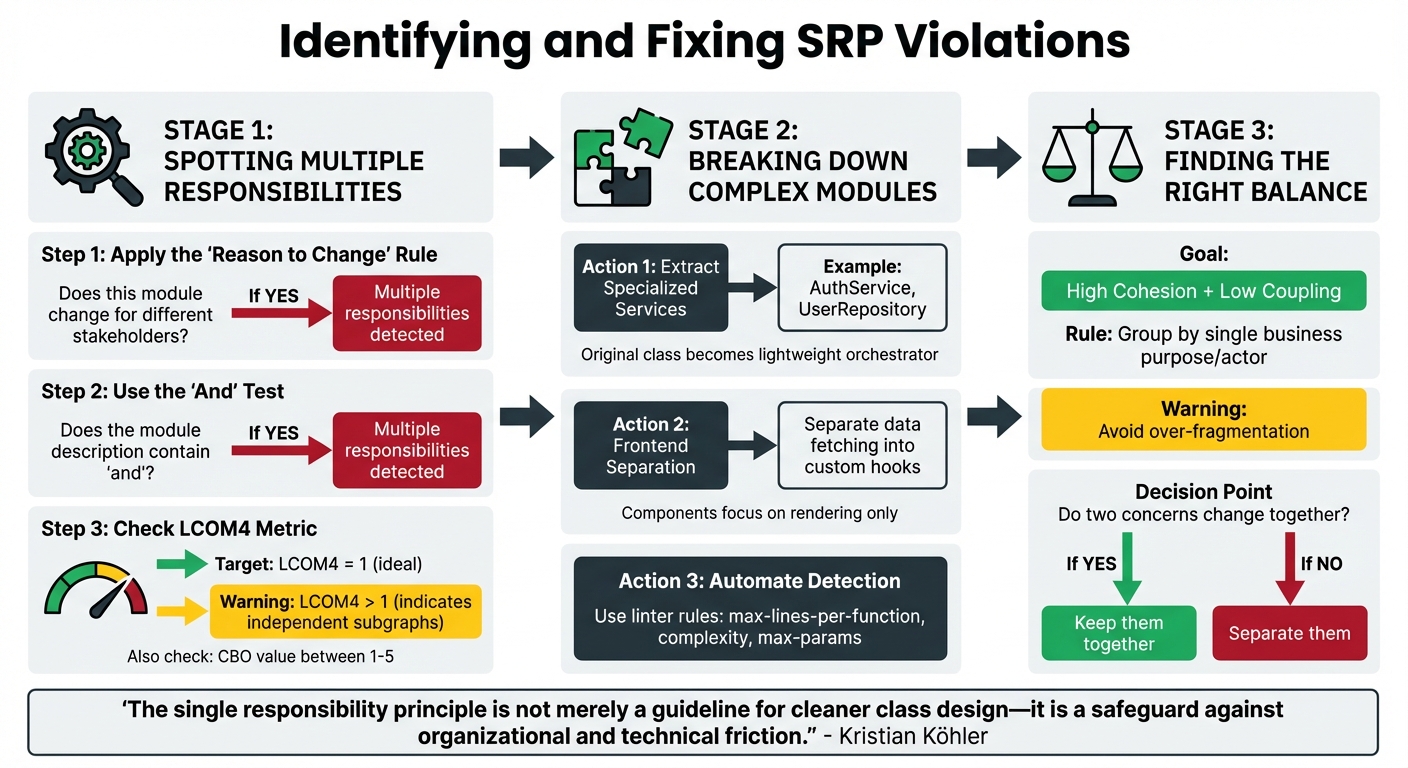
How to Identify and Fix Single Responsibility Principle Violations
When working with the Single Responsibility Principle (SRP), recognizing and dividing responsibilities effectively is crucial for creating maintainable and modular code. Here are some practical ways to spot and address multiple responsibilities in your code.
Spotting Multiple Responsibilities
A good starting point is the "reason to change" rule: if a module needs updates to accommodate different stakeholder demands, it likely has more than one responsibility. Another quick test is the "and" test – try summarizing the module’s purpose in one sentence. If you find yourself using the word "and", it’s a sign that the module might be handling more than one responsibility.
For a more analytical approach, use the LCOM4 metric (Lack of Cohesion of Methods). If the LCOM4 value exceeds 1, it indicates that the class contains independent subgraphs, each representing a distinct responsibility. Ideally, aim for an LCOM4 of 1 and a Coupling Between Objects (CBO) value between 1 and 5. These metrics can help ensure your design aligns with SRP, making your code more scalable and easier to maintain.
Breaking Down Complex Modules
Once you’ve identified multiple responsibilities, consider breaking them down into specialized services. The original class can act as a lightweight orchestrator, focusing only on coordinating tasks. For instance, you could move authentication logic into an AuthService and database operations into a UserRepository.
In frontend development, you might separate data fetching and state management into custom hooks, leaving components to focus solely on rendering. If you find yourself changing a method’s visibility from private to public just for testing, it’s a sign that the logic might belong in a separate class. To automate these checks, use linter rules such as max-lines-per-function, complexity, and max-params to catch violations early. These practices reinforce SRP and support cleaner, more modular design.
Finding the Right Balance Between Cohesion and Separation
The aim is to achieve high cohesion (where everything in a module is related) and low coupling (where modules are minimally dependent on each other). Group code based on a single business purpose or "actor." For example, if two pieces of logic are driven by the Finance team and always change together, they should remain in the same module to avoid unnecessary fragmentation.
While modularization is important, over-fragmenting logic into overly small components can make the system harder to understand. As Software Architect Kristian Köhler explains:
"The single responsibility principle is not merely a guideline for cleaner class design – it is a safeguard against organizational and technical friction."
Use SRP when a module has multiple unrelated reasons to change or when testing becomes overly complex. However, if two concerns consistently evolve together, they’re likely better off staying together.
Implementing SRP in Software Design
Class Separation and Delegation
To follow the Single Responsibility Principle (SRP), you can use delegation to simplify and streamline responsibilities. This means pulling out specialized logic into separate service classes and having the original class delegate tasks to these new components. For example, if a class is juggling both authentication and database operations, split those into distinct classes like AuthService and UserRepository. The original class then acts as a lightweight orchestrator, focusing only on delegating tasks.
Dependency injection is a great way to make this setup easier to test in isolation. Be on the lookout for warning signs like bloated classes with too many methods or tangled dependencies – these make testing and maintenance harder. Delegation aligns perfectly with SRP’s goal of keeping responsibilities clearly separated.
Using Coordinators for Complex Interactions
Coordinators are a practical way to handle interactions between multiple specialized components. Take a UserService, for example – it could coordinate tasks across an AuthService, UserRepository, and NotificationService without needing to know the inner workings of each. This layered structure allows coordinators to manage workflows while leaving the business logic to the components themselves.
That said, coordinators should stay lean. Their role is to delegate tasks, not take on business logic. Keeping them focused ensures they don’t become bloated or stray from SRP principles. However, there’s a balance to strike – breaking down responsibilities too much can create its own set of challenges, as explained next.
Avoiding Over-Modularization
While separating responsibilities is the backbone of SRP, going overboard with modularization can backfire. Too many tiny classes can shift the complexity from the logic itself to managing countless micro-dependencies. The key is to aim for strong cohesion while minimizing unnecessary coupling.
A useful rule of thumb is the "change together" principle: if two parts of the code always need to evolve together for the same reason, they probably belong in the same class. Remember, SRP doesn’t mean a class should only have one method – it’s about ensuring all methods serve a single, well-defined purpose. Start with straightforward designs, and only refactor when you encounter clear SRP violations. This approach keeps your code manageable without introducing unnecessary fragmentation.
SRP in System Architecture
How SRP Works with Separation of Concerns
When we move beyond individual modules and apply the Single Responsibility Principle (SRP) to entire systems, its value becomes even more apparent. It works hand-in-hand with Separation of Concerns (SoC) to build systems that are easier to maintain. SoC splits a system into broad categories – like user interface, business logic, and data access – while SRP ensures that each module or class within those categories has a single, clear focus. Think of SoC as setting the framework, while SRP refines each piece to stay on task.
In Clean Architecture, this relationship is especially visible. Software is organized into layers – Domain, Data, and Presentation – so changes in one layer (like updating the user interface) don’t ripple into others, such as the business rules.
At a higher level, SRP also guides how modules are organized around the specific groups, or "actors", they serve. For instance, a finance team and a growth team should have their own separate modules. This way, changes requested by one team don’t accidentally disrupt the work of another. When modules try to serve multiple actors, they often become "change magnets", requiring constant updates from multiple teams, which can lead to merge conflicts and deployment headaches.
While this approach is ideal in theory, putting it into practice often brings its own set of challenges, requiring a clear digital transformation roadmap to navigate effectively.
Common Implementation Challenges
Applying SRP at scale isn’t always straightforward. One common issue is overdoing modularization. Breaking the system into too many tiny classes or modules can overwhelm developers, making the system harder to understand and manage. If two pieces of code always change together for the same reason, they probably belong in the same module.
Another challenge is shared code liability. Reusing code is great when it works, but shared modules can become a problem when different teams have conflicting requirements. A change for one team might unintentionally break functionality for another, creating hidden dependencies.
Overburdened components are also a recurring issue, especially in frontend frameworks like React and Angular. A single component might end up handling too much – data fetching, state management, and rendering the user interface all at once. A better approach is to split these into "Smart" components for managing logic and "Dumb" components focused purely on rendering.
To catch potential SRP violations early, developers can use tools like linters with rules such as max-lines-per-function, complexity, and max-params. These tools help identify "change magnets" – components that multiple teams frequently modify – making it easier to target them for refactoring. Monorepo tools and custom ESLint rules can also enforce architectural boundaries between layers, keeping things clean.
Case Study: Modular Application Design
Let’s look at an example to see how these principles work in practice. Imagine a modular food delivery app that’s built around the needs of specific teams. It’s divided into three main modules:
:feature-accountfor the Growth Team:feature-menufor the Operations Team:feature-checkoutfor the Finance Team
Each module focuses on a single stakeholder, allowing teams to work independently without stepping on each other’s toes. For instance, the Finance Team might update payment logic in the :feature-checkout module to add a new payment provider, while the Growth Team enhances profile search in the :feature-account module. These changes happen in parallel, with no merge conflicts or unintended side effects.
Each module is structured using both horizontal and vertical slicing. Horizontally, it separates distinct business domains. Vertically, it breaks down architectural layers – like Entities, Infrastructure, Application, and UI – within each module. For example, the :feature-checkout module contains everything it needs for payment processing: domain models, API clients, orchestration services, and UI components. This setup keeps domains loosely connected but highly focused within their boundaries, making the system scalable and easier to maintain as the business grows. To help organize these requirements, teams can use a custom app feature planner to prioritize module responsibilities.
Conclusion
Key Takeaways
The Single Responsibility Principle (SRP) stands out as a cornerstone of effective system architecture. By focusing on assigning one clear purpose to each component, SRP simplifies complexity and ensures software systems are easier to manage. Whether applied to a single function or an entire microservice, its benefits are undeniable.
SRP helps isolate changes, making testing and debugging more straightforward. It also allows for independent deployment, reducing the risk of unintended side effects. Perhaps most importantly, it minimizes cognitive overload, making codebases more approachable and easier to maintain.
A helpful practice is the "And" Test: if you can’t describe a module’s responsibility in one sentence without using "and", it’s time to refactor. Similarly, if a module could be impacted by multiple business or technical reasons, it’s likely a candidate for splitting. These simple strategies help avoid "change magnets" – components that frequently require updates from multiple teams, leading to potential conflicts and deployment headaches.
As software continues to evolve, SRP will remain a guiding principle for creating robust and scalable systems.
The Future of SRP in Software Development
SRP’s influence on maintainability and scalability is set to grow, especially as AI becomes more integrated into software development. With 96% of developers expressing some level of distrust in AI-generated code and only 48% consistently reviewing it before committing, breaking down logic into single-purpose units is more important than ever for thorough verification. As Clean Code Guy aptly put it:
In the age of AI acceleration, clean code isn’t just good practice – it’s the difference between systems that scale and codebases that collapse under their own weight.
Beyond its traditional role in class-level design, SRP is now an essential part of broader architectural strategies. Modern systems often organize modules around specific stakeholder needs – like Finance, Growth, or Operations – ensuring that changes by one team don’t inadvertently disrupt another’s work. Tools like linters, which flag complexity issues early, further reinforce SRP as a critical safeguard in managing increasingly complex, AI-driven codebases.
At Digital Fractal Technologies Inc. (https://digitalfractal.com), we embrace SRP to build software solutions that are both scalable and maintainable, tailored to meet the evolving needs of our clients. By adhering to SRP, we ensure cleaner code and create systems that stand the test of time in an ever-changing technological landscape.
FAQs
How can I tell if a module has more than one responsibility?
A module takes on more than one responsibility when it manages unrelated tasks or faces different triggers for change. For example, if it handles both core business logic and external integrations, or if it needs updates for entirely separate reasons, it’s a sign of trouble. This kind of setup goes against the Single Responsibility Principle (SRP). SRP focuses on keeping functionalities distinct, making the design easier to manage and scale.
When does splitting code for SRP become over-modularization?
Splitting code to follow the Single Responsibility Principle (SRP) can sometimes lead to over-modularization, especially in smaller projects or during early development. When taken too far, this approach can introduce unnecessary complexity. Instead of improving the structure, excessive modularization can make the code harder to understand, maintain, or adapt as needs evolve. It’s all about striking the right balance.
How can SRP guide microservice or feature-module boundaries?
The Single Responsibility Principle (SRP) is a guiding concept in software design that ensures each microservice or feature module is dedicated to a single, well-defined responsibility. By focusing on one specific function, SRP avoids the clutter of combining unrelated tasks into a single unit. This makes systems easier to maintain and scale over time.
Adhering to SRP promotes modularity, which means individual components work independently. It also enhances testability, as smaller, focused modules are simpler to test. Additionally, SRP minimizes dependencies, reducing the risk of one change causing ripple effects across other parts of the system.
In essence, SRP lays the groundwork for building scalable and maintainable systems, aligning perfectly with the principles of modern software architecture.