
Top Benefits of IaC in CI/CD

Infrastructure as Code (IaC) simplifies how teams manage infrastructure by automating provisioning and configuration through code. This eliminates manual errors, ensures consistency, and accelerates software delivery in CI/CD pipelines. Key benefits include:
- Consistent Environments: Define infrastructure in code to ensure identical setups across development, staging, and production.
- Faster Deployments: Automate provisioning to reduce setup time from days to minutes.
- Error Reduction: Eliminate manual configurations, cutting infrastructure-related incidents by up to 80%.
- Version Control: Track changes with Git for better collaboration, audits, and rollbacks.
- Scaling and Cost Savings: Automate resource scaling and optimize costs, reducing expenses by up to 75%.
- Improved Security: Integrate compliance checks and detect drift to maintain secure configurations.
IaC transforms CI/CD pipelines by automating repetitive tasks, boosting reliability, and enabling faster, more efficient deployments.
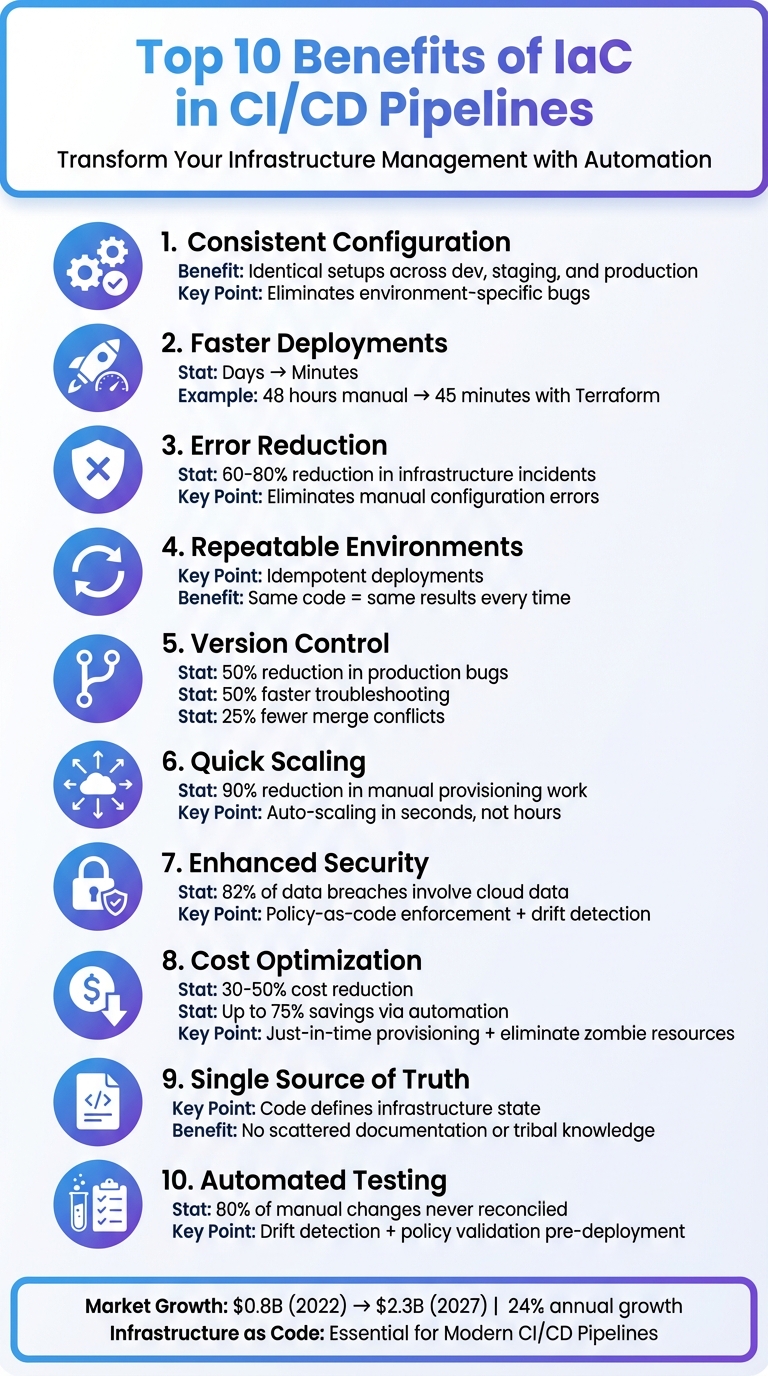
Top 10 Benefits of Infrastructure as Code in CI/CD Pipelines
How Do CI/CD Pipelines Integrate With Infrastructure as Code in the Cloud? | Cloud Stack Studio News
sbb-itb-fd1fcab
1. Consistent Configuration Across All Environments
Setting up infrastructure manually often leads to inconsistencies between environments, which can make troubleshooting a frustrating and time-consuming process.
Infrastructure as Code (IaC) solves this problem by letting you define your infrastructure’s desired state in code. Whether you’re rolling out a development, QA, or production environment, the same configuration file ensures that every setup is identical. This consistency helps catch and eliminate environment-specific bugs before they make it to production.
"Consistency is another vital benefit of IaC. When multiple engineers are manually deploying configurations, inconsistencies are inevitable." – AWS Prescriptive Guidance
IaC also ensures idempotence, meaning that running the same script multiple times always results in the same configuration. It automatically corrects any manual drift, removing untracked changes or manual overrides. This level of precision leads to faster and more dependable deployments.
2. Faster Deployments and Quick Provisioning
Setting up infrastructure manually can be a time sink, requiring teams to spend hours – or even days – on repetitive tasks. Infrastructure as Code (IaC) changes the game by automating these processes with scripts that machines can execute. This automation means deployments happen faster and more efficiently.
"Infrastructure as Code collapses this timeline from days to minutes. A single command can spin up an entire production-equivalent environment with databases, application servers, networking, and monitoring." – Upstat
With IaC, you can define and manage your entire infrastructure stack through code. A single command is all it takes to provision the entire setup in just minutes. This just-in-time provisioning approach allows your CI/CD pipeline to create resources dynamically before deployment, optimizing both speed and cost.
The benefits are undeniable. Faster deployments not only make routine updates quicker but also enhance the resilience of CI/CD systems during emergencies. For instance, a mid-sized SaaS company was able to redeploy its entire Terraform configuration to AWS in just 45 minutes – a task that would have taken 48 hours if done manually. Beyond disaster recovery, this speed allows developers to quickly create identical testing environments, run their tests, and dismantle the setup without delays caused by infrastructure requests.
"A platform engineer can write infrastructure code to create environments and deploy cloud resources in minutes rather than hours or days using provisioning tools like Terraform." – Sujatha R, Technical Writer, DigitalOcean
Additionally, using immutable infrastructure with pre-baked images eliminates the need for post-launch configurations. This approach ensures that Auto Scaling groups can handle sudden traffic spikes immediately, without waiting for time-consuming software installations or configuration scripts to finish.
3. Less Manual Work and Fewer Errors
Speeding up deployments isn’t just about moving faster – it’s also about reducing the reliance on manual tasks. When infrastructure is provisioned manually through cloud consoles, it opens the door to errors and untracked changes. These manual configurations make it harder to maintain consistency and control versions effectively. By automating these processes, teams can simplify operations and significantly cut down on mistakes.
"IaC directly minimizes human error, replacing manual configurations with automated processes and ensuring consistent configurations across different environments." – Mariusz Michalowski, DevOps.com
The benefits aren’t just theoretical – they’re measurable. Organisations that adopt IaC often see a 60% to 80% reduction in infrastructure-related incidents. This improvement comes from eliminating those "quick fixes" applied in one environment that never make it to others. These untracked tweaks can create inconsistencies that only show up at the worst possible times.
IaC also boosts traceability by integrating with version control systems like Git. Every infrastructure change is logged, complete with details about who made the change, when it happened, and why. This creates a clear audit trail, making it easier to conduct peer reviews and roll back changes when needed. The result? Infrastructure management becomes a more predictable and automated process, free from the chaos of manual interventions.
4. Repeatable and Predictable Environments
One standout feature of Infrastructure as Code (IaC) is its ability to consistently recreate identical infrastructure every time the code is executed. This removes the uncertainty often associated with deployments. By defining your infrastructure as code, you establish a reliable blueprint that guarantees the same results, no matter when or how often you deploy – be it on a Tuesday morning or a Friday afternoon.
The concept of idempotency plays a key role here. It ensures that running the same IaC code multiple times always results in the exact same infrastructure state. Modern tools are designed to detect and correct any discrepancies automatically, maintaining consistency across environments.
"Running the same Infrastructure as Code script repeatedly results in the same environment state, ensuring consistency across environments." – Harness
IaC treats the code as the ultimate source of truth. This means reapplying the code not only corrects any configuration drift but also ensures that your development, staging, and production environments are perfect replicas of each other. For instance, when your QA team tests a feature in staging, they are working in an environment identical to production. This eliminates the classic "it works on my machine" issue, offering a predictable process and simplifying troubleshooting when problems arise.
This level of repeatability also paves the way for better version control and smoother collaboration in managing infrastructure as teams move forward. This consistency is a cornerstone of a successful digital transformation roadmap.
5. Version Control for Better Team Collaboration
Using version control systems like Git to store infrastructure code can completely change how teams collaborate. Instead of scattered documentation and inconsistent processes, version control creates a centralised system where everyone works with the same configurations. This shared foundation promotes smoother and more efficient teamwork.
One of the biggest advantages is how it improves day-to-day collaboration. For example, pull requests make it easy for team members to review each other’s work, catching errors and vulnerabilities early. This process can reduce production bugs by up to 50%. As Joel George points out, even junior engineers can contribute by proposing changes, which reinforces good practices and builds team cohesion.
Version control also provides full transparency into the history of changes. With detailed commit messages, teams can easily track what was changed, when, and why. This can cut troubleshooting time in half, helping teams quickly identify and fix issues by rolling back to a stable version with a single command.
Branching strategies are another game-changer. They let teams test new features or fixes in isolation, without affecting the production environment. This approach reduces merge conflicts by 25% and increases productivity by 20%.
The benefits don’t stop there. Version control simplifies onboarding for new team members. By reviewing existing code and participating in pull requests, newcomers can quickly learn best practices. Repository documentation also helps them get up to speed faster. Instead of relying on informal knowledge held by individual engineers, version control turns infrastructure into a well-documented, shared resource that everyone can access and understand. These practices also make automated, repeatable deployments easier, reinforcing the key principles of Infrastructure as Code (IaC). This foundation is essential when you add automated testing to CI/CD pipelines to ensure code quality.
6. Quick Scaling and Full Automation
Infrastructure as Code (IaC) has completely changed the way teams manage traffic surges and fluctuating demand. Instead of spending hours – or even days – manually configuring cloud consoles or setting up new servers, IaC allows you to define your infrastructure’s desired state directly in code. Tools like Terraform and AWS CloudFormation take it from there, automatically calculating and provisioning the exact resources needed. And the best part? This all happens within seconds when demand spikes. Beyond just speeding up deployments, IaC ensures your infrastructure can adapt dynamically to changing conditions.
Here’s where IaC gets even more impressive: you can integrate scaling rules directly into your infrastructure code. You can set specific thresholds for metrics like CPU usage, memory, bandwidth, or response times. When traffic increases, the system instantly adds resources to meet demand. When things slow down, it scales back to avoid wasting money on idle servers. This level of precision goes beyond simple provisioning – it’s about fine-tuned, intelligent scaling.
"With IaC in place, infrastructure can automatically adapt to changes in configuration and react to spikes in traffic with auto-scaling features" – Atlassian
By automating these processes, IaC eliminates repetitive manual tasks. In fact, low-code and no-code IaC platforms can handle up to 90% of the manual work involved in provisioning cloud resources. The system takes care of everything – from launching new instances to ensuring they’re functioning properly.
This automation doesn’t just save time; it also slashes costs. Automated cloud platforms can reduce infrastructure expenses by as much as 75% through efficient scale-out and scale-in processes. Plus, modern IaC tools can create isolated environments for testing or deployment on-demand. Once the task is complete, these environments are torn down immediately, ensuring you get the most out of your cloud investment.
7. Better Security and Compliance Controls
Infrastructure as Code (IaC) doesn’t just speed up deployments – it also raises the bar for security and compliance in your CI/CD pipeline. By embedding security policies directly into the infrastructure code, IaC ensures that protection starts at the foundation. Tools like Open Policy Agent (OPA) automatically enforce governance rules, such as requiring encryption for storage or limiting SSH access, before anything is deployed.
Version control systems like Git make compliance much simpler by creating a detailed audit trail. Every change – who made it, what was changed, and when – is recorded, which is crucial for meeting standards like SOC 2, GDPR, and HIPAA. As Mrinalini Sugosh from Harness explains: "If infrastructure can be changed outside version control, you don’t have an IaC security model, you have best intentions".
"Prevention is the only cure… It is simply not possible to remediate cloud security issues at scale. We must move to a preventative model." – Mike McCabe, Cloud Security Partners
IaC also tackles configuration drift, a common issue where live systems deviate from their defined setup. Modern IaC tools can continuously monitor for unauthorized changes, alert security teams, or even roll back to the approved configuration automatically. Considering that around 82% of data breaches involve cloud-stored data, this proactive approach is far more effective than trying to fix problems after the fact.
Another advantage of IaC is shifting security testing earlier in the development process. Automated tools like Checkov and Tfsec scan infrastructure templates for vulnerabilities during development, catching potential issues before they hit production. Teams can also use "golden modules" – pre-approved templates vetted by security experts – to ensure consistent security standards from the start. These measures not only enhance security but also support the overall efficiency and agility of the CI/CD pipeline.
8. Lower Costs and Resource Optimization
Infrastructure as Code (IaC) simplifies deployments and helps cut costs by avoiding unnecessary spending. One standout feature is just-in-time provisioning. With this approach, CI/CD pipelines can spin up resources only when needed for tasks like testing or deployment, then shut them down immediately after. This means you’re paying only for active use, not for idle servers sitting unused. As AWS explains: "You only pay for the resources you are actively using, so there is no unnecessary overhead".
The financial impact of IaC is significant. Companies adopting it often see cost reductions of 30–50% and a drop in infrastructure-related incidents by 60–80%. A major factor in these savings is the elimination of over-provisioning. With IaC, resource needs are defined in code, ensuring infrastructure closely aligns with actual requirements instead of relying on costly assumptions.
Dynamic scaling also plays a big role. Automated scale-in logic reduces resources during periods of low demand, cutting costs tied to oversized infrastructure during off-peak hours. This ensures you’re not stuck paying for capacity you don’t need.
Another key benefit is visibility. Since infrastructure exists as code in a shared repository, teams can easily audit their environments to identify and eliminate "zombie resources" – those unused resources quietly draining budgets. Joel George highlights this advantage: "IaC makes it easy to audit infrastructure for unused resources, oversized instances, or inefficient configurations. You can also use code review processes to catch expensive mistakes before they’re deployed". This level of transparency is becoming even more crucial as the global IaC market grows, with projections increasing from $0.8 billion in 2022 to $2.3 billion by 2027.
On top of cloud savings, IaC reduces labour costs by automating repetitive infrastructure tasks. This means fewer engineers are needed for time-consuming setups, allowing teams to focus on innovation instead of maintenance. Tools like policy-as-code further enhance cost control by enforcing rules, such as blocking expensive instance types in non-production environments. Together, these efficiencies create a framework that not only saves money but also strengthens the speed and reliability of CI/CD pipelines. When combined with better collaboration and testing, the financial advantages of IaC solidify its role as a game-changer for modern development workflows.
9. One Source of Truth for Infrastructure
Infrastructure as Code (IaC) changes how teams manage and track their systems by providing a single, reliable definition stored in a version control system. Instead of piecing together information from scattered documentation, the code itself becomes the definitive guide for how systems should be configured. Harness puts it well: "Code becomes the single source of truth, dictating exactly how every environment should be set up".
This approach replaces informal, tribal knowledge with infrastructure details codified in shared repositories. Everyone on the team has access to these repositories, making it easier to collaborate and verify information. It builds on the consistency and teamwork that version control already fosters.
Another big win with IaC is its self-documenting nature. Outdated manuals become a thing of the past. Engineers can quickly check the environment’s state, which simplifies audits and compliance reviews. This clarity complements the predictable and repeatable environments IaC creates.
IaC tools also keep a watchful eye on the production environment. They compare the desired state (defined in the code) with the actual state, automatically spotting and fixing any drift. This ensures the environment remains consistent over time.
For teams handling complex CI/CD pipelines, having one trusted source of truth means faster problem-solving, better teamwork, and the ability to rebuild entire environments in minutes if something goes wrong. Centralizing control like this amplifies the automation and efficiency that modern development workflows demand.
10. Easier Testing and No Configuration Drift
With IaC, maintaining reliable environments becomes simpler thanks to automated testing and drift prevention. Testing infrastructure changes, once a manual and error-prone task, is now automated and consistent. Tools like terraform validate, TFLint, and Checkov allow teams to catch syntax errors and security issues early – without needing to provision any actual resources.
The terraform plan command provides a detailed preview of changes, outlining which resources will be created, updated, or removed before applying them. This transparency helps teams avoid surprises during deployment.
Modern IaC frameworks also come equipped with testing features. For example, Terraform (from version 1.6 onwards) includes terraform test, which allows unit tests with mocks. Tools like Terratest and KitchenCI go a step further by creating temporary sandbox environments for functional testing, ensuring infrastructure behaves as expected before it goes live.
Another challenge IaC addresses is configuration drift – where manual tweaks cause the live environment to differ from the codebase. Studies show that only 20% of emergency manual changes are reconciled back into the code, leaving 80% as permanent drift. In one instance, a manual fix was overwritten by a terraform apply, leading to 90 minutes of downtime.
IaC tackles this issue by treating the code repository as the single source of truth. Drift detection tools, such as running terraform plan -detailed-exitcode daily in CI/CD pipelines, flag inconsistencies. Automated processes can then restore the environment to its intended state, keeping everything aligned.
Security also benefits from IaC through Policy as Code frameworks like Open Policy Agent (OPA) and Sentinel. These tools scan infrastructure plans against compliance rules, enforcing policies like requiring encryption for S3 buckets or restricting port 22 exposure in security groups. By integrating these checks, teams can address both planned changes and drift before they turn into vulnerabilities.
How Digital Fractal Technologies Uses IaC in AI-Driven CI/CD Pipelines
Digital Fractal Technologies leverages Infrastructure as Code (IaC) to create scalable, AI-powered CI/CD pipelines tailored for industries like public services, energy, and construction. Their process kicks off with an AI Readiness Audit, which evaluates current workflows, data, and tools. This audit results in a 6- to 12-month roadmap aimed at identifying areas where automation can drive noticeable time and cost efficiencies. This structured approach sets the stage for delivering measurable, sector-specific outcomes.
Once the groundwork is laid, the company incorporates AI tools – such as computer vision and predictive analytics – into automated workflows. These enhancements replace manual processes with AI-driven systems that operate seamlessly around the clock. In heavy industries, this often means digitizing paper-based forms and automating tasks like regulatory compliance (e.g., tracking certificates and permits), all while maintaining strict data security and sovereignty.
Take Xtreme Oilfield, a Canadian energy services firm, as an example. Digital Fractal developed a mobile app and web backend system for them, which streamlined operations by digitizing paper forms, automating certificate and permit management, and computerizing job dispatching. Regg M., from Operations at Xtreme Oilfield, shared:
"The Xtreme Oilfield mobile application and web backend system that was developed for us, digitized our paper forms, automated certificate/permit management, computerized job dispatching, and brought timesheets, vehicle repair and communications to the field on an iPad."
Another example is the last-mile delivery system launched for Deeleeo in October 2020. This solution included iOS and Android apps for drivers and a web-based admin backend, enabling real-time delivery tracking. Digital Fractal prides itself on transforming clients’ operations within 90 days, using AI agents and automation to eliminate repetitive tasks.
Conclusion
Infrastructure as Code (IaC) has reshaped how teams approach software development and deployment. By automating the provisioning process, organisations can create environments quickly, maintain consistent configurations, and minimise human error. With the global IaC market expected to hit $2.3 billion by 2027 and an annual growth rate of 24.0%, it’s clear that this approach is gaining traction. Additionally, automated platforms can slash infrastructure costs by as much as 75%.
One of the standout advantages of IaC is its ability to establish infrastructure as a single source of truth. By ensuring that development, staging, and production environments are identical, teams can eliminate the dreaded "it works on my machine" issue and deploy with greater confidence. Version control further enhances this by documenting changes, streamlining rollbacks, and simplifying audits. As Flavius Dinu and Kyle Galbraith from Spacelift aptly state:
"An investment into a healthier infrastructure process using infrastructure as code can pay dividends for the entire life of the product or company".
For organisations aiming to drive digital transformation, IaC is no longer optional – it’s a necessity. It liberates engineers from repetitive tasks, enabling them to focus on innovation rather than troubleshooting. With Policy as Code, security and compliance are seamlessly integrated, and disaster recovery becomes as straightforward as redeploying infrastructure.
To modernise your CI/CD pipelines and harness the power of AI-driven automation, consider partnering with Digital Fractal Technologies Inc. Their tailored, scalable solutions are designed to align with your industry’s specific needs, starting with a deep dive into your current workflows and creating a roadmap for automation that delivers measurable results.
FAQs
Which IaC tool should we start with?
When you’re choosing an Infrastructure as Code (IaC) tool, it’s important to weigh factors like ease of use, community support, and how well it integrates with CI/CD pipelines. Among the available options, Terraform stands out as a favourite. Its declarative syntax, extensive provider ecosystem, and cloud-agnostic design make it a go-to for automating infrastructure. This tool streamlines deployments, enhances consistency, and supports scalability.
Other tools are worth mentioning too. For example, Ansible is agentless and great for configuration management, while CloudFormation is tailored specifically for AWS environments. However, when it comes to creating scalable and flexible CI/CD workflows, Terraform often takes the lead.
How can IaC be safely added to an existing CI/CD pipeline?
To make Infrastructure as Code (IaC) work smoothly within your CI/CD pipeline, there are a few smart steps to keep in mind:
- Start small: Begin by incorporating IaC with less critical components. This allows you to test and refine the process without risking major disruptions.
- Use version control: Keep your IaC scripts in a version control system. This makes it easier to track changes, collaborate, and roll back if something goes wrong.
- Automate testing: Run automated tests to catch syntax errors, security vulnerabilities, and compliance issues early in the pipeline. This ensures your code is reliable before deployment.
- Secure sensitive data: Protect secrets like API keys or credentials through encryption or secret management tools. Combine this with automated security scans to identify potential risks.
- Monitor deployments: Keep an eye on deployments by auditing and tracking changes. This helps maintain consistency and quickly addresses any unexpected issues.
By following these steps, you can confidently integrate IaC into your pipeline while minimizing risks.
What’s the best way to prevent configuration drift?
The most effective method to avoid configuration drift is by integrating continuous drift detection directly into your CI/CD pipelines. This process involves regularly comparing live infrastructure configurations with the desired states defined in your code. By catching unauthorized changes early – preferably during pull requests or pre-deployment checks – you can ensure your infrastructure stays consistent and minimize potential errors.