Mobile App Threat Detection: AI Use Cases

If you treat every mobile app risk the same, you miss the point. In public sector, energy, construction, logistics, and healthcare, the best AI threat checks depend on who uses the app, what data it handles, and how much disruption the team can tolerate.
Here’s the short version:
- Pre-installation scanning is the main fit across all five sectors
- Low false positives matter most when blocked access can stop care, delay field work, or hurt public trust
- LightGBM-style models stand out for APK screening, with reported ROC AUC of 0.9633 and about 64× faster runtime than some Vision Transformer options
- Semantic APK analysis can help find Trojan-like behaviour early, with reported 92% precision and 91% recall
- In many production setups, teams aim for 1% false positive rate or less
- In Canada, teams still need to line up mobile AI security work with PIPEDA, sector privacy rules, and risk controls such as NIST AI RMF, ISO 27001, and SOC 2
What changes by sector is simple:
- Public sector: stop bad access without blocking citizens or staff
- Energy and utilities: protect shared field devices and offline workflows tied to OT/SCADA
- Construction: catch risky apps before they affect safety, records, or site access
- Logistics: screen at fleet scale without slowing routing, dispatch, or delivery
- Healthcare: guard PHI and care workflows with almost no room for bad alerts
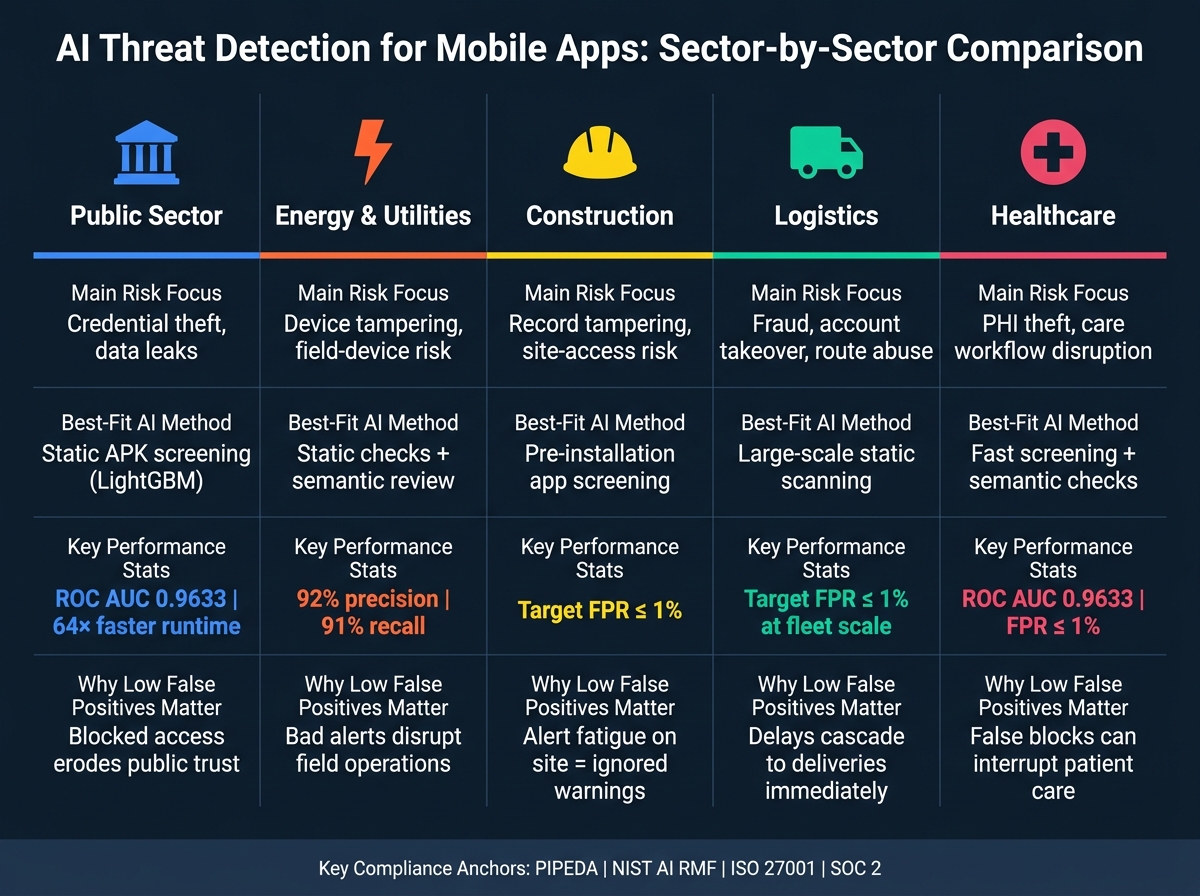
AI Threat Detection for Mobile Apps: Sector-by-Sector Comparison
Threat Hunting for Mac and Mobile: How to Find What Others Miss
sbb-itb-fd1fcab
Quick Comparison
| Sector | Main risk focus | Best-fit AI use | Why low false positives matter |
|---|---|---|---|
| Public sector | Credential theft, data leaks | Static APK screening before rollout | Blocked access can hurt service trust |
| Energy & utilities | Device tampering, field-device risk | Static checks and semantic review | Bad alerts can disrupt field work |
| Construction | Record tampering, site-access risk | Pre-installation app screening | Too many alerts get ignored on site |
| Logistics | Fraud, account takeover, route abuse | Large-scale static scanning | Delays can affect deliveries right away |
| Healthcare | PHI theft, care workflow disruption | Fast screening plus semantic checks | Bad blocks can interrupt patient care |
So if I had to sum up the whole article in one line, it would be this: the same AI model can scan every app, but the alert threshold, review flow, and risk tolerance should change by sector.
1. Public Sector Mobile Apps
Public sector apps serve both citizens and staff. That means security has to protect access at scale without getting in the way of service. In this setting, the core problem is simple: stop bad access without locking out the people who need the app.
Threat Patterns
Public sector apps handle broad public use and internal staff workflows, so they face a wide attack surface. In Android-based public sector apps, the most common threats include credential theft, sensitive data exfiltration, monetization fraud, and device hijacking for botnets.
AI Detection Methods
For Android apps in the public sector, LightGBM-style tabular models are a strong fit. One model trained on permissions, certificate metadata, DEX code statistics, and string patterns reached an ROC AUC of 0.9633 and ran about 64× faster than Vision Transformer models like SHERLOCK. That mix of speed and accuracy matters when teams need to screen apps before deployment and keep delays low.
Static models also match this use case well because they screen apps before installation, have a predictable cost, and don’t require teams to run risky code. In practice, signals pulled from AndroidManifest.xml matter a lot. Things like odd permission combinations or suspicious intent filters can point to malicious behaviour, even when false-positive tolerance is tight.
Put plainly, pre-installation screening is the best fit when the goal is to catch malicious apps before users ever install them.
Data Sensitivity
These apps often handle citizen records. If a threat slips through, it can expose high-value personal data.
Compliance Pressure
Federal public sector teams rely on PIPEDA and the Directive on Automated Decision-Making as main compliance anchors, along with voluntary frameworks like the NIST AI Risk Management Framework. On the ground, that means systems need audit logs, documented limits, and clear escalation paths. Low false positives matter here for a very practical reason: blocked logins can erode public trust fast.
For public sector teams, the trade-off is pretty direct. Models need to support low false positives and fast, pre-installation scanning without disrupting legitimate users.
The next sector shifts the problem from broad service access to field-device exposure and offline risk.
2. Energy and Utility Mobile Field Apps
Energy and utility field teams often work on shared devices that need to function offline and connect back to OT and SCADA systems. That changes the risk picture. If one of these apps gets compromised, the damage may hit physical operations, not just stored data. In this setting, pre-installation screening and offline checks matter more than they do for office apps.
Threat Patterns
The main risks here are credential theft, device tampering, and data exposure on shared field devices that may stay offline for long stretches. In critical infrastructure, those problems can disrupt both information handling and service continuity.
AI Detection Methods
Static models are a good fit for field apps. They can scan APKs before installation, behave in a predictable way, and avoid running risky code on the device itself.
For custom utility software, semantic checks add another layer. They can review app structure before coding is finished or before deployment starts, which helps teams spot Trojan-style risks early. One study found that Data_Send_Trojan, which steals card data and passwords, appeared 552 times in semantic-query detection. That same approach reached 92% precision and 91% recall.
Data Sensitivity
False positives need to stay low. If crews using shared devices keep seeing bad alerts, they’ll start ignoring them or switch them off.
Compliance Pressure
In Canada, PIPEDA, SOC 2, and ISO 27001 shape how teams handle security and privacy controls. Teams building energy field apps with Digital Fractal Technologies should build these requirements into the design from day one.
Construction apps run into many of the same field-device issues, but with more safety and site-access risk.
3. Construction and Field Safety Apps
Construction apps are high-stakes tools. If an inspection app or site-access app gets hit, work can stop fast, and the risk isn’t just admin trouble. People on site can be put in harm’s way. That’s why construction apps are closer to field-control systems than standard business apps.
Threat Patterns
The main risks here are credential theft, altered records, and data being pulled out without approval. A trojanised app can steal credentials, contact lists, and log files. Once that happens, what starts as a cyber issue can turn into a site-access problem or a safety incident. Location spoofing and unsafe network access add another layer of risk for crews in the field.
AI Detection Methods
In construction, the best AI use case is simple: catch dangerous apps before anyone installs them. Static analysis can help spot over-permissioning, altered records, and suspicious endpoints ahead of installation. In practice, that means:
- flagging GPS or camera access that goes beyond what the app needs
- spotting tampered inspection records through code-level review
- finding hardcoded IP addresses that may point to data exfiltration
That screening happens before a crew member even opens the app.
Data Sensitivity
Construction apps often hold worker credentials, inspection records, and project data. If credentials are stolen or inspection records are changed, the fallout can go well past privacy concerns. Work can be delayed, site access can be blocked, and safety exposure can increase right away.
There’s also a practical issue with AI screening. False positives need to stay near 1% so teams don’t get buried in reviews or start tuning out alerts. And if a company leans too hard on AI, that can create a single point of failure in safety-critical workflows.
Compliance Pressure
PIPEDA still applies to worker and contractor data, so higher-impact tools need a formal review before rollout, with input from more than one team. It helps to classify AI systems by risk level from day one. Safety inspection software, for example, should have documented limits and clear escalation paths.
Voluntary frameworks such as NIST AI RMF, ISO 27001, and SOC 2 can also help show that AI is being used with care, especially in areas where regulation hasn’t fully caught up yet.
Those controls matter even more in logistics, where routing and delivery data can shift minute by minute.
4. Logistics and Delivery Mobile Apps
Logistics apps move fast and handle a lot at once. Drivers, warehouse staff, dispatchers, and customers all depend on the same app setup, often under tight deadlines. That means a single security gap can throw off day-to-day work and delay deliveries. And unlike field apps, logistics security has to guard live routing, customer handoffs, and high-volume account activity all at the same time.
Threat Patterns
The most common risks in logistics apps are credential theft, sensitive data exfiltration, monetization fraud, and device compromise, including hijacked phones or tablets used for fraud or botnet activity. Logistics apps stand out because of the mix of data they carry: customer addresses, proof-of-delivery records, payment details, and real-time GPS location. If stolen credentials get into the wrong hands, the damage can spread fast, from fraudulent deliveries to route changes to payment abuse.
AI Detection Methods
In logistics, speed matters. A delay in deployment can easily disrupt delivery windows. That makes static, pre-installation scanning a good fit for logistics fleets. Models can screen apps before rollout without running any harmful code, which helps teams clear large fleets fast without slowing operations.
At scale, even a 5% FPR creates too many manual reviews. So in production, systems should stay near 1% or lower.
Detection accuracy matters, but logistics also brings privacy concerns into the picture because location data is part of the workflow.
Data Sensitivity
Logistics apps handle addresses, proof-of-delivery records, payments, and employee location data, so de-identification should happen before AI training.
Compliance Pressure
With Canada’s AIDA still paused, logistics teams rely on NIST AI RMF, ISO 27001, and SOC 2 to document AI risk controls.
Healthcare apps face similar mobile threats, but with stricter clinical privacy and patient-safety requirements.
5. Healthcare and Clinical Mobile Apps
Healthcare deals with the same mobile threats as other sectors, but the stakes are higher. Privacy rules are tighter, and mistakes can affect patient care.
Threat Patterns
Healthcare apps are a top target for credential theft and PHI exfiltration. Malware in the Data_Send_Trojan category stands out as a direct risk. That puts pressure on security teams to catch bad apps before clinicians or patients install them, and to do it with very few false alarms.
AI Detection Methods
Two methods stand out for clinical apps.
LightGBM, trained on Extended EMBER features, looks at permissions, API-family distributions, certificate metadata, and DEX code analysis. It reached a ROC AUC of 0.9633 and runs about 64× faster than Vision Transformer models such as SHERLOCK, which makes it a strong fit for high-volume pre-installation screening.
A second option is semantic APK analysis. This method reverse-engineers APKs into UML models and OWL ontologies, then uses SPARQL queries to spot malicious data-sending structures before installation. In testing, it reached 92% precision and 91% recall across 600 infected Android packages.
That said, there’s a catch. Semantic analysis involves semi-manual steps, and it doesn’t catch every malware type. For example, it can miss worms spread through spam.
In live use, both methods should aim for a false positive rate of 1% or lower. At a 5% FPR, scanning 1,000 legitimate apps would wrongly block 50. In a clinical setting, that’s more than a nuisance – it can interrupt care workflows.
Data Sensitivity
Do not train models on PHI unless the data has been de-identified. In most clinical setups, models lean on manifest, DEX, signing, and string features to spot over-permissioning, spoofed apps, and hardcoded exfiltration endpoints.
Compliance Pressure
Healthcare organisations often use PIPEDA, SOC 2, ISO 27001, and the NIST AI RMF as key compliance reference points. For high-impact clinical systems, review usually needs to go beyond IT and include legal, privacy, security, and clinical teams.
These differences across the sector come down to user behaviour, data sensitivity, and how little room healthcare teams have for false alerts.
How Risk Patterns Differ by App Type, User Base, and Data Sensitivity
After the sector-by-sector examples, the next step is figuring out which app traits should shape AI detection priorities.
Across sectors, three factors do most of the heavy lifting: app type, user base, and data sensitivity. Those factors decide which threats matter most and which AI signals deserve the most attention. The AI methods themselves are often similar from one sector to another. What changes is the decision logic.
Some data types leave almost no room for error. PHI and SINs need the tightest controls and the lowest false-positive tolerance. Inspection images and compliance records may not be as sensitive as PHI, but their integrity still matters a lot. If that evidence is changed, the damage can be serious.
The table below pulls those differences into one view, showing the signals, threats, and compliance pressure points that matter most by sector.
| Sector | Typical App Type | Dominant Threats | AI Signals Monitored | Data Sensitivity | Relevant Compliance Frameworks |
|---|---|---|---|---|---|
| Public Sector | Citizen service portals | Impersonation, credential theft | Manifest permissions, certificate anomalies, string patterns (URLs/IPs) | Citizen records, SIN, personal identifiers | Privacy Act, PIPEDA |
| Energy & Utilities | Field service / grid apps | OT/IoT disruption | API family usage, byte-entropy histograms, DEX code analysis | Grid telemetry, infrastructure maps, geolocation | NERC CIP, PIPEDA, ISO 27001 |
| Construction | Safety & inspection apps | Evidence tampering | Resource/file structure integrity, byte-entropy (obfuscation), DEX code complexity | Inspection images, safety logs, compliance records | Provincial OHS Acts, SOC 2 |
| Logistics | Delivery & route apps | Route fraud, account takeover | String features (IPs), geolocation-linked API calls, byte histograms | Real-time geolocation, customer addresses, transaction data | PIPEDA, NIST AI RMF |
| Healthcare | Clinical & patient apps | PHI exposure, workflow manipulation | Sensitive API usage (camera/contacts), reflection/loading indicators, permission sets | Personal Health Information (PHI) | PHIPA, PIPEDA, provincial privacy laws |
One way to think about it: the same model output does not mean the same thing in every sector. A strange permission set in a healthcare app can point to PHI exposure risk. In a logistics app, geolocation-linked API calls may matter more because route fraud and account takeover sit closer to the top of the risk stack.
That’s why detection teams can’t treat all apps the same. A citizen portal, a grid app, and a safety inspection tool may all be scanned with similar AI techniques, but the threshold for alerts, triage, and human review should shift with the stakes.
These patterns also shape the accuracy, latency, and review-load trade-offs discussed next. Organizations can also calculate workflow automation benefits to see how these efficiencies impact their bottom line.
Strengths, Limitations, and Trade-Offs Across Sectors
The key issue isn’t whether AI can spot threats. It’s which trade-offs a sector can live with.
There’s no single winner here. AI threat detection helps in every sector, but each setting comes with its own limits. Those limits shape how teams set thresholds, pick models, and handle reviews.
Public sector apps have one clear edge: large behavioural baselines are easier to build. That gives teams more data to tune against. But the downside is hard to ignore. If a false positive blocks someone from a tax portal or health portal, it turns into a public trust problem, not just a service issue.
Energy and logistics apps both depend on speed. They need fast screening at scale, and AI fits that job well. But the cost of a false positive looks different in each case. In energy, a bad flag can interrupt critical field work. In logistics, it can cut off driver messaging or navigation in the middle of a delivery.
Construction apps deal with a messier setup. Devices vary a lot, connectivity can be weak, and some sites have little or no network access. That changes everything. Detection models need to work well across uneven hardware, different OS versions, and offline conditions.
Healthcare apps often produce the richest signals, including camera permissions, location data, and sensitive API usage. That gives detection systems more to work with. But it also leaves almost no room for delay, weak audit trails, or privacy mistakes. Blocking or even slowing access to a clinical app isn’t just annoying. It can affect patient care.
The table below puts those trade-offs into day-to-day terms.
| Sector | Main Advantage | Main Constraint | False-Positive Risk |
|---|---|---|---|
| Public Sector | Large behavioural baselines support model tuning | Errors damage public trust and service access | Blocking legitimate access to government portals |
| Energy & Utilities | Real-time anomaly visibility; fast inference at scale | Must avoid operational downtime; field devices need efficiency | False alarms triggering shutdowns of critical infrastructure |
| Construction | Handles device diversity and offline environments | Uneven connectivity; wide hardware and OS variation | Flagging custom sensor-integration or IoT apps as suspicious |
| Logistics | Strong fraud analytics; supports high-volume APK scanning | High-volume scan queues need rapid scaling | Blocking driver navigation or communication apps mid-delivery |
| Healthcare | Rich permission and API usage signals | Strict audit, consent, and privacy obligations | Delayed access to clinical or monitoring apps |
In practice, these trade-offs decide the right model, the right threshold, and the right review flow for each sector.
Conclusion: Matching AI Threat Detection to Your Sector’s Mobile App Needs
AI threat detection works best when it fits the sector’s users, data, and tolerance for disruption. That fit depends on the app type, the user base, and how sensitive the data is.
Public sector and healthcare sit at the trust-first end of the spectrum. These apps need tight privacy and identity controls, which means low false-positive rates matter a lot. If the system flags too much, it can slow access, frustrate users, and chip away at trust. Canadian organisations should line up these systems with PIPEDA and, where it applies, the federal Directive on Automated Decision-Making.
Energy and construction have a different problem to solve. Here, the focus shifts from trust to uptime. These apps need fast detection with as little friction as possible. Feature-engineered tabular models such as LightGBM are a good fit for field devices because they work well with the offline and on-site limits common in those settings.
Logistics sits in the middle of several risks at once: identity, fraud, and telemetry. Mobile apps in this sector need to catch fraud and guard telemetry data without getting in the way of dispatch, routing, or delivery. If detection slows the operation, the app starts creating its own problem.
Across all five sectors, the same rule applies: match control depth to operational risk. For Canadian organisations, that means matching detection depth to risk as well. High-impact systems such as patient triage need formal review, while lower-risk tools can work with lighter controls. It also means doing the basics well:
- Inventory all mobile AI systems
- Assign cross-functional owners for high-impact use cases
- Monitor for model drift after deployment
With AIDA still paused as of Sep 2026, NIST AI RMF remains the most practical guide for responsible, sector-appropriate use.
FAQs
How do we set the right alert threshold by sector?
Balance risk materiality with day-to-day continuity. In high-impact settings like the public sector or energy, classify assets by risk so each system gets the right level of control. Then track model performance against accuracy and fairness benchmarks, and use policy-as-code for real-time checks.
Alert fatigue is a pain, so it helps to use tiered alerting instead of treating every issue the same. A simple setup looks like this:
- Immediate notifications for critical issues
- Same-day alerts for high-severity findings
- Weekly digests for lower-priority concerns
Continuous monitoring and feedback loops help fine-tune thresholds over time while still meeting Canadian privacy standards.
When should semantic APK analysis be added to static scanning?
Add semantic APK analysis when static scanning alone may miss platform-specific structure, behaviour, or design-level threats.
It helps spot security anti-patterns and malicious intent that surface-level checks may miss, especially in complex apps or security-sensitive sectors.
What mobile app data can be used for AI training in Canada?
In Canada, mobile app data used for AI training needs to comply with privacy laws such as PIPEDA, PHIPA, and Quebec’s Law 25. That means data collection can’t be a free-for-all. It should be limited to what’s strictly needed, and the data should be anonymized before it’s used.
The most useful inputs often come from patterns, not personal details. This can include system call patterns, network traffic metrics, user behaviour indicators, app metadata, authentication logs, device telemetry, and data access patterns.
Just as important, the dataset itself needs to be cleaned and checked. If the data is messy, outdated, or off-topic, the model will learn the wrong things. So quality and relevance matter as much as volume.