
RIME/RAM Scorecard: Work Order Prioritization for Maintenance Managers

Score every incoming request on two axes, business impact and resource intensity, with safety and environmental risk overriding everything else. Run that score through a fixed set of priority bands, not a supervisor’s gut feeling. Apply the scorecard below to your top 10 backlog items this week, or run a 30-day pilot before rolling it out plant-wide. The output should be clear priority bands and a weekly verification loop that proves the ranking is cutting real losses.
TL;DR:
- Most plants rely on informal prioritization methods based on loudest complaints, leading to backlog bloat, reactive repairs, and untrustworthy priority fields.
- Implementing structured scoring frameworks like RIME or RAM, with consistent triage and weekly verification, reduces unnecessary reactive work and aligns tasks with business impact.
- Embedding automated priority scores into a cloud-based CMMS, with asset defaults and sensor validation, ensures real-time, reliable work order ranking without alert fatigue.
- Conducting regular audits and training helps prevent score inflation and maintains discipline in applying the system, especially when managing high-impact or overdue jobs.
- Running small-scale pilots before plant-wide adoption and integrating fixed review routines significantly improve the system’s effectiveness and reduction of reactive maintenance costs.
Table of Contents
- Why Maintenance Work Order Prioritization Breaks Down Without a System
- RIME, RAM, and the Work Priority Index: Which Scoring Framework Fits Your Plant
- A Step-by-Step Process for Scoring and Scheduling Work Orders
- Building Prioritization Into Your CMMS Without Creating Alert Fatigue
- Priority Scorecard Template With Two Worked Examples
- Keeping the System Honest: Training, Audits, and the Weekly Review
- Common Pitfalls That Sabotage Even a Good Scoring System
- Reactive vs. Preventive Work Orders: Different Prioritization Logic
- Adjusting the Priority Matrix During Emergencies and Operational Disruptions
- What Actually Separates a Working System From a Paper One
- Turn Your Priority Framework Into an Automated System
- Sources
Why Maintenance Work Order Prioritization Breaks Down Without a System
Most plants don’t lack a prioritization process. They have one, it just runs on whoever complains loudest to the maintenance manager that morning. That’s not a system, it’s a mood ring, and it produces predictable damage: backlog bloat, chronic firefighting, and a “priority” field on every work order that reads “High” because nobody wants to argue about it.
The failure modes repeat across industries. A production supervisor flags a work order as urgent to jump the queue, even when the asset has redundancy. A technician defers a bearing replacement because it’s inconvenient, and it becomes an unplanned line stoppage six weeks later. Planners stop trusting the priority field entirely and just work whatever’s oldest or loudest.
That drift has a cost. Reactive repairs run more expensive than planned ones, and unscored backlogs hide the handful of jobs actually driving your losses. Structured work order prioritization connects daily maintenance decisions to business outcomes and stops reactive firefighting when teams apply it consistently rather than occasionally.
The pattern behind almost every broken system:
- No shared definition of what “critical” actually means across shifts or departments
- Priority levels assigned by whoever submits the request, not by a scoring rule
- No feedback loop checking whether yesterday’s “urgent” jobs actually reduced downtime
- Safety-critical work competing in the same queue as cosmetic requests
Fix the scoring, and the queue stops lying to you.
RIME, RAM, and the Work Priority Index: Which Scoring Framework Fits Your Plant
Two proven frameworks dominate serious maintenance prioritization, and most plants end up blending them into a custom work priority index rather than picking just one.
- RIME (Ranking Index for Maintenance Expenditure). RIME combines equipment criticality with maintenance work class in a matrix, criticality on one axis, work type on the other, multiplied into a score from 1 to 100. That score then maps to color-coded bands, so a red-band job on a bottleneck asset jumps the queue automatically, no debate required. RIME works best when your criticality rankings are already solid and you need a fast, repeatable way to translate “this asset matters” into “this job goes first.”
- RAM (Risk Assessment Matrix). RAM scores likelihood against consequence rather than criticality against work type. High likelihood combined with high consequence produces the highest priority, which makes RAM the better tool for safety and environmental exposures where the asset itself might be low-criticality but the failure mode is catastrophic (a corroded containment valve, a frayed lifting sling).
- Work priority index (a generic impact/effort matrix). Many teams build their own hybrid: business impact on one axis, resource intensity on the other, scored independently rather than blended into one number.
The practical rule that separates working systems from broken ones: never let resource intensity quietly stand in for business impact. A high-impact job that also happens to require four technicians and a parts order isn’t “complicated,” it’s high priority and high effort, and treating it as merely inconvenient is how bottleneck assets end up starved of attention.
A Step-by-Step Process for Scoring and Scheduling Work Orders
Every functional prioritization system runs the same four-stage loop: triage, score, schedule, verify. Skip a stage, and the queue drifts back toward mood-based decisions within weeks.
- Triage at intake. Before anything gets scored, confirm the request has the fields it needs: asset ID, failure description, requester, and a safety flag. Incomplete requests get bounced back immediately, not scored on partial information. Any request flagging a safety or environmental hazard skips straight to the top of the queue regardless of what the matrix says later.
- Score against your matrix. Apply your RIME, RAM, or hybrid work priority index score to everything that clears triage. Weight the inputs consistently, criticality, consequence, and likelihood shouldn’t shift definition between technicians. Add an age-based increment so a medium-priority job that’s sat for 45 days climbs the queue rather than aging out silently.
- Route into scheduling buckets. Once scored, work orders should land in one of four buckets: Quick Wins (low effort, meaningful impact, do this week), Constraint Focus (high impact on a bottleneck asset, protect the schedule slot), Deferred Work (low impact, low urgency, batch it), and Efficiency Projects (high effort, moderate impact, plan around available labor). Routing scored work into these buckets keeps planners from treating every job as equally urgent.
- Verify with a weekly loop. Attach a loss KPI, downtime minutes, scrap rate, overtime hours, to each completed job, and check weekly whether the highest-scored work actually moved that number.
Pro Tip: Run the 30-day pilot on one production line or one equipment class before scaling the scorecard plant-wide. You’ll catch scoring disagreements between technicians in week one instead of after six months of bad data.
Building Prioritization Into Your CMMS Without Creating Alert Fatigue
A scoring matrix on a whiteboard dies within a month. A scoring matrix embedded in your CMMS as a default rule survives, because it stops depending on someone remembering to apply it.
Cloud-based CMMS platforms digitize the full work order lifecycle, approval, prioritization, scheduling, execution, and analysis, which means the priority score can be calculated automatically the moment a request is submitted, rather than assigned manually by whoever’s on shift. Set asset-based defaults so a request against a bottleneck asset inherits a higher baseline score before a human touches it. Build job templates for recurring failure modes so the criticality and consequence fields auto-populate instead of getting typed in fresh each time. Route anything above a set score threshold to a supervisor approval step, so high-priority jobs can’t quietly slip through without a second look.
Condition monitoring adds a layer worth using carefully. Vibration sensors, thermal readings, and oil analysis can trigger an automatic re-score when a threshold is crossed, but only when that threshold has been validated against real failure history. A better CMMS setup for this kind of AI-driven maintenance operation treats sensor data as one input among several, not an automatic override.
The mistake to avoid: wiring up every sensor you own and calling it automation. A narrow set of high-quality signals, validated against actual failures, beats a dashboard blinking twenty alerts nobody trusts anymore.
- Set asset criticality as a default score input, not a manual override
- Template recurring failure modes so scoring stays consistent across technicians
- Require supervisor approval above a defined priority threshold
- Re-score only when a sensor threshold has been validated against real failure data, not on every reading
Priority Scorecard Template With Two Worked Examples
Here’s a scorecard you can drop straight into a spreadsheet or CMMS custom field today.
Total the safety, production, and environmental scores (likelihood weights them) to get a raw priority number, then check resource intensity separately before scheduling.
- 0 to 15: Deferred Work, batch it into a planned window
- 16 to 25: Quick Wins if resource intensity is low, Constraint Focus if it’s high
- 26 and above: Immediate action, safety override applies automatically above a 7 on that single factor
Worked example 1: A conveyor motor on the only line feeding final packaging throws a bearing fault code. Production impact scores 9, likelihood 8, safety 3. Total lands well above 26. Resource intensity is moderate (two technicians, part in stock). This routes straight into Constraint Focus, worked today.
Worked example 2: A technician requests a guard rail upgrade on a rarely used platform. Safety scores 5, production impact 2, likelihood 2. Total lands under 15. It’s real, but it’s Deferred Work, batched with the next scheduled shutdown rather than jumping the queue.

Keeping the System Honest: Training, Audits, and the Weekly Review
A scoring matrix is an estimate, not a law of physics, and teams that skip training and enforcement watch it decay into mood-based prioritization within a few months. The fix isn’t a better matrix. It’s a training program every technician and planner sits through before touching the score fields, plus a monthly audit that pulls a sample of scored work orders and checks whether the scores match the actual failure data.
Assign a single owner for the prioritization system, usually the maintenance planner, and pull operations into the criticality conversation directly rather than letting production supervisors override scores informally on the floor.
- Run initial training for every technician and planner who touches the priority field
- Audit a sample of scored work orders monthly against real outcomes
- Name one accountable owner for the scoring rules, typically the planner
- Log every deferral with a reason code, not a blank field
The weekly review is the piece most plants skip, and it’s the one that actually catches drift. A 25-minute weekly meeting checking constraint minutes lost, Quick Wins completed, and whether condition alerts actually preceded real failures keeps the system calibrated against reality instead of theory.
Pro Tip: Keep the weekly review to four questions: what got deferred and why, did the Quick Wins get done, did any condition alert turn out to be a false positive, and did the loss KPI move. Anything longer turns into a status meeting nobody wants to attend.
Common Pitfalls That Sabotage Even a Good Scoring System
The scorecard usually isn’t the problem. How it gets used is.
The most common failure is score inflation: everyone learns that “9 out of 10” gets a job worked sooner, so scores creep upward until the matrix loses all discriminating power. The fix is the monthly audit already mentioned, checked against actual outcomes rather than self-reported scores.
A second pitfall is letting the loudest requester win regardless of score. A plant manager’s pet project shouldn’t jump a Constraint Focus job just because it came with a phone call instead of a work order. Enforce the score, or the whole system becomes theater.
A third is treating the priority field as static once assigned. A medium-priority job that’s aged 60 days without action represents a different risk than the day it was submitted, and scores need an age-based increment to reflect that, otherwise legitimate work quietly falls off the radar while newer, louder requests dominate.
A fourth, more subtle pitfall: scoring resource intensity and business impact as one blended number. Separating the two explicitly prevents high-impact jobs that also happen to be labor-intensive from getting mislabeled as low priority simply because they’re inconvenient to schedule.
The last pitfall is starting too big. Rolling a new matrix across an entire plant in one week guarantees inconsistent scoring, because nobody’s had time to calibrate against real outcomes yet. A narrower pilot, one line, one equipment class, catches disagreements before they scale into plant-wide bad data.
Reactive vs. Preventive Work Orders: Different Prioritization Logic
Reactive and preventive work orders don’t belong in the same scoring conversation, even though they often compete for the same technician hours.
Reactive work orders arrive already carrying urgency, something broke, and the scoring job is to figure out how urgent, fast. Safety flags, production impact, and likelihood of cascading failure dominate the score, and the RAM approach (likelihood times consequence) tends to fit better here because you’re assessing an active risk, not a scheduled maintenance class.
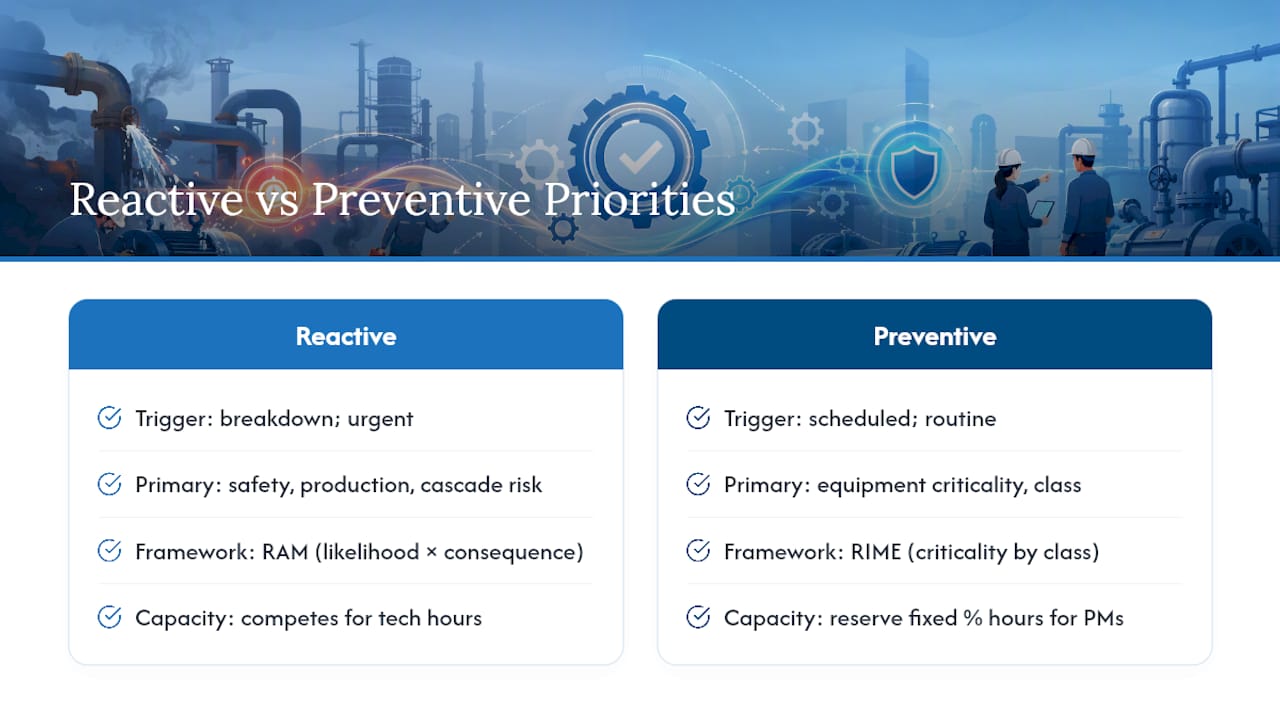
Preventive work orders carry a different question entirely: not “how bad is this,” but “how much worse does it get if we push it back another cycle.” RIME fits this better, since it scores against equipment criticality and a known work class rather than an active failure state. A preventive lubrication task on a non-critical pump can slip a week with near-zero consequence. The same task on a bottleneck compressor can’t, and the RIME criticality axis captures that distinction without needing a live failure event to justify the priority.
The practical guideline: don’t let preventive work permanently lose to reactive work in the queue, or you guarantee more reactive work down the line. Reserve a fixed percentage of technician hours for preventive tasks regardless of how the reactive queue looks that week, and score preventive slippage with an age increment, just like reactive backlog, so a deferred PM task doesn’t quietly vanish into next quarter.
Adjusting the Priority Matrix During Emergencies and Operational Disruptions
Emergencies expose whether your scoring matrix is a real system or a nice-looking spreadsheet nobody actually trusts when it counts.
During a genuine operational disruption, a supply chain failure, a regulatory shutdown, a multi-asset outage, the normal scoring bands need a temporary override layer, not a full rebuild. Define in advance what qualifies as an emergency trigger: total production stoppage, a safety incident, or a regulatory compliance failure are reasonable thresholds. Once triggered, safety and stabilization work automatically outranks everything else, including jobs that scored high under normal conditions.
The mistake plants make during disruptions is either abandoning the matrix entirely (reverting to pure gut-feel triage) or refusing to adjust it at all (rigidly working the normal queue while the plant burns). Neither works. The better approach: freeze new low-priority intake, redirect all available labor to stabilization and safety work, and explicitly log which normally scheduled jobs got bumped and why, so the backlog doesn’t quietly disappear once the emergency passes.
Once the disruption clears, run a fast re-triage rather than dumping everything back into the normal queue at once. Jobs that aged during the emergency likely need a score bump from the age increment, and any temporary workarounds put in place during the crisis need their own follow-up work orders, scored normally, not left as permanent patches.
What Actually Separates a Working System From a Paper One
Most prioritization advice treats the scoring matrix as the hard part. It isn’t. Building a RIME or RAM matrix takes an afternoon. The hard part, and the part almost every guide underplays, is the enforcement layer: the audits, the weekly review, the willingness to tell a plant manager that his pet project scored a 12 and goes in the Deferred bucket.
The conventional wisdom oversells the framework and undersells the discipline. Teams that fail at this usually have a perfectly reasonable matrix sitting in a shared drive that nobody’s opened in four months. What separates the plants that actually cut reactive repair costs is the boring stuff: the monthly audit, the 25-minute weekly meeting, the age-based increment that stops a job from quietly aging out of relevance.
If you take one thing from this, take the separation between business impact and resource intensity. Blending those into a single number is the single most common scoring mistake, and it’s the one that quietly starves your highest-value work of the attention it needs. Score them separately, schedule around both, and audit whether the ranking is actually reducing losses. That’s the whole job.
— Souhail
Turn Your Priority Framework Into an Automated System
A scorecard on a spreadsheet only works as long as someone remembers to update it. Digitalfractal builds the layer most maintenance teams skip entirely: automated scoring rules embedded directly into your existing workflow, so priority bands, age increments, and safety overrides calculate themselves instead of depending on a planner’s memory.
The starting point is an AI Readiness Audit, which maps exactly where your current work order process leaks time, duplicate scoring, missing safety flags, manual re-triage after every disruption, and identifies which parts are ready for automation now versus later. From there, most clients run a pilot on one line or one equipment class before scaling, and see a working automated system within 90 days, not a multi-year IT project.
If your team is still deciding priority by whoever emailed last, book an AI Readiness Audit and get a concrete plan for workflow automation built around your actual maintenance data.
Sources
For readers who want the original frameworks behind this playbook: the RIME and RAM scoring methods, the Quick Wins and Constraint Focus bucket framework, the training and audit case for enforcement, and background on CMMS work order lifecycles. For a maintenance-adjacent industry parallel, see this aircraft maintenance workflow guide.
- How to Prioritise Maintenance Work Requests: 2 Proven Methods for Objective Prioritisation
- A practical framework for maintenance prioritization in industrial operations | Plant Services
- Prioritizing Maintenance Work Orders