Order Picking Optimization: A Practical Guide for Canadian Warehouses

Order picking optimization means cutting the walking, waiting and mistakes between a released order and a packed one. You do it with five levers: pick paths, picking method, slotting, inventory accuracy and the way you design work for people. Most warehouses gain more from fixing the order of those levers than from buying any single tool.
This guide is for operations and logistics leaders who run a pick floor and want to know where the gains are, what to fix first and where AI earns its place.
TL;DR
- Picking is the most expensive activity in a warehouse, so small gains in travel time and accuracy compound quickly.
- Fix inventory accuracy before routing. A perfect pick path to a wrong bin location is still a wasted trip.
- Simple, robust routing rules often beat clever algorithms once aisle congestion and worker comfort enter the picture.
- Automated cycle counting replaces shutdown counts with continuous, exception-based checks.
- A focused 90-day pilot, started with a readiness audit, is a safer path than a big-bang overhaul.
Table of Contents
- Why picking deserves the first look
- The five levers, in the order we would pull them
- Start with inventory accuracy and cycle counting
- Slotting: put the right stock in the right place
- Picking methods: choose how orders are grouped
- Pick path optimization: simpler than it sounds, harder than it looks
- Where AI genuinely helps in the pick process
- Design for the people doing the work
- Our perspective: audit first, then automate one thing well
- A 90-day plan for your pick floor
- Start with an AI readiness audit
- FAQ
- Sources
Why picking deserves the first look
Picking is the single largest cost line on most pick floors. A human factors dissertation on manual order picking describes it as accounting for over 50% of total warehousing expenses, and a paper on large-scale warehouses calls it the most cost-intensive activity in picker-to-parts operations. If half your cost sits in one activity, a 10% improvement there beats a 10% improvement almost anywhere else.
Canadian operators have a second reason to act. The Canadian e-commerce warehouse market is forecast to grow from $0.79 billion USD in 2025 to $1.11 billion USD by 2031, and the same report describes operators moving from simply adding capacity to using AI orchestration and robotics in space-constrained urban sites. Land near Toronto, Calgary, Montreal and Vancouver is expensive. Throughput per square foot matters more every year.
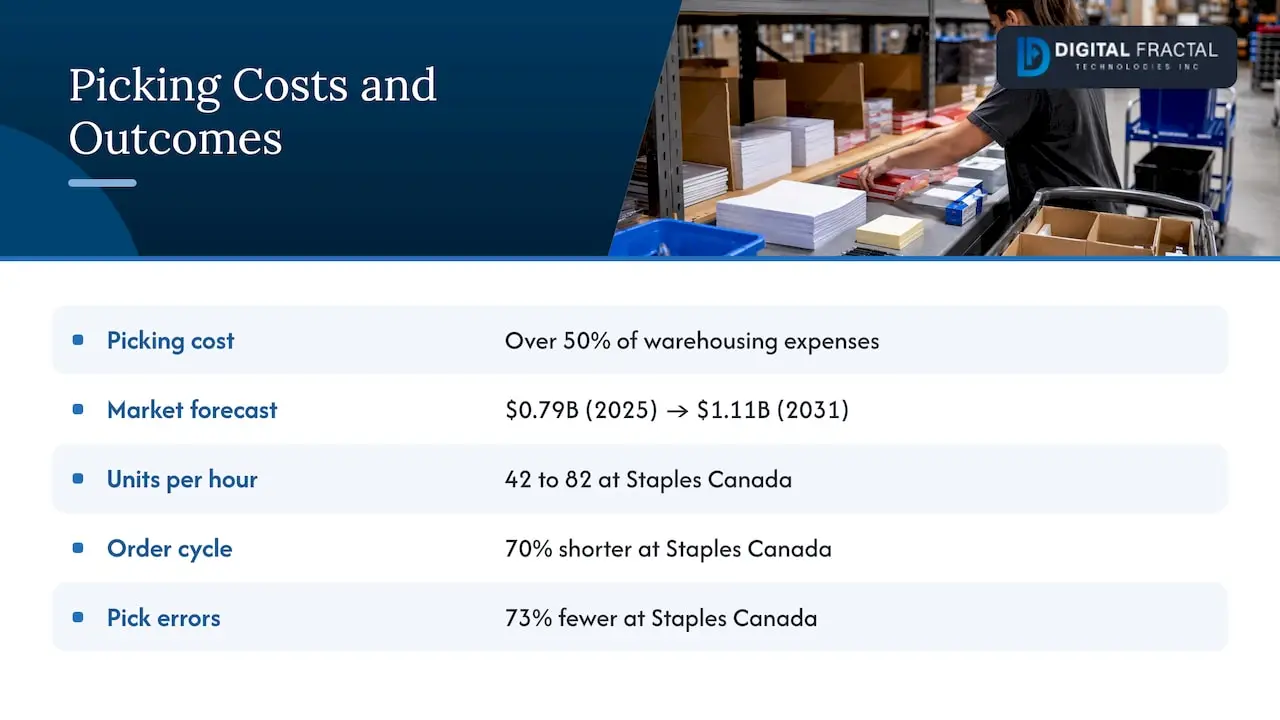
What good looks like is not abstract. Staples Canada redesigned its fulfillment model with robotics and new warehouse management processes. According to Supply Chain Management Review, units per hour rose from 42 to 82, order cycle time fell 70% and pick errors dropped 73%. That result combined technology with process redesign, which is the pattern worth copying.
The five levers, in the order we would pull them
| Lever | What it changes | Typical starting question |
|---|---|---|
| Inventory accuracy | Whether the system knows where stock really is | How often does a picker find the bin empty or wrong? |
| Slotting | Where fast movers live | Are your top sellers near the dock and at waist height? |
| Picking method | How orders are grouped | Do pickers walk the floor for one order at a time? |
| Pick path | The route through the aisles | Who decides the sequence of stops on a pick list? |
| Work design | Fatigue, safety, adoption | Would pickers describe the new system as help or surveillance? |
Most articles on this topic start with routing because it is the most visible. In practice we would start higher in the table, because the later levers depend on the earlier ones.
Start with inventory accuracy and cycle counting
Experts in warehouse optimization keep returning to one point: routing software is only as good as the stock data underneath it. If the warehouse management system says 12 units sit in a bin and the bin is empty, the picker walks the optimized route, finds nothing, and the order stalls. Every downstream gain is capped by that error rate.
Traditional cycle counting is a periodic chore: a clerk walks assigned locations with a scanner, often in a quiet window or during a shutdown. It finds errors days or weeks after they occur. Automated cycle counting changes the rhythm. Cameras on forklifts, fixed cameras or drones read labels and pallets as normal work happens, and the system only asks a person to check where the count disagrees with the record. The practical result is that stock-taking becomes a continuous by-product of operations instead of an event, and discrepancies get resolved in minutes instead of days.
If you are evaluating cycle count automation, a few questions help:
- Which locations cause the most pick failures? Start there, usually high-velocity pick faces and partial pallets.
- What does your WMS accept as input? An exception feed that cannot be written back into the system is just another report.
- What happens to an exception? Define who verifies it, how fast, and how the correction is logged.
- How will you measure success? Track inventory record accuracy and short-pick rate before and after.
Our article on how AI improves custom inventory systems goes deeper on the data side, and AI inventory optimization covers the planning layer above it.
Slotting: put the right stock in the right place
Slotting decides where each SKU lives. It is the cheapest travel reduction you can buy because it costs thinking time rather than equipment. The principles are well known:
- Place high-velocity items closest to the pack-out or dock, so the most frequent trips are the shortest.
- Keep heavy and bulky items at waist level to reduce strain, and keep light, small items higher or lower.
- Put items that are often ordered together near each other, so one stop serves several lines.
- Re-slot on a schedule, because demand shifts with season, promotions and customers.
The last point is where data work pays off. A slotting plan that was right in January can be wrong by June. A model that reads order history and proposes moves, ranked by travel saved against labor to move, turns re-slotting from an annual project into a routine.
Picking methods: choose how orders are grouped
The common methods are discrete, batch, cluster, zone, wave and case picking, and each runs with a pick path such as S-shape or return. None is best everywhere. The right choice depends on order profile.
- Discrete picking: one picker, one order. Simple and accurate, but travel per line is highest when orders are small.
- Batch picking: a picker collects several orders in one round and sorts later. It cuts travel when many orders share items, and it adds a sorting step.
- Cluster picking: a picker carries a cart with a tote per order and picks several orders in one pass, which avoids a separate sort.
- Zone picking: pickers stay in an area and orders pass between zones. It reduces congestion and walking, and it needs balancing between zones.
- Wave picking: orders are released in timed groups to match carrier cutoffs or dock schedules.
A useful rule: if your orders average one or two lines, batching or cluster picking usually pays. If they average fifteen lines across a large footprint, zone picking is worth testing. Run the comparison with your own order data rather than with a rule of thumb.
Pick path optimization: simpler than it sounds, harder than it looks
A pick path is the route a picker takes to collect every line on a pick list. Optimizing it means choosing the rule that generates routes, not redrawing one route by hand. The textbook problem resembles the Traveling Salesman Problem, and software can find the shortest possible route for a list.
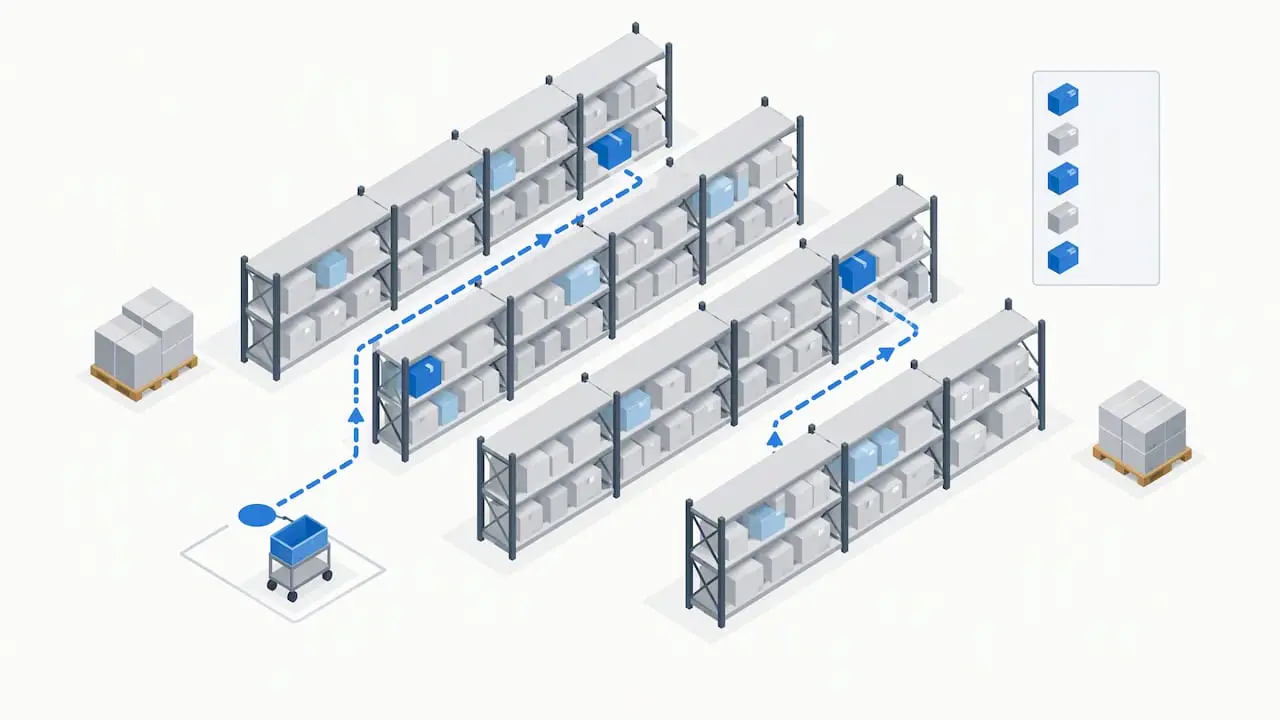
The shortest route is not always the best one. Real aisles have people in them. A mathematically ideal path can send three pickers into the same narrow aisle, create confusing turns or force awkward reaching. Practitioners therefore often prefer robust, near-optimal rules such as S-shape or midpoint routing over complex algorithms that produce routes pickers cannot follow intuitively.
That is why the hybrid approach works best: routing logic that knows your layout, your slotting and your congestion points, then presents the route in a way a person can follow. For picking route optimization, a good evaluation checklist is:
- Measure current travel distance and time per line on a sample of pick lists.
- Simulate two or three routing rules on the same lists using your real layout.
- Add constraints: one-way aisles, equipment, weight limits, congestion caps.
- Pilot the winner in one zone for two weeks and compare with the control zone.
- Keep a human override. Pickers see blocked aisles before any system does.
Systems like this can also learn. As the pilot collects timings, the model can adapt estimates for congested hours, a step static rules cannot take.
Where AI genuinely helps in the pick process
AI is not a replacement for the fundamentals above. It is a multiplier once they are in place. The places we see it fit best:
- Vision for verification and counting. Cameras can confirm the right item and quantity at pick and support continuous inventory counts. Our guide to how AI vision systems work in order picking explains the mechanics and what data you need.
- Dynamic routing and batching. Models that rebuild batches as new orders arrive, instead of releasing fixed waves.
- Labor planning. Matching staffing to forecast volume and zone load. See AI workforce scheduling for warehouses.
- Orchestration. Industry analysis of warehouse automation shows adoption rising from roughly 5% to 25% over a decade, with attention moving from buying hardware to integrated software that gives real-time control and visibility, and to incremental, scalable rollouts instead of all-at-once overhauls.
Your WMS matters here too. If you are choosing or replacing one, our overview of WMS software options lays out the criteria. For the wider set of quick wins in logistics, see automation use cases that deliver ROI in 90 days.
Design for the people doing the work
The factor most often missed is how the system feels on the floor. Automation that raises fatigue, or that pickers read as a tool for policing their speed, will be worked around. Automation framed as removing heavy lifting and walking gets adopted faster. A Locus Robotics article on human-centered automation describes feedback from Staples Canada pickers that centers on not having to carry items, and links that kind of design to safety and retention.
Practical steps:
- Involve a few experienced pickers when you test routes. They will find the aisle problem in a day.
- Report team and zone metrics before individual ones, at least in the first months.
- Track ergonomic indicators such as reach height and carry distance, not just picks per hour.
- Explain what data is collected and what it is used for.
Our perspective: audit first, then automate one thing well
We work with logistics, construction and oil and gas operators, and the pattern is consistent. Teams arrive asking for a route optimizer or a vision system. When we look at the operation, the biggest constraint is often upstream: records that do not match the shelf, orders that arrive in a shape that defeats the pick method, or data trapped in systems that do not talk to each other.
That is why we do not sell generic, off-the-shelf consulting. We start with an AI readiness audit that maps the workflow, the systems and the data, and ranks automation opportunities by value and difficulty. Then we build tailored solutions around your layout, your WMS and your goals, aiming for tangible change inside 90 days. A narrow pilot, such as continuous counts on your fastest pick faces or dynamic batching in one zone, proves its value on your numbers before anyone commits to a larger program.
The case for picking: it is where the money is, so it is where careful, measured automation pays first.
— Souhail
A 90-day plan for your pick floor
- Days 1 to 15: baseline. Measure travel time per line, pick accuracy, short-pick rate, inventory record accuracy and units per hour by zone. Collect a month of order data and your layout.
- Days 15 to 30: diagnose. Rank causes of lost time. Typical findings are bad slotting, stale inventory records and poor batching.
- Days 30 to 60: fix the foundation and pilot. Correct the top inventory problems, re-slot the fastest movers, and launch one pilot (routing, batching or counting) in a single zone with a control zone.
- Days 60 to 90: measure and decide. Compare pilot against control, collect picker feedback, and decide whether to extend, adjust or stop.
Keep the scope small. The Staples Canada example shows large gains, but it came from changing the process around the technology, not from the technology alone.
Start with an AI readiness audit
If you want an outside view of where AI would help your picking operation, our AI Readiness Audit is the usual first step. It is a one-off engagement priced at $2,500 to $10,000, and it ends with a ranked list of automation opportunities tied to your workflows and systems. From there, our workflow automation and AI implementation services turn the chosen opportunity into a working solution. Our AI readiness checklist is a good way to prepare before we talk.
FAQ
What is the fastest way to improve order picking?
Fix what costs the least first: correct inventory records for your fastest-moving locations and re-slot top sellers closer to the dock. Then test a batching or cluster method on a single zone. These changes need data and discipline rather than capital, and they make later routing software more effective.
What is the difference between pick path optimization and picking method?
The picking method decides how orders are grouped, for example discrete, batch, cluster or zone. The pick path decides the route a picker walks through the aisles to collect those lines. You usually choose the method first, then the routing rule that fits it.
How does automated cycle counting help picking?
It keeps the system’s stock records close to physical reality, so pickers find what the screen promised. Instead of periodic manual counts, cameras or scanners check locations continuously and flag only the mismatches for a person to verify. That cuts short picks and removes the need for shutdowns to count.
Do we need robots to optimize order picking?
No. Many gains come from slotting, batching, routing rules and accurate inventory. Robots and other automation make sense when volumes, labor constraints or space justify them, and an incremental rollout carries less risk than replacing the whole operation at once.
Sources
- Staples Canada rethinks its fulfillment model, Supply Chain Management Review
- The Integration of Human Factors to Warehousing and Manual Order Picking Operations
- Joint Order Selection, Allocation, Batching and Picking for Large Scale Warehouses
- Canada E-commerce Warehouse Market report, Mordor Intelligence
- Warehouse Automation industry update
- Human-Centered Warehouse Automation for Safety and Retention, Locus Robotics