
Invoice Data Extraction for Canadian Businesses in 2026

What AI-powered invoice data extraction actually does for your bottom line
AI-powered invoice data extraction automatically captures, interprets, and validates invoice fields using a combination of optical character recognition, large language models, and arithmetic reconciliation logic. The result is structured, ERP-ready data without a human touching the document. For Canadian companies in logistics and construction, where invoice volumes are high and vendor formats vary wildly, that matters.
Key benefits worth knowing before you commit to any platform:
- Speed: Specialized enterprise platforms can process an individual invoice in under 7 seconds from receipt to ERP posting.
- Accuracy: Layout-agnostic AI reads invoices by semantic meaning rather than rigid templates, reducing the maintenance burden that kills traditional OCR setups.
- Compliance: Canadian deployments must align with PIPEDA and financial reporting standards, including vendor tax ID validation and secure data handling.
- Audit readiness: Professional-grade systems link every extracted field back to the source document, which is non-negotiable for CRA audit trails.
- Cost reduction: Efficiency gains enabling much faster processing translate directly into AP headcount savings for mid-to-large operations.
Digitalfractal specializes in tailored AI integration for Canadian industries, including logistics and construction, where invoice complexity is the norm rather than the exception.
Table of Contents
- How the AI pipeline actually works, and where most implementations break
- Digitalfractal gives Canadian operations a faster path to working automation
- Key Takeaways
How the AI pipeline actually works, and where most implementations break
Modern invoice processing runs through four distinct stages. Understanding each one helps you ask the right questions before signing any contract.
Stage 1: Document ingestion and OCR. The system accepts PDFs, scanned images, or phone captures and converts them to machine-readable text. Modern parsing APIs use a multi-stage pipeline: OCR or native text-layer parsing, semantic field identification using LLMs, arithmetic validation, and mapping to standardized schemas like EN 16931.

Stage 2: Semantic extraction. This is where AI-powered tools separate themselves from legacy software. Layout-agnostic extraction interprets documents by semantic meaning rather than strict templates, so a new vendor format does not break your workflow.
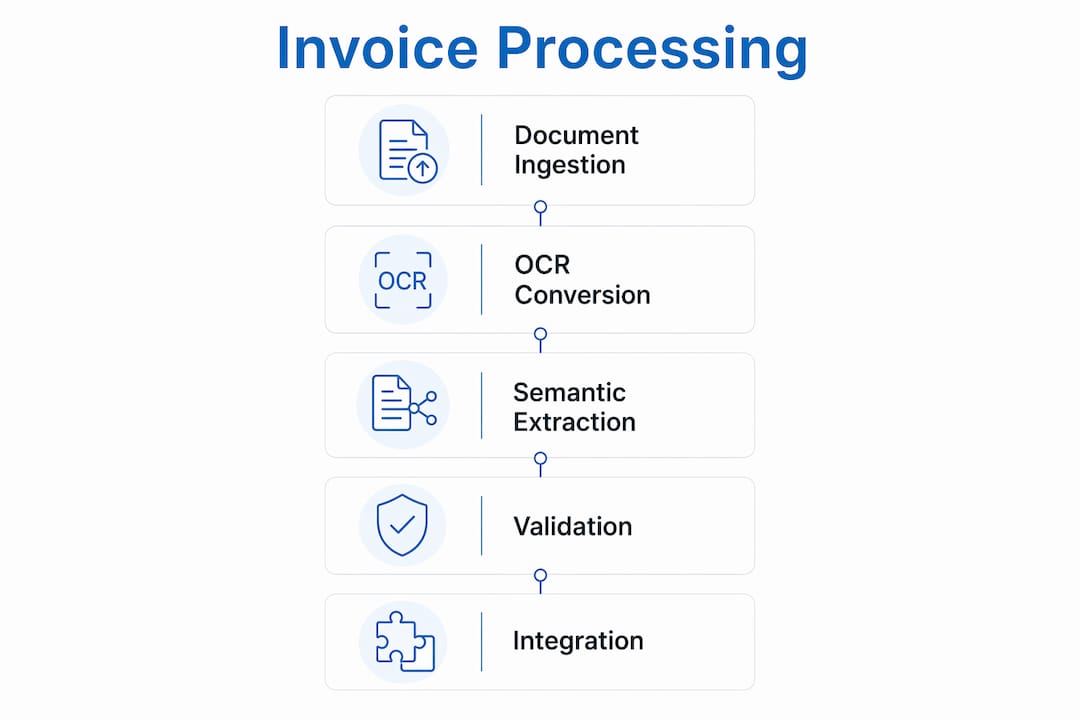
Stage 3: Arithmetic validation. Before any data touches your ERP, the system validates extracted totals and flags discrepancies. Skipping this step is how bad data gets posted and audits get messy.
Stage 4: ERP mapping and audit trail. Structured JSON maps to your GL codes. A complete audit trail linking extracted fields to source document pages is critical for compliance and dispute resolution in construction and logistics.
A hybrid approach mixing prebuilt AI models and custom-trained models is recommended to handle both standard invoices and complex, industry-specific vendor invoices — one-size-fits-all solutions consistently underperform in high-variety environments.
Pro Tip: Before selecting any AP automation platform, map your common vendor invoice formats. If a significant portion use non-standard layouts, a custom-trained model layer is worth the additional setup cost.
Key technical components to confirm with any vendor:
- LLM-based semantic field extraction (not just template OCR)
- Arithmetic reconciliation before ERP posting
- Audit trail with field-level source citations
- PIPEDA-compliant data handling and Canadian tax ID validation
- ERP connector compatibility (SAP, Oracle, Microsoft Dynamics, or your specific stack)
- Support for custom workflow automation when prebuilt models fall short
Digitalfractal gives Canadian operations a faster path to working automation
Skipping months of vendor evaluation and failed pilots is the real value Digitalfractal delivers. Rather than selling a generic platform, Digitalfractal runs an AI Readiness Audit that maps your specific invoice types, ERP environment, and compliance requirements before recommending any technology stack.
That audit-first model means the automation you deploy actually fits your workflows in logistics or construction, not a hypothetical average business. Many clients reach working automation within a few months. Use the workflow automation savings calculator to estimate your ROI before the first conversation, then book your AI Readiness Audit to get a plan built around your actual operations.
Key Takeaways
AI-powered invoice data extraction cuts processing time and errors when built on semantic AI, arithmetic validation, and PIPEDA-compliant audit trails tailored to your operation.
| Point | Details |
|---|---|
| Speed benchmark | Specialized enterprise platforms can process an individual invoice in under 7 seconds from receipt to ERP posting. |
| Hybrid AI strategy | Combining prebuilt and custom-trained models handles diverse vendor formats that template OCR cannot. |
| Validation before posting | Arithmetic reconciliation must happen before ERP integration to prevent bad data and audit exposure. |
| Canadian compliance | PIPEDA alignment, vendor tax ID validation, and field-level audit trails are required, not optional. |
| Digitalfractal approach | An AI Readiness Audit maps your invoice types and ERP stack before any technology is deployed. |