AI-Powered Email Personalization for B2B Marketing | Digital fractal, Edmonton, AB

AI is transforming B2B email marketing into a precision tool. It uses machine learning to tailor emails based on job roles, behaviours, and company data, leading to better engagement and ROI. Here’s what you need to know:
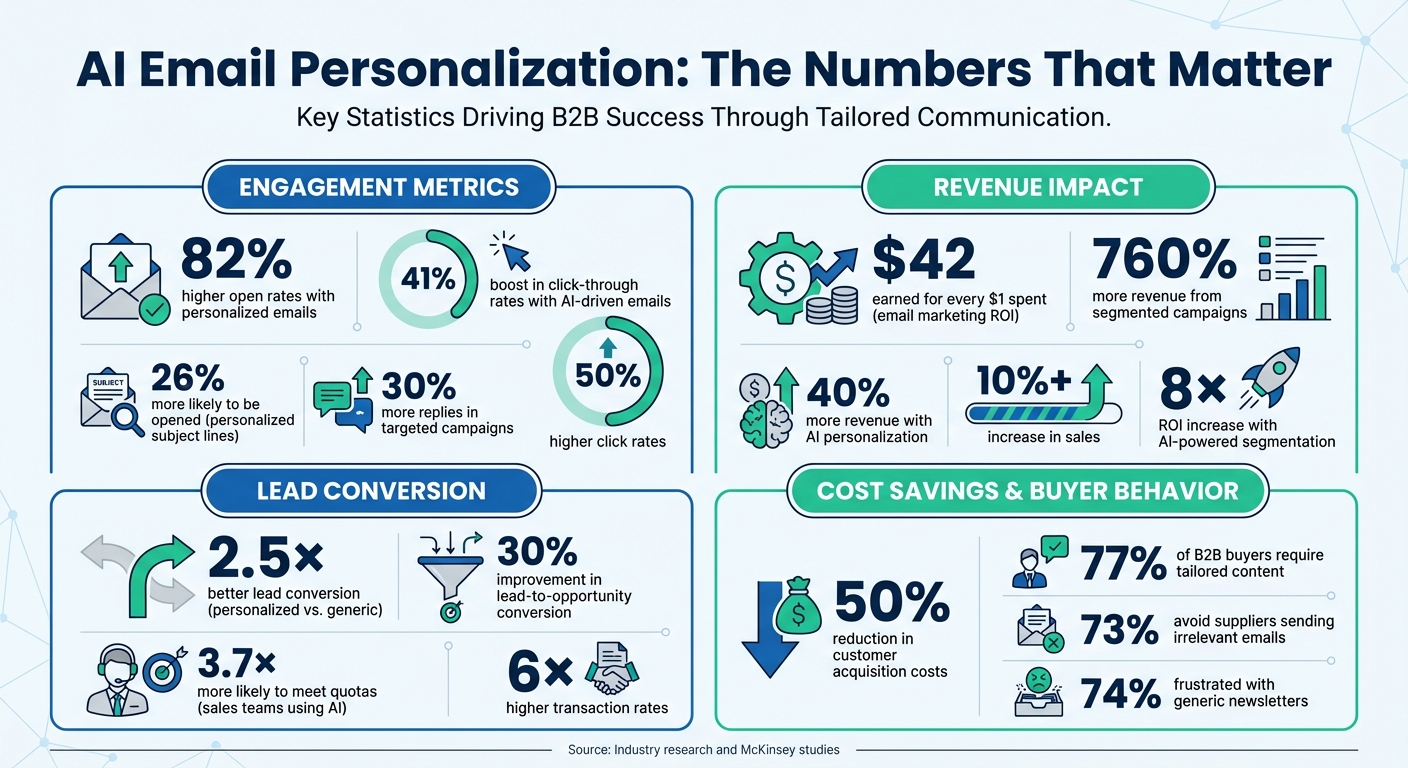
- Why it matters: Generic emails no longer work. Personalized emails see 82% higher open rates, while AI-driven ones boost click-through rates by 41%.
- Industries thriving: Energy and construction sectors leverage AI to manage complex sales cycles and target decision-makers like CFOs and VPs.
- Key stats: Companies using AI for personalization report up to 760% more revenue from segmented campaigns and 10%+ sales growth.
- Challenges: Success depends on clean data and balancing automation with human oversight.
AI-driven tools, like those from Digital Fractal Technologies Inc, simplify this process by centralizing data and automating real-time personalization. For businesses, this shift is no longer optional – it’s how you stay competitive in today’s market.
AI Email Personalization ROI Statistics for B2B Marketing
1. Energy Sector
Email Engagement Metrics
In Canada’s energy sector, AI-powered personalization is reshaping email engagement by delivering precise, action-oriented messages. For example, trigger-based marketing – where companies respond to specific customer actions like searching FAQs or experiencing bill shock – has shown acceptance rates of 20–30%. This approach is a game-changer, especially when you consider that 74% of customers feel frustrated with generic newsletters. Timing is everything: responding to a customer trigger within 24 hours often outperforms sending a polished but delayed message days later.
Tailored subject lines and AI-generated variations are also making a big impact. These strategies have led to a 26–29% increase in email open rates and a 41% boost in click-through rates. Energy providers can use their wealth of customer data – like energy consumption patterns and contract history – to craft highly relevant messages. For instance, high-energy users might receive offers for photovoltaic installations, while customers showing signs of churn (e.g., frequent FAQ searches) can be targeted with retention strategies.
ROI Improvements
The financial benefits of AI personalization in the energy sector are undeniable. Personalizing content effectively can lead to over a 10% increase in sales while delivering a return on marketing investment of five to eight times the initial spend. Additionally, customer acquisition costs can drop by nearly 50% when personalized approaches are used.
One compelling example comes from a McKinsey study, where an energy company used just a few key data points to identify customers with an 85% likelihood of cancelling their electricity contracts. By acting swiftly with tailored retention messages, the company reduced churn by 15 percentage points compared to a control group.
"Companies that provide effective personalized content can increase sales by 10 per cent or more, as well as delivering five- to eightfold improvements in their return on marketing spending." – Marcel Meuer, Jan Middelhoff, João Segorbe, and Kai Vollhardt, McKinsey & Company
Scalability and Integration Challenges
Scaling AI personalization from pilot projects to full-scale operations presents unique challenges for energy companies. Interestingly, the biggest hurdle isn’t technical – it’s cultural. Organizations need to shift from a perfectionist mindset to an agile, "test-and-learn" culture. This means moving from running 2–5 campaigns per month to managing 20–30 campaigns across cross-functional teams like marketing, IT, and analytics.
Data quality is another sticking point. The old saying "garbage in, garbage out" applies here – poorly organized or incomplete data can hinder AI’s ability to create accurate customer segments. For instance, inconsistent industry labels like "Utilities" versus "Energy Services" can cause issues. However, companies don’t need a fully developed data lake to get started. Basic data, such as consumption patterns, billing history, and interaction records, is often enough to identify promising opportunities.
Digital Fractal Technologies Inc offers a practical solution with their custom CRM systems and AI-driven tools. These systems centralize data and automate real-time personalization, helping energy companies overcome these challenges. Their approach highlights how AI can deliver timely, hyper-relevant communications, setting a strong foundation for similar advancements in other industries.
sbb-itb-fd1fcab
Use AI to Help Personalize B2B Emails
2. Construction Sector
Just like in the energy industry, the construction sector is using AI to turn email marketing into a highly targeted, data-driven approach.
Email Engagement Metrics
Construction companies are seeing big gains in how their emails perform. Moving beyond basic first-name personalization, they now use detailed data points – like office expansions, new executive hires, or recent tech upgrades – to craft messages that create a sense of urgency. By keeping their core message consistent and using AI to adjust subject lines, introductions, and framing for specific roles, these campaigns have seen an 82% boost in opens, 30% more replies, and 50% higher click rates.
For example, a CFO might receive an email focusing on ROI projections, while a VP of Operations gets details about technical specs – all within the same campaign. Emails with personalized subject lines are 26% more likely to be opened, and personalized campaigns outperform generic ones by 2.5× in lead conversion. These strong engagement numbers are crucial for navigating the long sales cycles that are typical in the construction industry.
Sales Cycle Impact
In construction, sales cycles can stretch over months, requiring ongoing communication and relationship-building before contracts are finalized. AI-driven email marketing helps maintain this critical dialogue. Automated follow-up sequences address a common issue: 80% of sales require five or more follow-ups, but most reps stop after four. AI ensures these follow-ups happen at just the right intervals, keeping potential clients engaged without overwhelming them.
AI also speeds up the process with predictive lead scoring, which identifies high-priority prospects based on their actions – like downloading a whitepaper or visiting a pricing page. This allows sales teams to focus their energy on the most promising leads. Companies that use AI to deliver actionable insights instead of just asking for meetings have seen their revenue grow by 41%. By offering immediate value, businesses can significantly improve their sales outcomes.
ROI Improvements
The financial benefits of AI-driven personalization in construction are impressive and align with trends in other industries. Companies using AI for personalization generate 40% more revenue from their marketing efforts compared to those that don’t. Additionally, AI-powered segmentation and intent analysis can increase ROI by as much as 8× compared to static prospect lists. Personalized emails also drive six times higher transaction rates and account for 58% of all email revenue.
However, these results rely heavily on having clean, accurate data. Poor data quality costs businesses an average of $12.9 million annually. To tackle this, companies like Digital Fractal Technologies Inc provide custom CRM systems that centralize data from various sources. This ensures that AI tools have access to reliable, structured information. Their expertise in the construction industry helps them identify critical data points – such as project timelines, bid submissions, and equipment inventories – that are essential for effective personalization.
Scalability and Integration Challenges
Scaling AI personalization in the construction sector requires a careful balance between automation and human input. AI can analyze digital content and generate personalized email openers in seconds, a task that would take a sales rep 5–10 minutes. This allows human reps to focus on refining the message and driving meaningful conversations. As SalesHive puts it:
"The best AI personalization doesn’t replace your SDRs – it replaces the blank page, so humans can focus on judgment, accuracy, and moving conversations forward".
That said, integrating AI tools successfully requires technical know-how, and training teams to use these tools effectively can be a challenge. Additionally, construction firms must manage risks like email deliverability issues. Sending too many AI-generated emails too quickly can trigger spam filters, so it’s important to gradually warm up domains and limit daily send volumes per inbox. On the bright side, advancements in AI are making production faster: by 2025, only 6% of teams will need two weeks or more to produce a single email, compared to 62% in 2024.
Pros and Cons
AI-driven email personalization offers clear advantages for businesses but also presents some challenges, particularly around data accuracy and technical expertise.
Benefits: Email marketing delivers an impressive return on investment, with an average of $42 earned for every $1 spent. Segmented campaigns can drive up to 760% more revenue compared to generic email blasts. Sales teams benefit significantly as well – those using AI are 3.7× more likely to meet their quotas. Predictive lead scoring further enhances performance, improving lead-to-opportunity conversion rates by 30%. Personalization has become essential, with 77% of B2B buyers unwilling to make purchases without tailored content and 73% actively avoiding suppliers who send irrelevant emails.
Drawbacks: The effectiveness of AI depends heavily on accurate data. Errors in data can lead to misleading outputs, undermining trust and performance. A lack of technical expertise poses another hurdle – 67% of marketers cite insufficient training as a key barrier to optimizing AI tools, and only 26% of organizations currently offer AI training programs. Additionally, AI can sometimes "hallucinate", fabricating details about a prospect’s role or company, which can be particularly damaging in sectors where trust is critical. Overzealous scaling of email volume can also backfire, triggering spam filters and harming your domain’s reputation.
| Factor | Energy Sector | Construction Sector |
|---|---|---|
| Engagement Rates | 30%+ engagement boost for complex buying groups | Significant lift when targeting project triggers or hiring spikes |
| ROI | Potential for 760% revenue growth through deep segmentation | Strong ROI ($42:1) by automating follow-ups in lengthy sales cycles |
| Scalability | High; AI manages outreach across diverse roles like CFOs and VP Operations | High; AI supports high-volume outreach to contractors and firms |
| Data Integration | Critical; requires firmographic and technographic data integration | Essential; needs real-time updates on project timelines and intent signals |
| Resource Needs | Heavy focus on human-led strategy for enterprise-level messaging | Emphasis on automated drip campaigns to capture missed opportunities |
These insights highlight the importance of combining AI with human expertise. As SalesHive explains:
"The best AI personalization doesn’t replace your SDRs – it replaces the blank page, so humans can focus on judgment, accuracy, and moving conversations forward".
Companies like Digital Fractal Technologies Inc are helping businesses bridge the gap by offering custom CRM systems that centralize data from multiple sources. With a focus on critical elements like project timelines, regulatory updates, and equipment inventories, they ensure businesses have the tools needed for effective and targeted personalization.
Conclusion
AI-driven email personalization is transforming the way B2B email marketing operates. For industries like energy and construction, where managing intricate buying committees is a challenge, this technology offers measurable improvements. As highlighted in this analysis, personalized email campaigns consistently achieve better results than generic ones, particularly in engagement and revenue growth.
To achieve these outcomes, everything starts with clean and reliable data. Begin by auditing your CRM system – correct any inconsistencies in fields like industry classifications, job titles, and company sizes before integrating AI tools. Start small with manageable initiatives, such as testing subject lines or optimizing send times, to demonstrate value before advancing to more complex tasks like full content generation.
For construction firms, focus on firmographic signals like revenue growth trends and project timelines. Energy companies, on the other hand, should prioritize technographic data and regulatory compliance triggers. AI can help identify critical buying signals and ensure timely engagement, often within a crucial 24–48 hour window.
"AI provides the scale, but humans provide the soul" (Kas Andz, Founder, The B2B Labs).
To maintain trust in high-value enterprise deals, it’s crucial to establish thorough review processes to catch any AI-generated errors or inaccuracies. Additionally, limit email volumes to protect your domain reputation and avoid overwhelming recipients with excessive communication.
Digital Fractal Technologies Inc supports this approach by offering tailored CRM systems that consolidate data from various sources. This ensures your AI tools operate with accurate, real-time information, covering everything from project schedules to regulatory updates and equipment inventories.
The shift from generic templates to targeted, value-driven outreach is no longer optional – it’s essential. Consider embedding mini-consultations or technical audits directly into your emails. By adopting a human-in-the-loop strategy, where AI handles drafting and marketers oversee the strategy, businesses can strike the perfect balance for long-term success. This collaborative approach underscores AI’s growing influence in reshaping B2B email marketing.
FAQs
How can AI enhance email open rates and engagement in B2B marketing?
AI takes B2B email marketing to the next level by using data-driven personalization to create messages that resonate deeply with recipients. It fine-tunes subject lines, schedules emails for peak engagement times, and adapts content dynamically to suit each individual. These smart adjustments make emails more compelling, boosting both open rates and click-through rates.
With AI, businesses gain sharper insights into their audience, enabling them to build stronger connections and communicate more effectively. This not only enhances engagement but also fosters lasting relationships.
What challenges do businesses face when using AI for email personalisation in B2B marketing?
Using AI to personalise emails in B2B marketing isn’t without its challenges. One of the biggest obstacles is handling complex data. Many companies face issues with messy, inconsistent, or low-quality customer information. This makes it tough for AI to craft content that feels truly tailored. Plus, cleaning, merging, and managing data across large systems takes a lot of time and effort.
Another key challenge is privacy and regulatory compliance. In Canada, organisations must navigate rules like PIPEDA while respecting customer consent preferences. Missteps here could lead to data misuse or breaches. On top of that, outdated IT systems and a shortage of AI talent can make rolling out and fine-tuning AI solutions more difficult.
Finally, keeping the human element in email communication is essential. AI-generated emails can sometimes come across as robotic or impersonal, which can hurt engagement. By focusing on clean data, staying compliant, and blending AI with human input, businesses can deliver emails that feel both personalised and authentic.
How does AI-powered email personalization drive sales growth and improve ROI?
AI-driven email personalization has proven to be a game-changer for boosting sales. By tailoring content to match the specific interests and needs of recipients, businesses can see conversion rates soar by as much as 82%. This kind of precision helps brands connect with their audience on a deeper level, making their messages far more impactful.
When it comes to return on investment, the numbers speak for themselves. AI-powered email campaigns can deliver exceptional results, with businesses earning an estimated $36 for every $1 spent. By using AI to craft smarter, data-informed strategies, companies not only optimize their marketing budgets but also build stronger, more meaningful relationships with their customers.