Best Fleet Management Software for Canadian Businesses in 2026

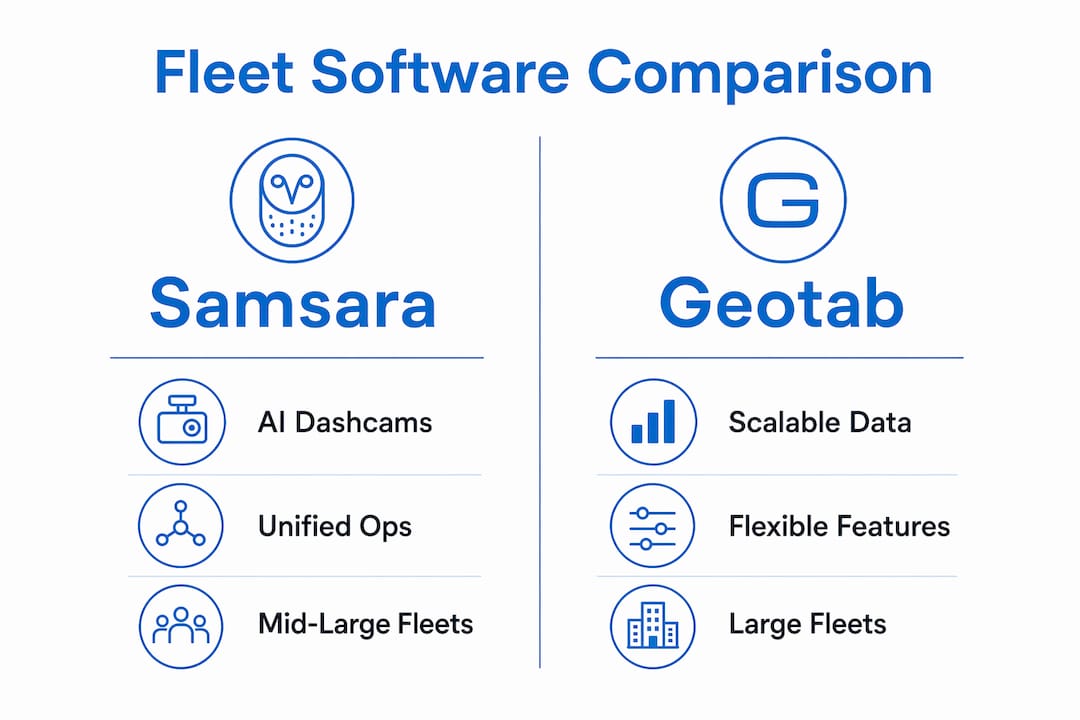
For Canadian fleets weighing their options in 2026, two AI-driven platforms stand above the rest: Samsara and Geotab. Samsara wins for mid-to-large fleets that want AI dashcam safety and a unified operations platform under one vendor. Geotab wins for large enterprises and government fleets with internal IT teams that need deep analytics, open API access, and global compliance across 160+ countries. The right pick depends on three things: your fleet size, your IT capacity, and whether video-based safety or data depth drives the decision.
| Feature | Samsara | Geotab |
|---|---|---|
| Best for | Mid-to-large fleets needing AI dashcams and unified ops | Large enterprises with IT teams needing deep customization |
| Key AI features | AI dashcams, real-time driver coaching, predictive maintenance | Advanced analytics, AI-powered reporting, open data pipelines |
| Customizability | Moderate; controlled hardware and software ecosystem | High; open SDK, API, and extensive marketplace integrations |
| Integration capabilities | TMS, ERP, QuickBooks, NetSuite, Sage, Samsara App Marketplace | Open API, MyGeotab SDK, broad third-party ecosystem |
| Ease of use | High; intuitive interface, direct vendor support | Moderate; steeper learning curve, reseller-dependent support |
| Fleet size suitability | 25+ vehicles, mixed assets | 100+ vehicles, enterprise and government |
| Deployment considerations | Direct sales, multi-year hardware-leasing contracts | Reseller-only model; dealer quality shapes your experience |
Modern fleet management has moved well past GPS dots on a map. AI-driven operational intelligence now processes vehicle data to predict maintenance failures before they happen and coach drivers toward safer behavior in real time. For Canadian logistics operators, that shift means the software choice carries real operational and safety consequences.
Table of Contents
- How Samsara and Geotab compare for Canadian fleet managers
- How to choose the best fleet management software for your business
- What does a typical AI fleet software deployment look like?
- What ROI do Canadian fleets actually see from AI fleet software?
- Digitalfractal helps you get more from your fleet software investment
- Key Takeaways
How Samsara and Geotab compare for Canadian fleet managers
The practical split between these two platforms comes down to one question: do you want a unified safety and operations stack, or a deeply configurable analytics engine?
- Samsara integrates GPS tracking, AI dashcams, ELD compliance, and driver coaching into a single subscription sold directly by the vendor. You get one contract, one support line, and one platform.
- Geotab delivers superior analytics depth through MyGeotab, with an open SDK and API widely regarded as the strongest in the category. The catch: it sells exclusively through authorized resellers, so your support experience depends heavily on which dealer you choose.
- On safety, Samsara uses dashcam footage for in-cab alerts and virtual coaching. Geotab uses Go Talk audio feedback, safety scorecards, and collision avoidance prompts. If video evidence is non-negotiable, Samsara has the edge.
- Geotab’s fuel management scores 9.6 on G2 user reviews, compared to Samsara’s 8.4. For fleets where fuel cost is the primary pain point, that gap matters.
- Samsara is generally regarded as easier to use compared to Geotab based on user feedback. New users and smaller operations teams feel that difference quickly.
- Geotab operates internationally with strong cellular support across multiple countries. Samsara is primarily North American. Canadian fleets with cross-border U.S. operations can use either, but multinational fleets lean Geotab.
- Samsara pricing typically runs $27–$33 per vehicle per month for ELD-only, up to $70–$95+ for the full platform. Geotab starts lower but full-platform costs vary by reseller.
Pro Tip: Before signing with either vendor, request a formal quote with your exact fleet size and feature set, then run the full three-year math including hardware costs and contract exit terms. The monthly per-vehicle number rarely tells the whole story.
How to choose the best fleet management software for your business
The best software choice depends heavily on your internal IT capacity. Dedicated data teams extract real value from Geotab’s open platform. Fleets without that resource are better served by Samsara’s turnkey approach.
Key selection criteria:
- Fleet size: Samsara fits 25+ vehicles; Geotab delivers its full value at 100+ with technical staff to configure it.
- IT capability: Geotab’s open API rewards teams that can build custom integrations and reports. Samsara’s API covers most enterprise use cases including TMS and ERP, but is not designed as an open development platform.
- Safety priority: Camera-led coaching and incident footage point to Samsara. Scorecard-based driver management and fuel analytics point to Geotab.
- Support model: Samsara’s direct sales model means one accountable vendor. Geotab’s reseller model means your experience varies with your dealer’s quality.
- Integration needs: Both connect to TMS and ERP systems. Fleets with mixed assets or complex multi-site reporting benefit from Samsara’s broader ecosystem. Fleets needing custom data pipelines benefit from Geotab’s SDK depth.
- Regulatory compliance: Canadian fleets operating under federal ELD mandates can use either platform. Geotab’s compliance tooling scales better across multiple jurisdictions.
For a structured view of where AI fits your current workflows, Digitalfractal’s AI integration benefits analyzer helps logistics teams map automation opportunities before committing to a platform.
What does a typical AI fleet software deployment look like?
Deployment follows a predictable sequence: needs assessment, hardware installation, software configuration, user training, and ongoing optimization. The hardware installation phase is where most delays occur, since vehicles must be taken offline briefly for device fitting.
Best practices to minimize disruption:
- Stage the rollout by depot or vehicle type rather than deploying fleet-wide at once.
- Assign an internal project owner who coordinates with the vendor or reseller throughout.
- Complete driver training before go-live, not after. Adoption problems are almost always training problems.
- Validate integrations with your TMS or ERP in a test environment before connecting live data.
- For Geotab deployments, vet your reseller’s technical service capability as carefully as the platform itself.
Samsara’s direct model includes dedicated implementation support on higher tiers. Geotab’s deployment quality depends on the reseller. Either way, use Digitalfractal’s AI implementation planner to map integration milestones against your existing systems before the hardware ships.
What ROI do Canadian fleets actually see from AI fleet software?
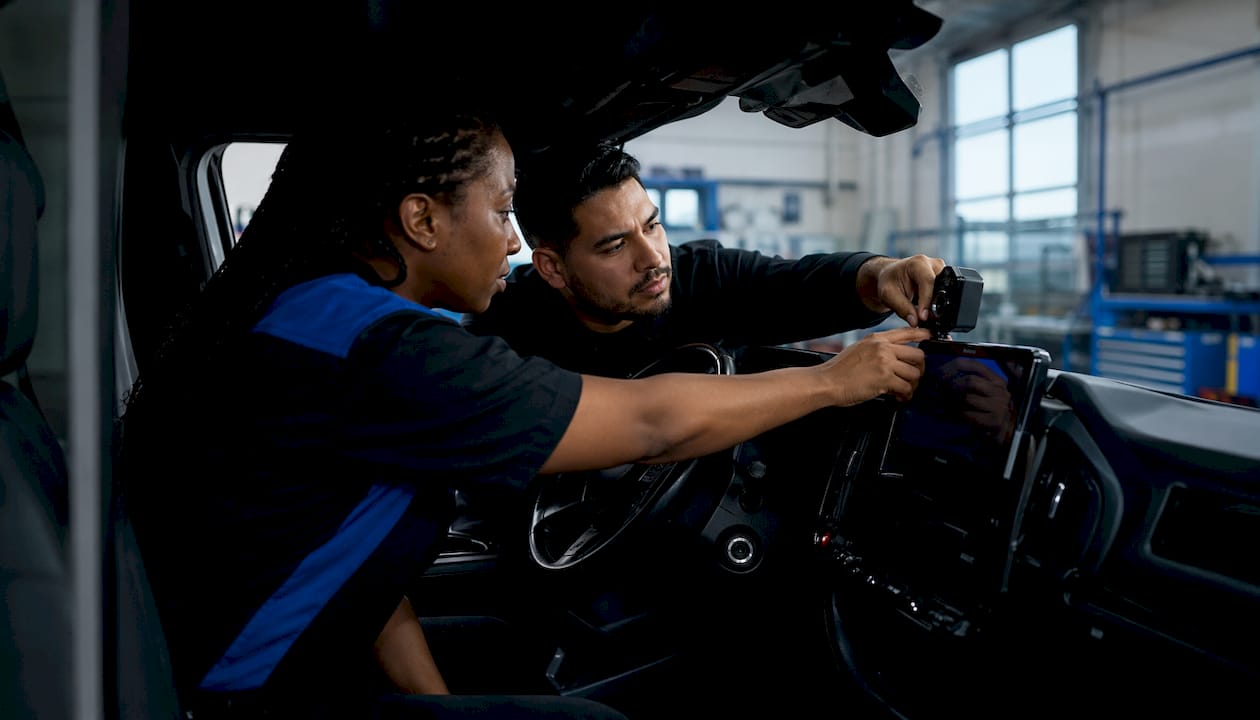
Geotab’s platform processes over 37 trillion data points annually from more than 5 million connected vehicles. That scale reflects real operational use, not just installed base. Fleets using predictive maintenance alerts reduce unplanned breakdowns by catching engine fault codes before they become roadside failures. Driver coaching through AI dashcams reduces harsh braking and distracted driving events, which lowers insurance claims and fuel consumption simultaneously.
For a parts compatibility checklist that pairs well with predictive maintenance programs, fleet managers running heavy trucks will find that combining telematics data with parts planning tightens maintenance cycles further. Canadian fleets that have integrated telematics with their TMS report faster dispatch decisions and cleaner IFTA mileage reporting, two areas where manual processes consistently create errors and audit risk.
Digitalfractal helps you get more from your fleet software investment
Picking Samsara or Geotab gets you the platform. Getting real operational returns from it requires connecting that platform to your existing workflows, ERP, and reporting systems in a way that actually changes how your team works.
Digitalfractal specializes in exactly that integration layer. Rather than a generic software rollout, Digitalfractal’s AI Readiness Audit identifies which workflows in your logistics operation are ready for automation, then builds the connectors and custom logic that turn raw telematics data into decisions your dispatchers and operations managers can act on. The result is a fleet management setup that works with your existing systems, not around them, delivered within a 90-day project timeline. Use the workflow automation savings calculator to estimate what that integration could save your operation before the first conversation.
Key Takeaways
Samsara and Geotab are the leading AI-driven fleet management platforms for Canadian businesses, and the right choice depends on fleet size, IT capacity, and whether safety cameras or analytics depth drives the decision.
| Point | Details |
|---|---|
| Platform fit by IT capacity | Geotab rewards teams with internal IT; Samsara suits fleets wanting a turnkey vendor-managed solution. |
| AI dashcam advantage | Samsara’s integrated AI dashcams lead on video safety; Geotab relies on third-party camera partners. |
| Pricing range | Samsara runs $27–$95+ per vehicle per month depending on bundle; Geotab starts lower but varies by reseller. |
| Deployment reality | Geotab’s reseller model means dealer quality shapes your rollout; Samsara’s direct model centralizes accountability. |
| Digitalfractal’s role | Digitalfractal connects fleet software to your existing ERP and workflows, turning telematics data into operational decisions within 90 days. |