Computer Vision Defect Detection for Manufacturers

What computer vision defect detection actually does on your production line
AI-driven computer vision defect detection automatically identifies, localizes, and classifies product flaws during manufacturing, replacing slow manual inspection with real-time automated decisions. Industry documentation from 2026 confirms accuracy levels surpassing 99% for defect detection, a threshold no human inspector can sustain across a full shift.
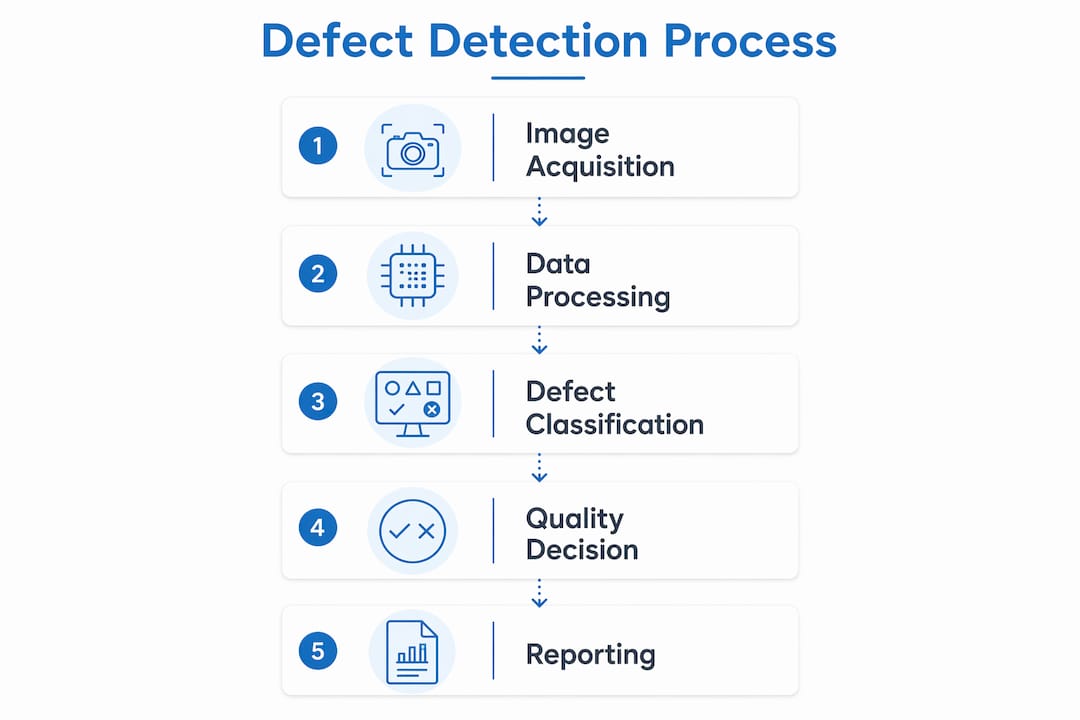
The architecture behind this has three core layers. First, image acquisition captures high-resolution frames from cameras positioned along the line. Second, defect localization pinpoints exactly where a flaw sits, using bounding boxes for object-level detection or pixel-level segmentation for precise boundaries. Third, automated classification assigns a defect type and severity, triggering downstream actions without human intervention. This integrated architecture is what separates modern AI inspection from older rule-based machine vision, which could only flag a handful of defect types at once.
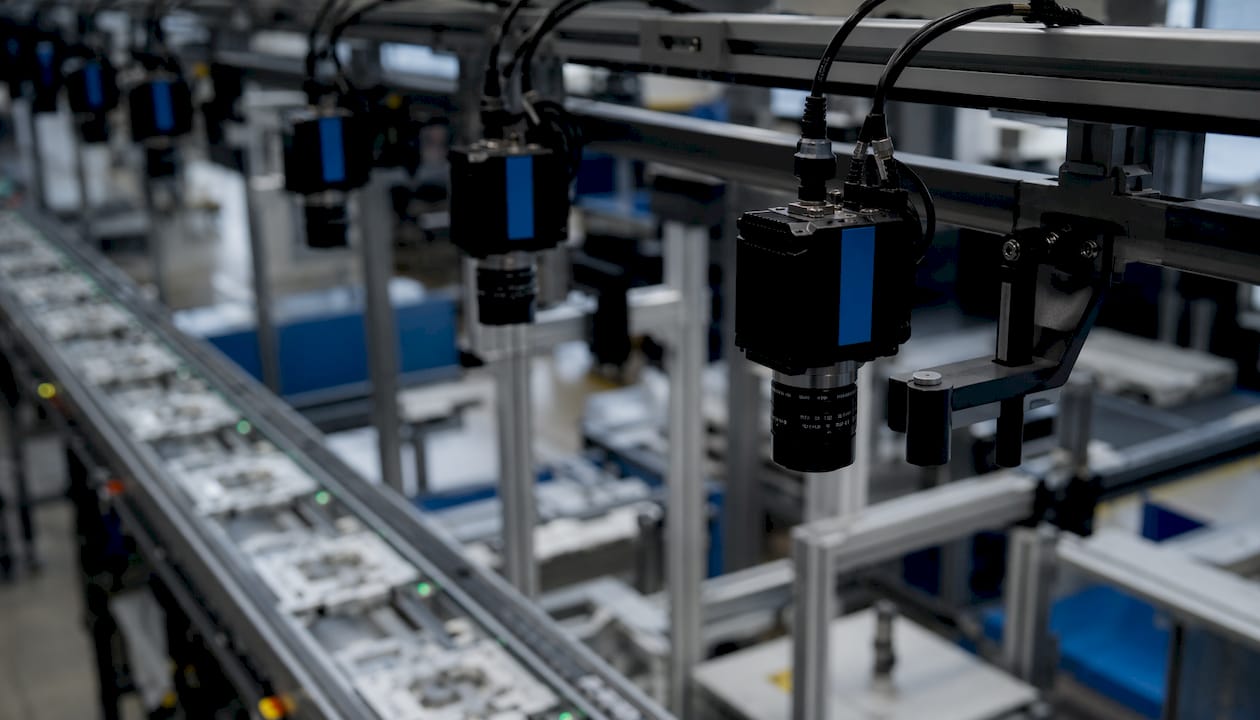
Common defect types the system catches include surface scratches, dents, cracks, dimensional deviations, discoloration, and material inconsistencies. AI models also handle poor image quality and varying lighting where traditional software simply fails.
Key benefits at a glance:
- Accuracy: Consistent defect detection accuracy surpassing 99% across high-volume production runs
- Speed: Real-time inspection synchronized with production line throughput
- Consistency: No fatigue, shift variation, or subjective judgment calls
- Labor savings: Frees quality staff for higher-value analysis and process improvement
- Scalability: Models adapt to new product lines without rebuilding from scratch
Table of Contents
- How AI outperforms traditional methods, and how to implement it in Canada
- Digitalfractal helps Canadian manufacturers deploy AI inspection that actually works
- Key Takeaways
How AI outperforms traditional methods, and how to implement it in Canada
Classical machine vision relies on hand-crafted feature engineering: engineers manually define rules for what a defect looks like. Deep learning skips that entirely. Models learn directly from labeled images, capturing complex, nonlinear patterns that no rule set could encode. That shift is why deep learning is now the baseline for serious industrial inspection.
For tiny defects, standard models struggle because downsampling layers compress a 15-pixel scratch into near-invisibility. Sliced Adaptive Inference (SAHI) solves this by subdividing high-resolution images into overlapping tiles, running inference on each tile, then merging results. A defect that disappears in a full-image pass becomes clearly detectable in a zoomed tile. Architectures like MFDH-Net push further, combining multi-scale feature fusion with cross-perception decoupling to achieve high mAP on dense industrial defect datasets at real-time speeds.
Data is the real bottleneck for most Canadian manufacturers. Annotated defect images are scarce, and class imbalance (hundreds of good parts for every defective one) skews model training. Semi-supervised and self-supervised learning methods reduce annotation burdens while maintaining accuracy. Synthetic anomaly generation, as used in the CLIP-MDC framework, fills dataset gaps by generating realistic defect variations the camera may rarely capture.
A practical implementation path for manufacturers:
- Define defect taxonomy — list every defect type, severity level, and acceptable threshold before touching a model
- Collect and annotate images — prioritize quality and diversity over volume; a few hundred well-labeled images beat thousands of poor ones
- Train and validate — use accuracy, mAP, and AUROC as your core evaluation metrics
- Integrate into the line — connect model outputs to your production control system via API or edge hardware
Pro Tip: Detection alone is not enough. Build a quality decision logic layer that translates AI output into operational commands: GRADE_A, REWORK, REJECT, or MANUAL_REVIEW. Without this layer, your team still makes every call manually.
Compliance matters too. Canadian manufacturers in automotive, aerospace, and medical devices must align inspection systems with ISO 9001 quality management requirements and sector-specific standards. Documenting model performance, validation datasets, and decision logic is not optional in regulated environments.
Digitalfractal helps Canadian manufacturers deploy AI inspection that actually works
If you are ready to move beyond manual inspection but not sure where your operation stands, Digitalfractal’s AI Readiness Audit gives you a clear picture fast. The audit identifies exactly where computer vision for quality control fits your current workflow, what data you already have, and what gaps need closing before deployment.
Digitalfractal builds tailored AI systems for Canadian manufacturers in automotive, oil and gas, logistics, and construction, with full implementation delivered within a 90-day timeline. No generic playbook. Use the AI Implementation Planner to map your first deployment, or check your digital transformation readiness before committing to a full build.
Key Takeaways
AI-driven computer vision defect detection delivers very high accuracy, real-time classification, and scalable quality control that manual inspection cannot match at production volume.
| Point | Details |
|---|---|
| Accuracy benchmark | Industry documentation confirms defect detection accuracy surpassing 99% with AI visual inspection. |
| Architecture essentials | Effective systems combine image acquisition, bounding-box localization, and automated classification. |
| Tiny defect challenge | SAHI subdivides high-resolution images into tiles so small defects survive the model’s downsampling layers. |
| Decision logic layer | AI output must feed a grading layer (GRADE_A, REWORK, REJECT) to produce operational actions, not just detections. |
| Digitalfractal | Provides AI Readiness Audits and custom inspection system builds for Canadian manufacturers within 90 days. |