Pipeline Leak Detection AI: A Canadian Decision-Maker’s Guide

AI-based pipeline leak detection delivers faster, more accurate alerts with fewer false positives than any legacy rule-based system. The right move for Canadian operators is to adopt a continuous-learning, multi-method approach and run an AI readiness audit before committing to a pilot. Systems like KROHNE’s PipePatrol NEO have recorded detection in as little as 30 seconds on a 31 km pipeline with ±0.6% location accuracy. That kind of performance is not theoretical.
Before your team touches a sensor or writes a pilot SOW, three things need to be true:
- Your SCADA, GIS, GMS, and maintenance records are unified and timestamped reliably
- You have a clear map of data gaps and OT/IT integration blockers
- You have defined pilot KPIs with explicit acceptance criteria
Schedule an AI readiness audit with Digitalfractal to produce that map and a 90-day pilot proposal in roughly 30 days.
Table of Contents
- Why does pipeline leak detection AI outperform rule-based systems?
- What sensing and software technologies power AI leak detection?
- What data and systems must be in place before AI can work?
- How does the rollout actually work: audit, pilot, then scale?
- What KPIs should executives track?
- What questions should you ask when evaluating AI integration partners?
- What are the Canada-specific compliance and risk considerations?
- How does Digitalfractal approach pipeline AI projects?
- How do you prepare your operations team for AI-based monitoring?
- Key Takeaways
- The gap between AI hype and what actually ships
- What Digitalfractal offers Canadian pipeline operators
Why does pipeline leak detection AI outperform rule-based systems?
Legacy systems set fixed thresholds. When pipeline conditions shift — product changes, equipment ages, operating modes evolve — those thresholds drift out of calibration. False alarms climb. Operator confidence drops. Eventually, crews start ignoring alerts.
Continuous-learning, multi-method systems solve this differently. KROHNE’s PipePatrol NEO combines physics-based hydraulic models with AI-driven pattern recognition that adapts automatically to changing operational data. The model tunes itself rather than waiting for an engineer to recalibrate it. Detection speed, localization accuracy, and false-alarm rates all improve over the pipeline’s lifecycle instead of degrading.
The operational payoff is concrete:
- Faster mean time to repair (MTTR) because crews get precise location data, not just an alarm zone
- Fewer unnecessary shutdowns from spurious alerts
- Measurable compliance improvements tied to documented detection events
- Stable sensitivity even during transient conditions like start-up, shutdown, and product changeovers
Pro Tip: Ask any vendor to show you a documented retraining and validation plan tied to live SCADA data. If they cannot produce one, their “AI” is a static model wearing a marketing label.
What sensing and software technologies power AI leak detection?
No single sensor covers every leak scenario. The strongest deployments layer multiple technologies and feed them into a unified software stack.

| Technology | What it measures | Detection strength | Deployment complexity |
|---|---|---|---|
| Inlet/outlet flow & pressure | Mass balance, pressure transients | Ruptures, large leaks | Low — usually existing instrumentation |
| Distributed acoustic sensing (DAS) | Acoustic emissions along fiber | Third-party interference, mid-line leaks | Medium — fiber installation required |
| Thermal imaging | Surface temperature anomalies | Above-ground liquid leaks | Medium — aerial or fixed cameras |
| Aerial/satellite sensors | Broad area gas plumes | Large methane releases | Low operational, high per-survey cost |
| LiDAR (component-level) | Spatial gas concentration | Pinhole leaks at specific components | Medium-high — specialized equipment |
| Laser gas analyzers | Parts-per-billion gas concentration | Very small leaks | High — mobile or fixed deployment |
On the software side, the architecture that matters is KROHNE’s NEPM: a dynamic hydraulic model simulates a “virtual pipeline” in real time, and an AI neural engine compares it against measured data to flag deviations. This approach handles transient conditions where pure data-driven models produce unreliable alarms.
SLB’s methane LiDAR camera adds component-level spatial resolution, allowing crews to repair a single fitting rather than survey an entire facility. For small pinhole leaks where acoustic and mass-balance methods struggle, ABB’s laser gas analyzers provide parts-per-billion sensitivity that catches what other sensors miss.
Hardware upgrades are typically required for DAS fiber, LiDAR deployment, and laser analyzers. Flow and pressure instrumentation, by contrast, usually already exists and needs software integration rather than new hardware.
What data and systems must be in place before AI can work?
Without unified, validated data from SCADA, GIS, GMS, and maintenance records with reliable timestamps, AI models cannot reach enterprise-grade sensitivity. Context is what separates a real leak from a transient noise event. Primate Technologies makes this point directly: unifying SCADA, GMS, GIS, sensors, weather, and security data into a single operational view surfaces true anomalies faster and gives operators the context to distinguish leaks from noise.
Required data feeds for a production-ready system:
- Real-time flow, pressure, and temperature at inlet, outlet, and intermediate points
- Valve states and actuator telemetry
- Historian access with sub-minute sampling rates
- GIS pipeline geometry and asset metadata
- Maintenance records with timestamps and work-order history
Pro Tip: Timestamp drift between SCADA historians and field sensors is the most common silent killer of AI model accuracy. Audit your time synchronization before the pilot starts, not after.
Common legacy blockers include proprietary SCADA protocols that resist standard API bridging, missing intermediate sensors on long segments, and historian data stored in formats incompatible with modern ML pipelines. Practical mitigation: use protocol converters for legacy PLCs, add intermediate pressure taps where gaps exceed acceptable detection limits, and normalize historian exports to a common time-series format during the audit phase. Digitalfractal’s work on AI integration in legacy systems covers these patterns in detail.
How does the rollout actually work: audit, pilot, then scale?
- AI readiness audit (weeks 1–4): Evaluate data sources, network readiness, OT/IT gaps, and cybersecurity posture. Deliverables: a data map, a risk register, and a pilot proposal with explicit KPI targets. Digitalfractal’s readiness checker structures this diagnostic.
- Pilot design and execution (weeks 5–16): Scope one pipeline segment. Define success criteria: detection time, localization accuracy, false-positive rate. Run the pilot for 60–90 days against live operational data.
- Pilot review and decision gate: Compare results against acceptance criteria. Identify integration gaps before committing to scale.
- Phased scale (months 4–15): Roll out by region or segment. Integrate with operator consoles, maintenance crew workflows, and SLA reporting dashboards.
Budget shapes vary by project, but the highest costs typically fall in sensor upgrades (DAS fiber, LiDAR) and SCADA integration engineering. The audit and pilot phases are the lowest-cost, highest-information steps — skipping them to save money usually produces a failed full-scale deployment that costs far more to unwind.
What KPIs should executives track?
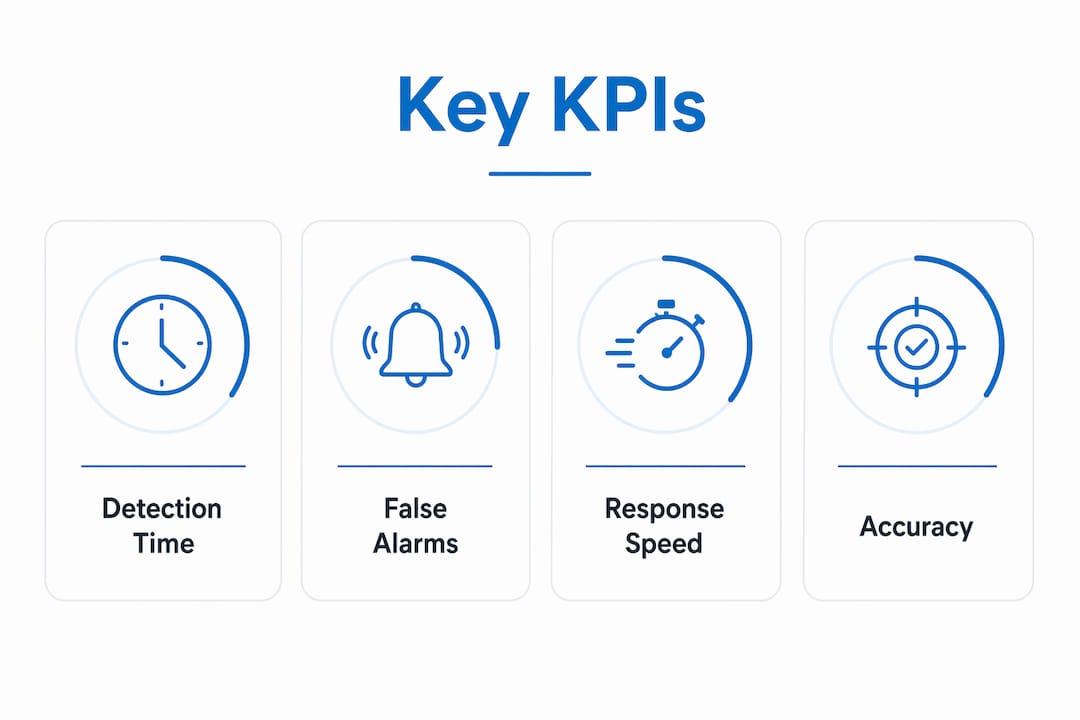
Focus on five metrics. Everything else is a derivative.
| KPI | Example target range | Why it matters |
|---|---|---|
| Detection time | Seconds to minutes depending on pipeline length | Drives spill volume and regulatory exposure |
| Localization accuracy | Within a low single-digit percentage of pipeline length (internal methods) | Determines crew dispatch precision |
| False-positive rate | Low false-positive rates | Protects operator trust in the system |
| Mean time to repair (MTTR) | Reduction vs. pre-AI baseline | Measures operational efficiency gain |
| % of leak events detected automatically | High coverage of qualifying events | Validates model coverage |
Operational outcomes beyond the metrics: reduced emergency shutdowns, targeted crew dispatch that cuts travel time, lower unplanned downtime, and compliance reports generated from documented detection logs rather than manual reconstruction. Executive dashboards should refresh daily; operational dashboards need near-real-time feeds.
What questions should you ask when evaluating AI integration partners?
- Can you show false-alarm rates from a real deployment on a comparable pipeline, not a lab benchmark?
- What is your model retraining cadence, and who owns the validation sign-off?
- Do you support on-premises model execution, or is cloud the only option?
- What SCADA protocols have you integrated, and can you name a reference site?
- How do you handle cybersecurity for OT environments, and what is your incident response process?
Red flags to watch for:
- Performance claims backed only by internal testing with no third-party reference
- No access to raw alarm logs for your own validation
- Cloud-only execution with no edge option for rupture detection latency requirements
- Vague answers about change-management support for operations crews
Require a measurable pilot SOW with explicit KPI targets and written acceptance criteria before signing anything.
What are the Canada-specific compliance and risk considerations?
Canadian pipeline operators work under federal oversight from the Canada Energy Regulator (CER) for interprovincial and international pipelines, and provincial regulators for intra-provincial systems. CSA Z662 is the governing standard for oil and gas pipeline systems and directly shapes what a compliant leak detection system must document and report.
Key compliance requirements to build into your pilot design:
- Emergency notification timelines under CER regulations require rapid, documented detection events — your system’s alarm logs become regulatory evidence
- LDAR (Leak Detection and Repair) campaign documentation must be traceable and auditable
- LiDAR component-level detection has EPA-framework approvals in the US; Canadian operators should confirm equivalency with provincial regulators before substituting it for OGI surveys
- Data residency: AI model hosting and historian data storage should comply with Canadian data sovereignty expectations, particularly for Crown corporation operators
Pro Tip: Build an audit trail and model validation log into your pilot SOW from day one. Regulators and internal auditors both ask for it — having it ready shortens approval cycles considerably.
Cybersecurity for OT is not optional. SCADA bridging to cloud AI platforms creates attack surface. Require network segmentation, encrypted data transit, and documented access controls as part of any vendor proposal.
How does Digitalfractal approach pipeline AI projects?
Digitalfractal delivers an AI Readiness Audit, a 60–90 day pilot, and phased scale integration with measurable KPIs and operator training built in. The audit produces a data map, a security review, and a pilot SOW. The pilot delivers a validated model baseline, documented alarm performance, and defined integration points for handover to operations.
- Audit (30 days): Data source inventory, OT/IT gap analysis, cybersecurity posture review, pilot proposal with KPI targets
- Pilot (60–90 days): Model deployment, SCADA integration, alarm validation against live data, operator workflow testing
- Scale (3–12 months): Phased regional rollout, dashboard integration, SLA reporting, continuous model governance
Pro Tip: Use the pilot phase to train your operations team on the new alarm workflow before scale. Teams that see the system catch real events during the pilot adopt it far faster than those handed a finished product.
How do you prepare your operations team for AI-based monitoring?
Technology adoption fails more often at the human layer than the technical one. Operators who distrust a new alarm system will route around it, and that defeats the entire investment.
Effective change management starts during the pilot, not after. Involve shift supervisors in defining what a “good alarm” looks like and what the response workflow should be. When operators help set the acceptance criteria, they own the outcome. Pair that with structured training on the new operator console, covering how to interpret AI-generated alerts, how to escalate, and how to log responses for the audit trail.
AI-assisted professional judgment, as explored in engineering and inspection workflows, works best when practitioners understand what the model is doing rather than treating it as a black box. The same principle applies to pipeline operations: brief your team on the detection logic, not just the interface. That transparency reduces alarm fatigue and builds the confidence operators need to act quickly when a real event fires.
Key Takeaways
Continuous-learning, multi-method AI leak detection outperforms static rule-based systems on every operational metric, and Canadian operators should start with a 30-day AI readiness audit before committing to a pilot.
| Point | Details |
|---|---|
| Start with an audit | A 30-day AI readiness audit maps data gaps, OT/IT blockers, and cybersecurity risks before pilot costs are committed. |
| Data unification is the real work | SCADA, GIS, GMS, and maintenance records must be unified and timestamped before AI models reach enterprise sensitivity. |
| Performance benchmarks exist | KROHNE’s PipePatrol NEO recorded 30-second detection with ±0.6% localization accuracy on a 31 km pipeline. |
| CSA Z662 shapes your design | Canadian operators must build audit trails, LDAR documentation, and emergency notification logs into the pilot SOW from day one. |
| Digitalfractal delivers audit to scale | Digitalfractal provides a 30-day audit, 60–90 day pilot, and phased scale integration with defined KPIs and operator training. |
The gap between AI hype and what actually ships
Most AI leak detection conversations focus on algorithm selection. That is the wrong starting point. The projects that deliver measurable results spend the first month on data hygiene, timestamp synchronization, and SCADA bridging. The algorithm is almost secondary once the data is clean and unified.
The other thing most guides understate: continuous-learning models require governance after go-live. A model that is not retrained as pipeline conditions change will drift back toward the same false-alarm problem it was supposed to solve. Build the retraining cadence and validation sign-off into your contract, not your wishlist.
Canadian operators also face a specific pressure that US-focused guides ignore: CER reporting timelines are tight, and regulators expect documented evidence, not verbal accounts. That means your AI system’s alarm log is a compliance artifact from the moment it goes live. Design it that way.
What Digitalfractal offers Canadian pipeline operators
Canadian pipeline operators need more than a software vendor. They need an integration partner who understands legacy SCADA environments, Canadian regulatory expectations, and the operational realities of getting a new system accepted by field crews.
Digitalfractal’s AI Readiness Audit gives you a documented data map, a security posture review, and a pilot SOW with explicit KPI targets, delivered in 30 days. The pilot runs 60–90 days against live operational data and produces validated alarm performance you can show to regulators and internal auditors. Use the AI Integration Benefits Analyzer to build your business case before the first meeting, and the Digital Transformation Roadmap Generator to convert audit findings into a phased implementation plan. Book a 15–30 minute discovery call at digitalfractal.com to scope your audit and define success criteria.