
Snowflake vs Databricks: 2026 Enterprise Guide for Canada

For most Canadian enterprises running analytics-first workloads, Snowflake is the faster path to production. If your team lives in Python notebooks and your roadmap includes large-scale ML training or sub-second streaming, Databricks earns serious consideration. By 2026, the feature gap has narrowed considerably — both platforms support SQL, Spark, and managed AI features — so the decision is now about operational fit, not capability.
Key decision triggers:
- SQL-first team, BI-heavy workloads, regulated data: Snowflake’s virtual warehouse isolation, built-in RBAC, and 99.99% uptime SLA make it the lower-risk choice.
- Code-first team, streaming, large ML training jobs: Databricks’ native MLflow, Mosaic AI, and Spark Structured Streaming deliver headroom that Snowflake’s architecture doesn’t match.
- Unclear workload shape or mixed team skills: Run a 2–6 week representative POC before signing any enterprise contract. Jump to the trial checklist below.
Table of Contents
- How do Snowflake and Databricks compare for enterprise AI and analytics?
- What questions should you ask before choosing a platform?
- How should you design a representative POC?
- What does migration actually cost and how long does it take?
- Which platform fits which enterprise workload?
- What Canadian compliance and data residency checks are required?
- What are the next steps for your platform decision?
- Who can help you in Canada?
- Key Takeaways
- The platform decision most enterprises get wrong
- Digitalfractal helps Canadian enterprises choose and implement the right platform
- Useful sources to verify vendor claims and Canadian compliance
How do Snowflake and Databricks compare for enterprise AI and analytics?
| Dimension | Snowflake | Databricks |
|---|---|---|
| Best for | BI/analytics, high-concurrency SQL, regulated industries | ML training, streaming, large-scale data engineering |
| Pricing model | Credit-based (compute + storage separated); predictable for stable workloads | DBU-based (VM infrastructure + runtime); cost advantage possible at scale with engineering maturity |
| Performance & concurrency | Virtual warehouse isolation prevents workload contention; consistent for many simultaneous analysts | Spark engine excels at transformation-heavy and ML workloads; concurrency management requires tuning |
| Processing paradigm | SQL-first; Python/Snowpark available | Code-first (Python, Scala, SQL); notebooks and Spark native |
| AI/ML tooling | Snowflake ML, Cortex, Snowpark ML; improving rapidly | MLflow, Mosaic AI, unified notebooks; purpose-built for production ML lifecycle |
| Ecosystem & integrations | Tableau, Looker, Power BI, Fivetran, Talend; multi-cloud (AWS, Azure, GCP) | Apache Kafka, Kinesis, Hadoop, BI tools; strong cloud integrations |
| Governance & compliance | Built-in RBAC, column/row-level policies, Horizon Catalog, Apache Iceberg support | Unity Catalog; governance requires more configuration; Delta Lake open standard |
| Data residency (Canada) | AWS Canada (Central), Azure Canada Central/East, GCP Montreal available | AWS Canada (Central), Azure Canada Central available; verify GCP region per workload |
| Operational complexity | Low; fully managed, minimal infrastructure decisions | Higher; cluster sizing, auto-scaling tuning, CI/CD for notebooks required |
| Migration effort & lock-in | Managed storage; Iceberg support improves portability | Delta Lake on cloud object storage reduces lock-in; easier data portability |
| Regional availability (Canada) | All three major clouds with Canadian regions | AWS and Azure confirmed; GCP Montreal — verify current availability |
Snowflake: strengths and trade-offs
- Strengths: Minimal ops overhead, consistent high-concurrency SQL performance, strong out-of-the-box governance, 99.99% SLA, simpler cost controls.
- Trade-offs: Can become expensive without tight compute governance; less native for complex ML pipelines; Snowpark ML is newer than Databricks’ ML stack.
- Best for: Analytics teams, BI-heavy organizations, regulated industries (financial services, healthcare), and teams without dedicated data engineers.
Databricks: strengths and trade-offs
- Strengths: Purpose-built ML lifecycle (MLflow, Mosaic AI), sub-second streaming via Spark Structured Streaming, cost advantages at scale when well-managed.
- Trade-offs: Higher operational complexity; cluster mismanagement leads to runaway costs; governance requires deliberate setup.
- Best for: Data engineering teams, ML-heavy programs, streaming pipelines, and organizations with Spark expertise already on staff.
What questions should you ask before choosing a platform?
Work through these before your RFP or vendor conversation.
- What is your team’s center of gravity? SQL-first teams adopt faster on Snowflake; code-first Spark/Python teams gain headroom with Databricks.
- What does your concurrency profile look like? Many simultaneous analysts on dashboards favor Snowflake’s warehouse isolation.
- Do you have sub-second streaming requirements? Databricks’ Spark Structured Streaming handles seconds-to-milliseconds latency; Snowpipe Streaming operates at seconds to roughly one minute.
- How much unstructured data do you process? Document extraction, NLP, and image workflows favor Databricks’ ML-native design.
- Where must your data reside? Confirm Canadian cloud region availability and cross-border transfer clauses before signing.
- Who owns cost governance? Neither platform is consistently cheaper — TCO depends on compute, storage, egress, and operating labor.
- What are the vendor SLAs and escalation paths? Snowflake commits to a 99.99% uptime SLA; Databricks SLAs vary by tier and configuration.
Red flags to watch for:
- A team with no Spark experience choosing Databricks because it looks cheaper in a demo.
- Relying on long-running interactive clusters without auto-termination policies.
- No designated cost owner for compute governance on either platform.
Pro Tip: Map your team’s skills before the vendor demo. If more than 70% of your data work happens in SQL editors rather than notebooks, Snowflake will reach production faster. If your ML engineers outnumber your SQL analysts, Databricks pays off. Treat the AI integration benefits analysis as a pre-POC exercise to quantify where each platform adds value.
How should you design a representative POC?
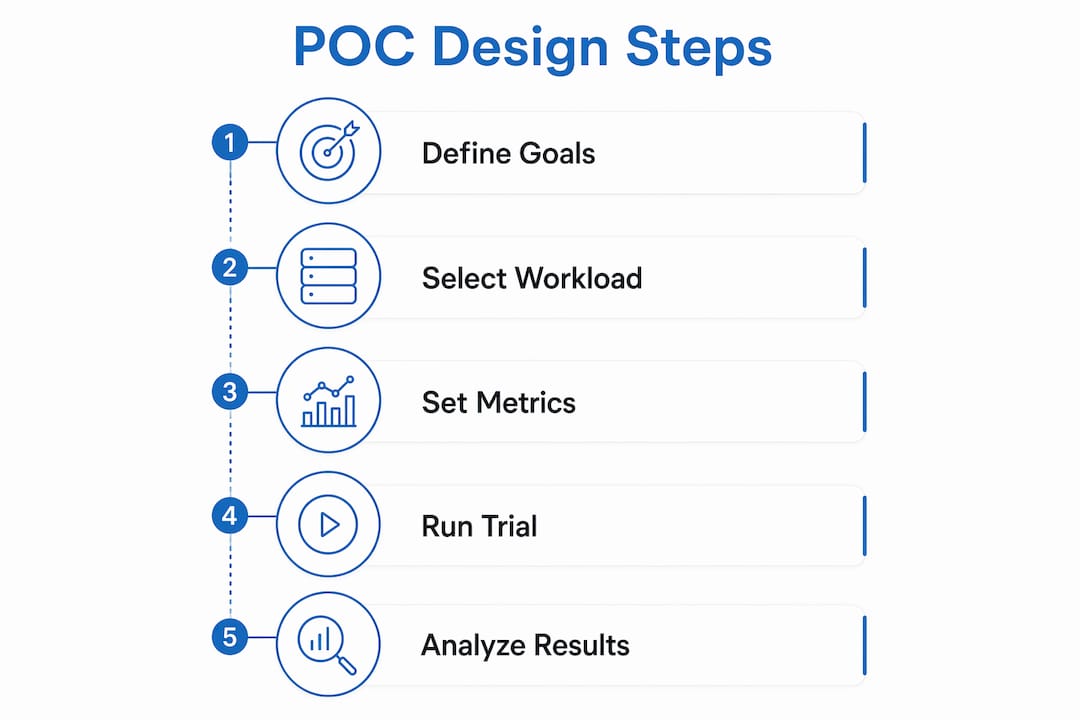
Skip synthetic benchmarks. A representative production-workload trial reveals true cost and operational profile; many enterprises fail by skipping this step.

| Metric to collect | Why it matters |
|---|---|
| Query latency distribution | Reveals tail latency under realistic load |
| Concurrency profile (peak simultaneous queries) | Tests warehouse isolation vs. cluster contention |
| Job throughput (records/sec for ETL) | Measures pipeline efficiency at production volume |
| Cluster startup / idle time | Directly drives compute cost on Databricks |
| Cost per runtime hour (compute + storage) | Baseline for TCO modeling |
| Storage and egress cost | Often underestimated; critical for cross-region Canadian setups |
| Failure and retry rates | Signals operational reliability |
| End-to-end SLA (data freshness to dashboard) | The number stakeholders actually care about |
POC checklist and timeline:
- Use a representative sample dataset (at least 20% of production volume, same schema).
- Run your actual production SQL queries, not simplified versions.
- Simulate peak concurrency: fire dashboard queries and ETL jobs simultaneously.
- Include at least one ML training job if that workload is in scope.
- Test a streaming window shape that matches your real ingestion pattern.
- Run for 2–4 weeks minimum; 6 weeks if workloads are seasonal or spiky.
Pro Tip: Use real production SQL and real concurrency patterns. A POC that runs one query at a time tells you nothing about how the platform behaves when 40 analysts hit dashboards during Monday morning reporting. For guidance on moving from POC to production, see scalable AI product development.
What does migration actually cost and how long does it take?
Typical migration phases:
- Assessment (2–4 weeks): Catalog existing pipelines, schemas, and data quality issues.
- POC (2–6 weeks): Validate fit and collect cost metrics (see above).
- Pilot (4–8 weeks): Migrate one non-critical workload to production.
- Migration (8–20 weeks): Move remaining pipelines in priority order.
- Cutover and dual-run (2–4 weeks): Run both platforms in parallel; validate reconciliation before decommissioning the old stack.
Primary cost drivers:
- Data egress fees between cloud regions or providers.
- Pipeline rework (SQL dialect differences, Spark job rewrites).
- Schema migration and data validation effort.
- Staff time for dual-running both platforms during cutover.
- Governance tooling setup (Unity Catalog configuration or Horizon Catalog policies).
Migration risk checklist:
- Data quality gaps discovered mid-migration.
- Schema drift between source and target environments.
- Lineage gaps that break compliance audit trails.
- Cross-platform reconciliation failures during dual-run.
Mitigation: automate reconciliation checks from day one of the pilot, not at cutover.
Which platform fits which enterprise workload?
- Analytics and BI: Snowflake. Virtual warehouse isolation keeps heavy transformations from degrading dashboard performance for concurrent analysts.
- Streaming and high-throughput processing: Databricks. Spark Structured Streaming handles sub-second to seconds latency with native Kafka and Kinesis connectivity.
- Large-scale ML training and feature engineering: Databricks. MLflow and Mosaic AI provide a unified notebook-to-production ML lifecycle that Snowflake’s newer ML stack doesn’t yet match.
- Unstructured document extraction (insurance, healthcare, legal): Databricks. NLP and image workflows benefit from its ML-native architecture despite the higher engineering cost.
- Hybrid architectures: Many enterprises run both, using Snowflake for governed BI and Databricks for ML and streaming. Success requires strict data-product ownership and automated cross-platform reconciliation.
What Canadian compliance and data residency checks are required?
Before signing any contract, verify these:
- PIPEDA compliance: Both platforms support the technical controls PIPEDA requires (encryption at rest and in transit, access logging, breach notification capabilities). Confirm your configuration actually enables them.
- Provincial considerations: Quebec’s Law 25 imposes stricter consent and residency requirements. If you serve Quebec residents, confirm data stays in Canadian regions and review cross-border transfer clauses explicitly.
- Canadian cloud region availability: AWS Canada (Central) in Montreal, Azure Canada Central (Toronto) and Canada East (Quebec City), and GCP’s Montreal region are available for Snowflake. Databricks confirms AWS and Azure Canadian regions; verify GCP Montreal availability for your specific Databricks tier.
- Cross-border transfer clauses: Standard vendor agreements often permit data movement to US regions for failover. Require explicit written confirmation that production data stays in Canada.
- Failover and replication: Ask vendors where failover targets are located. A Canadian primary region with a US failover may violate your data residency requirements.
Pro Tip: Add a single contract clause: “All production data, including replicas and failover targets, must remain within Canadian cloud regions at all times.” This one line forces the vendor to confirm their architecture supports it before you sign.
What are the next steps for your platform decision?
- Shortlist based on team skills and workload shape (Week 1–2): Use the checklist above. If your team is SQL-first and your primary workload is BI, Snowflake is the default. If you have Spark engineers and streaming requirements, Databricks goes on the shortlist.
- Run a 2–6 week representative POC (Week 2–8): Collect the eight metrics in the trial table. Model production costs from POC results before committing.
- Decide and plan migration (Week 8–10): Use POC cost data to build a realistic TCO model. Engage an external consultant if your team lacks migration experience, your workloads are complex, or your timeline is under six months.
Bring in external help when: your engineering team has no prior migration experience on the target platform, your compliance requirements are complex (Law 25, PIPEDA, sector-specific regulations), or your leadership needs an independent cost validation before a multi-year contract.
Who can help you in Canada?
The Canadian consulting ecosystem for both platforms has grown significantly. Certified Snowflake and Databricks partners operate across Toronto, Vancouver, Calgary, and Montreal, offering implementation, migration, and managed services. When evaluating a partner, ask for references from Canadian enterprises in your industry, confirm they have certified architects on staff (not just sales certifications), and verify they understand Canadian data residency requirements — not just the vendor’s global defaults.
For AI-heavy programs, look for partners who combine platform expertise with ML engineering depth. A partner who can configure a warehouse but cannot design a feature store or validate a model pipeline will leave your ML roadmap stranded. Treating AI as infrastructure rather than a project deliverable is the framing that separates partners who deliver lasting value from those who hand over a configured cluster and disappear.
Key Takeaways
Snowflake is the lower-risk default for SQL-first Canadian enterprises; Databricks earns its place when ML training, streaming, or large-scale data engineering is the primary workload.
| Point | Details |
|---|---|
| Team skills predict success | SQL-first teams reach production faster on Snowflake; Spark/Python teams gain more headroom with Databricks. |
| Run a real POC | Collect eight metrics including latency distribution, concurrency profile, and egress cost over 2–6 weeks using actual production workloads. |
| TCO requires all cost vectors | Compute, storage, egress, and operating labor all vary; neither platform is consistently cheaper without modeling your specific workload. |
| Canadian residency needs a contract clause | Require written confirmation that production data, replicas, and failover targets stay within Canadian cloud regions. |
| Digitalfractal accelerates the decision | Digitalfractal’s AI Readiness Audit and fixed-scope POC design help Canadian enterprises validate platform fit and model costs before signing a multi-year contract. |
The platform decision most enterprises get wrong
The most common mistake isn’t choosing the wrong platform. It’s choosing based on a vendor demo rather than a representative workload trial. I’ve seen teams pick Databricks because the cost estimate looked attractive in a slide deck, then spend months managing cluster sprawl and runaway DBU costs because no one owned infrastructure governance. The flip side: teams that defaulted to Snowflake for an ML-heavy program and spent a year fighting the platform’s limitations before migrating anyway.
The decision about balancing innovation and clarity in AI adoption applies directly here. Both platforms are genuinely capable. The question is whether your organization has the skills and governance discipline to realize the value of the one you pick. A well-designed 4-week POC with real production workloads answers that question more reliably than any benchmark report.
Digitalfractal helps Canadian enterprises choose and implement the right platform
Canadian enterprises that skip the POC or underestimate migration complexity routinely overspend by months of dual-running costs and engineering rework. Digitalfractal’s AI Readiness Audit gives your team a structured, fixed-scope assessment of platform fit before you commit to a multi-year contract — mapping your workload shape, team skills, and compliance requirements against both platforms in a matter of weeks, not quarters.
From POC design through production migration, Digitalfractal operates in Canada and brings hands-on AI integration expertise across logistics, construction, oil and gas, and enterprise software. The AI Implementation Planner converts your POC results into a production rollout plan with realistic timelines and cost models your leadership can actually approve. If you’re ready to shortlist platforms and need an independent cost validation, start with a readiness assessment at digitalfractal.com.
Useful sources to verify vendor claims and Canadian compliance
- Snowflake vs. Databricks (Snowflake’s official comparison): snowflake.com/en/snowflake-vs-databricks — vendor SLA commitments, governance feature parity, and BCDR details.
- PIPEDA guidance: priv.gc.ca — Office of the Privacy Commissioner of Canada; authoritative source for federal privacy obligations.
- Quebec Law 25 (Act 25): Commission d’accès à l’information du Québec at cai.gouv.qc.ca — provincial data residency and consent requirements.
- AWS Canadian regions: aws.amazon.com/about-aws/global-infrastructure/regions_az — confirm current service availability in Canada (Central).
- Azure Canadian regions: azure.microsoft.com/en-ca/explore/global-infrastructure/geographies — Canada Central and Canada East region service lists.
- GCP region availability: cloud.google.com/about/locations — verify Montreal region support for your specific Databricks or Snowflake tier.
- Databricks documentation (SLAs and Unity Catalog): docs.databricks.com — current SLA terms, Unity Catalog governance features, and region availability.