Computer Vision for Retail Shelf Optimization | Digital Fractal, Edmonton, AB

Retailers in Canada lose billions annually due to poor shelf management. Stockouts average 8%, climbing to 15% for promotions, directly impacting sales and customer satisfaction. Manual audits are slow, error-prone, and costly, while misplaced items and overstocking add to the problem. Enter computer vision: a faster, more accurate way to monitor shelves in real time.
Key Insights:
- Stockouts cost manufacturers CA$3.7M annually, cutting sales by 3%-5%.
- Manual audits delay action by hours or days and increase labour costs.
- Computer vision detects issues in minutes, reducing stockouts and improving inventory accuracy.
- Retailers using AI report operating cost reductions of 72%.
Why It Matters:
Computer vision systems automate shelf monitoring, flagging stockouts and planogram errors instantly. While initial costs can be high, the long-term savings and efficiency gains make it a smart investment for Canadian retailers. Companies like Digital Fractal Technologies Inc help businesses integrate these solutions for better inventory management and customer satisfaction.
1. Traditional Methods for Retail Shelf Optimization
Accuracy and Timeliness
Traditional shelf optimization heavily relies on manual audits, where staff physically check shelves for stock levels and compliance with planograms. This process is prone to human error, leading to misplaced products and inconsistent data. Limited staffing often means these audits are conducted during off-peak hours, creating significant delays between data collection and actionable insights. These delays, which can stretch from hours to days, make it difficult for retailers to address shelf issues promptly or respond to changing customer demands. On top of that, these inefficiencies contribute to higher operational costs.
Operational Costs
Manual audits not only take time but also pull staff away from tasks that directly contribute to sales. For instance, out-of-stock rates in a typical convenience store range between 5% to 10%, potentially reducing sales by as much as 4%. Across the retail sector, out-of-shelf stockouts result in an estimated annual loss of CA$93 billion. Adding to the problem, inaccurate manual data can lead to poor demand forecasting, resulting in overstocked items – especially perishable goods – leading to increased storage costs and waste. Misplaced inventory further exacerbates these issues, as employees waste time searching for items that were either logged incorrectly or shelved in the wrong spot. While RFID tagging could help, the high cost of tags and the labour required to label individual items make it impractical for most products. These inefficiencies also make it difficult for retailers to adjust prices quickly.
Dynamic Pricing and Revenue Impact
The lack of real-time data is a major drawback of manual methods, especially when it comes to dynamic pricing. Without accurate, up-to-date information on stock levels and shelf conditions, retailers struggle to adapt to changing customer preferences, competitor pricing, or promotional cycles. This inability to react quickly makes it harder to maximize revenue during peak demand or to clear out slow-moving items efficiently.
2. Computer Vision-Driven Shelf Optimization
Accuracy and Timeliness
Computer vision technology is transforming the way retailers manage their shelves. These systems provide continuous monitoring, instantly detecting issues like low stock, misplaced items, or planogram violations by comparing live camera feeds to reference images. Unlike manual audits – which can take hours or even days – this technology identifies discrepancies in just minutes. Retail giants like Walmart and Kroger use these systems to ensure shelves stay stocked, reducing stockouts and improving product availability. Similarly, Lowe’s and Carrefour have deployed robots equipped with cameras to perform automated audits, catching pricing errors and missing items much faster and more accurately than traditional methods.
This efficiency is also evident in how retailers like Auchan have implemented solutions such as "ReShelf." Using ceiling-mounted cameras, this system captures images of shelves, analyses them, and notifies staff instantly when stock runs low. Such advancements have cut in-store data collection times by over 50%, enhancing operational precision significantly.
Operational Costs
By automating time-consuming shelf audits, computer vision allows employees to focus on tasks that add more value, such as assisting customers. It’s no surprise that 72% of retailers using AI report lower operating costs. Quick detection of stockouts not only prevents lost sales in high-demand categories but also addresses inefficiencies that cost manufacturers roughly CA$3.7 million annually due to a 3% to 5% drop in sales.
While the upfront investment in cameras, sensors, and advanced software can be considerable, and cloud storage costs may rise with multi-camera setups streaming large amounts of data, the benefits often outweigh these challenges. In fact, over 64% of retailers are actively exploring computer vision solutions to improve inventory management. However, integrating these systems with existing inventory and ERP platforms can add layers of complexity and cost. Despite these hurdles, the cost savings and operational improvements enable retailers to implement more agile pricing strategies.
Dynamic Pricing and Revenue Impact
Real-time data from shelves empowers retailers to adjust prices dynamically based on factors like stock levels, competitor pricing, and demand. Amazon, for instance, uses computer vision to monitor shelf conditions and competitor prices, allowing them to fine-tune product pricing for maximum profitability. Beyond pricing, this technology can boost in-store sales by 2% to 4%, thanks to better inventory management and reduced stockouts.
Stock availability is critical – two out of three shoppers leave empty-handed or turn to competitors if they can’t find what they’re looking for. Additionally, computer vision helps address the CA$19 billion in annual sales lost due to long checkout lines. With 66% of Gen Z shoppers citing long queues as their biggest frustration and 35% abandoning purchases because of them, the impact is clear.
Retailers looking to adopt these AI-driven solutions can explore offerings from companies like Digital Fractal Technologies Inc, which specialises in custom software and AI consulting to improve operational efficiency and retail execution.
Retail Shelf Analytics with Computer Vision | YOLOv8, OpenCV & Real-Time Deployment
sbb-itb-fd1fcab
Pros and Cons
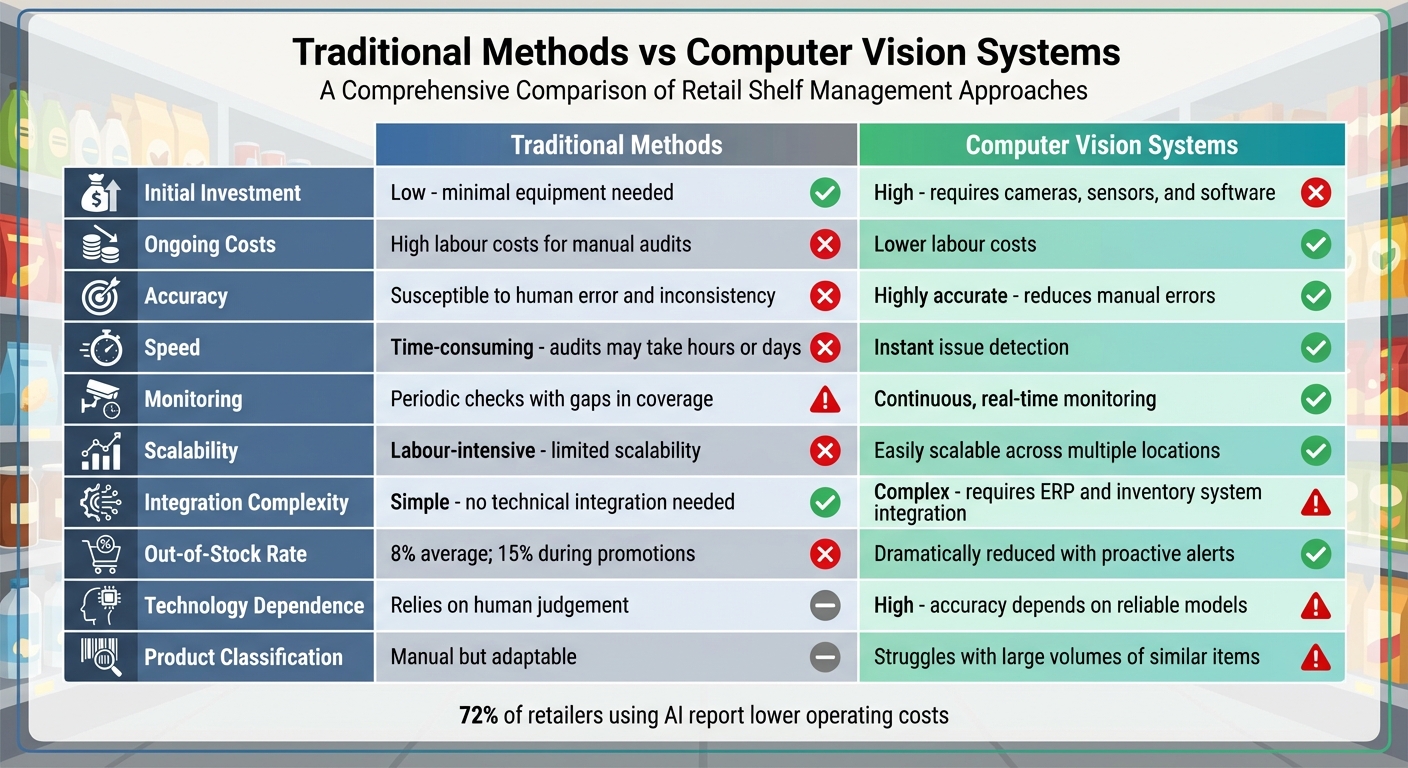
Traditional vs Computer Vision Retail Shelf Management Comparison
Traditional inventory methods are straightforward and inexpensive but come with drawbacks like human error and delayed audits. These issues contribute to an average out-of-stock rate of 8%, which can spike to 15% during promotions. Enter computer vision systems – a modern alternative designed to tackle these inefficiencies.
Computer vision offers continuous monitoring and near-instant alerts, significantly reducing manual errors. However, this technology isn’t without its challenges. High upfront costs, difficulty integrating with older systems, and the complexity of identifying thousands of similar products present notable hurdles. Additionally, real-world conditions like poor lighting, clutter, and shadows can impact the system’s performance compared to controlled environments.
Here’s a side-by-side comparison of the two approaches:
| Aspect | Traditional Methods | Computer Vision Systems |
|---|---|---|
| Initial Investment | Low; minimal equipment needed | High; requires cameras, sensors, and software |
| Ongoing Costs | High labour costs for manual audits | Lower labour costs |
| Accuracy | Susceptible to human error and inconsistency | Highly accurate; reduces manual errors |
| Speed | Time-consuming; audits may take hours or days | Instant issue detection |
| Monitoring | Periodic checks with gaps in coverage | Continuous, real-time monitoring |
| Scalability | Labour-intensive; limited scalability | Easily scalable across multiple locations |
| Integration Complexity | Simple; no technical integration needed | Complex; requires ERP and inventory system integration |
| Out-of-Stock Rate | 8% average; 15% during promotions | Dramatically reduced with proactive alerts |
| Technology Dependence | Relies on human judgement | High; accuracy depends on reliable models |
| Product Classification | Manual but adaptable | Struggles with large volumes of similar items |
For retailers weighing the switch to computer vision, it’s critical to understand these pros and cons. While the technology promises major efficiency gains and revenue boosts in the long term, the initial investment and integration challenges shouldn’t be overlooked. Companies like Digital Fractal Technologies Inc offer AI consulting and custom software solutions to help businesses navigate these complexities and implement systems tailored to their needs.
Conclusion
Retailers face mounting inventory challenges, and leveraging the right technology is key to tackling them effectively. For businesses managing large inventories, tools like computer vision can simplify operations and reduce the likelihood of out-of-stock situations – a major contributor to lost revenue.
While the upfront cost of implementing computer vision may seem steep, it’s worth noting that 72% of retailers using AI have reported lower operating expenses. For smaller retailers, adopting a step-by-step approach can be a smart move. Starting with targeted solutions – like reducing shrinkage or setting up out-of-stock alerts – can lead to measurable savings and pave the way for integrating more advanced systems over time. This balanced approach combines the strengths of technology and human expertise.
A hybrid strategy often strikes the perfect balance. Computer vision can handle labour-intensive tasks such as real-time stock tracking and planogram compliance, while human involvement remains essential for tasks like merchandising and customer interaction. This blend of automation and human insight allows retailers to enhance efficiency without losing the personal touch.
For Canadian retailers, integrating real-time insights into existing dashboards is a practical way to enable swift decision-making. Companies like Digital Fractal Technologies Inc offer AI consulting and custom software development to help businesses implement solutions tailored to their unique needs and infrastructure.
Though computer vision systems require ongoing upkeep and can be influenced by factors like poor lighting, the growing trend toward data-driven shelf management makes this technology a valuable tool. With over 64% of retailers planning to adopt these solutions for inventory management, it’s clear that the move toward smarter inventory practices is gaining momentum.
FAQs
How does computer vision enhance shelf monitoring compared to manual methods?
Computer vision is transforming how shelves are monitored by automating the process through real-time image analysis. Unlike traditional manual checks – often slow and prone to mistakes – this technology delivers constant and precise updates on inventory levels, product arrangement, and shelf conditions.
Retailers can use this tool to instantly spot stock shortages, misplaced products, or compliance issues, ensuring shelves are always well-stocked and properly organized to meet customer expectations. By removing the need for labour-heavy audits, computer vision not only saves time and resources but also boosts overall efficiency in store operations.
What challenges and costs should retailers consider when using computer vision for shelf optimization?
Implementing computer vision for retail shelf optimization is no small feat, presenting both technical and financial challenges. For starters, retailers need extensive, accurately labelled image datasets to train models that can recognize thousands of product SKUs. These models must perform well under varying conditions, like changes in lighting or packaging. Collecting and annotating such data can be expensive, and integrating these models with existing systems – such as point-of-sale and inventory platforms – requires careful coordination between data scientists, store operations teams, and IT staff. On top of that, ensuring these systems maintain accuracy in real-world settings demands continuous monitoring, which adds to operational costs.
Scalability and real-time processing bring their own set of obstacles. Rolling out cameras and edge-compute hardware across multiple locations comes with steep upfront costs for equipment and infrastructure. Beyond that, retailers face ongoing expenses for bandwidth and processing power. Practical challenges like sensor placement, occlusion (when products block each other on shelves), and the need for additional data sources – such as RFID or LiDAR – add complexity to the process. To keep up with new products, seasonal packaging, or layout adjustments, models also require frequent retraining, further driving up costs.
Digital Fractal Technologies Inc steps in to support Canadian retailers by providing customized AI solutions, scalable deployment options, and efficient workflows for data labelling. Their expertise not only helps reduce upfront and long-term costs but also ensures compliance with Canadian privacy regulations, making the entire process more manageable for businesses.
How does computer vision influence pricing strategies and revenue growth in retail?
Computer vision taps into real-time data captured by in-store cameras to monitor key metrics such as shelf activity, customer interest, and how shoppers interact with products. This information is then processed by AI-powered pricing systems that adjust prices dynamically, taking into account factors like demand, customer behaviour, and inventory levels.
This real-time pricing strategy helps retailers achieve several goals: increasing revenue, cutting down on waste, and managing inventory more effectively. By aligning pricing strategies with customer needs and market conditions, retailers not only stay competitive but also create a more satisfying shopping experience – all while improving their bottom line.