
AI Governance Framework for Canadian Businesses in 2026

What is an AI governance framework, and why does your business need one?
An AI governance framework is a structured system of policies, roles, technical controls, and oversight mechanisms that guides how your organization develops, deploys, and monitors AI systems responsibly. For Canadian businesses, this is not a theoretical exercise. Federal and provincial privacy laws, including PIPEDA, create real compliance obligations around how AI systems collect, process, and act on personal data.
The core elements every framework needs:
- Ethics and human dignity: AI decisions must respect individual rights and avoid discriminatory outcomes
- Fairness and bias mitigation: Training data and model outputs require ongoing audits for bias
- Transparency: Stakeholders must be able to understand how AI decisions are made
- Accountability: Clear ownership for every AI system, from development through decommissioning
- Release gates: Formal approval checkpoints that AI models must pass before moving to production
- Continuous monitoring: Tracking model drift, data shifts, and performance degradation after deployment
- ERM integration: AI risk embedded into your existing enterprise risk management structure, not siloed separately
Embedding AI risk into your enterprise risk management structure is the single most practical step most Canadian businesses skip. When AI risk lives inside existing corporate structures, including ethics review boards and senior leadership oversight, governance accountability becomes part of how the organization already operates.
Table of Contents
- Core principles and how to put them into practice
- Digitalfractal gets your AI governance off the ground fast
- Key Takeaways
Core principles and how to put them into practice
The layered approach is what separates policy from enforcement. Responsible AI governance maps abstract ethical principles to concrete technical controls across multiple governance layers, from hardware and data infrastructure up through application-level enforcement. Without this mapping, a policy document stays a policy document.

| Governance Layer | What It Covers | Practical Control |
|---|---|---|
| Policy | Organizational mandates and risk appetite | Written AI use policies, board approval |
| Ethical | Fairness, transparency, human oversight | Bias audits, explainability requirements |
| Technical | Data, models, infrastructure | Drift detection, access logs, audit trails |
Risk appetite definition is where most frameworks stall. The Singapore Model AI Governance Framework proposes harm-probability matrices that weigh both the severity and likelihood of harm to determine how much human oversight each AI decision requires. A logistics routing model carries different risk than an AI tool making credit or employment decisions.
Practical steps for Canadian businesses:
- Inventory every AI system in use, including third-party tools integrated via APIs
- Classify each system by risk level, with high-risk applications receiving the strongest controls
- Conduct formal risk assessments covering financial, physical, reputational, and legal harm categories
- Establish a cross-functional AI ethics board with legal, technical, business, and policy representation
- Define release gate criteria requiring documented bias audits and explainability summaries before any high-risk model reaches production
- Maintain immutable audit logs of model decisions and data access events
- Build incident response playbooks with escalation paths and rollback procedures
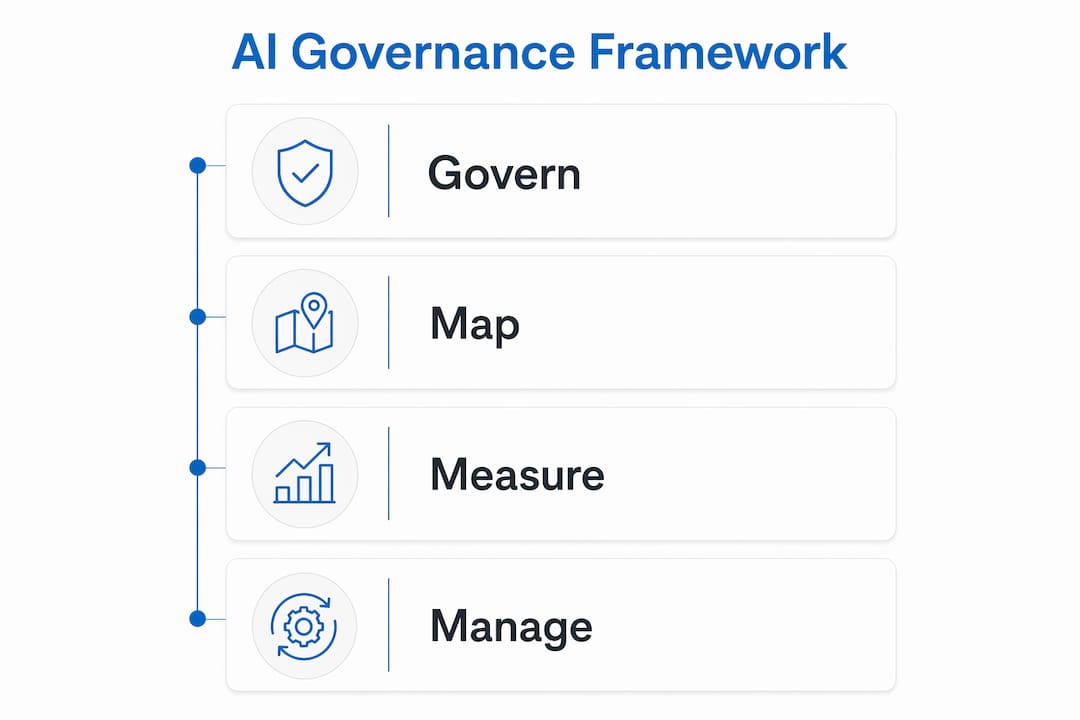
The NIST AI Risk Management Framework organizes this work into four functions: Govern, Map, Measure, and Manage. Aligning your internal program to NIST AI RMF or ISO/IEC 42001 gives you a credible baseline that holds up under regulatory scrutiny. Governance is not a one-time project. Models drift, regulations evolve, and your AI vulnerability exposure changes as you scale. Quarterly ethics board reviews and annual audits of high-risk systems keep the framework current. Pair that with AI safety compliance tools that automate monitoring coverage, and you close the gap between policy and real-world enforcement.
Digitalfractal gets your AI governance off the ground fast
Canadian businesses that want responsible AI without building a governance program from scratch get a concrete advantage with Digitalfractal. The AI Readiness Audit identifies exactly which systems carry the highest risk, where your compliance gaps are, and what controls to prioritize first, all within a short delivery timeline.
Generic consulting firms hand you a framework document. Digitalfractal builds the actual controls into your workflows, from bias audit processes to release gate approval procedures, tailored to your industry whether you operate in construction, logistics, or oil and gas. Use the digital transformation readiness checker to see where your organization stands today, then connect with Digitalfractal to build a governance program that protects your business and keeps AI working for you.
Key Takeaways
A sound AI governance framework embeds risk management, release gates, and continuous monitoring into existing enterprise structures to keep AI deployment ethical, compliant, and operationally effective.
| Point | Details |
|---|---|
| Embed AI risk into ERM | Integrate AI oversight into existing corporate risk structures rather than creating a separate silo. |
| Use harm-probability matrices | Classify AI systems by severity and likelihood of harm to set the right level of human oversight. |
| Apply release gates | Require documented bias audits and explainability summaries before any high-risk model reaches production. |
| Monitor continuously | Track model drift, data shifts, and fairness metrics after deployment, not just at launch. |
| Digitalfractal AI Readiness Audit | Identifies compliance gaps and builds governance controls into your workflows within 90 days. |