AI Training for Employees: A 2026 Guide for Canadian Businesses

Why AI training for employees is your most urgent workforce investment
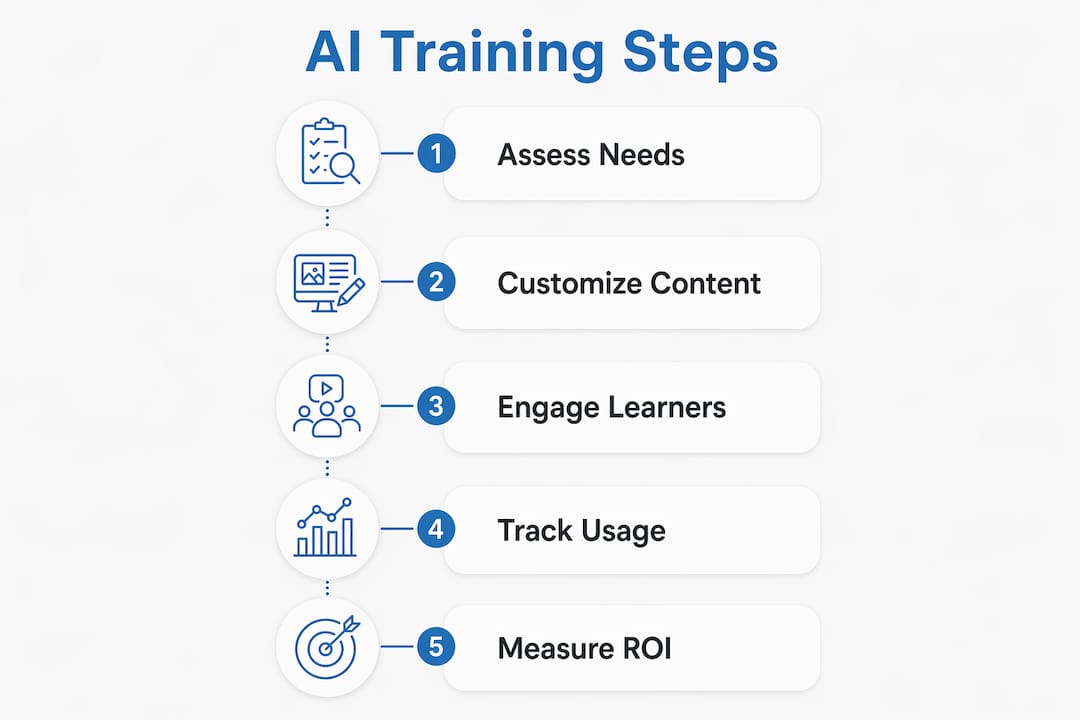
Structured AI training programs give employees the skills to use AI tools on real tasks, not just understand them in theory. Professionals who complete this kind of training save an average of 8 hours of work per week. For Canadian businesses navigating automation, that is a full recovered workday every week, per person.
The stakes are concrete:
- Productivity gains starting in week one of structured programs
- Workflow efficiency increases for employees who complete hands-on AI training
- Competitive positioning as AI reshapes hiring, operations, and client delivery across Canadian industries
- Risk reduction around data misuse, compliance gaps, and ungoverned AI adoption
Digitalfractal’s AI Readiness Audit identifies exactly where automation opportunities exist in your operations, giving training programs a concrete target from day one.
Effective methods for building employee AI skills
Not all training formats produce the same results. Passive video courses rarely translate to changed behavior. Active learning models that combine live virtual sessions, role-specific challenges, and capstone projects consistently outperform them.
- Live, expert-led virtual sessions keep employees accountable and allow real-time Q&A on actual work problems.
- Role-specific learning pathways connect AI skills directly to each employee’s daily tasks, whether that is a logistics coordinator automating dispatch notes or a project manager drafting status reports with AI assistance.
- Microlearning modules break training into 5–10 minute segments employees complete between meetings, making skill-building sustainable.
- Conversational AI tutors that map skills to performance outcomes and adapt as job demands evolve, per Cognizant’s 2026 Skillspring platform research.
- Capstone projects where employees build a real AI workflow they can deploy immediately, not a hypothetical exercise.
- Supervisory AI training for managers, covering how to delegate AI tasks safely, set output guardrails, and monitor KPIs without manual rework.
- Active output critique rather than passive acceptance. Employees who interrogate AI outputs develop stronger problem-solving and communication skills than those who simply accept what the tool produces.
Pro Tip: Encourage employees to document effective prompts in a shared team library. This small structural habit accelerates adoption and turns individual learning into organizational knowledge.
Best practices for rolling out AI training in Canadian businesses
A phased rollout beats a company-wide launch every time. Start with a pilot group of 10–20 employees across two or three roles, measure results, then expand.
- Run an AI readiness assessment first. Digitalfractal’s audit surfaces specific automation gaps before you design a single training module, so learning objectives connect to real operational problems.
- Tie every objective to a measurable business outcome. If the goal is faster client onboarding, set a specific target like reducing onboarding time from five days to three using AI-assisted document processing.
- Integrate training into daily workflows rather than scheduling isolated sessions. Small habit changes tied to existing tools drive adoption far better than dedicated training days.
- Build executive visibility in. A capstone showcase where employees present their AI workflows to leadership creates accountability and demonstrates ROI simultaneously.
- Plan for continuous improvement. AI tools evolve quickly; a training program that was current in January may need updates by June.
How to measure the ROI of your AI training program
ROI from AI training does not appear overnight. Lagging indicators like productivity improvements and cost savings typically take 3–6 months to materialize, so track them quarterly, not weekly.
Use a two-tier measurement framework:
- Leading indicators (weeks 1–4): completion rates, weekly active AI tool usage, skills assessment scores improving from baseline
- Lagging indicators (months 3–6): time saved per employee, error rates on automated tasks, output volume changes
Run 30-minute focus groups with 6–8 employees monthly. Ask which trained skills they have actually used and what prevented broader adoption. Patterns across groups reveal where the program needs adjustment faster than any dashboard will. Digitalfractal’s approach links training to business transformation within a 90-day timeline, giving executives a concrete reporting window.
How to identify skill gaps before training begins
Generic organization-wide AI training wastes budget. Different roles need different AI capabilities, and the gap between what employees know and what they need varies widely.

Start with a skills assessment for each team. Map the AI tasks most relevant to each role, then measure current proficiency against that target. A warehouse operations team needs different AI fluency than a finance team running forecasting models. The Korn Ferry 2026 research found that 77% of leaders say early-career employees often have more hands-on AI experience than senior staff, which makes reverse mentorship a practical gap-closing tool alongside formal training.
Prioritize HR and data leaders early. They can identify internal AI early adopters, champion adoption culture, and mentor peers across seniority levels.
How to address resistance and anxiety around AI adoption
Resistance to AI training usually comes from one of two places: fear of job replacement or frustration with tools that feel unfamiliar. Both are addressable with the right framing.
Korn Ferry’s research found that over 37% of senior leaders believe in a future where people and AI work together, and organizations that communicate this clearly see faster adoption. Frame AI as handling repetitive tasks so employees can focus on judgment-heavy work. That framing reduces anxiety and increases engagement. Pair it with AI-driven HR compliance guidance so employees understand the guardrails around AI use from day one.
Legal and ethical considerations for Canadian workplaces
Canadian businesses face specific obligations when deploying AI in the workplace. Canada’s Personal Information Protection and Electronic Documents Act (PIPEDA) governs how employee data used in AI training systems must be collected, stored, and disclosed. Quebec’s Law 25 adds stricter provincial requirements for organizations operating there.
Algorithmic bias is a real operational risk. AI training platforms that assess employee performance or recommend learning paths can embed bias if the underlying data is not audited. Build a review process for AI-generated assessments before they influence promotion or development decisions. Transparency with employees about how AI tools monitor or evaluate their work is both a legal and a retention issue.
AI training resources and providers available in Canada
Canadian businesses have access to a growing set of options for AI workforce training, ranging from self-directed platforms to fully managed programs.
- Government-backed programs: the Canada Digital Adoption Program (CDAP) has funded digital skills development for small and medium businesses, and the Future Skills Centre funds workforce AI research and pilot programs.
- Post-secondary institutions: universities including the University of Toronto, University of Waterloo, and McGill offer AI certificate programs and executive education modules accessible to corporate teams.
- Managed training providers: enterprise-focused platforms deliver role-specific AI curricula updated as tools evolve, with analytics connecting completion to business outcomes.
- Consulting-led implementation: Digitalfractal combines an AI Readiness Audit with tailored integration support, so training targets the specific workflows your team actually uses rather than generic use cases.
The right mix depends on your team size, industry, and how quickly you need results. For most Canadian businesses, a combination of a readiness audit, role-specific external training, and internal workflow integration delivers the fastest measurable return.
Key Takeaways
Structured AI training tied to real workflows and measurable business outcomes is the most direct path to productivity gains, with proficient employees saving an average of 8 hours of work per week.
| Point | Details |
|---|---|
| Start with a readiness audit | Identify specific automation gaps before designing training, so every learning objective maps to a real operational problem. |
| Use active learning formats | Live sessions, role-specific challenges, and capstone projects outperform passive video courses for skill retention and adoption. |
| Measure in two tiers | Track leading indicators weekly in months 1–2, then shift to lagging indicators like productivity and ROI at the 3–6 month mark. |
| Address resistance early | Frame AI as handling repetitive tasks; Korn Ferry finds this framing reduces workforce anxiety and accelerates adoption. |
| Know your Canadian obligations | PIPEDA and Quebec’s Law 25 govern employee data in AI systems; audit AI-generated assessments before they affect HR decisions. |
Ready to identify exactly where AI can save your team the most time? Use Digitalfractal’s AI Integration Benefits Analyzer to map your automation opportunities, or start with the Digital Transformation Readiness Checker to see where your business stands today.